How Does Product Positioning Influence Premium Rice Sales Growth?
Premium rice sales grow faster when product positioning connects grain specifications, consumer use cases, perceived value, packaging, price architecture, and market segment instead of treating premium rice as a single high-priced commodity. In 2026, this distinction matters because U.S. rice imports are forecast at a record 49.8 million hundredweight for 2026/27, with long-grain imports accounting for most of the increase and Asian aromatic varieties, including Basmati from India and Pakistan, remaining important sources.
For Vermont retailers and food businesses, positioning should begin with consumer needs rather than supplier terminology. The educational guide:
Why Vermont consumers are choosing premium imported Basmati rice explains the consumer-side demand context. Product positioning then translates that demand into a commercially understandable offer based on grain length, aroma, cooking behavior, grade, pack size, origin, and price.
What are the available solutions for positioning premium rice?
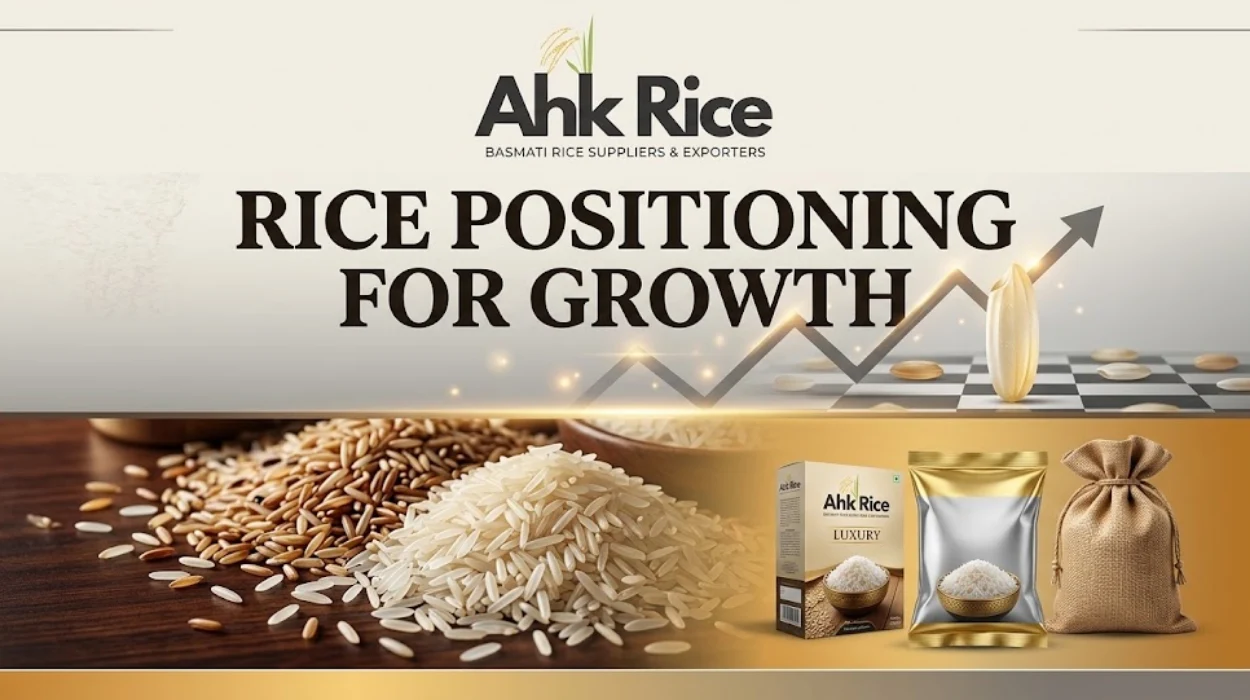
Premium rice can be positioned through quality, origin, culinary application, convenience, health-oriented value, or price-tier architecture, with the strongest strategy combining several attributes into one clear proposition for a defined Vermont customer segment and purchasing occasion.
The first solution is quality-led positioning. This approach emphasizes measurable specifications such as grain length, broken percentage, moisture, purity, milling quality, aroma, and cooking performance. It works when buyers already understand rice grades and want consistency.
The second is origin-led positioning. Pakistani Basmati can be positioned around its geographic origin, traditional cultivation, aromatic character, long grain structure, and established export identity. Origin gives the product a story, but the story becomes stronger when supported by measurable specifications.
The third is culinary-use positioning. Instead of presenting rice simply as premium, the product is associated with biryani, pulao, grilled foods, curries, rice bowls, or special-occasion meals. This makes the product easier for consumers to understand because the benefit connects directly to an eating occasion.
The fourth is convenience positioning. Steam or parboiled formats can be presented around preparation consistency, grain separation, and kitchen efficiency. This approach has particular value for restaurants and prepared-food operators that measure rice performance through yield, labor, holding quality, and portion consistency.
The fifth is tiered positioning. A supplier can offer multiple grades rather than forcing every customer into one premium specification. A retailer may use a flagship Basmati for premium shelves while maintaining another grade for value-conscious shoppers.
AHK Rice operates within this broader specification model by supplying 1121, Super Kernel, and 1509 varieties with processing, grading, packaging, inspection, and export coordination. For buyers assessing the supply side, its Pakistan Basmati rice export service provides a relevant reference point for evaluating product specifications and export requirements.
How do different premium rice positioning approaches compare?
Quality positioning creates the strongest technical credibility, origin positioning creates differentiation, culinary positioning clarifies consumer value, convenience positioning supports repeat use, and tiered positioning provides the best structure when one market contains several price-sensitive customer groups.
| Positioning Attribute | Quality-Led | Origin-Led | Culinary-Led | Convenience-Led | Tiered |
|---|---|---|---|---|---|
| Main value signal | Measurable specifications | Pakistani origin | Specific dishes | Easier preparation | Choice by budget |
| Best customer | Quality-focused buyer | Origin-conscious buyer | Home cooks and restaurants | Time-sensitive users | Mixed customer base |
| Key proof | Grade and laboratory data | Origin and traceability | Cooking results | Processing format | Multiple specifications |
| Price logic | Premium justified by quality | Premium justified by differentiation | Value linked to usage | Value linked to efficiency | Multiple price points |
| Main risk | Technical message becomes complex | Story lacks proof | Narrow usage association | Convenience overshadows quality | Brand positioning becomes unclear |
| Sales strength | High repeat potential | Strong differentiation | High relevance | Strong practical value | Broad market coverage |
| Best measurement | Repeat purchase and complaints | Conversion and awareness | Category sales | Reorder frequency | Sales by tier |
The table shows why premium positioning should not rely on the word “premium” alone. Premium is a market position, not a technical specification. A product earns that position when the buyer can identify what makes it different and why the difference matters.
For example, a 1121 Basmati product can be positioned around long slender grains and presentation after cooking. Super Kernel can be positioned around a premium Basmati identity and consistent cooking characteristics. A 1509 product can occupy another position where buyers want long-grain Basmati characteristics within a different purchasing structure.
This differentiation also helps retailers avoid placing every imported rice SKU into the same price comparison. When two products have different specifications, package sizes, cooking applications, and customer targets, their prices should not be evaluated as if they were identical commodities.
How should Vermont businesses compare premium rice specifications?
Vermont buyers should compare premium rice through grain specification, processing method, cooking performance, packaging, shelf-life controls, origin documentation, and landed cost because these factors determine whether a higher purchase price creates measurable retail or foodservice value.
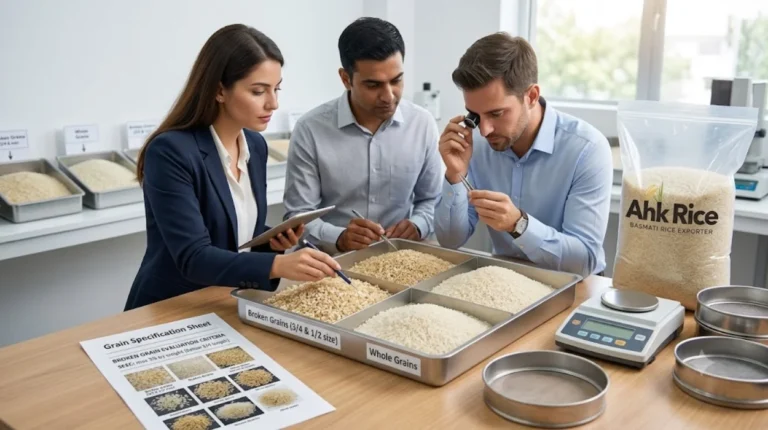
A useful comparison starts with the raw grain. Grain length and slenderness influence visual presentation. Broken kernels affect the appearance and perceived quality of cooked rice. Moisture influences storage stability and processing behavior. Purity affects the consistency of the finished product.
Processing also changes the commercial proposition. White rice follows a milling process that removes the husk, bran, and germ layers to produce milled kernels. Steam or parboiled rice uses controlled soaking and steaming before drying and milling. This changes the structure and cooking behavior of the grain.
Packaging is another positioning tool. A 5-pound consumer pack communicates a different purchase proposition from a 20-pound foodservice pack. Smaller packaging supports household trial and shelf visibility. Larger packaging supports restaurants, caterers, and high-frequency consumers.
Shelf life should also be evaluated as a supply-chain attribute rather than treated only as a printed date. Properly processed and packaged milled rice has a long storage life when protected from moisture, pests, heat, contamination, and unsuitable storage conditions. Buyers should compare the supplier’s declared shelf life, packaging barrier, production date, storage instructions, and remaining shelf life at arrival.
In Vermont, unit-price transparency also matters because state law requires retail sellers of covered consumer commodities, including grains, to disclose unit prices alongside total prices. This makes pack-size positioning commercially important. A premium package must communicate enough value to justify its unit price.
Which premium rice grades fit different market regions?
Vermont is best served by matching grades to customer use rather than selecting one universal premium specification, while broader U.S. Northeast demand favors aromatic Basmati formats that combine recognizable origin, long-grain appearance, cooking performance, and accessible retail packaging.
For the Vermont and broader Northeast retail market, 1121 Basmati can serve a premium flagship position where grain length and visual presentation are important. Super Kernel can support shoppers looking for a recognizable premium Pakistani Basmati category without relying exclusively on one grain specification. 1509 can provide another long-grain option for buyers comparing premium products across price levels.
For the U.S. foodservice and specialty-food market, grade selection should follow menu requirements. Restaurants serving biryani, pulao, Persian-style rice dishes, South Asian cuisine, or premium grilled-food combinations can evaluate grain separation, aroma, expansion, yield, and holding performance. Foodservice buyers should therefore judge a grade through cooking trials rather than package appearance alone.
This regional approach reflects the wider U.S. import structure. USDA reports that more than 60% of U.S. rice imports are aromatic varieties from Asia, mainly jasmine from Thailand and Basmati from India and Pakistan. The August 2026 USDA outlook forecasts U.S. long-grain imports at 43.0 million hundredweight in 2026/27, with Asian aromatic varieties expected to remain the dominant component.
How do grade preferences affect price per metric ton?
Grade preference changes price because buyers pay for different combinations of kernel length, broken percentage, processing, sorting, packaging, origin, documentation, and supply reliability, so a single commodity price cannot accurately represent the value of every premium Basmati specification.
A useful 2026 purchasing framework is to compare landed cost per metric ton, not only an advertised export quotation. Landed cost includes the product price plus applicable freight, insurance, handling, customs-related charges, inland transportation, packaging configuration, and other buyer-side costs.
Indicative commercial positioning can be expressed as:
| Market region | Preferred positioning | Relative price per MT | Shelf-life comparison |
| Vermont / Northeast retail | 1121, Super Kernel, selected 1509 | Premium | Long when properly stored and packaged |
| U.S. foodservice / specialty distribution | 1121 Steam, Super Kernel, 1509 Steam/Sella formats | Premium to value-premium | Long when properly stored and packaged |
These are positioning ranges rather than fixed 2026 market quotations. Actual prices change with crop conditions, origin, grade, processing, packaging, freight, exchange rates, order quantity, and shipment timing. USDA’s April 2026 outlook also recorded changes in exporter price quotes and noted stronger competition in global rice trade, demonstrating why static price claims quickly become outdated.
The commercial lesson is important: a buyer should not automatically select the lowest price per MT. The correct comparison is cost per usable kilogram, cost per cooked portion, sales value per shelf unit, and repeat-purchase performance.
Which method works best for different premium rice cases?
Quality-led positioning works best for specialist buyers, origin-led positioning suits imported-food shoppers, culinary positioning suits restaurants and recipe-driven retail, convenience positioning suits high-frequency users, and tiered positioning works best for mixed customer portfolios.
A specialty grocery store should prioritize quality plus origin. Its customers can understand long grain, Basmati origin, aroma, and cooking performance. Product information should explain the difference without overwhelming shoppers with laboratory terminology.
A restaurant distributor should prioritize cooking performance plus pack format. The buyer needs predictable yield and repeatability more than an elaborate origin story. Samples, cooking trials, specifications, and batch consistency become the strongest sales tools.
A South Asian or Middle Eastern grocery retailer can combine origin, culinary application, and grade. Customers may already understand Basmati categories, so the retailer can use grain length, processing style, and regional cuisine to organize the shelf.
A mainstream supermarket should use tiered positioning. One premium flagship SKU can establish the category, while another product provides a lower entry point. This reduces the risk of making the entire category appear inaccessible.
The most effective strategy therefore depends on the customer’s decision criteria. Positioning should answer one question clearly: why should this buyer choose this rice instead of the next product on the shelf?
What are the pros and cons of each positioning strategy?
Every positioning method creates a different commercial advantage and limitation, so buyers should select the approach that matches customer knowledge, sales channel, price sensitivity, product specifications, and the evidence available to support the premium claim.
Quality-led positioning provides strong credibility. Its advantage is measurable differentiation. Its limitation is complexity. Consumers may not understand terms such as broken percentage or milling yield without clear explanation.
Origin-led positioning provides strong identity. Pakistani Basmati has a recognizable geographic association and culinary heritage. Its limitation is that origin alone does not guarantee the same specification across suppliers or lots.
Culinary positioning makes the benefit immediately understandable. “Designed for biryani” communicates a use case faster than a technical specification. Its limitation is that the positioning can become too narrow if the product is suitable for multiple dishes.
Convenience positioning supports repeat purchasing. Restaurants value consistent preparation and operational efficiency. Its limitation is that convenience can reduce attention to origin, grade, and premium quality if the message becomes purely functional.
Tiered positioning provides flexibility. It allows retailers to serve several price segments. Its limitation is portfolio complexity. Too many similar SKUs can cause internal competition and confuse customers.
The strongest approach combines these methods without making every product claim equally prominent. One primary positioning statement should lead. Secondary attributes should reinforce it.
What decision factors should buyers use before selecting a positioning strategy?
Buyers should evaluate target customer, product specification, cooking application, price architecture, package size, supply consistency, shelf life, documentation, and reorder behavior before selecting a premium rice position because positioning must remain commercially sustainable after the initial sale.
| Decision factor | Question to evaluate | Practical indicator |
| Customer | Who buys the product? | Household, restaurant, specialty shopper |
| Specification | What makes the grain different? | Grade, length, broken percentage |
| Application | Where is it used? | Biryani, pilaf, curry, rice bowls |
| Economics | Does the premium create value? | Margin and cost per usable portion |
| Supply | Can the position be maintained? | Repeat lots and shipment consistency |
The first factor is customer definition. A product positioned for a premium household shopper requires different packaging and messaging from one positioned for a restaurant procurement manager.
The second is specification integrity. A premium claim should remain connected to the physical product. If the product changes from one shipment to another, the positioning loses credibility.
The third is application. Cooking trials are particularly important for foodservice buyers because the value of rice is realized after cooking. Yield, separation, aroma, texture, and holding performance should be recorded.
The fourth is economics. A higher-priced rice can still produce better commercial results if it generates higher menu prices, stronger shelf margins, lower waste, better portions, or stronger repeat demand.
The fifth is supply continuity. Premium positioning creates customer expectations. A retailer cannot build a reliable premium category around a product that changes specifications without notice.
How can product positioning support long-term premium rice sales growth?
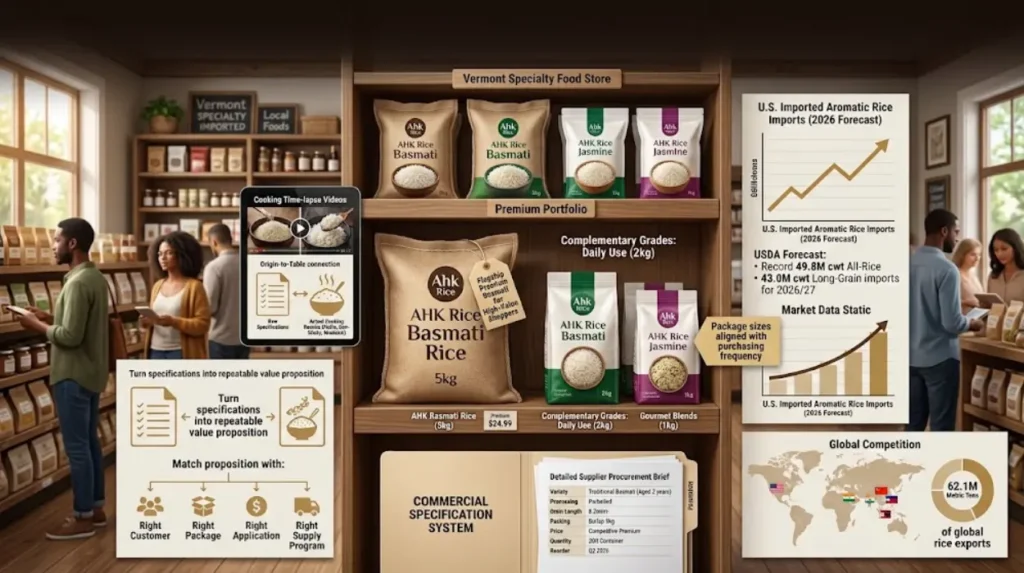
Long-term growth comes from turning product specifications into a repeatable value proposition, then matching that proposition with the right customer, package, price, application, and supply program instead of depending on temporary discounts or generic premium labeling.
The 2026 U.S. market provides a favorable structural environment for imported aromatic rice. USDA forecasts record U.S. all-rice imports of 49.8 million hundredweight for 2026/27, while long-grain imports are forecast at 43.0 million hundredweight.
That opportunity does not mean every imported rice will achieve premium growth. Competition remains strong. USDA’s April 2026 global outlook projected 62.1 million metric tons of global rice exports for calendar year 2026 and noted competition from lower-priced exporters.
The differentiator is therefore product clarity. A retailer must know which grain it is selling, which customer it serves, why that grain deserves its price, and what evidence supports the positioning.
For Vermont, the strongest model is a structured portfolio: one flagship premium Basmati for high-value shoppers, complementary grades for different applications, package sizes aligned with purchasing frequency, and product information that connects origin and specification to actual cooking results.
This model also gives suppliers a clearer procurement brief. Instead of requesting “premium Basmati,” buyers can specify the variety, processing method, grain characteristics, packaging, documentation, target price, shipment quantity, and expected reorder cycle.
That is where product positioning moves beyond marketing. It becomes a commercial specification system that connects consumer demand with sourcing, processing, packaging, pricing, and distribution. For deeper insight explore:
Expand Vermont Premium Rice Sales with AHK Rice Supply
Frequently Asked Questions
How does product positioning influence premium rice sales growth?
Product positioning helps premium rice stand out by connecting grain quality, origin, cooking performance, packaging, price, and customer needs. Clear positioning makes the product easier to understand and supports stronger purchase decisions and repeat sales.
What is premium rice product positioning?
Premium rice product positioning is the process of defining how a rice product should be perceived compared with competing products. It can emphasize grain length, Basmati variety, Pakistani origin, aroma, cooking performance, processing method, packaging, or culinary use.
Which rice varieties can be positioned as premium products?
Pakistani Basmati varieties such as 1121, Super Kernel, and 1509 can support different premium positioning strategies. Their commercial positioning depends on grain specifications, processing method, cooking characteristics, packaging, target market, and customer requirements.
How does grain quality affect premium rice sales?
Grain quality directly affects consumer perception and cooking performance. Attributes such as grain length, slenderness, broken percentage, moisture, purity, aroma, and milling consistency help buyers distinguish premium rice from lower-priced alternatives.
Which premium rice positioning strategy works best for retailers?
Retailers generally benefit from combining quality, origin, culinary application, and tiered pricing. A flagship premium Basmati can establish the category while complementary grades provide options for customers with different budgets and cooking requirements.
How does packaging influence premium rice positioning?
Packaging communicates product quality, intended customer, quantity, and usage. Smaller packs can support household trial and retail visibility, while larger packs can serve frequent consumers, restaurants, caterers, and foodservice distributors.
Why is Pakistani origin important when positioning Basmati rice?
Pakistani origin provides geographical differentiation and connects the product with an established Basmati-producing region. Origin becomes more commercially valuable when supported by traceability, specifications, processing information, and consistent product quality.
How should businesses compare premium rice prices per metric ton?
Businesses should compare landed cost per metric ton rather than only the supplier quotation. Freight, insurance, handling, packaging, customs-related costs, inland transportation, grade, processing, and order volume can all affect the final purchasing cost.