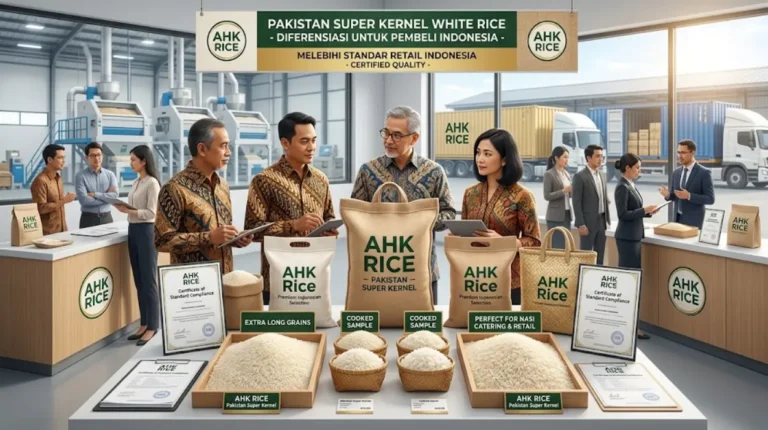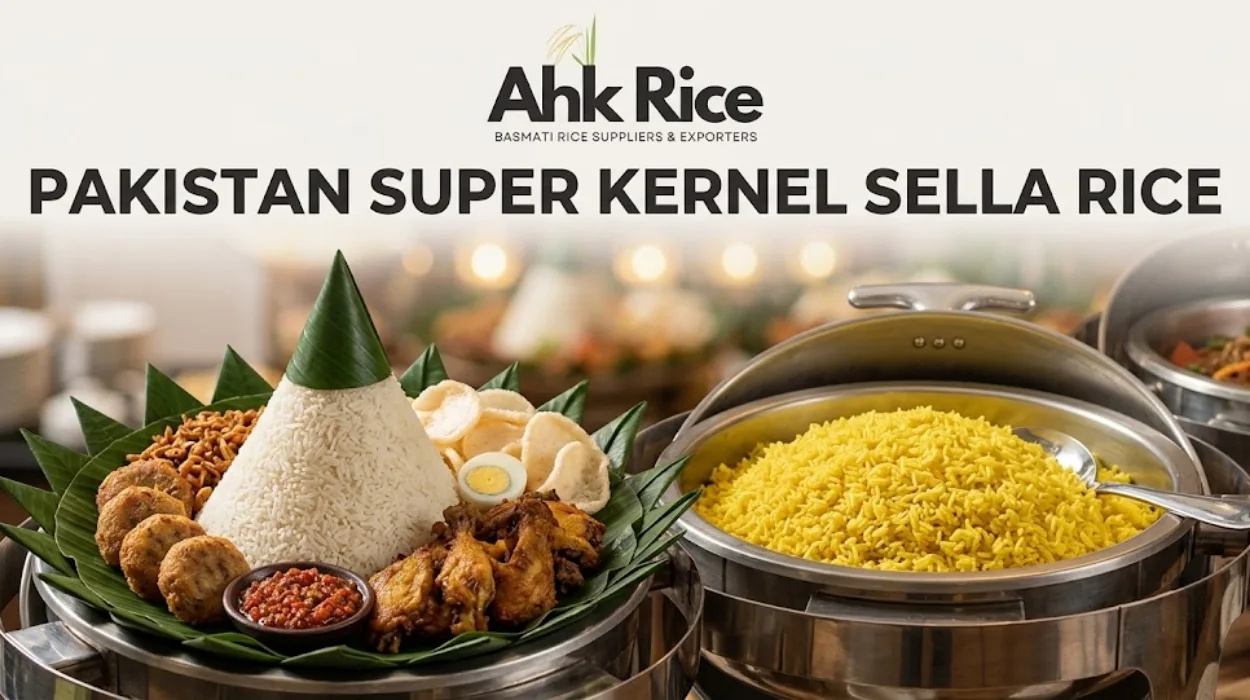
What Makes Pakistan Super Kernel Sella Rice Suitable for Indonesian Catering?
Pakistan Super Kernel Sella Rice is a parboiled form of traditional Super Kernel Basmati rice grown mainly in Punjab, Pakistan. Its suitability for Indonesian catering comes from its aromatic grain, firm cooked texture, separation after cooking, controlled processing, and stable performance in high-volume food preparation. Super Kernel typically measures about 7.2–7.6 mm before cooking and develops significant elongation during cooking.
The term “Sella” describes the processing method rather than a separate rice variety. Paddy is soaked, steamed, dried, and then milled. This process strengthens the rice kernel and reduces breakage during milling and cooking. Indonesian catering businesses therefore assess Super Kernel Sella through grain length, moisture, broken grains, purity, cooking behavior, aroma, packaging, and food-safety documentation rather than appearance alone.
Indonesia is also an established rice-import market for specialty and food-service applications. USDA reporting states that Indonesian private-sector rice imports reached 512,723 metric tons during January–August 2025, while 2025/26 imports were forecast at 750,000 metric tons. The same report identifies further-processing and restaurant demand as important import channels.
What is Pakistan Super Kernel Sella Rice?
Pakistan Super Kernel Sella Rice is an aromatic long-grain Basmati product made by parboiling Super Kernel paddy before milling, producing stronger kernels, high cooking stability, traditional Basmati aroma, and separate cooked grains for catering applications.
Super Kernel is a traditional Pakistani Basmati variety. It is cultivated primarily in the Basmati-growing areas of Punjab, where soil, irrigation, climate, and seasonal conditions support aromatic long-grain development. The grain has a distinctive fragrance associated with Basmati rice and develops a soft but separate texture after cooking.
Sella is different from White Basmati because the paddy receives thermal treatment before milling. The basic sequence is soaking, steaming, drying, dehusking, polishing, sorting, and grading. The thermal treatment partially gelatinizes the starch structure and makes the kernel more resistant to mechanical stress.
For Indonesian caterers, this distinction matters because catering kitchens often prepare rice in larger batches than households. A stronger kernel helps reduce excessive breakage during handling and cooking. The final product also provides a recognizable long-grain appearance for dishes such as biryani, pilaf, rice platters, and buffet meals.
Super Kernel Sella generally occupies a different position from 1121 Sella and 1509 Sella. 1121 focuses on extra-long grain presentation, while 1509 combines long grain characteristics with value-oriented positioning. Super Kernel emphasizes traditional Basmati aroma and a balanced long-grain profile.
Where is Super Kernel Basmati rice grown in Pakistan?
Super Kernel Basmati rice is grown primarily in Punjab’s traditional Basmati belt, where fertile alluvial soils, irrigation, seasonal temperatures, and established rice cultivation practices support long grain development and natural aromatic characteristics.
Punjab is the central production region for Pakistan’s Basmati rice. Important rice-growing areas include districts within the traditional Basmati belt around the Chenab and Ravi river systems. These production zones provide the agricultural conditions required for aromatic rice cultivation.
The growing cycle begins with paddy cultivation during the Kharif season. Farmers manage seed selection, nursery establishment or direct sowing, irrigation, nutrient application, weed control, and crop protection. Harvest timing affects grain maturity and therefore influences subsequent milling performance.
After harvesting, paddy requires controlled drying before long-term storage or processing. Excess moisture increases the risk of deterioration, while excessively rapid drying can increase fissuring and kernel breakage. A controlled moisture profile is therefore important before the paddy enters the parboiling plant.
Pakistan remains a major rice-exporting country. USDA’s April 2026 Pakistan Grain and Feed Annual forecasts 2026/27 rice production at 9.8 million metric tons and rice exports at approximately 5.0 million metric tons, compared with projected 2025/26 exports of 4.7 million metric tons.
How does Sella processing work step by step?
Sella processing converts harvested Super Kernel paddy into a stronger parboiled rice through cleaning, soaking, steaming, drying, husk removal, milling, polishing, optical sorting, grading, inspection, and packing, with each stage controlling moisture, kernel integrity, appearance, purity, and cooking performance.
1. Paddy cleaning
Harvested paddy first passes through cleaning equipment. Stones, straw, dust, metal particles, immature grains, and other field materials are removed before thermal processing.
Cleaning protects the equipment and establishes a cleaner raw material for parboiling. The incoming paddy is also assessed for moisture, variety identity, foreign material, and physical condition.
2. Soaking
Clean paddy is soaked in controlled water conditions. The objective is to increase moisture penetration into the rice kernel before steaming.
Uniform hydration is important because unevenly hydrated kernels respond differently during steaming. The result can be inconsistent cooking characteristics and increased breakage during later milling.
3. Steaming
Hydrated paddy is exposed to steam. Heat partially gelatinizes the starch and strengthens the internal structure of the grain.
This stage creates the defining physical characteristics of Sella rice. The stronger kernel structure improves resistance to mechanical stress during dehusking, milling, transport, and cooking.
4. Drying
After steaming, the paddy contains excess moisture and requires controlled drying. Drying reduces moisture to a level suitable for milling and storage.
The drying rate matters because sudden moisture changes can produce internal stress. Controlled drying therefore supports whole-kernel recovery and consistent milling performance.
5. Dehusking
The dried paddy enters a husker that separates the outer husk from the rice kernel. The resulting brown rice still contains bran layers that must be removed.
Husk separation is monitored because excessive mechanical pressure increases grain damage. Proper equipment adjustment protects kernel integrity.
6. Milling and polishing
Brown rice passes through milling stages that remove bran layers and produce the desired white Sella appearance. Polishing controls surface appearance and removes remaining bran particles.
The objective is not simply to make the grain white. Milling must preserve whole kernels while achieving the contracted appearance and cleanliness specification.
7. Sorting and grading
The milled rice is separated according to length, broken percentage, color, foreign material, and other agreed specifications. Modern processing plants use mechanical graders and optical sorters to remove discolored or defective kernels.
A typical Super Kernel Sella specification begins with grain length around 7.2–7.6 mm, but the exact commercial specification should be established in the purchase contract.
8. Quality inspection and packing
Finished rice is tested before packing. Common parameters include moisture, grain length, broken grains, foreign matter, damaged grains, color, aroma, and cooking characteristics.
The rice is then packed according to the intended market and distribution channel. Catering supply commonly uses larger commercial bags, while retail channels use smaller consumer packs.
What are the key specifications of Super Kernel Sella Rice?
The key specifications are grain length, broken percentage, moisture, foreign matter, kernel appearance, aroma, cooking performance, processing grade, packing format, crop year, and food-safety documentation, because these parameters determine consistency during commercial preparation and distribution.
Grain length establishes the physical identity of the product. Super Kernel Sella commonly falls around 7.2–7.6 mm before cooking. Cooking causes additional elongation, producing a longer visual appearance on the plate.
Broken percentage is important because excessive broken grains alter both appearance and cooking behavior. A catering kitchen purchasing rice for plated meals, buffet service, or biryani therefore needs a defined broken-grain tolerance.
Moisture affects storage stability. A controlled moisture level reduces deterioration risk during transport and warehousing. The contract should state the maximum permitted moisture rather than relying on the general description “dry rice.”
Foreign matter and purity also require measurable specifications. Examples include stones, husk fragments, weed seeds, discolored grains, and other non-rice materials.
Aroma is another important Super Kernel characteristic. Traditional Basmati aroma differentiates the variety from ordinary non-aromatic long-grain rice. Cooking performance then determines whether that aroma combines with the desired texture and grain separation.
Why does Super Kernel Sella suit Indonesian catering?
Super Kernel Sella suits Indonesian catering because its parboiled kernel structure supports large-batch cooking, separate grains, lower mechanical breakage, recognizable Basmati aroma, attractive presentation, and repeatable preparation across restaurants, hotels, caterers, banquet kitchens, and institutional food-service operations.
Catering kitchens need rice that behaves consistently when prepared in large quantities. Rice that becomes excessively sticky or breaks easily creates problems during serving, portioning, holding, and transportation.
Sella processing addresses part of this requirement by strengthening the kernel before milling. The resulting rice retains its structural integrity during cooking better than untreated kernels with comparable handling conditions.
The grain profile also supports dishes where visual separation matters. Examples include biryani, pulao, rice platters, banquet meals, buffet rice, and specialty South Asian menus served by Indonesian hotels and restaurants.
Aroma provides another functional advantage. Super Kernel is known for traditional Basmati fragrance rather than relying only on extreme grain length. This gives caterers a product positioned around both sensory identity and physical appearance.
Indonesia’s import structure provides a relevant commercial context. USDA reporting identifies rice for further processing and restaurant requirements as part of the country’s private-sector import demand, alongside specialty rice for retail and food-service channels.
Which catering businesses use Super Kernel Sella Rice?
Super Kernel Sella is relevant to restaurants, hotels, banquet operators, event caterers, food-service distributors, institutional kitchens, specialty rice wholesalers, and prepared-food businesses that require aromatic long-grain rice with consistent cooking behavior.
Restaurants use it when rice forms a central part of plated meals. Hotels use long-grain aromatic rice for buffets, banquets, room-service menus, and specialty cuisine.
Event caterers require another characteristic: batch consistency. A kitchen preparing rice for 100, 500, or 1,000 guests cannot rely on a product that changes substantially from one cooking batch to another.
Food-service distributors also require stable specifications because they supply multiple kitchens. A defined grain length, broken percentage, moisture limit, packaging format, and crop-year requirement makes inventory easier to manage.
Specialty restaurants serving biryani and other aromatic rice dishes have a separate requirement. They need fragrance and grain separation in addition to basic yield and cost considerations.
Which grades of Pakistani Sella rice are available?
Pakistani Sella rice includes several commercial grades, with 1121 Sella emphasizing extra-long grain, Super Kernel Sella emphasizing traditional Basmati aroma and balanced grain length, and 1509 Sella combining long grain characteristics with value-oriented commercial positioning.
1121 Sella
1121 Sella is recognized for an extra-long grain profile. Its typical raw grain length is around 8.3–8.5 mm, placing it above Super Kernel in physical grain length. It is commonly positioned for premium presentation where post-cooking elongation is a major purchasing criterion.
Super Kernel Sella
Super Kernel Sella generally measures around 7.2–7.6 mm before cooking. Its principal identity is traditional Basmati aroma combined with strong kernel structure and good cooking performance.
1509 Sella
1509 Sella generally measures around 8.0–8.3 mm before cooking. It provides a long-grain profile and is commonly positioned as a value-oriented alternative within Pakistani Sella rice categories.
The term Sella therefore does not identify one universal grain size. The variety and processing method must both appear in the product description. A specification such as “Super Kernel Sella” is more precise than simply stating “Sella rice.”
Which markets import Pakistani Sella rice?
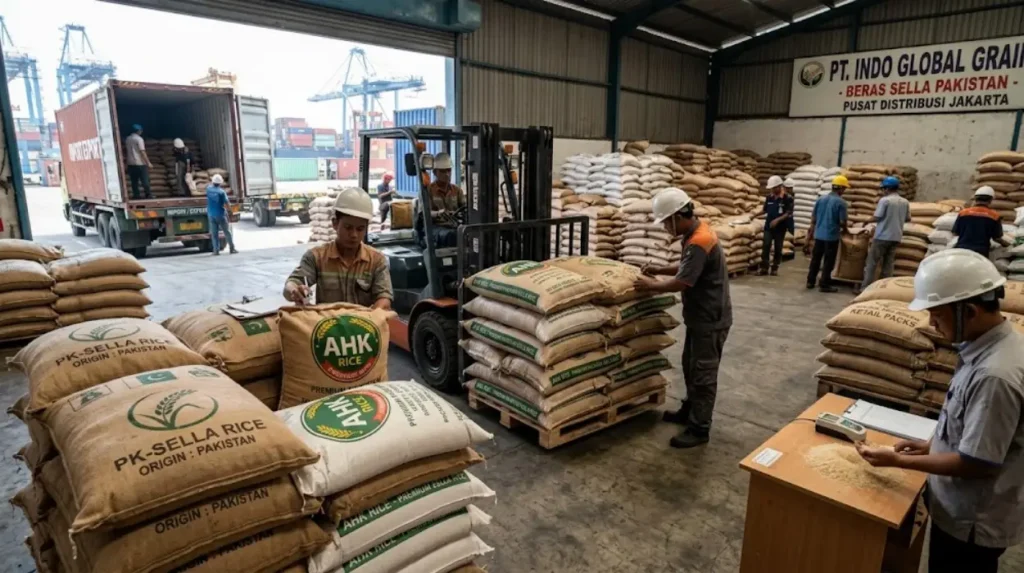
Pakistani Sella rice serves international food-service, retail, wholesale, and specialty markets across the Middle East, Europe, North America, Africa, and Asia-Pacific, with demand determined by local cuisine, grain preferences, price, documentation, and importer specifications.
Indonesia is particularly relevant for specialty rice and food-service applications because imported rice includes products used for further processing and restaurant requirements. USDA reporting also identifies continued demand for Basmati and Japonica rice as international restaurant categories expand.
The market should not be treated as one specification. Indonesian buyers can require different grain lengths, moisture levels, packaging formats, labeling details, and documentation depending on whether the rice enters a restaurant, hotel, distributor, retail packer, or food manufacturer.
This is why product comparison must follow the intended use. A caterer prioritizing cooking stability evaluates the rice differently from a retailer prioritizing package appearance or a wholesaler prioritizing landed cost.
What certifications and documents apply to Pakistani Sella rice?
Certification and documentation depend on the product form, destination rules, importer status, and intended sale channel, with food-safety evidence, product specifications, commercial documents, packing information, and applicable import documentation forming the core compliance package.
Food safety requirements must be separated from voluntary certifications. A certificate such as HACCP, ISO 22000, or another food-safety management certification describes a management system, while laboratory reports establish specific product characteristics.
For Indonesian imports, regulatory classification also matters. Indonesia’s BPOM states that fresh foods such as rice are outside the category for which its processed-food import certificate, SKI, is issued. Retail-packaged processed foods have separate BPOM requirements.
Indonesia also updated food-safety rules during 2026. BPOM announced Regulation No. 3 of 2026 concerning maximum microbial contamination limits in processed food and Regulation No. 11 of 2026 concerning food packaging. These updates matter when rice is handled or marketed under a processed-food classification.
Export documentation commonly includes the commercial invoice, packing list, certificate of origin where required, transport documents, product specification sheet, inspection or laboratory documentation where required, and other documents requested by the importing authority or buyer.
What are the common misconceptions about Super Kernel Sella?
The main misconceptions are that Sella is a separate rice variety, that longer grain automatically means better quality, that parboiling eliminates aroma, and that appearance alone proves suitability; in practice, variety, processing, specifications, cooking tests, and documentation must be evaluated together.
The first misconception is that Sella means one particular variety. It does not. Sella describes the parboiling process, so Super Kernel Sella and 1121 Sella are different products despite sharing the same processing category.
The second misconception is that the longest grain is always the best choice. Grain length is only one attribute. Aroma, broken percentage, moisture, cooking behavior, purity, and price also influence suitability.
The third misconception is that parboiling removes the identity of Basmati rice. Properly processed Super Kernel Sella retains the characteristic aromatic profile associated with the variety while gaining a stronger kernel structure.
The fourth misconception is that rice quality can be judged from color. A bright or uniform appearance does not establish moisture, purity, broken percentage, cooking performance, or food-safety compliance.
The fifth misconception is that catering suitability can be determined from a product photograph. Commercial buyers need a specification sheet and cooking evaluation. The correct assessment compares the contracted parameters with an approved physical sample.
How should Indonesian caterers evaluate Super Kernel Sella?
Indonesian caterers should evaluate Super Kernel Sella through a specification-controlled process covering grain length, broken percentage, moisture, purity, aroma, cooking yield, texture, packaging, documentation, and batch consistency rather than selecting rice from appearance or variety name alone.
The first step is to define the kitchen application. A biryani restaurant, hotel buffet, banquet caterer, and food manufacturer have different cooking volumes and presentation requirements.
The second step is to establish measurable specifications. These should include grain length, broken percentage, moisture, foreign matter, processing grade, crop year, packing size, and acceptable physical appearance.
The third step is to conduct a cooking test. The sample should be prepared using the intended water ratio, soaking period, cooking equipment, and holding conditions. The evaluation should record cooked grain separation, elongation, aroma, softness, firmness, breakage, and yield.
The fourth step is to compare the test result with the purchase specification. The physical sample becomes the reference point for future commercial shipments.
For Indonesian caterers ready to compare measurable purchasing criteria, the next step is to:
Compare Super Kernel Sella specifications for Indonesian catering, including grain length, broken percentage, moisture, cooking performance, and overall quality.
Frequently Asked Questions
What is Pakistan Super Kernel Sella Rice?
Pakistan Super Kernel Sella Rice is a parboiled Basmati rice made from Super Kernel paddy grown mainly in Punjab, Pakistan. It is known for long grains, Basmati aroma, firm texture, and good grain separation after cooking.
What does Sella mean in Basmati rice?
Sella refers to the parboiling process used before milling. Paddy is soaked, steamed, dried, dehusked, milled, sorted, graded, and packed. Sella is therefore a processing category, not a separate rice variety.
Where is Super Kernel Basmati rice grown?
Super Kernel Basmati rice is grown primarily in Pakistan’s Punjab rice-growing areas. The region provides suitable soil, irrigation, climate, and farming conditions for aromatic Basmati rice production.
What is the typical grain length of Super Kernel Sella Rice?
Super Kernel Sella commonly has a raw grain length of about 7.2–7.6 mm. The grain elongates during cooking, creating the long-grain appearance associated with Basmati rice.
Why is Super Kernel Sella suitable for catering?
Its parboiled structure provides good kernel strength, grain separation, cooking stability, and resistance to breakage. These characteristics support large-batch preparation in restaurants, hotels, banquet kitchens, and catering operations.
How is Super Kernel Sella Rice processed?
The process includes paddy cleaning, soaking, steaming, controlled drying, dehusking, milling, polishing, sorting, grading, quality inspection, and packaging. Each stage affects grain integrity, moisture, purity, and cooking performance.
What is the difference between Super Kernel Sella and 1121 Sella?
Super Kernel Sella emphasizes traditional Basmati aroma and a balanced long-grain profile, while 1121 Sella is recognized for its extra-long grain. Their physical grain lengths and commercial positioning therefore differ.
What is the difference between Super Kernel Sella and 1509 Sella?
Super Kernel Sella is associated with traditional Basmati aroma and a balanced grain profile. 1509 Sella provides a long-grain profile and is commonly positioned as a more value-oriented Sella option.