AHK Rice Pakistan Super Kernel Parboiled Rice Supply for Indonesian Food Businesses
The best solution is a specification-controlled Pakistan Super Kernel Parboiled Rice supply that combines approved samples, measurable grain standards, controlled processing, suitable packaging, export documentation, predictable shipping, and repeatable quality instead of choosing suppliers primarily on quoted price.
Indonesian food businesses need more than a rice supplier. Restaurants, caterers, wholesalers, distributors, and food manufacturers need a product that performs consistently after cooking and remains commercially viable after freight, import handling, storage, and distribution costs.
After understanding the product’s suitability, buyers should compare the available grades before selecting a commercial specification. The guide on:
Comparing Pakistan Super Kernel Parboiled Rice grades for Indonesian food businesses helps buyers evaluate grade, grain characteristics, cooking performance, and purchasing requirements before requesting a supply quotation.
For buyers starting their supplier evaluation,
What makes Pakistan Super Kernel Parboiled Rice suitable for Indonesian food businesses provides the technical background. The decision stage is different: the buyer must now determine whether a specific supplier can deliver the required specification repeatedly.
AHK Rice supplies Super Kernel Parboiled Rice from Pakistan for Indonesian buyers, with published specifications including approximately 7.0–7.2 mm average grain length, maximum 12.5% moisture, maximum 2% broken grains, maximum 3% chalky grains, and controlled sorting and polishing requirements. Exact specifications should be confirmed in the commercial contract before production.
For an Indonesian restaurant, the practical target is not simply “long-grain rice.” The target is consistent grain size, controlled breakage, suitable moisture, acceptable aroma, reliable cooking performance, secure packaging, and predictable replenishment.
Why choose AHK Rice for Super Kernel Parboiled Rice supply to Indonesia?
AHK Rice provides a specification-led export process covering product selection, sample approval, production, quality inspection, packaging, documentation, container loading, and sea shipment from Karachi to Indonesian ports for commercial food businesses.
The Indonesia Super Kernel rice export service is designed around the requirements of importers buying from Pakistan for Indonesian distribution and foodservice operations. AHK Rice’s published process supports shipments from Karachi to Indonesian destinations including Jakarta, Surabaya, and Belawan.
The commercial advantage is control at several points instead of depending on one final inspection.
First, the buyer defines the specification. This should include variety, processing method, grain length, broken percentage, moisture, foreign matter, packaging, quantity, and destination.
Second, AHK Rice prepares a representative sample. The buyer can test the rice before committing to a commercial shipment.
Third, the approved sample becomes the reference point for production. This reduces the risk of accepting a quotation based on one specification and receiving a different commercial result.
Fourth, the finished rice is inspected before loading. Documents and shipment details can then be aligned with the approved order.
AHK Rice also offers different packaging formats for Super Kernel products, including PP, jute, non-woven, cloth, box, and other formats depending on the product and buyer requirement.
This is particularly useful for Indonesian businesses operating different channels. A foodservice distributor may require larger bags, while a retailer or restaurant chain may require smaller branded packs.
The objective is therefore not merely to export rice. It is to establish a repeatable procurement specification that can be reordered without changing the product definition every time.
What results can Indonesian food businesses expect from a controlled supply program?
A controlled supply program can deliver more consistent cooking performance, lower specification uncertainty, better purchasing visibility, easier quality verification, and more predictable replenishment when each shipment follows an approved product and logistics specification.
The first expected result is cooking consistency. Super Kernel Parboiled Rice is processed to strengthen the grain structure and support firm, separate cooked kernels. This can be valuable for restaurants preparing repeated batches of rice for biryani, rice platters, catering, and other foodservice applications.
The second result is lower quality uncertainty. A written specification gives procurement teams measurable acceptance criteria instead of relying on descriptions such as “premium” or “high quality.”
The third result is better inventory planning. A buyer knows the expected production period, vessel transit period, destination port, and inland delivery requirement before placing the order.
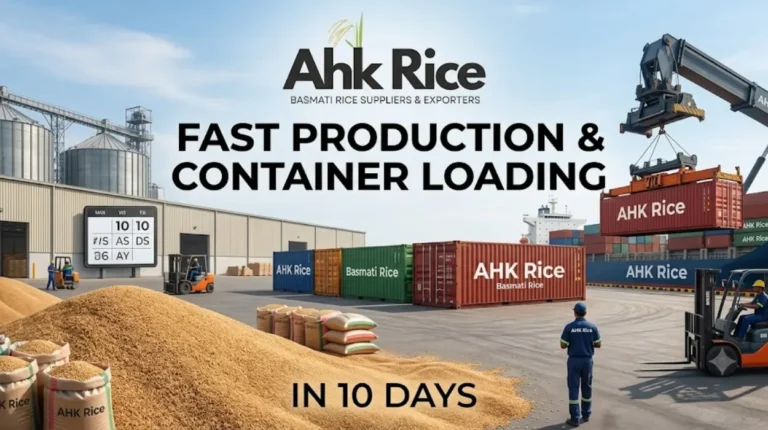
AHK Rice currently describes standard production scheduling for Super Kernel parboiled orders at approximately 7–10 days when stock availability and order conditions permit. Published Indonesia shipment information gives approximately 20–30 days for sea transit, depending on port, carrier, routing, and vessel schedule.
A practical planning window is therefore approximately:
| Stage | Typical planning period |
|---|---|
| Specification and quotation | 1–2 days |
| Sample approval | About 5–7 days by air |
| Production scheduling | About 7–10 days |
| Export preparation | About 3–5 days |
| Sea transit | About 20–30 days |
| Destination handling | About 2–3 days after docking |
These are planning ranges, not guaranteed delivery dates. Vessel availability, customs procedures, port congestion, documentation, inspection, holidays, and destination delivery can change the final timeline.
For Jakarta, Surabaya, and Belawan, buyers should therefore build the purchasing plan around the specific vessel schedule rather than assuming every shipment will take the same number of days.
How does the sample process work before a commercial Super Kernel order?
The sample process should move from specification confirmation to sample dispatch, controlled cooking tests, commercial approval, contract confirmation, production matching, and final inspection so the bulk shipment is purchased against a product the buyer has actually evaluated.
The first step is specification collection. The Indonesian buyer should provide the required variety, processing grade, grain length, broken tolerance, moisture limit, packaging, quantity, destination port, and intended application.
The second step is sample selection. A representative Super Kernel Parboiled Rice sample is prepared against the requested specification. AHK Rice states that samples can be supplied for evaluation, with customers generally covering sample shipping and applicable phytosanitary costs.
The third step is courier dispatch. AHK Rice’s broader Indonesia process indicates 1–2 kg samples can be shipped by air, with approximately 5–7 days used as a planning period.
The fourth step is kitchen testing. The restaurant should use its normal cooking equipment and recipe rather than testing the rice under unusually favorable conditions.
The buyer should record:
- Dry rice weight
- Water quantity
- Cooking time
- Resting time
- Cooked yield
- Grain separation
- Grain expansion
- Texture
- Aroma
- Broken cooked grains
- Holding performance
The fifth step is commercial approval. If the sample passes, the buyer should approve the exact specification in writing.
The sixth step is contract confirmation. Quantity, price basis, Incoterm, payment terms, packaging, shipment destination, quality tolerances, inspection arrangements, and documentation should be recorded.
The seventh step is production. AHK Rice then schedules processing against the confirmed commercial requirement.
The eighth step is final inspection. The buyer can require pre-shipment inspection or agree on inspection documentation before container release.
This process costs less than discovering a quality mismatch after a full container has arrived in Indonesia.
How much does Super Kernel Parboiled Rice cost for Indonesian buyers?
There is no responsible single landed price because Super Kernel Parboiled Rice cost changes with grade, crop, quantity, packaging, inspection, payment terms, FOB or CFR basis, freight, destination charges, and the exact Indonesian delivery location.
AHK Rice’s published Indonesia Super Kernel page displays an indicative FOB range of approximately US$1,100–1,300 per metric ton for Super Kernel Basmati, with a stated minimum order beginning around 20 MT; buyers should request a current quotation because market prices change.
For Indonesian buyers, FOB Karachi is only one part of the purchasing calculation.
A commercial landed-cost model should include:
| Cost component | Why it matters |
| Rice price | Depends on grade and specification |
| Packaging | Changes with bag size and material |
| Inland movement in Pakistan | Moves product to Karachi |
| Export handling | Covers port and shipment preparation |
| Ocean freight | Changes by destination and vessel |
| Insurance | Depends on agreed Incoterm |
| Inspection | Depends on buyer requirements |
| Indonesian port charges | Destination-specific |
| Customs and clearance | Depends on applicable import requirements |
| Inland delivery | Depends on final warehouse or factory |
A buyer comparing two suppliers should therefore compare equivalent Incoterms. An apparently cheaper FOB quotation can become more expensive after freight, destination handling, inspection, packaging, and inland transportation are included.
AHK Rice’s published commercial information also indicates payment structures can include LC at sight or agreed TT arrangements, while the exact terms should be established in the final quotation and contract.
The correct purchasing metric is therefore landed cost per usable kilogram, not simply the quoted price per metric ton.
Which shipping schedule should Indonesian buyers use for planning?
Indonesian importers should plan approximately four to six weeks from confirmed order through delivery for a standard sea shipment, while allowing additional buffer for production, vessel schedules, customs, port congestion, inspection, and inland transportation.
For a Jakarta-bound shipment, the planning sequence normally begins with production in Pakistan, movement to Karachi, export documentation, container loading, vessel departure, sea transit, port arrival, customs processing, and final delivery.
AHK Rice currently states approximately 20–30 days of sea transit from Karachi to Indonesian ports on its Indonesia export information.
A Surabaya shipment should be planned against the actual vessel schedule because routing and transshipment can affect the transit period.
Belawan-bound cargo should similarly be planned according to the confirmed carrier schedule and destination handling conditions.
A buyer placing an order for restaurant inventory should not wait until existing stock is almost exhausted. The procurement cycle should begin early enough to absorb production and shipping variability.
For example, if a restaurant consumes 20 MT per month and maintains a one-month safety stock, the next shipment should be planned before the remaining inventory reaches the reorder threshold.
AHK Rice can provide shipment coordination and documentation so the importer has visibility from production through dispatch and arrival.
How should Indonesian buyers prove the supplier can deliver consistently?
Supplier proof should come from the approved sample, measurable specification, production controls, inspection evidence, export documents, packaging consistency, shipment history, and ability to repeat the same commercial specification across subsequent orders.
A single successful sample is not enough to establish long-term supply performance.
Indonesian buyers should request a specification sheet before signing the order. The sheet should define grain length, broken percentage, moisture, foreign matter, damaged kernels, processing, packing, crop information where applicable, and inspection requirements.
The buyer should then compare the specification with the sample.
AHK Rice’s published Super Kernel Parboiled specification includes 7.0–7.2 mm average grain length, maximum 12.5% moisture, maximum 2% broken grains, and maximum 3% chalky grains. These figures should be treated as the product-page specification and confirmed for the exact commercial lot before purchase.
Documentation should also be reviewed according to the transaction and Indonesian import requirements. Certificates such as phytosanitary documentation, certificate of origin, laboratory reports, Halal documentation, and food-safety certifications serve different purposes and should not be treated as interchangeable.
AHK Rice supports the export documentation and inspection process as part of its Indonesia supply workflow.
The final proof is repeatability. After the first shipment, the buyer should compare the received product with the approved specification and retain the quality record for the next purchase.
How should an Indonesian food business get started with AHK Rice?
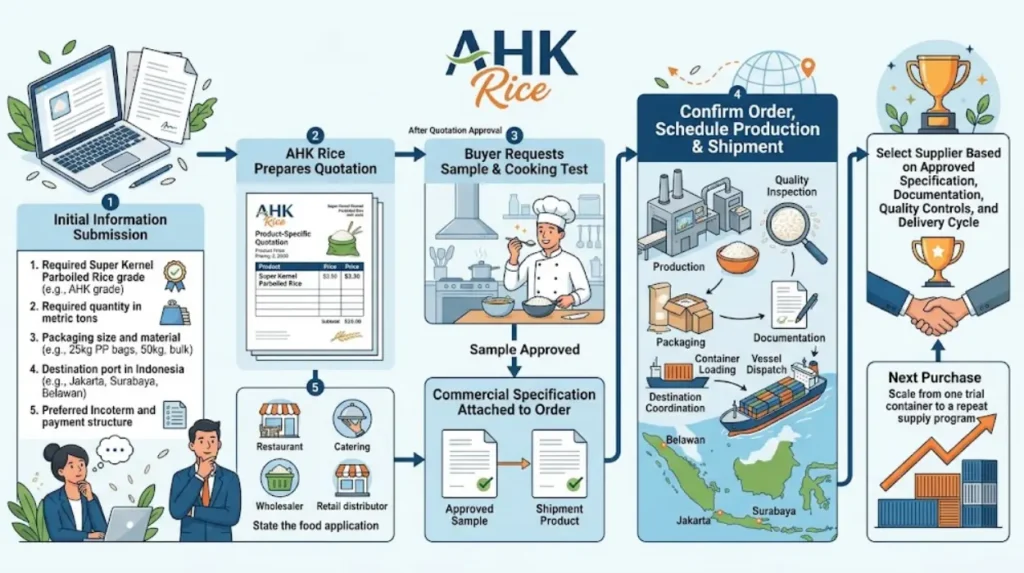
Start by submitting the required specification, quantity, packaging, destination port, and commercial terms; review the quotation, test the sample, approve the specification, confirm the order, and then schedule production and shipment against the agreed contract.
The process should begin with five pieces of information:
- Required Super Kernel Parboiled Rice grade
- Required quantity in metric tons
- Packaging size and material
- Destination port in Indonesia
- Preferred Incoterm and payment structure
The buyer should also state the food application. A restaurant, catering company, wholesaler, and retail distributor may require different packaging and quality priorities.
AHK Rice can then prepare a product-specific quotation rather than providing an unsuitable generic rice price.
After quotation approval, the buyer should request the sample and perform the cooking test.
Once the sample is approved, the commercial specification should be attached to the order documentation. This creates a direct link between the product tested by the buyer and the product produced for shipment.
Production can then be scheduled, followed by quality inspection, packaging, documentation, container loading, vessel dispatch, and destination coordination.
AHK Rice’s Indonesia export workflow identifies Jakarta, Surabaya, and Belawan among the relevant Indonesian destinations and supports customized packaging and export shipment arrangements.
The strongest decision is therefore not simply to select the lowest quotation. It is to select the supplier that can meet the approved specification, document the shipment, maintain quality controls, and support the required delivery cycle.
For Indonesian food businesses that need a repeatable Pakistan Super Kernel Parboiled Rice program, AHK Rice offers a practical specification-to-shipment model built around sample approval, controlled processing, inspection, packaging, documentation, and sea freight.
The next purchase should be based on the same approved specification and measurable acceptance criteria, allowing procurement teams to scale from one trial container to a repeat supply program with greater confidence.
To start the commercial process, request a customized rice quotation.
Frequently Asked Questions
What is Pakistan Super Kernel Parboiled Rice?
Pakistan Super Kernel Parboiled Rice is a long-grain rice processed through parboiling to improve grain strength, cooking consistency, and separation. It is suitable for restaurants, caterers, wholesalers, and food distributors requiring consistent commercial rice.
Why should Indonesian food businesses import Super Kernel Parboiled Rice from Pakistan?
Indonesian food businesses can source Super Kernel Parboiled Rice from Pakistan for its long-grain characteristics, controlled processing, commercial availability, and suitability for foodservice applications. The final choice should be based on specification, sample performance, landed cost, and documentation.
What Super Kernel Parboiled Rice specifications should Indonesian buyers request?
Buyers should request grain length, broken percentage, moisture, chalky grains, foreign matter, damaged kernels, processing type, packaging, crop information, and inspection requirements. A written specification should be agreed before commercial production.
Can Indonesian buyers receive a sample before placing a bulk order?
Yes. A sample can be requested before confirming a commercial shipment. Buyers should cook the sample using their normal recipes and equipment and evaluate grain separation, texture, aroma, expansion, yield, and holding performance.
How much does a Super Kernel Parboiled Rice sample cost?
Sample costs depend on quantity, courier charges, destination, and required documentation. The buyer should confirm the current sample shipping and any applicable certification or phytosanitary costs before dispatch.
How long does shipping from Pakistan to Indonesia take?
Sea transit from Karachi to Indonesian ports is commonly planned at approximately 20–30 days, depending on the destination, carrier, routing, transshipment, vessel schedule, and port conditions. Production and destination clearance time should be added to the overall procurement schedule.
Which Indonesian ports can receive Pakistan Super Kernel Parboiled Rice?
Common commercial destinations include Jakarta, Surabaya, and Belawan. The appropriate port depends on the buyer’s warehouse location, shipping route, freight quotation, and inland transportation requirements.
What affects the price of Super Kernel Parboiled Rice in Indonesia?
Price depends on rice grade, specification, quantity, packaging, payment terms, Incoterm, ocean freight, inspection, export handling, Indonesian port charges, customs clearance, taxes or duties where applicable, and inland transportation.
What packaging options are available for Indonesian buyers?
Packaging can be customized according to the buyer’s requirements. Options may include PP, jute, non-woven, cloth, box, and other formats, with the final bag size, material, printing, and packing configuration confirmed in the commercial specification.
How can Indonesian restaurants test rice quality before changing suppliers?
Restaurants should conduct a controlled cooking trial using their normal recipe, water ratio, cooking equipment, and holding conditions. They should compare grain separation, texture, aroma, cooked yield, breakage, appearance, and performance after holding.