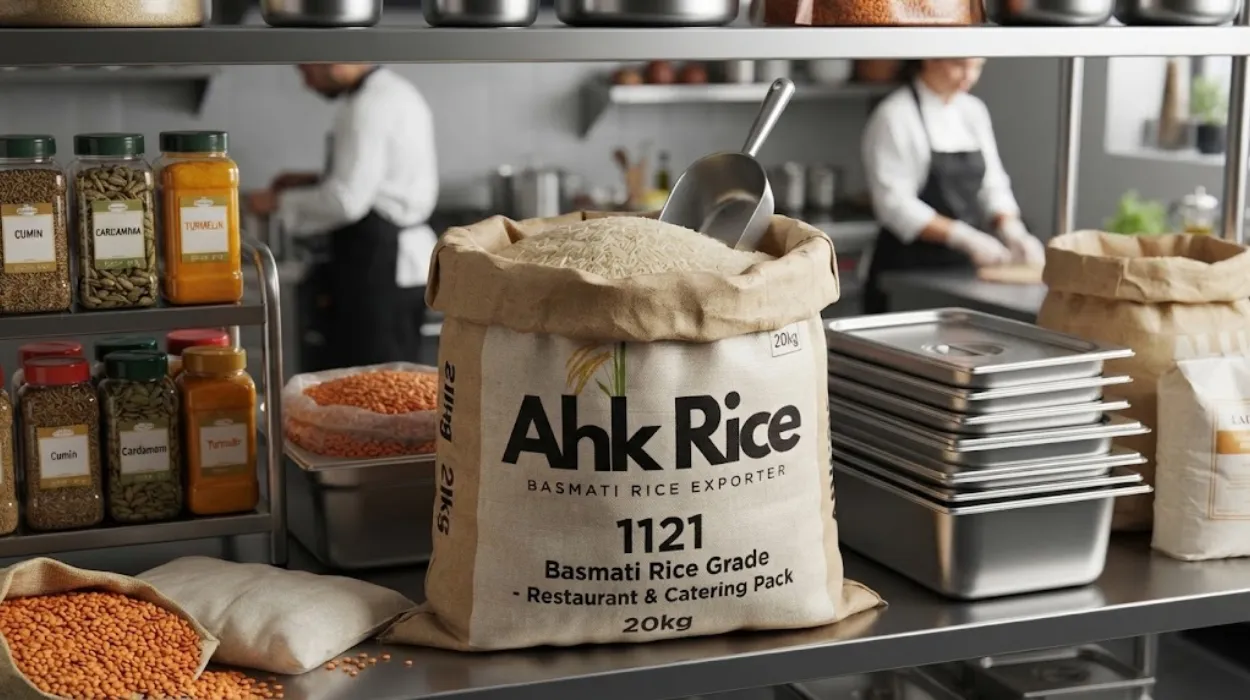
Best 1121 Basmati Grade for Restaurants and Catering Business
1121 Steam suits premium restaurants, while 1121 Golden Sella suits catering and large-batch kitchens. Here is why: Steam delivers separate grains and a softer texture, while Golden Sella provides firmer grains, stronger holding performance, and consistent bulk cooking.
Restaurant procurement should compare processing grade, grain length, broken percentage, moisture, aroma, cooking yield, and storage requirements. A restaurant serving fresh plated dishes needs a different specification from a catering company preparing hundreds of portions.
For a broader explanation of why 1121 performs well in premium foodservice, read why Pakistan 1121 Basmati suits premium Indonesian restaurants. The guide explains grain length, aroma, elongation, processing types, and restaurant applications.
AHK Rice supplies Pakistan 1121 Basmati rice through its export service, alongside Super Kernel and 1509 varieties. Its supply model covers processing, grading, sorting, custom packaging, quality inspection, and export coordination.
What are the available 1121 Basmati solutions for restaurants?
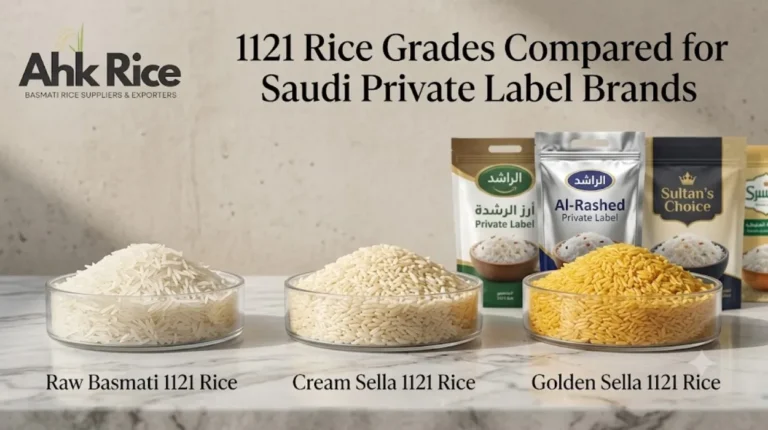
The main solutions are 1121 White, 1121 Steam, 1121 Golden Sella, 1121 Creamy Sella, and 1121 Brown. Each grade uses 1121 Basmati but applies different processing methods that change texture, appearance, firmness, and storage performance.
1121 White Basmati
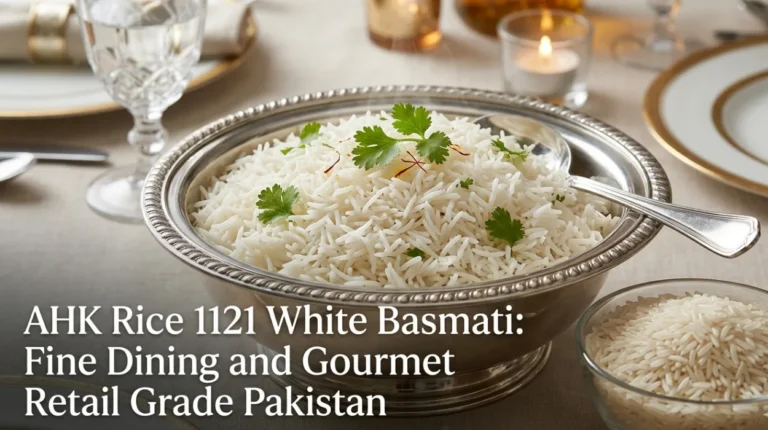
1121 White is conventionally milled rice with a bright appearance and soft cooked texture. Dehusking and polishing remove the outer layers and create a clean white grain.
This grade suits restaurants serving rice immediately after cooking. The softer texture works for menus where tenderness and fresh preparation matter more than extended holding.
1121 Steam Basmati
1121 Steam receives controlled steam treatment before drying and milling. The process strengthens the grain while retaining a light appearance and aromatic character.
Steam suits premium restaurants serving biryani, pilaf, rice platters, and made-to-order dishes. Its cooked grains remain separate while providing a softer texture than Sella grades.
1121 Golden Sella
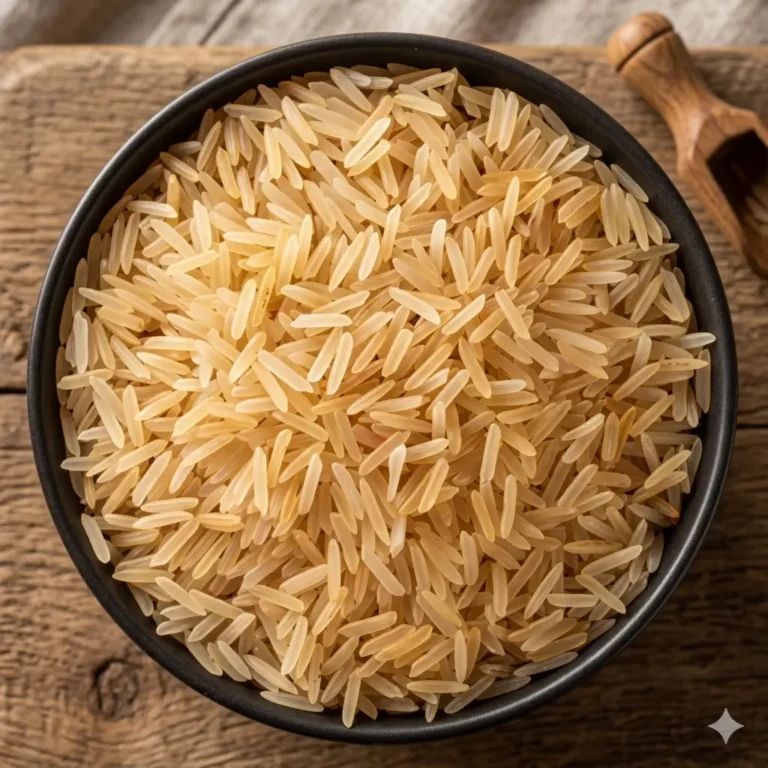
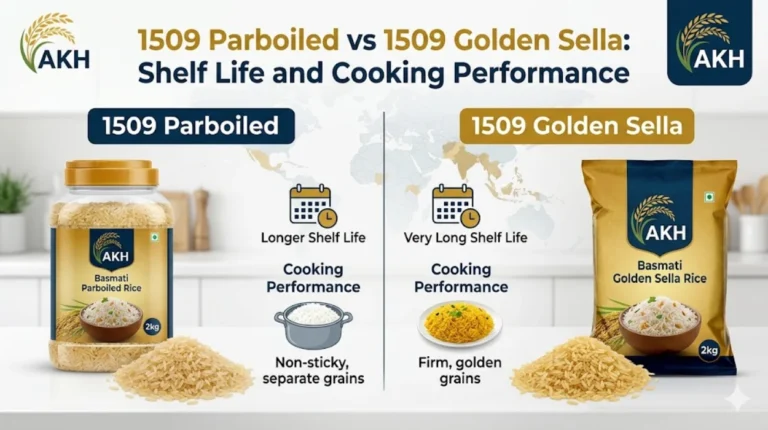
1121 Golden Sella is a parboiled grade with a distinctive golden appearance. The paddy undergoes soaking, steaming, drying, dehusking, and milling before final grading.
Golden Sella suits catering kitchens, banquet operations, restaurant groups, and high-volume foodservice. Its firmer structure supports bulk cooking, holding, reheating, and repeated service.
1121 Creamy Sella
1121 Creamy Sella is a lighter-coloured parboiled grade. Controlled processing produces a creamy appearance with firm cooked grains.
Creamy Sella suits buyers that want Sella cooking performance without the stronger golden appearance. It provides an alternative for catering menus with specific presentation requirements.
1121 Brown Basmati
1121 Brown retains more of the grain’s outer layers after dehusking. The result is a darker appearance and firmer eating texture.
Brown Basmati suits restaurants with whole-grain menu requirements. It is less relevant for conventional biryani and premium white-rice menus.
These five grades create the available solution set. The next comparison shows how their specifications affect restaurant operations.
How do different 1121 Basmati grades compare?
1121 Steam balances premium presentation and fresh service, while Golden Sella prioritizes firmness and bulk cooking. Here is why: processing changes water absorption, grain structure, texture, holding performance, and the operational tolerance required by commercial kitchens.
| Attribute | 1121 White | 1121 Steam | 1121 Golden Sella | 1121 Creamy Sella | 1121 Brown |
|---|---|---|---|---|---|
| Processing | Milled | Steam treated | Parboiled | Parboiled | Partially milled |
| Appearance | Bright white | Light white | Golden | Creamy | Brown |
| Raw grain | About 8.05–8.30 mm | About 8.05–8.30 mm | About 8.2–8.4 mm | About 8.2–8.4 mm | Long grain |
| Cooked texture | Soft | Soft-firm | Firm | Firm | Firm |
| Grain separation | Good | Very good | Excellent | Excellent | Good |
| Bulk cooking | Moderate | High | Very high | Very high | High |
| Main use | Fresh restaurant service | Premium restaurants | Catering and foodservice | Catering and specialty menus | Whole-grain menus |
The 8.05–8.30 mm range represents the common raw-grain range cited for 1121, while individual commercial specifications vary by grade and contract. Cooked grain length can exceed 22 mm under suitable processing and cooking conditions.
Processing therefore matters as much as variety. A restaurant should not select 1121 solely because the raw grain looks long.
Which method works best for different restaurant and catering cases?
Choose 1121 Steam for fresh premium dishes and Golden Sella for large batches, holding, and catering. Here is why: Steam emphasizes fresh texture and aroma, while Golden Sella provides stronger grain structure for bulk preparation and longer service windows.
Premium restaurants
1121 Steam fits premium restaurants where chefs cook rice close to service time. Biryani, pilaf, and plated rice dishes benefit from long, separate grains and a lighter cooked texture.
Steam also supports visual presentation. Long grains create a clear distinction between individual kernels on the plate.
Restaurant groups
Restaurant groups need repeatable specifications across multiple kitchens. 1121 Steam works for restaurants with immediate service, while Golden Sella suits branches preparing rice in larger batches.
A group operating both formats can maintain two specifications. Steam can serve premium fresh-service outlets. Golden Sella can serve high-volume branches.
Catering companies
1121 Golden Sella fits catering companies because parboiling produces firm grains with stronger shape retention. Large kitchens can cook substantial quantities before service without relying on immediate plating.
Golden Sella also suits banquet operations. Its firm structure supports handling, portioning, holding, and reheating better than softer grades.
Hotels and banquet kitchens
Hotels need consistency across breakfast, lunch, dinner, conferences, and events. Golden Sella provides a practical specification for kitchens managing large production volumes.
Steam remains suitable for made-to-order premium menus. The final choice depends on the service window and required texture.
Whole-grain restaurants
1121 Brown suits restaurants with whole-grain menu requirements. Its retained outer layers create a different texture and appearance from polished white rice.
The grade should therefore be treated as a menu-specific solution rather than a direct substitute for Steam or Sella.
These use cases show why restaurant type changes grade selection. The next factor is commercial cost.
What are the price and shelf-life differences between 1121 options?
Fresh 1121 generally costs less than aged 1121, while aged rice provides stronger storage stability and cooking consistency. Here is why: controlled aging reduces moisture, stabilizes the grain, strengthens aroma, and increases storage costs before export.
Source material gives the following indicative export ranges for Pakistan 1121 based on crop age:
| Crop Type | Approx. Export Price | Typical Shelf Life | Commercial Position |
|---|---|---|---|
| Fresh Crop | US$950–1,100/MT | 12–18 months | Cost-focused |
| Semi-Aged | US$1,050–1,180/MT | Around 24 months | Mid-range |
| Fully Aged | US$1,180–1,350/MT | Up to 24 months | Premium |
These figures represent planning ranges rather than fixed quotations. Harvest volume, freight, currency, milling quality, packaging, order quantity, and international demand change the final price.
Aged rice remains commercially relevant for restaurants because lower moisture and greater grain stability support consistent cooking and warehouse storage. Fresh crop provides a lower entry price for buyers prioritizing rapid inventory turnover.
Gulf market
Gulf restaurants and catering companies commonly prioritize grain separation, aroma, storage stability, and consistent bulk cooking. UAE foodservice buyers can therefore compare aged 1121 against fresh 1121 according to their inventory cycle.
Premium restaurant operations benefit from a specification that protects cooking consistency. Catering companies with longer storage periods place greater value on stable grain performance.
European market
European buyers place additional emphasis on traceability, food safety documentation, laboratory testing, and consistent specifications. Semi-aged or fully aged 1121 can serve premium restaurant and private-label foodservice programs.
European importers also need to align the rice specification with packaging, labeling, and destination compliance requirements.
The price difference becomes meaningful only after considering kitchen performance, inventory duration, and customer expectations. The next section examines the advantages and limitations of each approach.
What are the pros and cons of each 1121 Basmati approach?
Steam offers premium fresh-service performance, while Golden Sella offers stronger bulk-service performance; White and Brown serve narrower kitchen requirements. Here is why: each processing method changes texture, firmness, appearance, and tolerance during commercial cooking.
1121 Steam
Advantages: Premium appearance, strong aroma, separate grains, softer texture, and strong suitability for fresh restaurant service.
Limitations: Less suitable than Sella for very long holding periods and intensive bulk handling.
A premium biryani restaurant can use Steam when chefs cook rice close to service. The specification supports presentation without requiring the firmer structure associated with parboiled rice.
1121 Golden Sella
Advantages: Firm grains, strong separation, high bulk-cooking performance, better holding tolerance, and strong catering suitability.
Limitations: Golden colour changes visual presentation, and the firmer texture does not suit every restaurant menu.
A catering company serving 500 portions can use Golden Sella when cooking begins well before guests receive the meal.
1121 White
Advantages: Bright appearance, soft texture, familiar presentation, and suitability for immediate service.
Limitations: Lower holding tolerance than Sella and less suitability for extended bulk cooking.
A small restaurant serving freshly cooked rice can use White when softness matters more than extended holding.
1121 Creamy Sella
Advantages: Firm grains, strong separation, lighter colour, and reliable bulk cooking.
Limitations: Higher processing requirements than conventional White rice and a narrower visual preference.
A restaurant group can use Creamy Sella when it wants Sella performance without a pronounced golden appearance.
1121 Brown
Advantages: Whole-grain positioning, firm texture, and distinctive appearance.
Limitations: Different sensory characteristics and limited suitability for conventional white-rice dishes.
A health-focused restaurant can specify Brown when its menu requires whole-grain rice.
The advantages and limitations point toward a specification-based decision rather than a universal grade choice.
Which decision factors should restaurants evaluate before procurement?
Restaurants should evaluate cooking method, service window, volume, texture, grain separation, price, storage, packaging, and quality tolerances before approving 1121. Here is why: a complete specification prevents buyers from selecting rice based only on raw grain appearance or purchase price.
| Decision Factor | Restaurant Question | Suitable Direction |
|---|---|---|
| Cooking method | Is rice served immediately? | Steam or White |
| Production volume | Are large batches prepared? | Golden Sella |
| Holding time | Does rice wait before service? | Golden Sella or Creamy Sella |
| Texture | Is soft or firm texture required? | White or Steam / Sella |
| Procurement budget | Is cost control critical? | Fresh crop or suitable processing |
| Storage | Will inventory remain for months? | Aged crop |
| Presentation | Does grain appearance drive menu value? | 1121 Steam |
| Packaging | Does the kitchen need large bags? | 20–40 kg foodservice formats |
The specification should also define moisture, broken percentage, foreign matter, grain length, crop year, packaging, quantity, and permitted tolerances.
Buyers should request a representative sample before approving commercial volume. Cooking tests should use the same water ratio, equipment, batch size, resting period, and service window used by the kitchen.
Sample approval creates a physical reference for future shipments. The approved specification then becomes the basis for production, inspection, packaging, and shipment documentation.
How should restaurants test a 1121 Basmati sample?
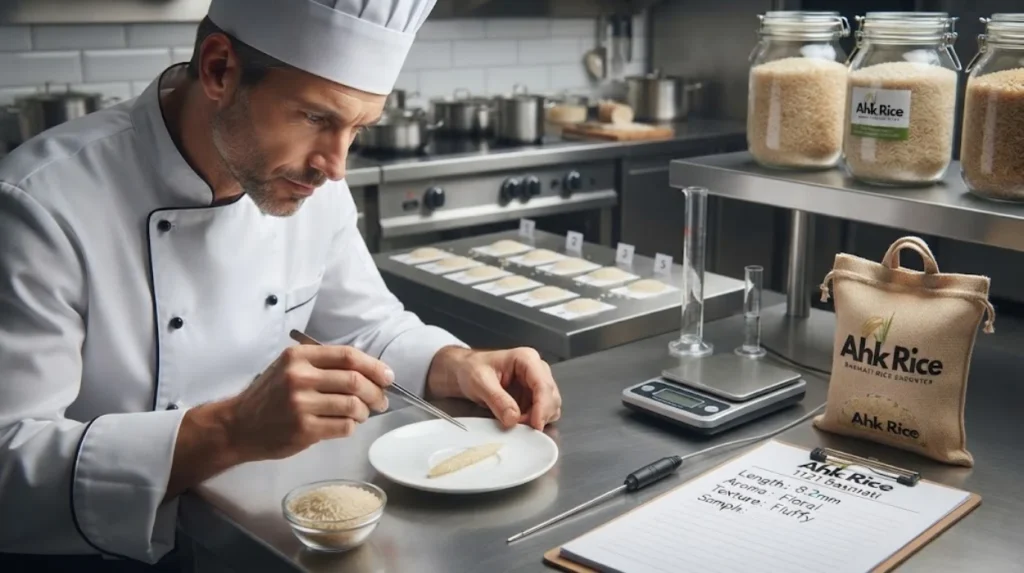
Restaurants should compare raw grain, cooking expansion, aroma, texture, separation, breakage, and holding performance under identical kitchen conditions. Here is why: a controlled trial reveals differences that raw grain appearance cannot show before commercial procurement.
Start with the required processing grade. Test 1121 Steam against Golden Sella when the kitchen has not established a clear preference.
Measure raw grain length before cooking. Record the average measurement and broken percentage against the supplier specification.
Cook identical quantities. Use the restaurant’s normal equipment and water ratio to produce a realistic result.
Record cooked grain length. Check whether the grains remain separate after the normal resting period.
Evaluate aroma and texture. Record results immediately after cooking and again during the normal service window.
Test holding performance. Golden Sella often provides stronger structural stability during extended holding, while Steam provides a softer fresh-service result.
Record the final outcome. The approved sample should include the variety, processing type, crop information, quality limits, packaging, and cooking result.
This sample process converts product comparison into a measurable procurement decision.
What should the final 1121 Basmati specification include?
A commercial specification should define variety, processing, grain length, moisture, broken percentage, purity, packaging, crop year, quantity, and inspection requirements. Here is why: precise specifications allow the approved sample and commercial shipment to remain aligned.
A restaurant purchase order should identify 1121 Basmati rather than using only the term “premium Basmati.”
The processing type should state White, Steam, Golden Sella, Creamy Sella, or Brown.
The grain specification should state the agreed raw grain measurement and tolerance.
The quality section should define moisture, broken percentage, foreign matter, damaged grains, and other agreed limits.
The packaging section should state bag material, net weight, printing requirements, and closure format.
The commercial section should state quantity, Incoterm, destination, payment terms, and shipment window.
The inspection section should identify laboratory testing or third-party inspection requirements where applicable.
A complete specification creates a stronger connection between kitchen requirements and export execution. It also makes supplier quotations easier to compare.
What is the final decision framework for restaurants and catering businesses?
1121 Steam fits premium fresh-service restaurants, while Golden Sella fits catering, banquet, and high-volume operations. Here is why: Steam emphasizes fresh texture and presentation, while Golden Sella emphasizes firmness, bulk cooking, holding, and operational consistency.
The final selection should follow the kitchen’s actual production system. A restaurant serving premium biryani immediately after cooking has a different requirement from a catering company preparing thousands of portions hours before service.
| Buying Situation | Grade Direction | Main Reason |
|---|---|---|
| Premium restaurant | 1121 Steam | Presentation and fresh texture |
| Biryani restaurant | 1121 Steam | Long grains and aroma |
| Catering company | 1121 Golden Sella | Bulk cooking and holding |
| Hotel banquet | 1121 Golden Sella | Firmness and consistency |
| Soft-texture menu | 1121 White | Tender cooked texture |
The crop decision should then follow the operating model. Fresh crop supports lower procurement cost and faster availability. Semi-aged rice provides a middle position. Fully aged rice provides stronger cooking consistency and storage stability.
The final procurement decision should come from sample testing, specification approval, and commercial comparison. This process gives restaurants a measurable basis for choosing the grade that matches their menu and service model.
Frequently Asked Questions
Which 1121 Basmati grade is best for restaurants?
1121 Steam suits restaurants serving premium dishes immediately after cooking. Its long, separate grains support presentation and a softer texture.
Which 1121 grade is best for catering?
1121 Golden Sella suits catering because parboiling creates firmer grains with stronger separation. The grade supports bulk cooking, holding, portioning, and reheating.
Is 1121 Steam suitable for biryani?
Yes. 1121 Steam suits biryani because its long grains, aroma, and separate cooked structure support premium presentation. Cooking conditions should be standardized before bulk procurement.
Is Golden Sella better for large-volume kitchens?
Golden Sella suits large-volume kitchens because its firmer grain structure tolerates bulk cooking and extended holding. The final specification should match the kitchen’s cooking and service process.
What should restaurants check before buying 1121 Basmati?
Restaurants should check grain length, broken percentage, moisture, aroma, purity, cooking expansion, texture, grain separation, packaging, crop year, and export documentation.
What is the price of 1121 Basmati per metric ton?
Indicative source ranges place fresh 1121 around US$950–1,100/MT and fully aged 1121 around US$1,180–1,350/MT. Actual quotations depend on crop, grade, packaging, quantity, freight, and Incoterm.
How long can 1121 Basmati be stored?
Fresh crop has a typical planning shelf life of 12–18 months, while aged crop can reach up to 24 months under suitable storage conditions. Moisture, packaging, processing, and warehouse conditions affect actual stability.