1509 Basmati Rice Benefits for Bulk Cooking
1509 Basmati rice suits bulk cooking because it combines 8.10–8.40 mm grain length, high yield efficiency, firm cooked grains, and fast crop maturity. Here is why: 1509 produces long grains with controlled cooking expansion, making it suitable for restaurants, caterers, foodservice kitchens, and large-volume rice preparation.
1509 Basmati rice is an aromatic rice variety cultivated mainly in Punjab, Pakistan. The variety reaches maturity in about 95–105 days, compared with approximately 135–145 days for traditional Basmati types. Its shorter maturity cycle supports efficient agricultural production and commercial procurement.
The grain measures approximately 8.10–8.40 mm before cooking. During cooking, 1509 can reach elongation of up to 2.5 times its original length. This expansion creates a long-grain appearance in prepared rice dishes.
1509 Basmati is processed into different commercial forms, including White, Steam, Golden Sella, and other specification-based grades. Processing changes the grain’s cooking behaviour, appearance, texture, and storage characteristics.
What is 1509 Basmati rice?
1509 Basmati rice is a long-grain aromatic rice variety cultivated in Punjab, Pakistan, with 8.10–8.40 mm raw grain length and up to 2.5× cooking elongation. The variety combines aromatic characteristics with commercial yield efficiency.
1509 belongs to the Basmati rice category and is cultivated for domestic consumption and export markets. Punjab provides the main agricultural environment for Pakistani 1509 production.
The variety has a relatively short crop cycle. Farmers harvest 1509 after approximately 95–105 days. Traditional Basmati varieties require approximately 135–145 days.
The shorter growing period contributes to production efficiency. This characteristic also helps explain why 1509 occupies an important position in commercial rice procurement.
What makes 1509 different from traditional Basmati?
1509 combines long grain length with a shorter maturity period. Its raw grain measures approximately 8.10–8.40 mm. Its cooked grain can reach approximately 2.5 times its original length.
This combination matters for bulk cooking. Large kitchens need rice that provides consistent portion yield and recognizable long-grain presentation.
The variety also supports multiple processing formats. Buyers can select White, Steam, or Sella processing according to cooking requirements and distribution conditions.
With the variety defined, its processing route explains how raw paddy becomes bulk-cooking rice.
How is 1509 Basmati rice processed?
1509 Basmati rice passes through cleaning, dehusking, polishing, grading, sorting, quality testing, and packing before export or bulk use. Each stage controls a specific physical or quality characteristic of the finished grain.
How does milling prepare 1509 rice?
Milling removes the outer husk and prepares the kernel for further processing. The process begins with harvested paddy rather than finished white rice.
The main processing sequence follows these steps:
- Clean the paddy to remove stones, dust, straw, and other foreign material.
- De-husk the grain to remove the outer rice husk.
- Polish the grain to achieve the required surface appearance.
- Grade the grain according to length, broken percentage, and other specifications.
- Sort the grain using mechanical and optical sorting systems.
- Test the rice for moisture, purity, broken grains, and other quality parameters.
- Pack the rice according to the buyer’s required packaging specification.
White 1509 follows the standard milling route. Steam and Sella processing introduce controlled heat and drying stages that change the grain structure.
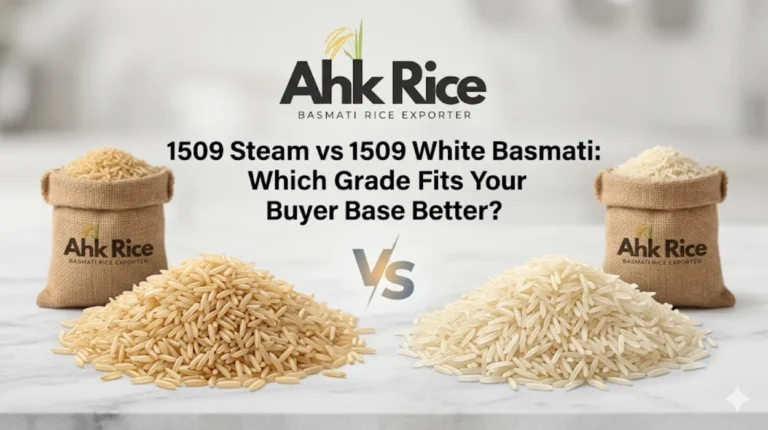
What is 1509 Steam rice?
1509 Steam is processed with controlled steaming before drying and milling. The process produces a firm grain structure and supports consistent cooking performance.
Steam processing also produces a white appearance after the grain completes the required processing stages. This makes Steam suitable for dishes where long, white grains are important.
What is 1509 Golden Sella rice?
1509 Golden Sella is parboiled before drying and milling. Parboiling changes the physical structure of the grain and increases resistance during cooking.
Golden Sella is commonly associated with applications requiring grain resilience. Examples include biryani preparation, catering, foodservice, and large-volume cooking.
With processing established, the next section explains the specific benefits that make 1509 suitable for bulk kitchens.
What are the benefits of 1509 Basmati rice for bulk cooking?
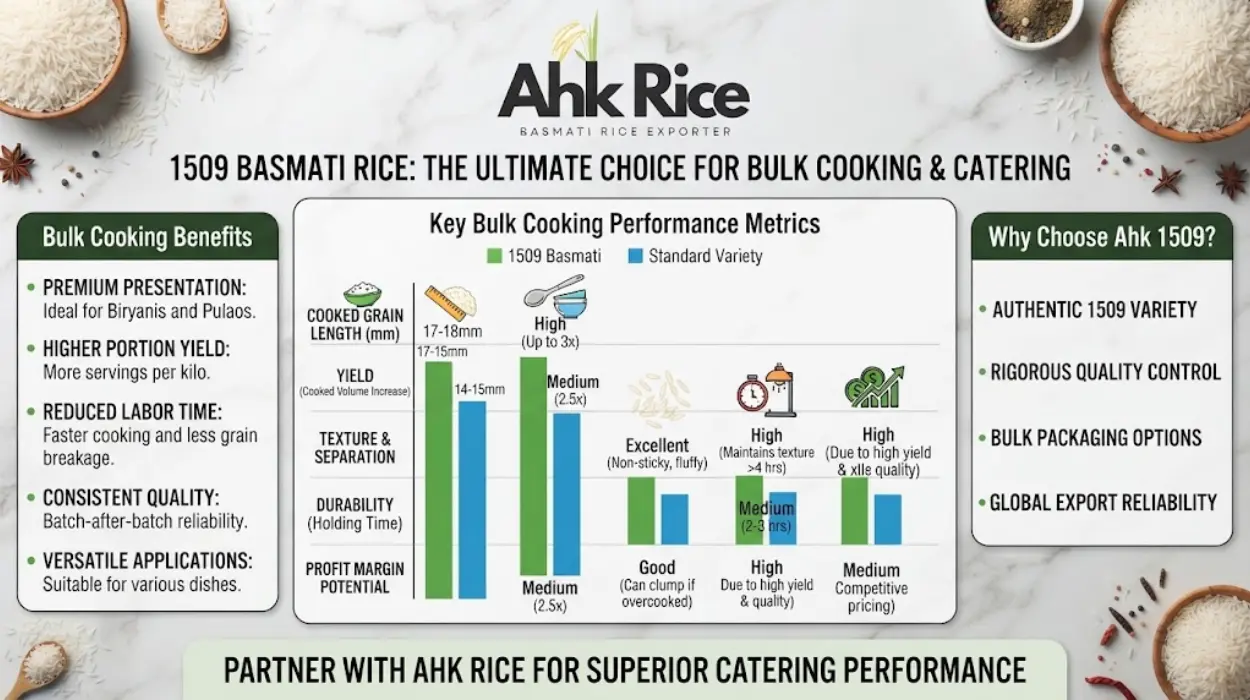
1509 Basmati provides long grain appearance, up to 2.5× cooking elongation, commercial yield efficiency, and multiple processing options for large-volume food preparation. These characteristics support consistent portions and presentation.
Long cooked grain appearance
1509 starts with an average raw grain length of approximately 8.10–8.40 mm. Cooking expands the grain substantially.
Long cooked grains improve the visual presentation of biryani, pulao, steamed rice, and similar dishes. Large catering operations can therefore serve recognizable long-grain portions.
High cooking expansion
1509 can achieve up to 2.5× elongation during cooking. Expansion increases the volume generated from a given quantity of dry rice.
For bulk kitchens, cooking expansion affects portion planning. A kitchen preparing 50 kg of dry rice can calculate expected cooked volume from the approved cooking method and recipe.
Commercial yield efficiency
1509 has a shorter maturity cycle than traditional Basmati varieties. Its 95–105 day maturity period supports efficient cultivation.
This characteristic contributes to its commercial positioning. Bulk buyers often evaluate both cooking performance and procurement economics.
Multiple processing options
1509 is available in processing formats such as White, Steam, and Golden Sella. Each format produces different cooking and appearance characteristics.
White suits applications requiring a naturally white finished grain. Steam provides firm cooking characteristics. Golden Sella provides strong grain resilience for high-volume cooking.
Suitable portion consistency
Grain length and controlled cooking expansion support predictable portion planning. Consistency depends on the approved specification, cooking ratio, soaking process, and kitchen equipment.
Bulk kitchens should therefore test the exact commercial grade before establishing a production recipe.
With the core benefits established, the next section connects each processing form to its practical foodservice application.
Where is 1509 Basmati rice used for bulk cooking?
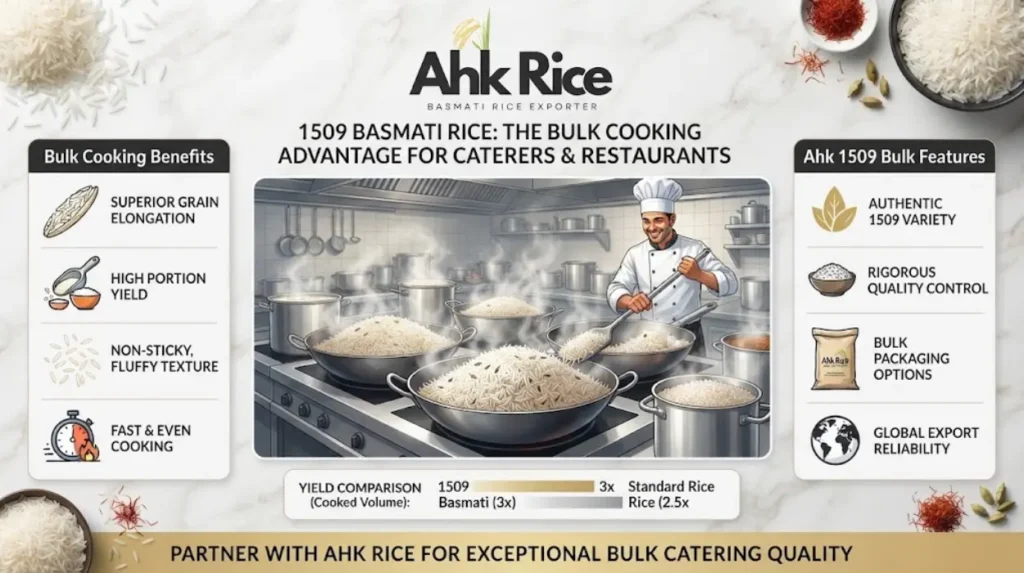
1509 Basmati serves restaurants, catering companies, hotels, institutional kitchens, foodservice operators, and commercial meal producers requiring long-grain rice in large quantities. Its processing grades determine the most suitable cooking application.
Restaurant cooking
Restaurants use long-grain Basmati for dishes such as biryani, pulao, fried rice, and steamed rice. 1509 supports large portions while maintaining a recognizable long-grain appearance.
Steam processing suits kitchens requiring firm white grains. Golden Sella suits recipes requiring greater grain resilience during cooking and holding.
Catering operations
Catering kitchens prepare hundreds or thousands of portions within controlled production schedules. 1509 supports these operations through long grain length and cooking expansion.
Golden Sella provides a resilient grain structure for large-batch cooking. Steam provides a white cooked appearance for freshly prepared service.
Hotel and institutional kitchens
Hotels, hospitals, universities, and institutional foodservice operations require repeatable rice preparation. Consistent specifications simplify recipe development and purchasing.
A defined grain length, moisture level, broken percentage, and processing grade help kitchens maintain consistent production results.
Commercial meal production
Prepared-food manufacturers use rice as an ingredient in ready meals, frozen meals, and large-scale food production. Processing specifications must match the manufacturing process.
The buyer should approve the exact sample before setting production parameters. The approved sample becomes the reference for grain appearance, cooking performance, and quality.
These use cases show why specification control matters as much as variety selection in bulk cooking.
What specifications should bulk buyers check for 1509 Basmati?
Bulk buyers should verify grain length, broken percentage, moisture, processing grade, purity, packaging, and cooking performance before approving 1509 Basmati for commercial production. These specifications determine actual kitchen performance.
| Specification | What the buyer should verify |
|---|---|
| Grain length | 8.10–8.40 mm raw grain |
| Processing | White, Steam, or Golden Sella |
| Cooking expansion | Up to 2.5× |
| Maturity | 95–105 days |
| Broken percentage | Approved contract specification |
| Moisture | Approved shipment specification |
| Purity | Foreign matter and varietal purity |
| Packaging | Required commercial bag format |
Grain length establishes the physical identity of the product. Processing determines cooking characteristics. Moisture affects storage stability and should match the agreed commercial specification.
Broken percentage also affects cooked appearance and yield. A bulk buyer should approve a defined maximum rather than rely on general descriptions such as premium or high quality.
Quality inspection should verify the agreed parameters before loading. Export documentation should reflect the approved product and shipment specification.
What are common problems with 1509 Basmati rice for bulk cooking?
Common problems include inconsistent cooking ratios, excessive broken grains, unsuitable processing grades, incorrect soaking, and specification differences between samples and shipments. Each problem requires specification and process control.
Confusing grain length with cooking quality
Long raw grain does not automatically guarantee the same cooked result. Processing, moisture, soaking, water ratio, heat, and cooking time also influence performance.
A kitchen should test the approved commercial sample using its actual cooking method.
Treating all 1509 grades as identical
White, Steam, and Golden Sella have different processing characteristics. Their cooking behaviour therefore differs.
A buyer should select the grade according to the required appearance, firmness, holding time, and cooking process.
Ignoring broken percentage
Broken grains cook differently from whole grains. A high broken percentage can change the appearance and consistency of a bulk batch.
The purchase specification should define an acceptable broken percentage before shipment.
Changing cooking methods without testing
Changing water ratios or cooking equipment changes the final result. Commercial kitchens should standardize soaking, water quantity, heat, and cooking time.
The approved rice sample should remain the reference for production testing.
With these problems controlled, the final purchasing decision depends on matching the 1509 grade with the intended bulk-cooking application.
Which 1509 Basmati grade suits bulk cooking?
1509 Steam suits fresh restaurant and catering service, while 1509 Golden Sella suits bulk cooking and longer holding requirements. White 1509 suits applications prioritizing a white finished grain and conventional cooking characteristics.
Grade selection should start with the final dish rather than the product name. Biryani, pulao, steamed rice, and institutional meals have different texture and holding requirements.
A caterer serving rice immediately after cooking can prioritize the required appearance and firmness. A catering operation holding cooked rice for longer service periods should evaluate grain resilience during actual production testing.
Bulk buyers should compare grades using the same recipe, cooking equipment, soaking procedure, and holding period. This produces a practical comparison based on the intended use.
For importers evaluating procurement cost alongside processing characteristics, the next consideration is how different 1509 grades compare commercially.
Frequently Asked Questions About 1509 Basmati Rice
Is 1509 Basmati rice good for bulk cooking?
Yes. 1509 Basmati is suitable for bulk cooking because it provides long grains, strong cooking expansion, and commercial yield efficiency. Restaurants, caterers, hotels, and institutional kitchens can use it for high-volume rice preparation.
What is the grain length of 1509 Basmati rice?
1509 Basmati measures approximately 8.10–8.40 mm before cooking. Its cooked grain can reach up to 2.5 times its original length under suitable cooking conditions.
How long does 1509 Basmati take to mature?
1509 Basmati matures in approximately 95–105 days. This is shorter than traditional Basmati varieties, which commonly require approximately 135–145 days.
What is the difference between 1509 Steam and 1509 Golden Sella?
1509 Steam uses controlled steaming, while Golden Sella uses parboiling and drying before milling. Steam produces firm white grains, while Golden Sella provides greater resilience during cooking and holding.
Is 1509 suitable for biryani?
Yes. 1509 suits biryani because its long grain expands substantially during cooking. Steam and Golden Sella grades provide different texture and holding characteristics for commercial biryani preparation.
What should importers check before buying 1509 Basmati?
Importers should verify grain length, processing grade, broken percentage, moisture, purity, packaging, cooking performance, and shipment documentation. A representative sample should be approved before bulk production and loading.