Which 1509 Basmati Grade Is Cheapest for Importers?
1509 White or Raw White is generally the cheapest 1509 Basmati grade for importers, while Steam and Golden Sella cost more because processing adds treatment, drying, and handling requirements. Here is why: 1509 White uses conventional milling, while Steam receives controlled steaming and Golden Sella receives parboiling before milling. The cheapest grade therefore depends on the buyer’s required cooking performance, storage period, and destination market.
Importers comparing 1509 should first understand the variety and its commercial position. The guide to 1509 Basmati rice and its export specifications explains its 8.10–8.40 mm grain profile, short maturity cycle, processing stages, and value-focused export positioning. AHK Rice supplies 1509 Basmati from Punjab through milling, grading, sorting, custom packaging, and export coordination.
What are the available 1509 Basmati grade solutions?
The main solutions are Raw White, Steam, Golden Sella, and other Sella formats, with Raw White normally carrying the lowest processing cost and Golden Sella carrying higher treatment costs. Here is why: each grade follows a different processing route that changes texture, appearance, storage performance, and commercial value.
1509 Raw White
1509 Raw White is conventionally milled rice. The process removes the husk, polishes the kernel, grades the grain, and sorts defects without parboiling.
Raw White normally provides the lowest processing burden. This makes it suitable for importers focused primarily on procurement cost. It also suits traditional retail and markets where buyers prefer soft cooked rice.
The trade-off is storage performance. Raw White does not receive the structural treatment associated with parboiled grades. AHK Rice’s published 1509 guide places Raw 1509 at consumption within roughly 12 months under appropriate storage conditions.
1509 Steam
1509 Steam receives controlled steam treatment before drying and final milling. The process strengthens the grain and improves cooking stability.
Steam generally costs more than Raw White. The additional treatment requires steaming, drying, moisture control, and processing time.
Steam suits retail and foodservice buyers seeking a balance between price and cooking performance. AHK Rice identifies Steam as a commercial grade that balances softness and shelf stability.
1509 Golden Sella
1509 Golden Sella is parboiled before drying and milling. Parboiling changes the internal grain structure and produces the characteristic golden appearance.
Golden Sella generally costs more than Raw White because its processing route requires additional heat, water, drying, and handling.
The additional processing creates stronger storage and cooking characteristics. AHK Rice states that Golden Sella can provide storage performance of up to 18 months in hot climates under suitable conditions.
1509 Sella and Creamy Sella
Sella refers to parboiled rice, while Golden Sella identifies a parboiled form with a golden appearance. Creamy Sella provides a lighter appearance while retaining parboiled characteristics.
These grades occupy a middle-to-premium position depending on specification. Grain length, broken percentage, moisture, ageing, packaging, and destination all affect the final quotation.
With the available grades defined, the next comparison shows how their specifications affect importer cost.
How do 1509 Basmati grades compare on specifications and price?
Raw White normally has the lowest processing cost, Steam adds cooking stability, and Golden Sella adds stronger storage performance; final prices vary by specification, quantity, packaging, and destination. Here is why: importers pay for the complete specification rather than the variety name alone.
| Attribute | 1509 Raw White | 1509 Steam | 1509 Golden Sella | 1509 Creamy Sella |
|---|---|---|---|---|
| Processing | Conventional milling | Steam treatment | Parboiling | Parboiling |
| Appearance | White/cream | White | Golden | Creamy/light |
| Grain profile | Long grain | Long grain | Long grain | Long grain |
| Cooking texture | Soft | Firm to tender | Firm | Firm |
| Processing cost | Lowest | Medium | Higher | Higher |
| Storage position | Shorter | Medium | Longer | Longer |
| Main use | Price-sensitive retail | Retail and foodservice | Catering and wholesale | Retail and foodservice |
Current commercial references show why price cannot be judged from the grade name alone. One September 2026 market reference places 1509 Basmati around US$900–US$1,150 per MT, with FOB, CFR, and CIF available depending on the transaction. The same reference lists Raw White, Steam, Golden Sella, and Creamy Sella among available grades. (source: CBIL, September 2026)
Shipment records also show meaningful variation. A Pakistan-to-UAE shipment of 1509 Steam recorded approximately US$860 per MT, while a 1509 Sella shipment to the UAE recorded approximately US$1,120 per MT. These are historical shipment values, not current quotations. (source: Volza trade records, 2025)
A Pakistan-to-Qatar 1509 Steam shipment recorded approximately US$900 per MT. A Pakistan-to-Saudi 1509 Sella shipment recorded approximately US$1,048 per MT. Packaging, quantity, destination, contract terms, and shipment date affect these values. (source: Volza trade records, 2024–2025)
The price table therefore identifies a commercial pattern rather than a fixed tariff. Raw White normally provides the lowest processing cost, while parboiled grades add processing value. The next section applies these differences to importing regions.
Which 1509 grade works best for different market regions?
GCC importers commonly prioritize Steam and Golden Sella for cooking stability and storage, while European buyers can use Raw White or Steam for retail programs requiring controlled procurement costs. Here is why: regional demand changes the value of processing, shelf life, appearance, and inventory turnover.
GCC market
GCC markets include the UAE, Saudi Arabia, Qatar, Oman, Kuwait, and Bahrain. These markets use Basmati extensively across retail, restaurants, catering, and foodservice.
1509 Steam suits retail and catering buyers seeking long-grain appearance with controlled cooking performance. Golden Sella suits distributors holding larger inventories in demanding storage environments.
Historical trade records show Pakistan-origin 1509 Steam shipments to Qatar and the UAE. Pakistan-origin Sella and Golden Sella shipments also appear in Saudi Arabia and the UAE. (source: Volza trade records, 2024–2025)
A GCC importer focused purely on acquisition price can evaluate Raw White. A catering distributor requiring stronger grain stability can evaluate Steam or Golden Sella. The cheapest purchase therefore does not automatically create the lowest operating cost.
UK and European market
European importers typically place greater emphasis on specification consistency, packaging, traceability, and documented food safety controls.
Steam can support retail programs requiring a stronger cooked grain. Raw White can serve price-sensitive retail lines where conventional white rice matches consumer expectations.
Historical UK shipment records show Pakistan-origin 1509 Steam and Golden Sella transactions. A 250 MT 1509 Steam shipment recorded approximately US$949 per MT, while a 250 MT Golden Sella shipment recorded approximately US$939 per MT. These values demonstrate that processing grade alone does not determine transaction price. (source: Volza trade records, 2024)
The following comparison summarizes the regional procurement logic.
| Market region | Common grade preference | Indicative price position | Typical shelf-life position | Commercial priority |
|---|---|---|---|---|
| GCC | Steam, Golden Sella | Medium to higher | Steam medium; Sella longer | Cooking and storage |
| UK/EU | Raw White, Steam, Golden Sella | Low to higher | Raw shorter; processed longer | Specification and retail consistency |
These regional differences show why importers should define the end market before selecting the cheapest grade. The next section compares procurement approaches more directly.
Which procurement method works best for different importer cases?
Raw White suits cost-first procurement, Steam suits balanced procurement, and Golden Sella suits storage-focused procurement; the correct choice depends on the importer’s sales channel and inventory cycle. Here is why: each method exchanges processing cost for a specific commercial benefit.
Cost-first procurement
Cost-first procurement selects Raw White with a controlled grain specification. This approach suits importers selling through price-sensitive channels.
The buyer should specify grain length, broken percentage, moisture, purity, packaging, and quantity. A low headline price without defined specifications creates weak comparisons between suppliers.
Balanced procurement
Balanced procurement selects Steam. The importer accepts additional processing cost in exchange for stronger grain stability and cooking performance.
This approach fits foodservice distributors and retailers that need a middle position between raw rice and parboiled products.
Storage-first procurement
Storage-first procurement selects Golden Sella or another suitable Sella specification. The importer accepts additional processing costs to obtain stronger grain structure and longer storage performance.
This approach suits wholesalers, caterers, and distributors carrying larger inventory volumes.
With the procurement approaches separated, the next framework makes the selection easier to apply.
What are the pros and cons of each 1509 grade?
Raw White minimizes processing cost, Steam balances cost and performance, and Golden Sella improves storage and cooking resilience; each advantage carries a corresponding commercial trade-off. Here is why: the processing route directly affects both purchase economics and downstream use.
Raw White
Raw White offers the lowest processing burden and a familiar white appearance. It suits price-sensitive retail and traditional consumption.
The limitation is shorter storage performance compared with parboiled grades. Buyers carrying inventory for extended periods need tighter warehouse management and stock rotation.
Steam
Steam improves grain firmness and cooking consistency without moving fully into the parboiled Sella category.
The limitation is additional processing cost. The importer pays more than Raw White for the treatment and associated drying requirements.
Golden Sella
Golden Sella provides stronger grain structure and extended storage performance. It works well for catering, wholesale, and high-volume foodservice.
The limitation is higher processing complexity and a different golden appearance. Retailers targeting white-rice presentation may prefer another grade.
Creamy Sella
Creamy Sella combines parboiled characteristics with a lighter appearance. It can serve markets where buyers want Sella performance without the stronger golden colour.
The limitation is that the final price depends heavily on the exact specification and market demand. The buyer should compare a representative sample rather than grade names alone.
These trade-offs lead directly to the five commercial factors that should control the final procurement decision.
What factors should importers use to choose the cheapest 1509 grade?
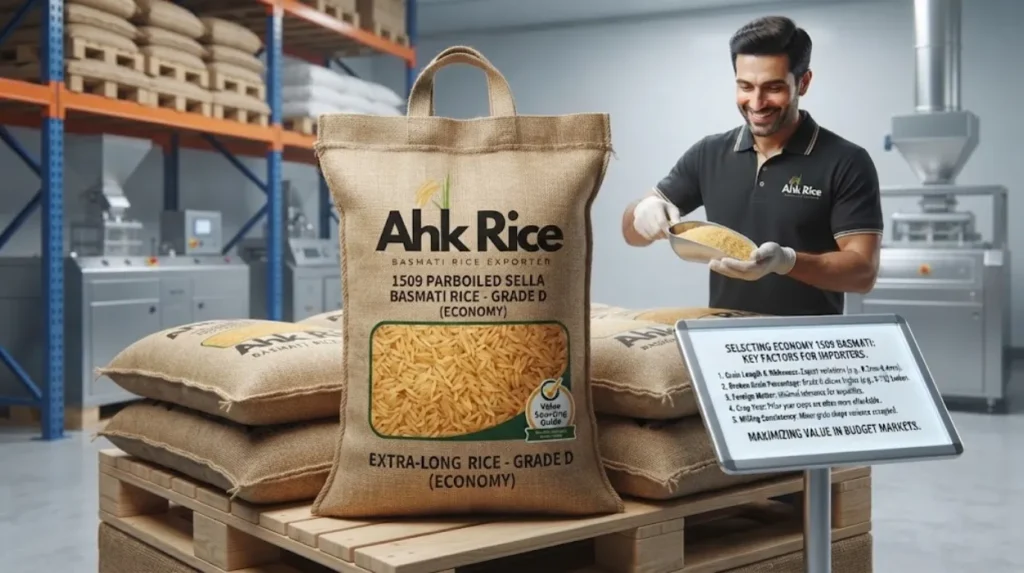
Importers should compare total procurement cost, required processing, shelf life, cooking performance, and destination requirements before selecting the lowest-priced 1509 grade. Here is why: the cheapest invoice price can become more expensive when storage, wastage, or quality requirements are ignored.
| Decision factor | Cost-first choice | Performance-focused choice |
|---|---|---|
| Purchase price | Raw White | Steam |
| Storage period | Raw White with faster rotation | Golden Sella |
| Catering use | Steam | Golden Sella |
| Retail appearance | Raw White | Steam |
| Inventory risk | Steam | Golden Sella |
Purchase price: Compare the same grain length, broken percentage, moisture, packing, quantity, and Incoterm.
Processing requirement: Raw White requires less processing treatment than Steam or Sella.
Storage period: Golden Sella provides stronger storage performance than Raw White under suitable conditions.
Cooking requirement: Steam and Sella provide stronger grain structure for commercial cooking.
Destination requirement: Match the grade to the destination market, packaging rules, customer expectations, and import specification.
The decision framework shows why “cheapest” must mean the lowest suitable commercial cost rather than the lowest number on a quotation. The final step is converting the selected specification into an accurate shipment price.
How should importers compare a 1509 Basmati quotation?
Importers should request the same specification on an FOB or CIF basis before comparing quotations, including grade, grain length, broken percentage, moisture, packaging, quantity, and destination port. Here is why: different specifications can make two apparently similar prices commercially incomparable.
FOB pricing covers the rice and agreed origin-side export costs up to the specified loading point. CIF pricing adds ocean freight and insurance to the destination port.
A 1509 White quotation at one specification cannot be compared fairly with 1509 Steam at another specification. The importer should standardize the product requirements first.
The quotation should state the variety, processing grade, grain length, broken percentage, moisture, packaging format, quantity, crop requirements, destination, Incoterm, and payment terms.
AHK Rice supports this specification-based approach through sourcing, milling, grading, sorting, packaging, inspection, and export coordination. Its export service also supports FOB and CIF pricing structures for international buyers.
For a buyer moving from grade evaluation to shipment planning, the next step is to request pricing against the approved specification.
Frequently Asked Questions
Which 1509 Basmati grade is cheapest?
1509 Raw White is generally the cheapest processing option because it does not require steaming or parboiling. The final quotation still depends on grain length, broken percentage, moisture, packaging, quantity, destination, and Incoterm.
Is 1509 White cheaper than 1509 Steam?
Yes, 1509 White normally has a lower processing cost than Steam. Steam requires controlled steaming and drying, which adds processing requirements. AHK Rice also positions White as a lower-cost option compared with Steam.
Is Golden Sella more expensive than Raw White?
Golden Sella normally carries additional processing cost because it requires parboiling, drying, and further handling. Its stronger storage and cooking characteristics can justify the added cost for suitable commercial applications.
Which 1509 grade is best for GCC importers?
Steam and Golden Sella are common choices for GCC buyers requiring cooking stability and storage performance. Raw White remains relevant for price-sensitive retail programs with faster stock rotation.
Which 1509 grade has the longest shelf life?
Golden Sella generally provides the strongest storage position among the main 1509 processing grades. AHK Rice identifies Golden Sella as capable of up to 18 months in hot climates under suitable storage conditions.
Does the cheapest 1509 grade always provide the lowest total cost?
No. The lowest invoice price can create higher total cost through shorter storage life, greater stock rotation requirements, or unsuitable cooking performance. Importers should compare purchase price with the complete operating requirement.
What specifications should an importer request?
Importers should specify grade, grain length, broken percentage, moisture, purity, packaging, quantity, crop requirement, destination port, and Incoterm. These details create a consistent basis for comparing suppliers and quotations.
Should importers choose FOB or CIF?
FOB suits buyers controlling international freight, while CIF suits buyers seeking a delivered port price from the exporter. The correct basis depends on freight arrangements, destination, insurance requirements, and procurement structure.