How Saudi Importers Structure Bulk Rice Procurement Deals with Pakistani Exporters
Saudi importers should structure bulk rice deals around an approved specification, representative sample, documented quality checks, agreed Incoterms, and shipment schedule. Here is why: Pakistan supplied about 169,000 tonnes of rice to Saudi Arabia in 2025, valued at approximately US$163 million, showing the scale of this bilateral supply relationship. (Source: Saudi Ministry of Environment, Water and Agriculture, 2026)
A practical procurement deal starts before price negotiation. The buyer defines variety, processing grade, grain length, broken percentage, moisture, packing, quantity, destination, and delivery term. The exporter then matches the specification with available production and logistics.
Saudi buyers can also review this Pakistan-Saudi Arabia rice trade value and export volumes in 2026 before evaluating suppliers. This market context helps procurement teams understand the scale behind current sourcing decisions.
What is the best solution for structuring a bulk rice procurement deal?
The best solution is a specification-led purchase agreement covering rice grade, quality limits, packaging, quantity, inspection, payment, Incoterm, and shipment timing. Here is why: these terms create one measurable standard for quotation, sampling, production, inspection, and delivery.
Bulk procurement becomes difficult when buyers compare prices without comparing specifications. A lower price can represent different grain length, broken percentage, moisture, packaging, or processing.
AHK Rice structures commercial supply around defined product specifications. Its Pakistani Basmati range includes 1121, Super Kernel, and 1509 Basmati rice varieties for international buyers.
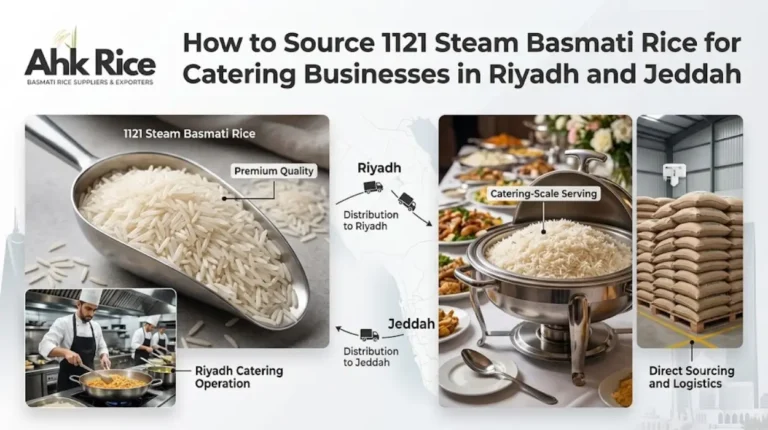
Saudi demand also includes different processing formats. Shipment records show Pakistani-origin 1121 Creamy Sella and 1121 Steam moving into Saudi Arabia, alongside long-grain Basmati shipments. (Source: Volza shipment data)
What should the procurement specification contain?
A complete specification should define seven core commercial variables:
| Procurement variable | Buyer requirement |
|---|---|
| Variety | 1121, Super Kernel, 1509, or agreed grade |
| Grain length | Contracted raw-grain measurement |
| Broken grains | Maximum agreed percentage |
| Moisture | Maximum agreed percentage |
| Processing | White, Steam, Sella, or other agreed grade |
| Packing | Retail or bulk format with agreed weight |
| Delivery | FOB, CIF, or another agreed Incoterm |
The specification should also identify origin, inspection method, tolerance, labeling requirements, and documentation.
Saudi importers must ensure food products satisfy Saudi regulations. The Saudi Food and Drug Authority states that importers must register their establishment and imported food products. Imported food must also meet applicable Saudi technical regulations and standards. (Source: SFDA)
With the procurement specification established, the next decision is selecting an exporter capable of executing it consistently.
Why choose AHK Rice for Pakistani bulk rice procurement?
AHK Rice combines sourcing, milling, grading, sorting, packaging, quality control, and export coordination into one procurement workflow. Here is why: buyers can manage the specification through one supplier instead of coordinating separate processing and export functions.
AHK Rice sources Pakistani rice and manages the processing sequence required for export supply. The workflow can include dehusking, milling, polishing, grading, sorting, packing, inspection, and shipment preparation.
AHK Rice also supports specification-based procurement for Saudi buyers seeking defined grain and processing characteristics. The commercial focus remains on matching the agreed specification rather than selling a generic commodity.
For variety selection, buyers can compare the Pakistani Basmati varieties dominating Saudi import demand in 2026 before requesting a specific commercial grade.
AHK Rice can then prepare the quotation around the selected variety, packing, quantity, destination, and delivery term. This creates a clearer connection between the product specification and the final landed cost.
Saudi shipment data demonstrates the importance of precise packing instructions. Recent Pakistani shipments to Saudi Arabia include 25 kg PP bags and mixed retail configurations such as 5 kg, 10 kg, and 40 kg packaging. (Source: Eximpedia shipment data)
With supplier capability established, the next stage is verifying the commercial and quality result before shipment.
What results can Saudi importers expect from a structured procurement process?
A structured procurement process delivers specification control, predictable documentation, clearer landed-cost calculation, and fewer quality disputes. Here is why: each stage connects the buyer’s purchase requirement with a measurable production and shipment requirement.
The first result is specification consistency. The buyer approves the exact rice grade before commercial production proceeds.
The second result is sample-based approval. A representative sample gives the buyer a physical reference for appearance, grain, aroma, cooking performance, and packing.
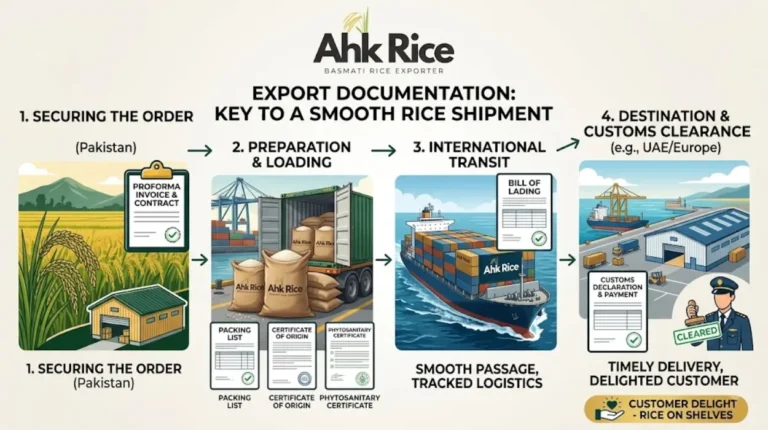
The third result is document alignment. Saudi food imports require regulatory and commercial documentation, including an authenticated original invoice and certificate of origin requirements. (Source: SFDA)
The fourth result is shipment planning. Pakistan-to-Saudi rice shipments commonly move through commercial maritime routes to Saudi ports. A current Pakistani exporter market listing indicates approximately 14–30 days sailing time to Jeddah or Dammam, although actual transit varies by vessel, port, carrier, and routing. (Source: Pakistan Rice, September 2026)
A buyer planning inventory for Jeddah should therefore separate production time from port-to-port transit. The same principle applies to Dammam and other delivery points.
AHK Rice can coordinate the export process around the agreed specification, shipment quantity, packaging, and destination.
The result is not simply a rice shipment. The result is a documented procurement transaction that can be repeated for future purchasing cycles.
How does pricing work for Saudi bulk rice purchases?
Bulk rice pricing depends on variety, processing grade, grain specification, broken percentage, moisture, packing, quantity, destination, freight, and Incoterm. Here is why: changing one commercial variable can change the supplier’s production or logistics cost.
FOB pricing separates the rice and export preparation from the international freight paid beyond the agreed loading point. CIF pricing incorporates freight and insurance to the named destination port.
Saudi buyers should therefore compare quotations using identical specifications. Comparing an FOB 1121 Sella quotation with a CIF 1121 Steam quotation does not create a like-for-like price comparison.
Recent shipment data illustrates why specification matters. One February 2025 Saudi shipment recorded 250,000 kg of Pakistani-origin 1121 Creamy Sella, while another recorded 60,000 kg of 1121 Steam. (Source: Volza shipment data)
Freight also changes the final landed cost. A current market listing gives an indicative freight figure of US$178/MT for its stated Saudi lane, but buyers should obtain a shipment-specific freight calculation rather than treat that figure as universal. (Source: Pakistan Rice, September 2026)
AHK Rice can structure the quotation around the buyer’s actual specification and destination rather than using an unrelated market benchmark.
The pricing model becomes useful only after the buyer fixes the specification, quantity, delivery term, and destination.
How does the sample and approval process work?
The sample process should move from specification confirmation to sample dispatch, buyer testing, written approval, production, inspection, and shipment. Here is why: the approved sample creates a physical quality reference before the bulk order is dispatched.
What steps should Saudi buyers follow?
- Define the specification — Confirm variety, grade, grain length, broken percentage, moisture, packing, quantity, and destination.
- Request the sample — Ask the exporter to prepare a representative sample matching the proposed commercial specification.
- Arrange courier delivery — The buyer covers courier charges and any applicable sample-related phytosanitary costs.
- Test the sample — Check appearance, aroma, grain characteristics, cooking performance, broken grains, and packaging suitability.
- Approve the sample — Confirm the accepted specification in writing before commercial production.
- Produce the order — The exporter mills, grades, sorts, packs, and prepares the contracted quantity.
- Inspect the shipment — Conduct agreed inspection or laboratory testing against the purchase specification.
- Release the shipment — Load and dispatch the approved cargo after documentation and commercial conditions are complete.
AHK Rice can support this sample-to-order workflow for buyers who need a physical product reference before committing to bulk procurement.
Sample costs depend on sample weight, courier destination, courier provider, packaging, and applicable certification or phytosanitary requirements. Buyers should therefore request the actual sample logistics cost for their Saudi delivery address.
The sample approval establishes the quality reference, leaving the buyer to finalize commercial terms and shipment execution.
How many shipping days should Saudi importers plan?

Saudi buyers should plan roughly 14–30 days for port-to-port sailing on the Pakistan-to-Jeddah or Dammam lane, plus production and export preparation time. Here is why: sailing time does not represent the full procurement cycle.
Jeddah planning should include rice production, packing, inspection, port handling, vessel scheduling, and maritime transit.
Dammam planning should use the same structure while allowing for different vessel schedules and port operations.
A buyer with a fixed retail promotion should therefore avoid treating the quoted sailing time as the complete lead time. The commercial order should be released early enough to cover production and dispatch before vessel departure.
AHK Rice can coordinate shipment preparation around the agreed destination and delivery term.
The correct shipping schedule comes from the complete procurement timeline, not the vessel transit figure alone.
How can a Saudi importer get started?
Saudi importers should begin with one written specification, one target quantity, one destination, and one delivery term. Here is why: these four inputs allow the exporter to prepare a comparable commercial quotation.
Start by identifying the rice variety and processing grade. Define the required grain length and quality limits.
Confirm the preferred packaging format. Saudi shipment records show both bulk PP bags and retail-oriented packaging configurations in actual Pakistan-to-Saudi trade. (Source: Eximpedia and Volza shipment data)
Confirm the destination port. State Jeddah or Dammam rather than requesting a general Saudi quotation.
Confirm the quantity. A full-container requirement produces a different commercial calculation from a smaller trial order.
Confirm the Incoterm. FOB and CIF quotations should remain separate because they allocate freight and other costs differently.
Request the sample before final production. Approve the physical reference in writing.
AHK Rice can then structure the commercial offer around the approved product and delivery requirements. The buyer receives a procurement framework that connects product quality, packing, pricing, documentation, inspection, and logistics.
For Saudi buyers, this approach also aligns purchasing decisions with the regulatory requirements of the Saudi food-import system. The SFDA requires registered importers and compliance with Saudi food regulations and standards. (Source: SFDA)
Pakistan’s established supply relationship provides a strong commercial base for continued sourcing. Saudi Arabia imported approximately US$163.38 million of rice from Pakistan in 2025, according to UN Comtrade data reported by Trading Economics.
The procurement decision should therefore focus on specification accuracy, supplier execution, landed cost, documentation, and delivery planning.
For a specification-based Saudi bulk rice procurement quotation, request an export quote from AHK Rice.
FAQs About Bulk Rice Procurement from Pakistan to Saudi Arabia
What rice varieties can Saudi importers buy from Pakistan?
Saudi buyers can source 1121, Super Kernel, and 1509 Basmati from Pakistan.
Each variety serves different commercial positioning and buyer requirements.
Processing grades can include White, Steam, and Sella formats.
The final choice should match the approved specification and market channel.
AHK Rice can structure the quotation around the selected variety and grade.
How long does rice take from Pakistan to Saudi Arabia?
Port-to-port sailing can take approximately 14–30 days on stated Jeddah and Dammam routes.
Production time must be added before vessel departure.
Inspection and export documentation can also affect dispatch timing.
Vessel schedules and port operations can change actual transit.
Buyers should therefore plan the complete procurement lead time.
What documents does Saudi Arabia require for food imports?
Saudi food importers must register with the SFDA and register imported food products.
Imported products must satisfy applicable Saudi technical regulations and standards.
The original invoice must meet Saudi authentication requirements.
A certificate of origin may also be required.
Additional certificates depend on the product and applicable Saudi requirements.
How should Saudi buyers compare rice quotations?
Compare identical varieties, grades, quality limits, packing, quantities, destinations, and Incoterms.
Separate FOB prices from CIF landed-cost calculations.
Confirm whether inspection costs are included in the offer.
Confirm freight and destination charges before accepting the price.
Use the approved sample as the physical quality reference.
What is the purpose of a rice sample?
A representative sample establishes the physical quality reference before bulk production.
Buyers can evaluate grain appearance, aroma, cooking performance, and broken percentage.
The buyer can approve the specification before commercial production.
The exporter then processes and packs the agreed bulk quantity.
Inspection can verify the shipment against the contracted specification.