Key Pakistani Basmati Rice Types Imported by Turkish Wholesalers in 2026
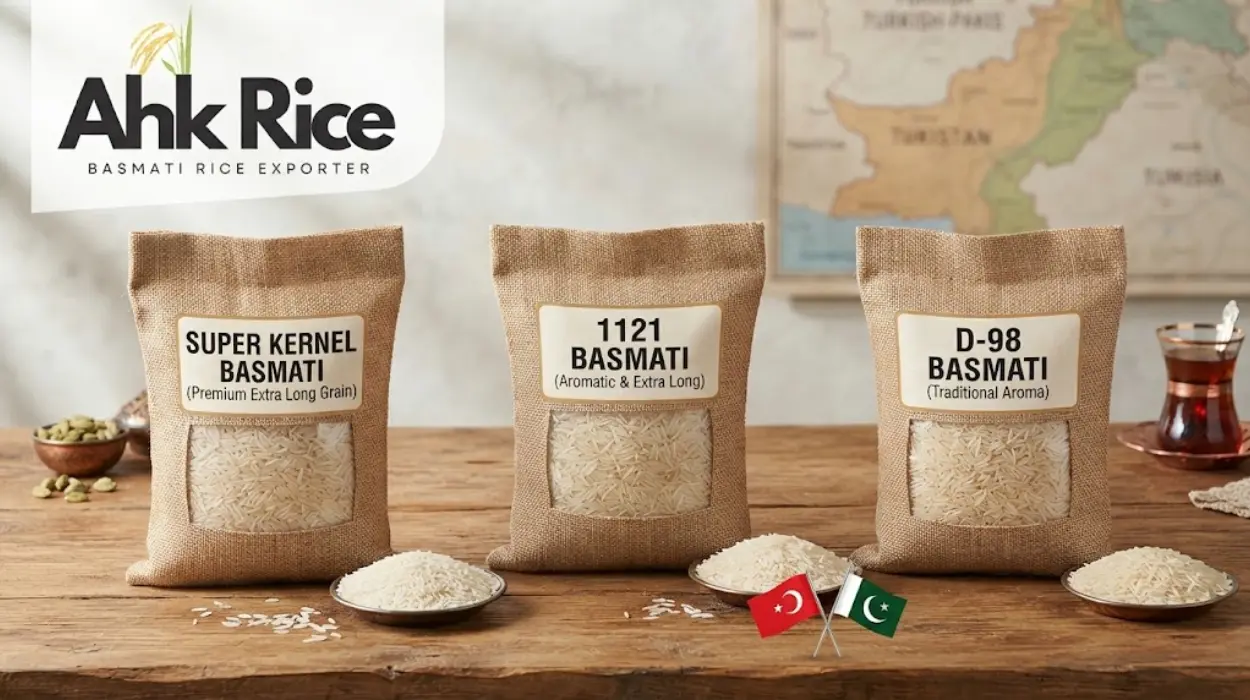
1121 Basmati, Super Kernel Basmati, and 1509 Basmati provide the main Pakistani options for Turkish wholesalers in 2026. Here is why: each variety offers a different balance of grain length, aroma, processing, cooking performance, shelf life, and procurement cost. Turkey’s rice market serves retail, restaurants, hotels, catering, and wholesale distribution. Turkey’s MY 2025/26 rice consumption is projected at 790,000 MT, while imports are forecast at 425,000 MT. (source: USDA market reporting, 2025/26)
Turkish wholesalers therefore need more than a variety name. They need a defined specification covering grain length, processing grade, broken percentage, moisture, packaging, quantity, and destination. A useful starting point is this guide to Pakistani Basmati rice and its varieties, processing, and export standards. The guide explains how cultivation and milling create different commercial products.
AHK Rice supplies 1121, Super Kernel, and 1509 from Punjab through end-to-end processing, custom packaging, and export coordination. Turkish buyers can therefore compare the varieties against one commercial specification instead of treating all Pakistani Basmati as identical.
What are the available Pakistani Basmati solutions for Turkish wholesalers?
1121 Steam, 1121 Golden Sella, 1121 White, Super Kernel, and 1509 provide distinct commercial solutions for Turkish buyers. 1121 targets premium presentation, Golden Sella supports bulk storage, Super Kernel emphasizes aroma, and 1509 provides value-focused long-grain supply.
1121 Basmati
1121 Basmati is an extra-long Pakistani Basmati variety. Its raw grain commonly measures around 8.30 mm. Its cooked length can exceed 22 mm under suitable preparation. The grain profile supports premium retail, restaurant, and foodservice applications.
1121 Steam receives controlled steam treatment before drying and milling. The process strengthens the grain while retaining a white appearance. Turkish retail buyers can use it for premium packs requiring long, separate grains.
1121 Golden Sella is parboiled before drying and milling. The process strengthens the kernel and improves breakage resistance. Turkish catering wholesalers can use it for large-batch cooking and longer storage cycles.
Super Kernel Basmati
Super Kernel Basmati is a traditional Pakistani aromatic variety. Its raw grain commonly measures around 7.00–7.40 mm. Its commercial identity depends more on aroma and traditional Basmati character than maximum grain length.
Super Kernel suits ethnic retailers, restaurants, and distributors serving consumers who value fragrance. White, Steam, and Sella processing can create different cooking and handling characteristics.
1509 Basmati
1509 Basmati is a long-grain Pakistani variety used across retail, catering, restaurants, and wholesale distribution. AHK Rice documents an average raw grain length of 8.20–8.40 mm and maximum moisture of 13% for its commercial specification.
1509 provides a practical value-oriented alternative to 1121. White, Steam, and Golden Sella forms allow wholesalers to match the same variety with different cooking and storage requirements.
The available varieties establish the product choices. The next comparison shows how their specifications affect commercial positioning.
How do Pakistani Basmati types compare for Turkish wholesalers?
1121 leads on grain presentation, Golden Sella leads on storage durability, Super Kernel leads on traditional aroma, and 1509 supports cost-focused volume supply. Turkish wholesalers should compare specifications rather than variety names because processing changes cooking, storage, appearance, and commercial value.
| Attribute | 1121 Steam | 1121 Golden Sella | Super Kernel | 1509 |
|---|---|---|---|---|
| Raw grain length | 8.30–8.50 mm | 8.20–8.40 mm | 7.00–7.40 mm | 8.20–8.40 mm |
| Processing | Steam treated | Parboiled | White/Steam/Sella | White/Steam/Golden Sella |
| Aroma | High | Medium-high | High | Medium |
| Cooking elongation | Very high | High | Medium-high | High |
| Shelf life | 12 months | 18–24 months | 12–18 months | 12 months |
| Breakage resistance | Medium | Very high | Medium | Medium-high |
| Main Turkish use | Premium retail | Catering and bulk | Ethnic retail | Institutional catering |
These figures represent commercial specifications published in AHK Rice market guides and should be confirmed against the final purchase specification.
Price also changes by specification. Current 2026 published FOB indications place 1121 Steam around US$1,160–1,200/MT, 1121 Sella around US$1,135–1,175/MT, and 1121 White around US$1,165–1,205/MT. (source: AHK Rice published 2026 export indications)
Shipment records provide another reference point. A March 2025 Pakistan-to-Turkey shipment listed 24,440 kg of long-grain Basmati Sella at US$21,990.81, equal to about US$900/MT based on the declared shipment value. Another February 2025 Basmati shipment listed 29,804 kg at US$17,881.75, or about US$600/MT. These records are transaction examples, not universal FOB benchmarks.
The comparison shows why Turkish buyers should compare equivalent specifications. The next question is how these products fit different Turkish market regions.
Which Pakistani Basmati type works best for different Turkish market regions?
Istanbul and Marmara favor visually premium 1121 grades, while Mediterranean and wider wholesale foodservice channels favor durable Sella, Steam, Super Kernel, and 1509 specifications. The correct selection depends on retail presentation, cooking volume, storage conditions, and resale positioning.
Istanbul and Marmara retail distribution
Istanbul and Marmara provide a strong framework for packaged retail distribution. Large urban networks require consistent appearance, packaging, cooking performance, and recognizable product positioning.
1121 White fits premium retail packs requiring a long white grain. 1121 Steam provides similar visual length with firmer cooking performance. Super Kernel provides differentiation through stronger traditional aroma.
A Turkish private-label retailer can therefore position 1121 as the visual premium product. A specialty retailer can use Super Kernel where aroma is more important than maximum grain length.
Mediterranean and wholesale foodservice
Mediterranean distribution and broader Turkish foodservice require a different specification. Restaurants, hotels, caterers, and institutional kitchens need consistent cooking performance and manageable storage requirements.
1121 Golden Sella fits bulk cooking because parboiling strengthens the grain. Its 18–24 month stated shelf-life range also supports longer inventory cycles under suitable storage conditions. 1121 Steam provides a white appearance for buyers that do not want golden colour.
Super Kernel fits wholesalers supplying traditional aromatic rice demand. 1509 fits institutional buyers seeking long-grain performance with stronger cost control.
The regional comparison connects grade choice with channel requirements. The next section evaluates the practical advantages and limitations.
What are the pros and cons of each Pakistani Basmati type?
1121 offers premium grain presentation, Super Kernel offers strong aroma, and 1509 offers commercial value. Their limitations also differ: 1121 requires premium positioning, Super Kernel provides less visual length, and 1509 has weaker premium differentiation than 1121.
1121 Basmati
Advantages
- Extra-long grain presentation
- Strong cooked elongation
- Premium retail positioning
- Multiple processing options
- Strong suitability for restaurants
Limitations
1121 requires a buyer capable of supporting premium positioning. A supermarket selling premium private-label Basmati can use its visual appearance to support a higher retail segment.
1121 Steam also has a shorter stated shelf-life range than Golden Sella. Buyers with long warehouse cycles therefore need stronger inventory planning.
Super Kernel Basmati
Advantages
- Strong traditional aroma
- Recognizable Basmati identity
- Flexible retail positioning
- Suitable for restaurants
- Competitive commercial positioning
Limitations
Super Kernel has less raw grain length than 1121. Its commercial differentiation therefore comes from aroma and traditional Basmati character rather than maximum visual elongation.
An ethnic grocery distributor can use this characteristic as a product identity. The buyer does not need to compete directly with 1121 on grain length.
1509 Basmati
Advantages
- Long-grain profile
- Commercial cooking performance
- Value-oriented procurement
- Foodservice suitability
- Multiple processing formats
Limitations
1509 creates less premium visual differentiation than 1121. Premium retailers seeking the longest grain can therefore prefer 1121.
A catering distributor can instead use 1509 to control purchasing costs while maintaining a long-grain Basmati specification.
These advantages define the commercial roles of each variety. The final decision should now focus on measurable procurement factors.
What decision factors should Turkish wholesalers use before buying?
Turkish wholesalers should evaluate variety, processing, grain specification, storage life, price, packaging, and landed cost before approving a Pakistani Basmati purchase. These factors create an equivalent comparison between suppliers and prevent buyers from comparing different rice specifications under one generic price.
Five-row decision framework
| Decision factor | What to check | Suitable focus |
|---|---|---|
| Grain profile | Raw length, cooked elongation, appearance | 1121 for premium presentation |
| Processing | White, Steam, Sella, Golden Sella | Match cooking method |
| Storage | Shelf life, moisture, warehouse conditions | Golden Sella for longer storage |
| Commercial cost | FOB/CIF, freight, packaging, quantity | 1509 or Super Kernel for value control |
| Sales channel | Retail, foodservice, catering, wholesale | Match grade to customer segment |
Grain specification
Approve the raw grain length and acceptable tolerance. A quotation for 8.30 mm 1121 should not be compared directly with a 7.20 mm Super Kernel quotation.
Processing specification
Define the processing method before comparing price. Steam, White, Sella, and Golden Sella produce different appearance and cooking behavior.
Storage specification
Use documented shelf-life requirements. Golden Sella provides a longer stated commercial storage range than Steam under suitable conditions.
Cost specification
Compare the complete landed cost. FOB alone does not represent the Turkish buyer’s final cost. Freight, insurance where applicable, destination charges, customs, warehousing, and inland transport can change the final economics.
Channel specification
Match the rice with the customer. Premium retail favors 1121. Aroma-focused ethnic distribution suits Super Kernel. Institutional catering can evaluate 1509. Bulk catering can evaluate Golden Sella.
This framework converts variety selection into a measurable procurement decision. The next step is connecting the approved specification with the supplier process.
How should Turkish wholesalers compare Pakistani rice suppliers?
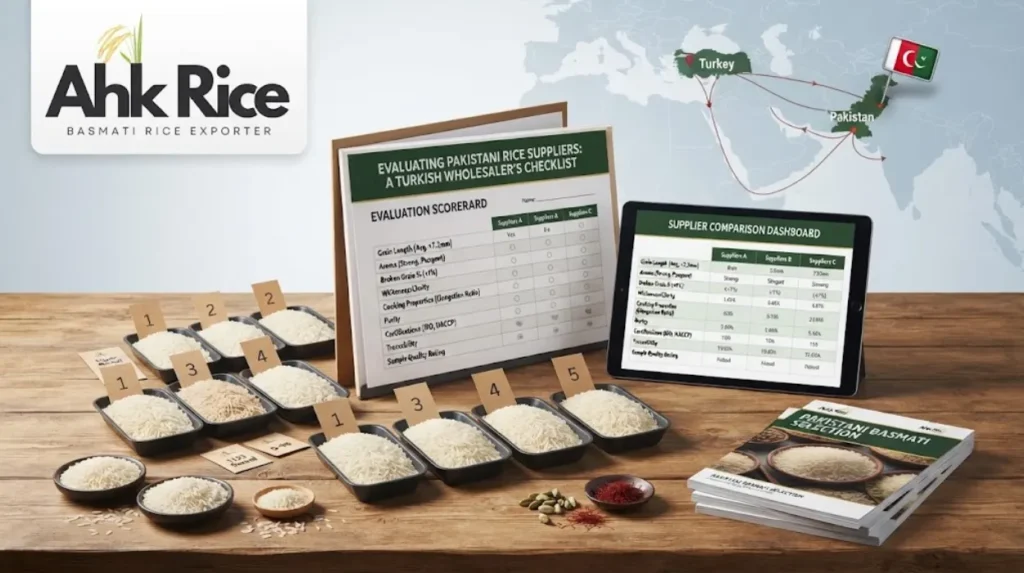
Turkish wholesalers should compare suppliers through specification control, representative samples, processing capability, packaging, inspection, documentation, and shipment terms. A lower quoted price does not establish equivalent rice quality when grain length, processing, broken percentage, or packaging differs.
A supplier should first confirm the requested variety and processing grade. The buyer should then approve grain length, moisture, broken percentage, packaging, quantity, destination, and Incoterm.
The representative sample should match the commercial specification. The buyer should evaluate appearance, aroma, elongation, separation, texture, and cooking consistency.
AHK Rice operates from Punjab and supplies 1121, Super Kernel, and 1509 Basmati rice to 15+ countries. Its model covers sourcing, milling, grading, sorting, packaging, and export coordination.
Turkey’s import environment also makes documentation important. Pakistan and Türkiye discussed increasing rice trade and improving price competitiveness in January 2026. Pakistan also raised the existing 18,000 MT tariff-rate quota under the Pakistan–Türkiye Preferential Trade Agreement as a market-access issue. (source: Government of Pakistan Press Information Department, January 2026)
Current trade records also show Pakistani rice moving into Turkey. Volza records include Pakistani 1121 Steam, Basmati Sella, white rice, and other Pakistani rice shipments to Turkey.
For Turkish buyers ready to move from grade comparison to supplier evaluation, the next step is the process for Turkish rice importers sourcing and partnering with Pakistani suppliers. The process covers specification approval, sampling, documentation, quotation, shipment planning, and supplier coordination.
A specification-led approach keeps the commercial decision measurable. The buyer can then compare samples, prices, storage requirements, and landed costs using the same criteria.
What is the most practical sourcing structure for Turkish wholesalers?
A specification-led sourcing structure gives Turkish wholesalers the clearest comparison between 1121, Super Kernel, and 1509. The buyer defines the requirement, approves a representative sample, confirms commercial terms, verifies documents, and uses the approved specification for shipment.
The first step is to define the customer channel. Premium retail requires a different specification from institutional catering.
The second step is to select the variety. 1121 supports premium grain presentation. Super Kernel supports aroma-focused positioning. 1509 supports value-led wholesale supply.
The third step is to select processing. White, Steam, Sella, and Golden Sella create different cooking and storage outcomes.
The fourth step is to define commercial specifications. Grain length, broken percentage, moisture, packaging, quantity, destination, and Incoterm should appear in the quotation.
The fifth step is to approve the sample. The approved sample should represent the product planned for commercial production.
The sixth step is to verify shipment requirements. Inspection, laboratory testing, export documents, packaging, loading, and dispatch should follow the agreed specification.
The seventh step is to compare landed cost. Turkish buyers should calculate the complete cost instead of comparing headline FOB values alone.
This structure allows Turkish wholesalers to treat rice as a specification-controlled commodity rather than an interchangeable product. That distinction matters most when multiple Basmati varieties compete within the same wholesale portfolio.
FAQs About Pakistani Basmati Rice for Turkish Wholesalers
Which Pakistani Basmati rice types do Turkish wholesalers import?
1121, Super Kernel, and 1509 are the main Pakistani varieties evaluated by Turkish wholesalers. 1121 serves premium retail and foodservice. Super Kernel supports aroma-focused distribution. 1509 supports value-led wholesale and institutional catering.
Which Pakistani Basmati grade has the longest shelf life?
1121 Golden Sella has the longest stated shelf-life range at 18–24 months under suitable storage conditions. 1121 Steam is listed at around 12 months. Super Kernel is listed at 12–18 months. 1509 is listed at around 12 months.
Which Pakistani rice suits Turkish premium retail?
1121 White and 1121 Steam suit premium Turkish retail because their long grains create strong visual presentation. 1121 White emphasizes natural white appearance. Steam provides firmer cooking performance while retaining a white presentation.
Which Pakistani rice suits Turkish catering?
1121 Golden Sella suits bulk catering because parboiling improves grain strength and storage performance. The grade supports large-batch cooking and longer inventory cycles.
Is Super Kernel suitable for Turkish wholesalers?
Super Kernel suits wholesalers serving aroma-focused retail and foodservice customers. Its raw grain is shorter than 1121, but its traditional Basmati aroma provides a distinct commercial position.
Is 1509 Basmati suitable for institutional buyers?
1509 suits institutional buyers seeking long-grain Basmati with cost-focused procurement. Its documented AHK specification uses an average raw grain length of 8.20–8.40 mm and maximum moisture of 13%.
What price per MT should Turkish buyers expect?
Price depends on variety, processing, grain length, broken percentage, packaging, quantity, destination, freight, and Incoterm. Published 2026 indications place 1121 Steam around US$1,160–1,200/MT FOB and 1121 Sella around US$1,135–1,175/MT FOB.
What should Turkish wholesalers request before ordering?
Buyers should request a specification sheet, representative sample, quotation, packaging details, inspection terms, export documents, and shipment schedule. These documents create an equivalent basis for supplier and price comparison.