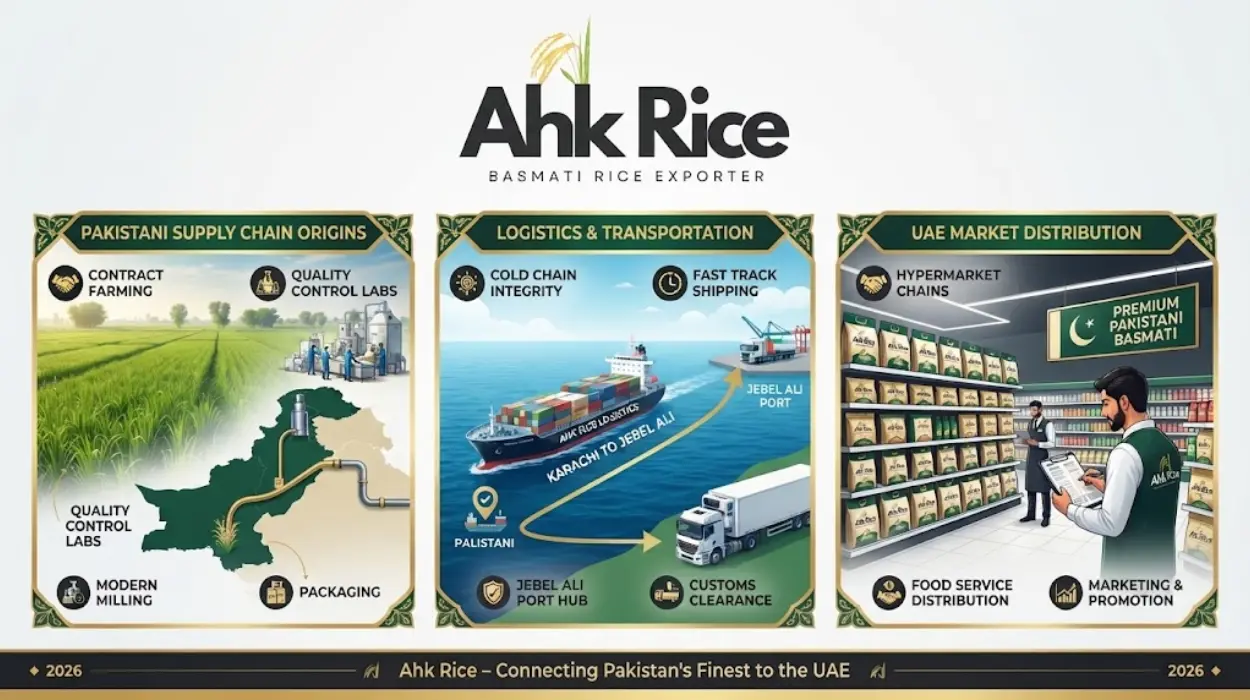
How UAE Rice Importers and Retailers Source from Pakistan in 2026
UAE rice importers and retailers source from Pakistan through specification-based procurement, supplier verification, sampling, documentation, food registration, shipment inspection, and port clearance. Here is why: Pakistan-to-UAE trade records show active sourcing across hundreds of buyers and suppliers, with Basmati rice among the established product categories.
What does sourcing rice from Pakistan mean for UAE buyers?
Sourcing rice from Pakistan means selecting a defined variety, approving specifications, checking samples, confirming documents, arranging shipment, and clearing the cargo through UAE food-control procedures before distribution. This process connects Pakistani cultivation and milling with UAE retail and foodservice requirements.
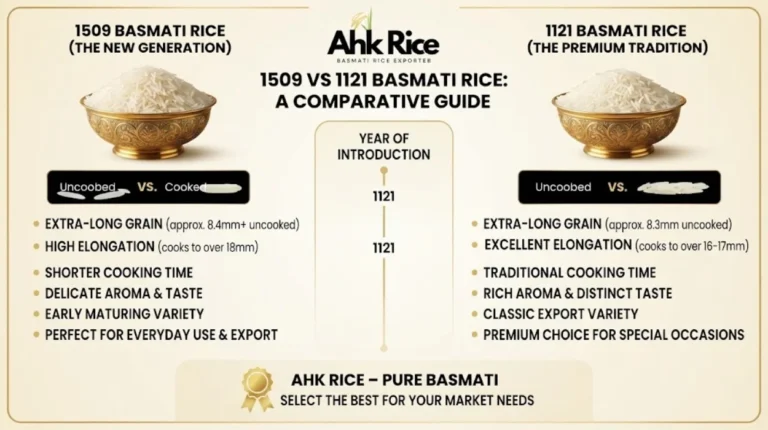
Pakistan produces Basmati rice mainly in Punjab. Pakistani exporters cultivate varieties such as 1121, Super Kernel, and 1509. Each variety has different grain characteristics, processing grades, cooking performance, and commercial positioning.
UAE buyers include importers, wholesalers, distributors, supermarkets, catering companies, restaurants, and foodservice operators. Each buyer purchases against a different specification. Retailers focus on consumer pack size, appearance, labeling, and consistency. Foodservice buyers focus on cooking performance, yield, grain integrity, and cost.
Current trade data confirms an active Pakistan-to-UAE sourcing network. Volza recorded 232 Basmati buyers and 1,635 Pakistan-sourced shipments in its database through October 2026. The dataset also identified 176 Pakistani suppliers connected with the trade lane.
The UAE market therefore operates through both direct importer sourcing and distribution networks. Dubai also functions as a major food-trade and re-export center within the region. Dubai Municipality states that the emirate receives food from more than 160 countries and re-exports significant volumes to regional markets.
With the sourcing relationship defined, the next step is understanding how UAE buyers specify and procure Pakistani rice.
How does the Pakistan-to-UAE rice sourcing process work?
UAE buyers source Pakistani rice through nine practical stages: define specifications, identify suppliers, request samples, verify documents, approve quality, confirm price, register products, arrange shipment, and clear cargo. Each stage connects product quality with commercial and regulatory requirements.
How do buyers define the rice specification?
Start with the rice variety. UAE buyers commonly specify Basmati varieties such as 1121, Super Kernel, and other long-grain products.
Define grain length, moisture, broken percentage, purity, processing grade, milling finish, packaging, quantity, and destination. A buyer purchasing 1121 Golden Sella for retail requires a different specification from a catering buyer purchasing bulk Steam rice.
How do buyers evaluate Pakistani suppliers?
Review the supplier’s processing capability, export history, product documentation, sample consistency, packaging capability, and shipment process.
AHK Rice supplies 1121, Super Kernel, and 1509 varieties from Punjab. Its export process covers sourcing, milling, grading, sorting, packaging, and shipment coordination.
How do buyers approve samples?
Request a representative sample before commercial shipment. Test the sample for grain appearance, aroma, cooking behavior, broken grains, moisture, impurities, and packaging presentation.
A retail buyer can compare cooked grain elongation and appearance. A catering buyer can test absorption, separation, holding performance, and yield.
How do buyers confirm the commercial order?
Confirm the product specification before accepting the commercial price. The purchase agreement should identify variety, grade, quantity, packaging, delivery term, destination port, inspection requirements, and required documents.
FOB Pakistan prices exclude the main ocean freight and destination costs. CIF UAE pricing includes the agreed freight and insurance components to the named destination.
With the procurement sequence established, the product itself becomes the next sourcing variable.
Which Pakistani rice varieties and grades do UAE buyers source?
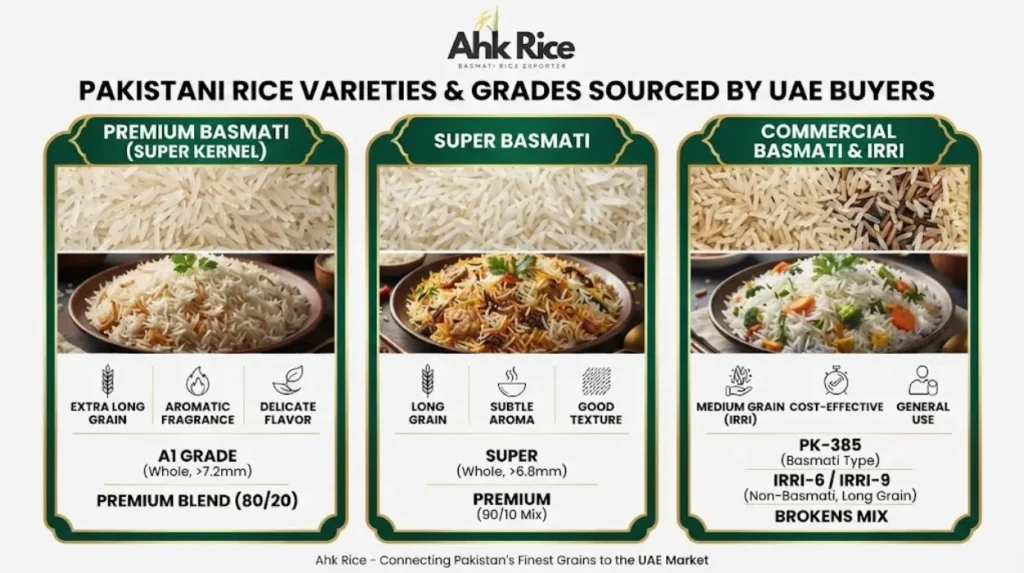
UAE buyers source Pakistani rice according to grain length, aroma, processing method, cooking performance, price position, and end use. Common commercial choices include 1121, Super Kernel, and 1509 Basmati rice, White, Steam, Golden Sella, and other specified grades.
What is 1121 Basmati?
1121 Basmati is a long-grain Pakistani Basmati variety known for long raw grains, aromatic character, and strong cooked elongation. UAE retailers use it for premium consumer positioning and established Basmati demand.
AHK Rice supplies 1121 in processing formats including White, Steam, Golden Sella, Creamy Sella, Brown, and broken grades.
What is Super Kernel Basmati?
Super Kernel is a traditional Pakistani Basmati variety associated with natural aroma, long grain appearance, and established South Asian consumption.
AHK Rice supplies Super Kernel with commercial specifications focused on grain length, controlled moisture, low broken percentage, and export-grade sorting.
What is 1509 Basmati?
1509 is a Pakistani Basmati variety associated with commercial yield, long grain appearance, and efficient bulk distribution.
AHK Rice supplies 1509 for retail, catering, restaurants, foodservice, and private-label distribution. Common processing options include White, Steam, and Golden Sella.
What are White, Steam, and Sella grades?
White rice is milled without parboiling and provides a bright cooked appearance. Steam rice receives controlled steaming before drying and milling. Sella rice is parboiled and dried before final milling.
Golden Sella provides a distinctive golden appearance. Steam provides a white cooked appearance. Retailers, restaurants, and caterers select these grades according to cooking requirements and consumer preferences.
With the principal varieties and grades established, UAE buyers can match each specification with its intended market use.
What do UAE retailers and foodservice buyers use Pakistani rice for?
UAE retailers use Pakistani rice for branded consumer packs, while wholesalers, restaurants, caterers, and foodservice operators use bulk grades for recurring commercial consumption. Packaging, grain performance, processing grade, and price determine the practical use.
How do supermarkets source rice?
Supermarkets generally require consumer-ready packaging. Common pack formats include 1 kg, 2 kg, 5 kg, and 10 kg units.
Retail packaging requires accurate product naming, net weight, origin information, labeling, barcode requirements, and shelf presentation. Private-label buyers also define artwork, packaging material, brand information, and pack configuration.
The UAE Ministry of Economy’s essential-goods platform currently lists several Basmati products in Dubai supermarkets, including 1121 Sella and Sella XXXL products. This demonstrates active retail segmentation by rice type and pack size.
How do wholesalers and distributors source rice?
Wholesalers usually purchase larger quantities for distribution across multiple retail and foodservice customers. Their specifications focus on consistent quality, pallet configuration, packaging, price, and replenishment.
Distributors can purchase Pakistani Basmati in retail-ready bags or bulk formats. They then supply supermarkets, independent stores, restaurants, hotels, and catering businesses.
How do restaurants and caterers select grades?
Restaurants and caterers select grades according to cooking volume and menu requirements. Biryani operations prioritize long grain appearance and separation. Catering operations also evaluate holding performance during large-scale service.
Golden Sella suits operations requiring parboiled grain performance and extended handling. Steam suits buyers seeking a white cooked appearance and long-grain presentation.
With use cases defined, regulatory compliance becomes the next part of the sourcing chain.
What documents and certifications apply to rice imports into the UAE?
UAE rice imports require accurate food registration, shipment documentation, product labeling, and applicable food-safety compliance. Required documents depend on the product, emirate, import channel, and shipment conditions. UAE authorities inspect imported food against applicable requirements.
Which food registrations apply?
The UAE requires imported food products to be registered in the national food registration system before handling in UAE markets. The official UAE government portal identifies the ZAD system for imported and locally produced food products.
Dubai Municipality also provides services for registering and assessing food items and releasing imported food consignments for the local market.
Which shipment documents matter?
Common commercial documents include the commercial invoice, packing list, bill of lading, certificate of origin, and relevant food or health documentation.
Plant-origin consignments can also require phytosanitary documentation under applicable UAE requirements. UAE agricultural import procedures identify phytosanitary certificates, customs declarations or bills of lading, certificates of origin, and invoices among relevant documents for regulated agricultural consignments.
Which certifications should buyers check?
Certification requirements depend on the product and UAE regulatory pathway. Buyers should verify applicable food-safety, conformity, halal, laboratory, and inspection requirements before shipment.
AHK Rice manages product processing, grading, sorting, packaging, and export documentation as part of its end-to-end export process. Buyers should approve the final specification and documentation set before loading.
With compliance requirements established, common sourcing problems become easier to identify.
What problems do UAE rice importers commonly face when sourcing from Pakistan?
Common problems include inconsistent specifications, unclear pricing terms, weak samples, incomplete documents, unsuitable packaging, quality variation, and confusion between variety and processing grade. Buyers solve these issues through written specifications, approved samples, inspection, and complete documentation.
Is rice variety the same as processing grade?
No. A variety identifies the rice type. A processing grade identifies how the grain is processed.
1121 is a variety. Golden Sella is a processing form. A buyer can therefore purchase 1121 Golden Sella rather than treating 1121 and Golden Sella as competing varieties.
Does the lowest FOB price represent the lowest landed cost?
No. FOB Pakistan excludes destination freight and several downstream costs. Landed cost also reflects freight, insurance where applicable, customs charges, clearance, handling, warehousing, and local distribution.
A UAE importer should compare the same specification under the same Incoterm. Comparing FOB against CIF produces an incomplete cost comparison.
Does every Pakistani rice shipment have the same quality?
No. Quality depends on variety, crop, milling, grading, sorting, moisture, broken percentage, packaging, and inspection.
AHK Rice defines commercial specifications before processing and shipment. Buyers should approve a representative sample and final specification before dispatch.
Do retail and catering buyers need the same packaging?
No. Retailers require consumer-ready packs. Catering buyers often require larger commercial bags.
A supermarket can require 5 kg branded bags. A foodservice distributor can require 25 kg or 50 kg commercial packaging. Private-label buyers add brand and labeling requirements.
With the main sourcing problems clarified, UAE buyers can connect product specifications with procurement decisions.
How can UAE buyers understand the Pakistan Basmati market in 2026?
UAE rice sourcing in 2026 combines Pakistani Basmati production, defined product specifications, commercial sampling, regulatory registration, shipment documentation, and UAE distribution. The market contains active importers, wholesalers, retailers, and foodservice buyers across multiple product segments.
AHK Rice represents one Pakistani export model within this broader supply chain. AHK Rice operates from Punjab and supplies 1121, Super Kernel, and 1509 varieties to more than 15 countries.
AHK Rice manages end-to-end processing from sourcing through milling, grading, sorting, packaging, and export coordination. This structure allows buyers to define a specification before shipment.
UAE sourcing also connects local consumption with regional distribution. Dubai’s food infrastructure supports imports, local sales, and re-export activity.
The 2026 trade data shows that Pakistan-to-UAE Basmati sourcing remains an active commercial channel. Volza recorded 89 active Basmati buyers between July 2024 and June 2025, with 176 Pakistani suppliers represented in its dataset.
For UAE buyers, the practical sourcing framework remains specification first, sample second, documentation third, and shipment fourth. This sequence reduces confusion between rice variety, processing grade, packaging, price, and regulatory requirements.
Frequently Asked Questions
How do UAE rice importers source rice from Pakistan?
UAE importers define the rice variety and specification first. They then evaluate suppliers, request samples, verify documents, approve quality, confirm commercial terms, and arrange shipment to the UAE.
Which Pakistani rice varieties do UAE buyers source?
UAE buyers source varieties including 1121, Super Kernel, and 1509 Basmati. Each variety serves different retail, wholesale, restaurant, catering, and foodservice requirements.
What documents are needed to import rice into the UAE?
Common documents include a commercial invoice, packing list, bill of lading, certificate of origin, and applicable food or plant-health documentation. Product registration and local food-control requirements also apply.
What is the difference between FOB Pakistan and CIF UAE?
FOB Pakistan covers the export-side delivery point and excludes the main ocean freight. CIF UAE includes agreed freight and insurance to the named destination. Buyers should compare identical specifications under identical Incoterms.
Which Pakistani Basmati grades are common in UAE retail?
Common grades include White, Steam, Golden Sella, and Creamy Sella, depending on the variety. Retailers select grades according to appearance, cooking performance, consumer demand, packaging, and price position.
How do UAE buyers verify rice quality before shipment?
Buyers approve a representative sample and define measurable specifications. These include grain length, moisture, broken percentage, purity, processing grade, packaging, and cooking performance. Pre-shipment inspection can provide an additional quality-control step.
Does Dubai support rice re-export activity?
Yes. Dubai functions as a major food-trade and logistics hub. Dubai Municipality reports substantial food imports from more than 160 countries, with significant quantities re-exported to regional markets.
Why do UAE retailers request private-label rice packaging?
Private-label packaging allows retailers and distributors to sell rice under their own brands. Buyers define pack sizes, artwork, labeling, barcodes, product information, and packaging materials before production.