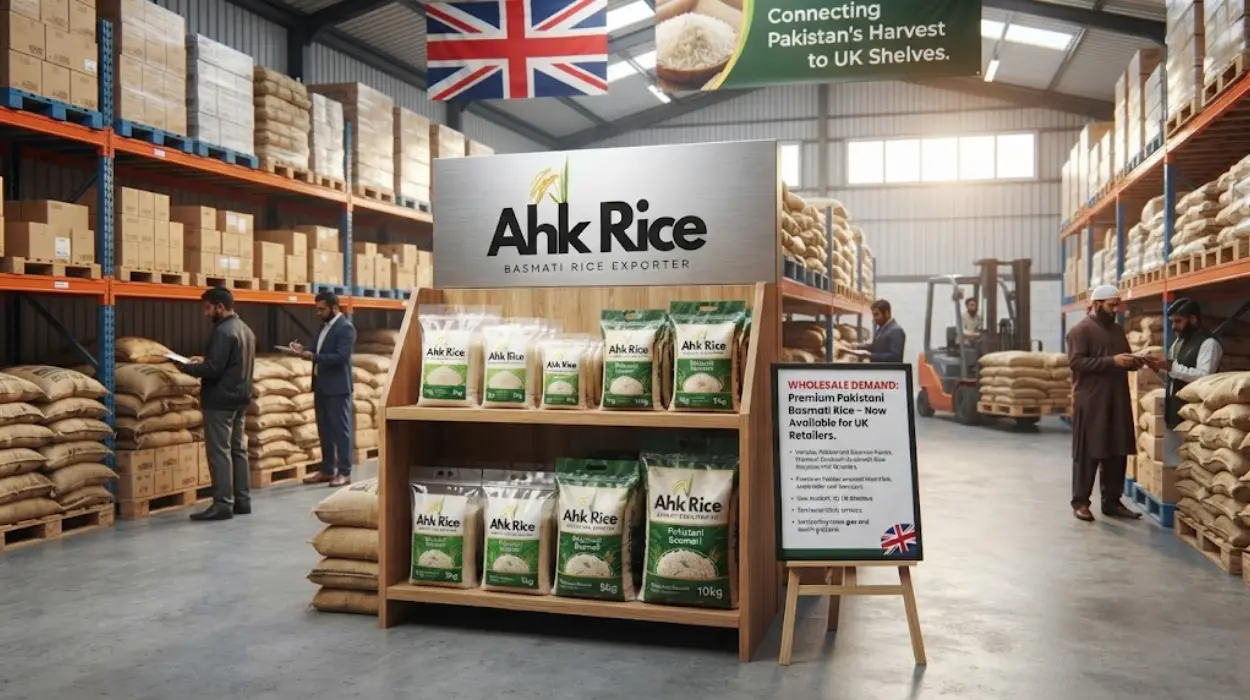
Which Pakistani Rice Varieties Dominate UK Retail and Wholesale Demand in 2026?
1121, Super Kernel, and 1509 Basmati rice serve the main UK retail and wholesale requirements in 2026. Here is why: UK shipment records show repeated demand for 1121 White, Steam, Sella, Creamy Sella, Super Kernel, and Super Basmati. UK buyers should select the variety by retail positioning, cooking performance, pack size, price target, and supply specification.
AHK Rice supplies Pakistani Basmati varieties from Punjab for international wholesale and retail procurement. AHK Rice manages sourcing, milling, grading, sorting, packaging, inspection, and export coordination. The company supplies 1121, Super Kernel, and 1509 varieties for different buyer specifications.
What is the best solution for UK rice buyers?
1121 fits premium retail, Super Kernel fits aroma-led wholesale, and 1509 fits price-sensitive volume distribution. Here is why: each variety provides a different balance of grain presentation, aroma, processing format, cooking performance, and commercial cost.
Which variety fits each UK channel?
1121 Basmati suits premium retail packs, private-label products, restaurants, and foodservice buyers. UK shipment records show substantial commercial volumes of 1121 Steam, Sella, White, and Creamy Sella.
Super Kernel suits buyers seeking traditional Pakistani Basmati aroma with flexible wholesale positioning. UK trade records also show Super Basmati White and Brown shipments in substantial commercial quantities.
1509 Basmati suits buyers targeting cost-controlled distribution and high-volume foodservice. AHK Rice supplies 1509 as part of its core Pakistani Basmati range.
| Variety | UK commercial role | Common processing | Suitable buyer |
|---|---|---|---|
| 1121 | Premium retail | White, Steam, Sella | Retailer, restaurant |
| Super Kernel | Aroma-led wholesale | White, Brown, Parboiled | Wholesaler, distributor |
| 1509 | Volume and value | White, Steam, Golden Sella | Foodservice, wholesaler |
A UK importer should avoid choosing only by the lowest FOB price. Grain specification, processing grade, broken percentage, moisture, packaging, freight, and destination all change the final commercial value.
The next decision is supplier capability, because a suitable variety still requires controlled processing and export execution.
Why choose AHK Rice for Pakistani rice supply?
AHK Rice combines direct Pakistani sourcing, controlled processing, custom packaging, inspection, and export documentation. Here is why: UK buyers need consistent specifications across repeat shipments rather than a single acceptable container.
AHK Rice Pakistan rice export service provides access to 1121, Super Kernel, and 1509. AHK Rice manages the supply chain from paddy sourcing through container loading. Its stated processing workflow includes cleaning, dehusking, drying, polishing, grading, sorting, inspection, testing, and export packaging.
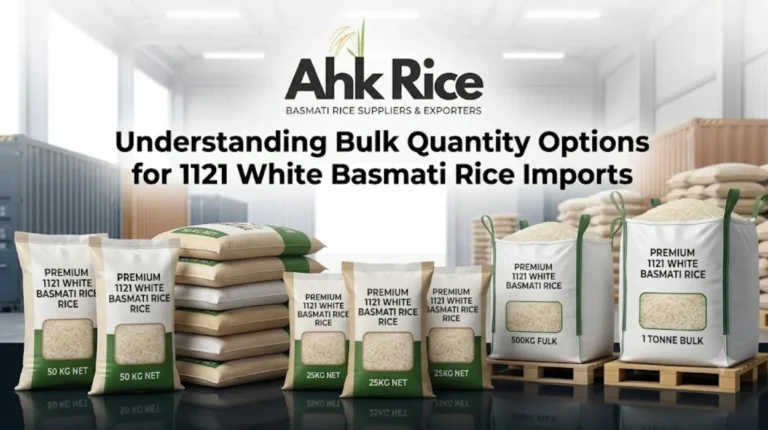
AHK Rice also supports private-label packaging. UK buyers can specify pack formats according to their retail or wholesale model. Common UK pack formats include 1 kg, 5 kg, 10 kg, 20 kg, and 40 kg.
Quality control remains central to the procurement decision. AHK Rice states that shipments can undergo pre-shipment inspection through recognized inspection organizations. Buyers can also establish contractual specifications for grain length, moisture, broken percentage, crop year, processing type, and packaging.
Documentation forms another commercial control point. UK rice shipments require accurate commercial and food-import documentation. Relevant documents can include commercial invoice, packing list, certificate of origin, phytosanitary certificate, and fumigation certificate.
AHK Rice therefore fits buyers seeking one supplier for product specification, processing, packaging, inspection, and export coordination.
With supplier capability established, the next question is what a UK buyer can expect from the purchasing process.
What results can UK buyers expect?
A specification-led purchase creates consistent rice quality, clearer landed-cost planning, and fewer disputes after shipment. Here is why: the buyer approves the actual rice specification before commercial production and shipment.
UK importers should approve a sample before confirming bulk production. AHK Rice can provide samples for product evaluation. The buyer should test grain appearance, aroma, moisture, broken percentage, cooking performance, elongation, texture, and packaging suitability.
The sample stage also protects private-label buyers. A retailer can test the rice with its target consumer group before committing to a full container. A wholesaler can cook the sample in a restaurant or catering environment before approving the grade.
UK shipment timing also needs planning. Published 2026 shipping benchmarks show Karachi-to-Felixstowe movement around 24–40 days. Karachi-to-Southampton can range around 19–34 days, depending on service and carrier.
Clearance and inland delivery add time after ocean arrival. Welsh distribution, for example, requires additional inland movement after UK port clearance.
For a UK importer, the practical sequence is sample approval, specification confirmation, quotation, payment, production, inspection, vessel booking, loading, ocean shipping, customs clearance, and warehouse delivery.
That sequence connects product selection directly with commercial planning and shipment execution.
What affects Pakistani rice pricing for UK buyers?
FOB price, rice grade, grain specification, packaging, quantity, freight, insurance, clearance, and inland delivery determine the final UK cost. Here is why: a published FOB price does not represent the buyer’s complete landed cost.
Current market references place comparable Pakistani premium Basmati around US$1,165–US$1,205 per metric ton FOB Karachi. This is an indicative range, not a fixed quotation. Freight and destination charges must be added for a UK landed-cost calculation.
1121 White generally occupies a premium specification position. Super Kernel can provide a traditional aroma-led alternative. 1509 can support buyers focused on price-controlled volume distribution.
Packaging also affects cost. Retail-ready metallic or laminated packs require different packaging inputs from bulk PP bags. Private-label artwork, packing size, carton configuration, and master-bag requirements can also change the quotation.
Quantity affects commercial economics. Full-container procurement normally produces a different cost structure from smaller trial quantities. Buyers should therefore request quotations against an exact quantity and destination port.
UK buyers should also compare FOB against CIF or CNF pricing. A direct FOB comparison can appear cheaper while leaving freight, insurance, port, and inland costs outside the comparison.
For a broader commercial comparison, use the planned “Pakistan UK Basmati Rice Trade Value and Market Size in 2026” MOFU article here: [Pakistan UK Basmati Rice Trade Value and Market Size in 2026]. The URL was not provided with the brief, so it should be attached to this anchor before publication.
Pricing becomes meaningful only after the specification and delivery terms are fixed.
How does the AHK Rice sample process work?
Start with the target variety, approve the specification, evaluate the sample, and then confirm the bulk order. Here is why: sample testing converts a product description into an approved commercial specification.
What should UK buyers do first?
- Define the variety — Select 1121, Super Kernel, or 1509.
- Define the grade — Select White, Steam, Sella, Golden Sella, or another required format.
- Define the specification — Confirm grain length, moisture, broken percentage, crop, and packaging.
- Request the sample — AHK Rice can arrange sample material for buyer evaluation.
- Test the sample — Check appearance, aroma, cooking performance, elongation, separation, and texture.
- Approve the specification — Record the accepted parameters for commercial production.
- Confirm the quotation — Confirm quantity, packing, destination, and Incoterm.
- Approve production — Authorize processing against the agreed specification.
- Inspect the shipment — Verify quality before container loading.
- Load the container — Pack, document, and dispatch the approved shipment.
AHK Rice’s sample policy can support Super Kernel evaluation with samples of up to 20 kg, while the buyer covers courier shipping and applicable phytosanitary charges. Exact courier and certification costs depend on the shipment destination and sample arrangement.
The sample should be treated as a commercial control document. The approved sample should match the agreed production specification. Buyers should retain the test results and approved parameters for future repeat orders.
This process reduces the risk of approving a variety based only on photographs or a verbal description.
How should UK buyers choose between 1121, Super Kernel, and 1509?
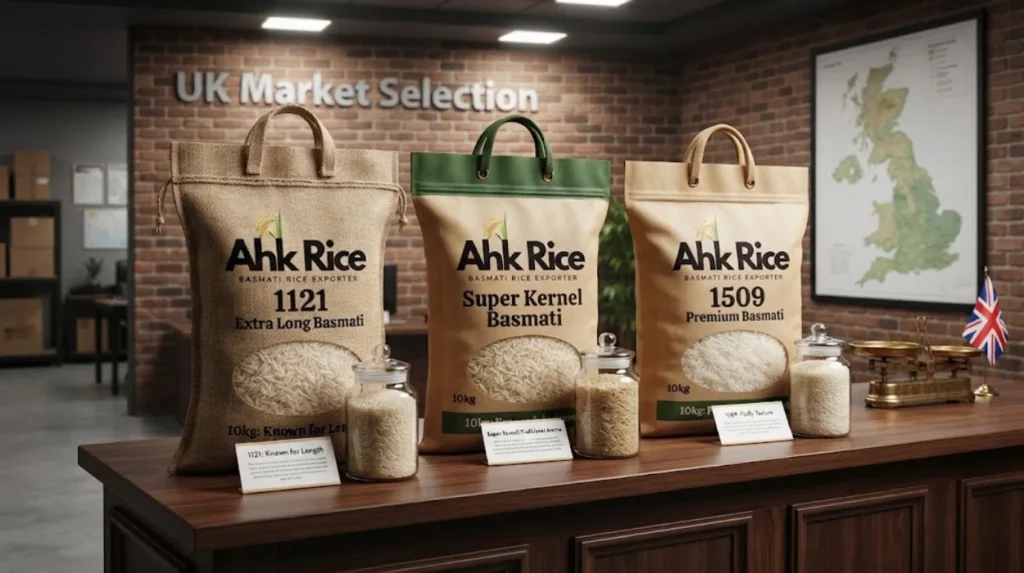
Choose 1121 for premium positioning, Super Kernel for aroma-led differentiation, and 1509 for value-focused volume supply. Here is why: each variety addresses a different commercial requirement.
| Buyer requirement | Suitable variety | Main reason |
|---|---|---|
| Premium retail | 1121 | Long grain presentation |
| Private label | 1121 | Strong premium positioning |
| Aroma-led wholesale | Super Kernel | Traditional aromatic profile |
| Restaurant supply | 1121 / Super Kernel | Cooking and presentation |
| Price-sensitive volume | 1509 | Commercial cost positioning |
| Large catering | 1509 / processed grades | Volume-focused procurement |
UK importers should make the final decision using their target retail price, consumer profile, cooking requirement, pack format, annual volume, and acceptable landed cost.
AHK Rice can structure the order around these variables rather than offering one generic specification. This approach allows the buyer to define the product before negotiating the shipment.
How can a UK importer get started with AHK Rice?
Start with the variety, quantity, destination port, packaging, and required specification. Here is why: these inputs allow AHK Rice to prepare a commercially relevant quotation instead of a generic price.
UK buyers should send the required rice variety and processing grade first. The next inputs are quantity, packaging size, destination port, target specification, and Incoterm.
AHK Rice can then coordinate sample evaluation, specification approval, production, inspection, packaging, documentation, vessel booking, and dispatch.
For a retailer, the process can begin with a 5 kg or 10 kg private-label specification. For a wholesaler, the buyer can begin with a 20 kg or 40 kg commercial pack. For foodservice, the buyer can evaluate the cooking performance and holding characteristics before approving larger volumes.
A specification-based procurement process gives the buyer a clear route from sample to container.
For UK buyers ready to define the product, quantity, packing, and destination, the next step is to request an export quotation from AHK Rice.
Frequently Asked Questions
Which Pakistani rice variety is most suitable for UK retail?
1121 Basmati suits premium UK retail positioning.
Super Kernel suits aroma-led retail and wholesale products.
1509 suits value-focused distribution programmes.
The final choice depends on pack size and target price.
A sample should confirm cooking and appearance before bulk approval.
How long does Pakistani rice take to reach the UK?
Karachi-to-Felixstowe movement can take around 24–40 days.
Karachi-to-Southampton can take around 19–34 days.
Carrier schedules affect the actual sailing period.
Customs clearance adds time after port arrival.
Inland delivery requires additional planning.
What Pakistani Basmati grades are imported into the UK?
UK shipment records show repeated 1121 White shipments.
1121 Steam and Sella also appear in commercial records.
Creamy Sella shipments are also documented.
Super Basmati White and Brown shipments occur as well.
Processing grade should match the buyer’s target market.
What affects the price of Pakistani rice in the UK?
Rice variety affects the base FOB price.
Grain length and broken percentage affect specification value.
Packaging and order quantity change processing costs.
Freight and destination charges affect landed cost.
Customs and inland delivery complete the UK cost calculation.
Can UK buyers request a rice sample from AHK Rice?
AHK Rice can arrange product samples for buyer evaluation.
Super Kernel samples can be provided up to 20 kg under its stated policy.
The buyer covers courier shipping and applicable phytosanitary charges.
Buyers should test aroma, cooking, grain separation, and appearance.
Bulk production should follow the approved sample specification.