Key Pakistani Rice Grades and Branding Formats Preferred by US Retail and Grocery Chains in 2026
1121 Basmati, Super Kernel, and selected 1509 formats provide the strongest Pakistani rice options for US retail and grocery chains, with 5 kg, 10 kg, private-label, and foodservice packs covering the main buying models. Here is why: US buyers evaluate grain appearance, cooking performance, packaging, compliance, documentation, and repeat-order consistency before approving a Pakistani supplier.
US importers should first understand how US importers negotiate certification, packaging, and compliance for Pakistani rice imports. FDA requires covered food importers to operate an applicable Foreign Supplier Verification Program, including supplier evaluation and verification activities.
AHK Rice supplies Pakistani Basmati varieties including 1121, Super Kernel, and 1509 for international buyers. The export model connects sourcing, milling, grading, sorting, packaging, documentation, and container loading.
What is the best solution for US retail rice buyers?
1121 Basmati suits premium shelves, Super Kernel suits traditional aromatic positioning, and 1509 suits value-led distribution and selected private-label programs. The correct format depends on retail positioning, target consumer, package size, and required landed cost.
Which Pakistani rice grades should US retailers choose?
1121 Basmati provides the strongest premium positioning. Current commercial specifications commonly place raw grain around 8.3 mm, with strong cooked elongation and premium visual presentation. Public 2026 market quotations place 1121 grades around $1,135–$1,205 per MT FOB Karachi, depending on processing form.
Super Kernel Basmati provides traditional Pakistani aroma with a lower grain-length profile. A commercial specification commonly places the raw grain near 7.2 mm. The grade fits South Asian grocery, ethnic retail, and distributors seeking aromatic Basmati at a competitive positioning.
1509 Basmati provides a long-grain option for buyers focused on value, cooking expansion, and high-volume distribution. The variety can fit private-label and foodservice programs where cost control matters alongside Basmati positioning.
The buying decision should therefore match grade to shelf position rather than select solely by price.
Which branding formats work best?
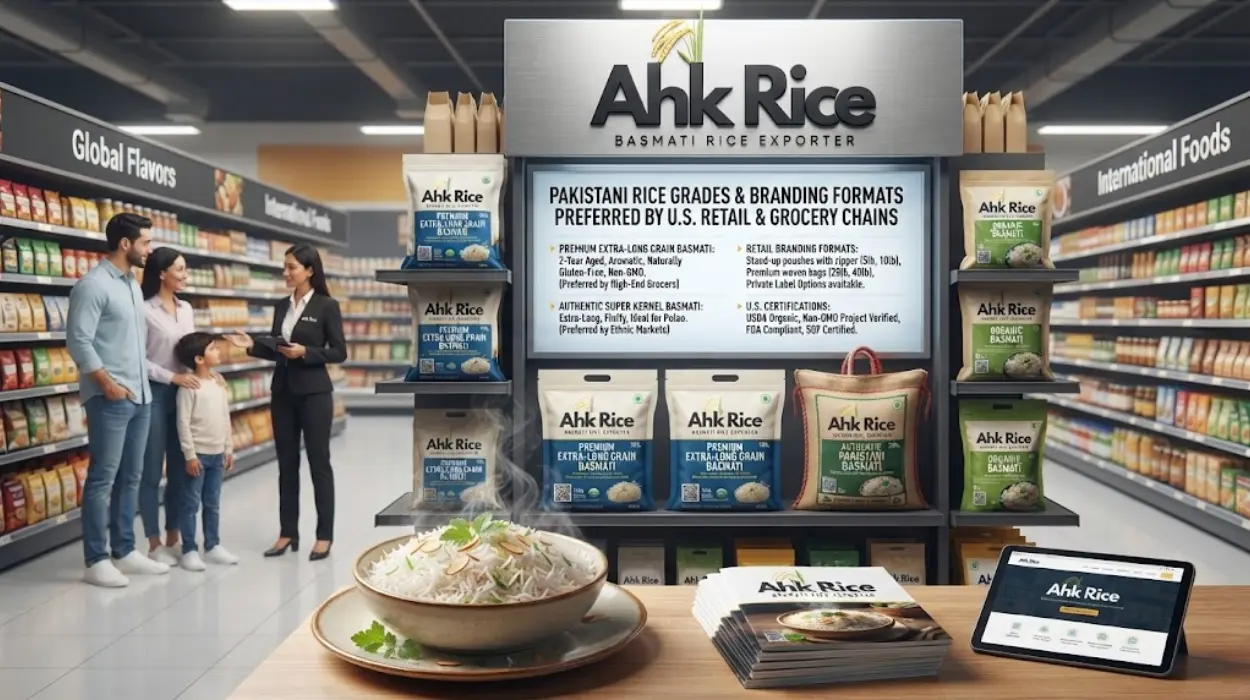
Private-label bags, printed retail pouches, laminated bags, and bulk foodservice bags cover the principal commercial formats. AHK Rice can coordinate custom packaging around the buyer’s approved product specification.
US retail packaging commonly uses 1 kg to 10 kg consumer formats. Common structures include BOPP laminated bags, PP woven bags with printed branding, vacuum packs, and stand-up pouches.
Foodservice programs commonly use 20 kg, 25 kg, 40 lb, and 50 lb formats. These packs prioritize handling strength and transportation efficiency over retail shelf presentation.
Private-label programs require stronger specification control. Artwork, nutritional information, barcode requirements, product identification, country-of-origin information, and importer details should be approved before production.
With the grade and packaging decision established, the next step is selecting an exporter capable of executing the specification consistently.
Why choose AHK Rice for US retail and grocery supply?
AHK Rice combines Pakistani Basmati sourcing, processing, grading, packaging, documentation, inspection coordination, and export logistics into one specification-led workflow. This reduces the number of separate commercial decisions required before container dispatch.
AHK Rice operates from Punjab and supplies 1121, Super Kernel, and 1509 Basmati varieties. The company manages the export process from product selection through shipment coordination.
AHK Rice starts with the buyer’s specification. The specification can identify variety, processing type, grain length, broken percentage, moisture, packing format, quantity, and destination.
AHK Rice then mills, grades, sorts, and prepares the selected rice for the agreed commercial specification. This approach gives a retail buyer a defined benchmark before production begins.
AHK Rice also supports custom packaging. Private-label buyers can establish artwork, package size, batch identification, and retail presentation before bulk packing.
US compliance remains the importer’s responsibility. FDA identifies the U.S. owner or consignee as the FSVP importer in applicable transactions.
AHK Rice supports the exporter-side documentation and shipment process. The US importer should coordinate its own FDA, FSVP, customs, labeling, and entry requirements.
The service therefore works best for buyers seeking one controlled Pakistan-side workflow rather than an unstructured spot purchase.
What results can US buyers expect?
A specification-led supply program can improve product consistency, packaging accuracy, documentation control, shipment planning, and repeat-order reliability. These outcomes matter most for grocery chains that cannot tolerate changes between approved samples and commercial containers.
What happens during the sample process?
Sample approval should precede commercial production, with rice evaluation covering appearance, aroma, grain length, moisture, broken percentage, cooking performance, and cleanliness. The approved sample then becomes the commercial reference for production.
A practical sample workflow is:
- Define the specification. State variety, processing type, grain length, broken percentage, moisture, packaging, quantity, and destination.
- Select the sample. Match the sample to the requested commercial specification.
- Pack the sample. Identify the grade and sample specification clearly.
- Arrange documents. Prepare applicable sample documentation and phytosanitary requirements.
- Dispatch the sample. Use the buyer’s courier account or arrange international courier service.
- Inspect the sample. Check appearance, aroma, cleanliness, grain length, moisture, and broken percentage.
- Cook the rice. Evaluate elongation, texture, aroma, water absorption, and grain separation.
- Approve the sample. Provide written confirmation of the accepted specification.
- Produce the order. Process the commercial lot against the approved benchmark.
- Inspect the shipment. Arrange third-party inspection when required.
- Load the container. Match packages, quantities, lot identification, and documents.
- Dispatch the shipment. Release the container after final documentation checks.
The sample itself can be offered free under AHK Rice’s stated sampling policy. Courier, phytosanitary, laboratory, and independent inspection charges remain separate. Courier cost depends on sample weight, destination ZIP code, service level, and documentation.
How long does shipping to the US take?
Pakistan-to-US ocean transit commonly requires roughly 24–40 days from Karachi to major US gateways, excluding production, booking, customs, and inland delivery. Public 2026 market information lists New York and Los Angeles as key destinations within this range.
| US market | Main gateway | Indicative ocean transit | Suitable buying focus |
|---|---|---|---|
| Northeast | New York | ~24–30 days | 1121, Super Kernel, private label |
| West Coast | Los Angeles | ~30–40 days | 1121, Super Kernel, 1509 |
| Nationwide distribution | Port-dependent | ~24–40 days | Mixed grade programs |
Transit time does not equal total order lead time. Production, sample approval, packaging artwork, inspection, booking, port handling, customs clearance, and inland delivery add additional time.
US grocery chains should therefore order against inventory requirements rather than expected sailing time alone.
With the expected supply outcomes established, pricing becomes the next decision factor.
How much does Pakistani rice cost for US retail programs?

FOB rice pricing depends on grade, processing, grain specification, broken percentage, moisture, packaging, quantity, crop, inspection, and shipment terms. Freight, customs, inland transport, and packaging development then determine the final landed cost.
Public September 2026 market quotations place 1121 Basmati around $1,135–$1,205 per MT FOB Karachi. Super Kernel is also publicly quoted around $1,165–$1,205 per MT in current market listings. These figures are indicative rather than fixed contract prices.
Packaging can change the commercial calculation. A 25 kg or 50 kg bulk PP bag carries a different packaging cost from a printed 5 kg retail bag.
Private-label artwork can also introduce design, printing, plate, packaging minimum, and production costs.
Freight changes with destination, container availability, booking date, carrier, equipment, and market conditions. A US buyer should therefore compare FOB cost + packaging + inspection + freight + import charges + inland delivery.
A lower FOB price does not automatically produce the lowest landed cost.
Which grade gives the best commercial value?
1121 provides premium shelf appeal, Super Kernel provides aromatic value positioning, and 1509 provides cost-focused volume potential. The strongest choice depends on consumer positioning rather than the lowest quoted metric-ton price.
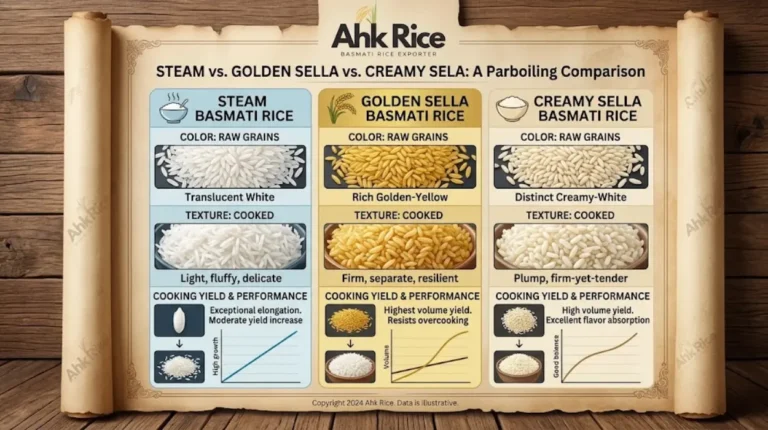
A premium South Asian grocery chain can select 1121 White or Steam for long-grain presentation.
A traditional Pakistani and South Asian grocery program can select Super Kernel for aroma and familiar Basmati character.
A price-sensitive distributor can evaluate 1509 for long-grain positioning and volume economics.
A private-label brand can use different grades under separate product lines. This allows the retailer to address premium, mainstream, and value customers without changing supplier relationships.
With grade economics defined, the final decision should focus on execution capability.
How can US retail chains get started with AHK Rice?
Start with the product specification, target quantity, package size, private-label requirement, destination port, and preferred Incoterm. AHK Rice can then structure the sample, quotation, packaging, documentation, inspection, and shipment workflow around those requirements.
US buyers should prepare these commercial details:
- Variety: 1121, Super Kernel, or 1509.
- Processing: White, Steam, or applicable parboiled format.
- Specification: Grain length, broken percentage, moisture, purity, and appearance.
- Packaging: Retail pack, private label, foodservice bag, or bulk format.
- Quantity: Trial order, container quantity, or recurring supply volume.
- Destination: New York, Los Angeles, or another US gateway.
- Compliance: Applicable FDA, FSVP, labeling, testing, and documentation requirements.
- Inspection: Buyer-approved third-party inspection or supplier quality verification.
- Commercial terms: FOB, CNF/CFR, CIF, or another agreed Incoterm.
AHK Rice can then align the sample with the proposed commercial specification. The buyer evaluates the sample before production. The approved specification becomes the benchmark for the container.
This approach gives grocery chains stronger control over product quality, branding, documentation, and replenishment.
The final decision is straightforward: choose 1121 for premium retail, Super Kernel for traditional aromatic positioning, and 1509 for value-oriented volume programs, then lock the specification before production.
For US retail buyers seeking a Pakistan-origin supply program, AHK Rice provides the commercial structure needed to move from sample approval to container shipment.
Request a quotation from AHK Rice for your required grade, packaging format, quantity, and US destination.
FAQs
Which Pakistani rice grade is best for US grocery chains?
1121 is the strongest premium retail option.
Super Kernel suits traditional aromatic positioning.
1509 suits value-focused distribution programs.
The final choice depends on shelf positioning and landed cost.
What packaging formats are common in the US?
Retail programs commonly use 1 kg to 10 kg packs.
Private-label bags support grocery branding.
Foodservice programs commonly use 20 kg to 50 lb formats.
Packaging must match applicable US labeling requirements.
How long does Pakistani rice take to reach the US?
Ocean transit commonly takes about 24–40 days.
New York can receive shipments faster than some West Coast routes.
Production and booking add additional lead time.
Customs and inland delivery require separate planning.
How much does Pakistani Basmati rice cost?
Public 2026 FOB indications place premium grades around $1,135–$1,205 per MT.
Final pricing depends on grade and specifications.
Packaging and freight change the landed cost.
Buyers should compare total landed cost rather than FOB alone.
Can AHK Rice provide private-label Pakistani rice?
AHK Rice supports custom packaging for export buyers.
Buyers can specify package size and branding requirements.
Artwork should be approved before commercial packing.
The final package must meet applicable US requirements.