Import Audit-Compliant Pakistani Basmati Rice into Washington State
For Washington State importers, the strongest solution is not simply buying Pakistani Basmati rice from a low-cost exporter; it is selecting a supplier that can connect factory-audit evidence, product specifications, food-safety documentation, pre-shipment inspection, compliant packaging, and predictable ocean logistics into one controlled import program. AHK Rice provides this structure for U.S. buyers sourcing 1121, Super Kernel, and 1509 Basmati rice from Pakistan.
Buyers should first understand:
Why third-party factory audits matter for rice procurement before approving a supplier. An audit gives the buyer evidence about processing controls, sanitation, traceability, storage, equipment, quality testing, and documentation instead of relying only on a supplier’s commercial claims. For a Washington distributor, this evidence becomes particularly valuable when the shipment will enter through a U.S. port and later move into retail, foodservice, wholesale, or ethnic grocery distribution.
What is the best solution for importing audit-compliant Pakistani Basmati rice into Washington State?
The best solution is a documented supplier-approval process combining factory audit evidence, agreed rice specifications, laboratory testing, third-party inspection, FDA import documentation, controlled packing, and shipment tracking before commercial loading. This reduces quality, documentation, supplier, and delivery risks simultaneously.
A practical Washington procurement program starts with a written product specification. The specification should identify variety, processing type, average grain length, moisture limit, broken percentage, foreign matter tolerance, packaging, net weight, labeling requirements, and required certificates.
For example, a buyer purchasing 1121 Basmati may specify extra-long grains, controlled moisture, low broken percentage, Sortex-clean appearance, and a defined cooking-performance requirement. A restaurant distributor may prioritize elongation and non-sticky cooking, while a retail importer may place greater weight on appearance, packaging, barcode requirements, shelf presentation, and repeatable lot consistency.
The supplier should then provide evidence that the factory can repeatedly produce those specifications. AHK Rice operates an integrated processing and export program covering paddy sourcing, milling, grading, color sorting, customized packaging, and container loading. Its published quality program also identifies third-party inspection availability and certifications including ISO 22000:2018, HACCP, ISO 9001:2015, GMP, and Halal.
A U.S. importer should not interpret a certification logo as a substitute for supplier verification. The commercial question is whether the actual production facility, product specification, lot testing, documentation, and shipment controls support the buyer’s contract requirements.
FDA requirements also matter. Imported food must comply with U.S. requirements, facilities handling food may need FDA registration, and importers must meet applicable prior-notice and import procedures. FDA also places FSVP responsibilities on covered U.S. importers to verify that foreign suppliers produce food in accordance with applicable food-safety requirements.
Why choose the USA export service for Washington State rice imports?
A U.S.-focused export service is valuable because Washington buyers need more than rice production: they need specification control, export documentation, inspection coordination, packaging flexibility, container planning, and logistics support from the Pakistani mill through the U.S. entry point.
The USA export service from AHK Rice is structured around U.S. importers seeking Pakistani Basmati varieties including 1121, Super Kernel, and 1509. The published U.S. program includes export documentation, customized packing, container shipment support, and third-party inspection options.
For Washington buyers, the main advantage is coordination. A supplier can produce excellent rice but still create commercial problems if the lot specification changes, documents contain inconsistent information, packaging does not match the purchase order, or the container misses the intended sailing.
AHK Rice can coordinate the product specification before production, sample approval before bulk processing, inspection before loading, and documentation before the container departs Pakistan. That sequence gives the buyer several points at which to identify discrepancies instead of discovering them after arrival.
An audit-ready purchase file should normally contain the approved product specification, sample approval record, supplier and factory information, applicable certifications, laboratory reports, inspection results, packing details, commercial invoice, packing list, certificate of origin, phytosanitary documentation where required, fumigation documentation where applicable, bill of lading, and other destination-specific documents.
The U.S. importer remains responsible for its own regulatory obligations. Supplier support does not transfer legal responsibility for FSVP, customs entry, labeling, or other importer-side requirements. FDA explicitly states that imported foods can be inspected at U.S. ports and that non-compliant products can be detained.
How does the factory audit prove that the Pakistani Basmati supplier is ready?
A useful factory audit connects physical production controls with documented evidence: raw-material traceability, milling controls, sorting, sanitation, pest management, laboratory testing, storage, packaging, employee practices, corrective actions, and shipment records should all support the specifications promised to the buyer.
The strongest audit is not merely a checklist of whether equipment exists. It should establish whether the factory can maintain the same result across commercial production. For a deeper comparison of the controls buyers should examine, see:
How factory audits verify Basmati rice processing standards
For Basmati rice, an importer should examine:
| Audit area | Evidence Washington buyers should request |
|---|---|
| Raw-material sourcing | Supplier records, variety identification and traceability |
| Milling | Process controls, equipment condition and yield records |
| Sorting | Color-sorting and foreign-material control records |
| Laboratory testing | Moisture, broken grains, purity and applicable safety tests |
| Hygiene | Cleaning schedules, sanitation controls and pest-management records |
| Storage | Warehouse conditions, lot identification and stock rotation |
| Packaging | Weight checks, bag specifications, labeling and batch coding |
| Corrective action | Non-conformance records and evidence of resolution |
AHK Rice states that its export operation manages processing through final container loading and provides third-party inspection options. This is commercially important because the audit should be connected to the exact production site supplying the buyer rather than treated as a generic company credential.
For a Washington importer, the final decision should therefore compare the audit report with the purchase specification. If the specification requires 12% maximum moisture, the buyer should see evidence that production and testing controls can consistently achieve the contracted value. If the requirement is less than 2% broken grains, the pre-shipment inspection should verify the actual commercial lot.
This is how audit evidence becomes a procurement tool rather than a marketing document.
What sample process should Washington importers follow before placing a container order?
The safest sample process is specification confirmation, sample request, courier dispatch, laboratory or buyer testing, cooking evaluation, written approval, commercial pre-production confirmation, and optional independent inspection before loading. This creates documented evidence linking the approved sample to the final shipment.
The process should begin with the buyer sending the exact requirements. Include variety, processing type, grain length, moisture target, broken percentage, purity requirement, packaging, quantity, destination port, and intended use.
AHK Rice states that up to 20 kg of Basmati rice samples can be supplied without a rice charge, while the buyer covers sample shipping and the applicable phytosanitary certificate cost.
A practical sample workflow is:
- Specification confirmation: Buyer sends the required commercial specification.
- Sample selection: Supplier selects a representative lot or production specification.
- Packing: Sample is packed securely with identification information.
- Phytosanitary/document preparation: Applicable sample documentation is arranged.
- Courier dispatch: Buyer pays courier charges or provides its courier account.
- Receipt and inspection: Buyer checks appearance, grain length, odor, moisture, broken percentage, and cleanliness.
- Cooking test: Buyer evaluates elongation, texture, aroma, water absorption, and post-cooking separation.
- Approval: Buyer provides written sample approval.
- Production confirmation: Supplier confirms that commercial production will match the approved specification.
- Pre-shipment inspection: Buyer can request an independent inspection before container loading.
For budgeting, the rice sample itself can be free under the supplier’s stated sample policy, but courier, phytosanitary, laboratory, and independent inspection charges are separate. International courier costs vary substantially by sample weight, destination ZIP code, courier account, service level, and documentation, so a fixed dollar figure should not be treated as a 2026 tariff.
A sensible procurement budget should therefore separate supplier sample cost, courier cost, phytosanitary/document cost, independent laboratory cost, and third-party inspection cost rather than combining them into an artificial sample fee.
How many shipping days should Washington importers expect from Pakistan?
Washington State should be planned as a longer U.S. West Coast logistics corridor than Los Angeles because Karachi-to-Seattle ocean services can involve transshipment and extended routing. Buyers should therefore build inventory around roughly 50–61 days of ocean transit on current public schedules, plus port and inland delivery time.
Current 2026 shipping data shows why Washington buyers should not simply use a generic “25–35 days to the USA” estimate. AHK Rice publishes a general USA door-to-door estimate of approximately 25–35 days for major U.S. ports, but current lane data specifically for Seattle shows materially longer ocean transit options.
For commercial planning, use the following framework:
| U.S. market | Pakistan origin | Current planning transit | Commercial planning note |
| Washington / Seattle | Karachi | ~61 days on one current FCL option | Allow additional time for port and inland delivery |
| Washington / Seattle | Port Qasim | ~50 days on one current FCL option | Verify sailing and transshipment before booking |
| California / Los Angeles | Karachi | ~32 days on one current FCL option | West Coast alternative with faster published transit |
| New York / East Coast | Karachi | ~27 days on one current FCL option | Different routing and port conditions apply |
| Texas / Houston | Karachi | ~36 days on one current FCL option | Gulf routing may change landed cost |
These figures are current schedule indicators, not guaranteed delivery commitments. Flexport’s public August 2026 rate pages list approximately 61 days from Karachi to Seattle and 50 days from Port Qasim to Seattle, while published options show approximately 32 days to Los Angeles, 27 days to New York, and 36 days to Houston.
The 2026 carrier environment also shows active Pakistan-to-West-Coast service development. CMA CGM’s PEARL service update lists a Karachi-to-Los Angeles transit of 42 days on its revised direct service, illustrating how carrier schedules can materially change the available routing.
For Washington, the safest purchasing decision is therefore to request the actual vessel schedule, ETD, ETA, transshipment points, port, and inland delivery arrangement before approving the purchase order.
What factors determine the final Pakistani Basmati rice import price?
The final Washington landed cost depends on rice grade, order volume, packaging, inspection, export documentation, FOB or delivered Incoterm, ocean freight, destination charges, customs-related costs, inland transportation, insurance, and the selected Seattle-area delivery point.
A low FOB price does not automatically create the lowest landed cost. A cheaper grade may also produce a weaker retail margin if the buyer must discount for inconsistent appearance or cooking performance.
For reference, AHK Rice publishes a U.S. 1121 Basmati product page with a starting FOB Karachi indication of $1,100 per metric ton for that particular product page, subject to quantity, specification, packaging, and commercial quotation. This should be treated as a published reference point, not a universal August 2026 market price for every Basmati grade.
A Washington buyer should request pricing against a precise specification. The quote should identify:
- Product and processing grade.
- Quantity in metric tons.
- Packaging and private-label requirements.
- FOB, CFR/CNF, CIF, or another agreed Incoterm.
- Origin port.
- Destination port.
- Inspection requirements.
- Required laboratory testing.
- Documentation.
- Freight validity period.
- Payment terms.
- Estimated production and loading date.
For an audit-compliant program, inspection and testing costs should be considered risk-control costs rather than unnecessary extras. A $100 difference in inspection expenditure is insignificant compared with the financial impact of a rejected container, delayed release, relabeling requirement, customer complaint, or inconsistent repeat shipment.
What results can Washington importers expect from an audit-controlled supply program?
A properly controlled program should deliver measurable improvements in specification consistency, documentation accuracy, shipment visibility, supplier accountability, and purchasing predictability. The objective is not merely to pass an audit but to reduce commercial variation across repeated Basmati rice shipments.
The first result is better supplier qualification. Instead of asking whether a factory “looks modern,” the importer can assess measurable controls.
The second is stronger lot consistency. Approved samples and written specifications establish a commercial baseline for future shipments.
The third is earlier problem detection. Laboratory testing and pre-shipment inspection can identify moisture, broken-grain, purity, packaging, or specification deviations before loading.
The fourth is stronger documentation control. U.S. importers can align supplier documentation with their internal compliance and FSVP procedures instead of collecting documents after the container has already sailed.
The fifth is better inventory planning. Washington importers can use actual sailing schedules rather than assuming that every U.S. destination has the same transit time.
AHK Rice supports this approach by combining processing, grading, sorting, packaging, documentation, and shipping coordination within its export operation.
How should a Washington importer decide whether AHK Rice is the right supplier?
Choose the supplier that can prove product consistency and export readiness before accepting the purchase order, not the supplier offering the lowest headline price. Audit evidence, approved samples, testing, documentation, logistics capability, and contract specifications should all support the final decision.
A practical decision can be made using five commercial questions:
| Decision factor | Buyer test | Accept when |
| Factory control | Can production evidence support the specification? | Audit and records are satisfactory |
| Product consistency | Does the commercial sample meet requirements? | Written sample approval is issued |
| Compliance | Are required U.S. documents and supplier records available? | Importer can complete its compliance review |
| Logistics | Is the Washington route commercially workable? | Sailing and delivery window fit inventory needs |
| Commercial value | Does landed cost protect the intended margin? | Total cost remains competitive after all charges |
AHK Rice is positioned for buyers that want a Pakistani Basmati supplier capable of managing more than the rice itself. Its U.S. export program covers 1121, Super Kernel, and 1509 varieties, while the company describes support for customized packaging, export documentation, inspection, and international shipping.
The final approval should still be based on the buyer’s own specification, sample evaluation, audit review, regulatory requirements, and commercial contract. That approach keeps the decision evidence-based.
How can Washington importers get started with an audit-compliant rice order?
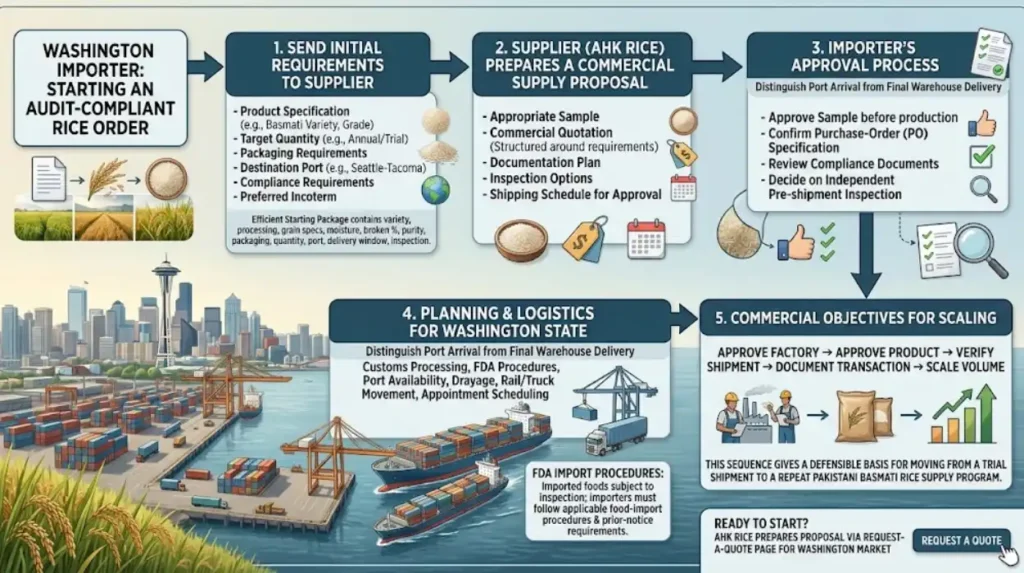
Start by sending the product specification, target quantity, packaging requirement, destination port, compliance requirements, and preferred Incoterm. The supplier can then prepare the appropriate sample, commercial quotation, documentation plan, inspection option, and shipping schedule for approval.
The most efficient starting package contains the Basmati variety, processing grade, grain specification, moisture target, broken percentage, purity requirement, packaging format, annual or trial quantity, destination such as Seattle-Tacoma, desired delivery window, and inspection requirements.
AHK Rice can then structure the quotation around the actual commercial requirement instead of providing a generic rice price. The buyer should approve the sample before production, confirm the purchase-order specification, review compliance documents, and decide whether independent pre-shipment inspection is required.
For Washington State, planning should also distinguish the port arrival date from final warehouse delivery. Customs processing, FDA procedures, port availability, drayage, rail or truck movement, and appointment scheduling can extend the total supply-chain timeline beyond the vessel’s published transit time. FDA confirms that imported foods are subject to inspection and that importers must follow applicable food-import procedures and prior-notice requirements.
The commercial objective is straightforward: approve the factory, approve the product, verify the shipment, document the transaction, and then scale the order volume. That sequence gives Washington importers a defensible basis for moving from a trial shipment to a repeat Pakistani Basmati rice supply program.
When the specification, sample, audit evidence, compliance requirements, and shipping plan are ready, AHK Rice can prepare the commercial supply proposal through its request-a-quote page for the Washington market.
Frequently Asked Questions
What makes Pakistani Basmati rice audit-compliant for Washington State imports?
Audit-compliant Pakistani Basmati rice should come from a verified processing facility with documented sanitation, traceability, quality testing, storage, packaging, and corrective-action controls. Importers should also review applicable U.S. food-import and supplier-verification requirements.
Why are factory audits important when importing Basmati rice into Washington?
Factory audits help Washington importers verify that the supplier can consistently meet agreed specifications. They provide evidence about processing controls, hygiene, laboratory testing, storage, packaging, traceability, and production practices before a commercial shipment is approved.
Which Pakistani Basmati rice varieties can Washington importers source?
Washington importers can source varieties such as 1121 Basmati, Super Kernel, and 1509 Basmati. The appropriate variety depends on the buyer’s target market, cooking requirements, grain-length specification, packaging format, and price position.
How does the Basmati rice sample approval process work?
The process normally starts with specification confirmation, followed by sample selection, packing, dispatch, buyer inspection, laboratory testing where required, cooking evaluation, written approval, commercial production, and optional third-party pre-shipment inspection.
How much does a Pakistani Basmati rice sample cost?
The rice sample may be supplied without a rice charge under the supplier’s sample policy, while the buyer generally pays applicable courier, phytosanitary, laboratory, and independent inspection costs. Actual charges depend on sample weight, destination, and testing requirements.
How long does Pakistani Basmati rice take to reach Washington State?
Transit time depends on the Pakistani origin port, shipping line, transshipment, vessel schedule, and destination port. Current 2026 schedules can show roughly 50–61 days of ocean transit to Seattle on some FCL services, excluding additional port and inland delivery time.
What documents should Washington rice importers request?
Importers should establish a document checklist covering the commercial invoice, packing list, bill of lading, certificate of origin, applicable phytosanitary and fumigation documents, laboratory reports, inspection reports, product specifications, certifications, and documentation required for U.S. import compliance.