Pakistani Rice Varieties Competitive in the Vietnamese Market in 2026
1121, Super Kernel, and 1509 Basmati rice grades offer the strongest Pakistani options for Vietnam’s niche imported-rice demand in 2026. Here is why: Vietnam is a major rice producer, yet import records show active demand for specialty Basmati from Pakistan. Volza recorded Pakistan as the leading Basmati supplier by shipment count in its Vietnam dataset, with Pakistan accounting for 51% of recorded Basmati shipments. Buyers should therefore compete through grain specification, aroma, processing, documentation, packaging, and landed cost rather than commodity volume.
Vietnamese import demand requires a different approach from Gulf or European markets. Buyers should match the rice variety to premium foodservice, specialty retail, ethnic distribution, and food-processing requirements. The broader Vietnam rice import shifts and niche demand opportunities provide the market context, while how buyers verify supplier credibility and quality standards supports the due-diligence stage. Pakistan-to-Vietnam shipment records confirm that Basmati and parboiled rice already move through this trade route.
What is the best solution for competing in Vietnam?
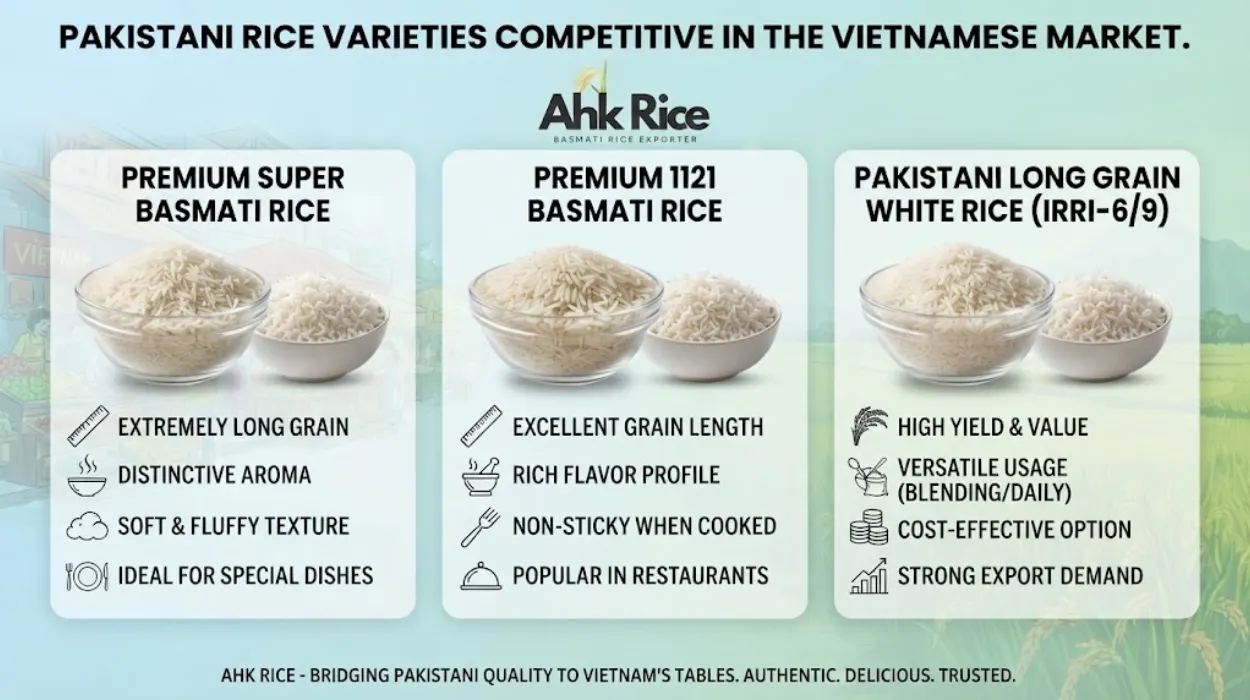
1121 Basmati should lead premium positioning, Super Kernel should target aromatic value, and 1509 should address cost-sensitive specialty demand. Here is why: each grade creates a different balance between grain length, aroma, processing, price, and buyer application.
1121 Basmati
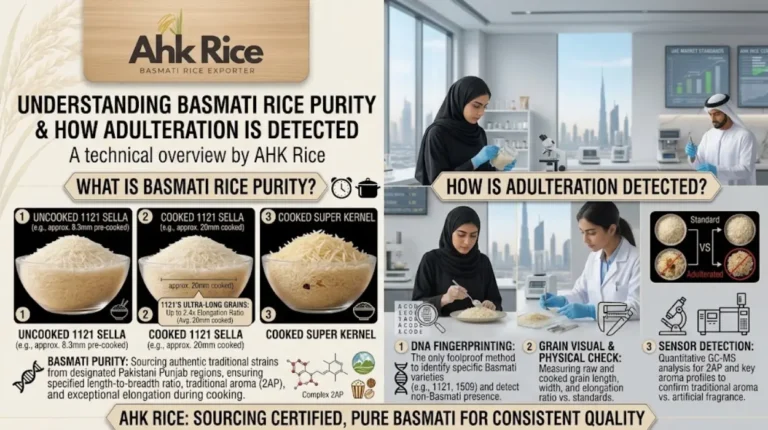
1121 Basmati provides the strongest premium proposition for Vietnamese buyers seeking long-grain aromatic rice. The variety supports premium restaurants, hotels, specialty distributors, and South Asian food channels.
1121 Steam suits buyers prioritising fresh white appearance and cooked grain separation. 1121 Sella suits foodservice buyers requiring parboiled performance and stronger handling characteristics.
Super Kernel Basmati
Super Kernel provides traditional Pakistani Basmati aroma with a strong value proposition. AHK Rice supplies Super Kernel for buyers comparing aromatic performance against landed procurement cost.
The commercial specification should target 7.0–7.5 mm raw grain, controlled moisture, low broken percentage, and consistent grading. Final COA approval should precede commercial dispatch.
1509 Basmati
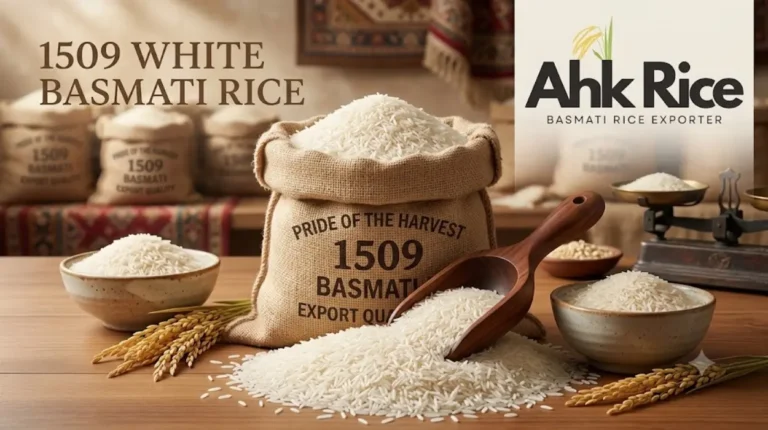
1509 provides a cost-focused alternative for buyers requiring long grain without paying the premium associated with traditional Basmati positioning. Pakistani 1509 commonly enters trade discussions around 8.10–8.50 mm raw grain, depending on grade and specification.
1509 Steam suits high-volume white-rice presentation. 1509 Golden Sella suits catering and institutional applications requiring parboiled handling performance.
The product decision therefore depends on the buyer’s application, not simply the longest grain.
Why choose AHK Rice for Vietnam supply?
AHK Rice combines Pakistani Basmati sourcing, processing, grading, packaging, inspection, and export coordination into one specification-led supply process. Here is why: Vietnamese buyers need consistent documentation and physical specifications before committing container volume.
AHK Rice sources Pakistani Basmati from Punjab and manages the commercial process from grain selection through shipment coordination. Its core export varieties include 1121, Super Kernel, and 1509.
The processing workflow covers the key quality controls required for commercial supply:
- Clean the paddy to remove field and foreign material.
- De-husk the grain through controlled milling.
- Polish the grain according to the agreed finish.
- Grade the rice according to size and quality.
- Sort the grain through mechanical and colour-based controls.
- Inspect the finished rice against the agreed specification.
- Pack the rice according to buyer requirements.
- Load the shipment after documentation and quality approval.
AHK Rice can also support custom packaging for Vietnamese importers developing retail or private-label programs. Packaging should specify variety, net weight, origin, production details, shelf-life information, and required compliance information.
What results can be expected from Pakistani rice in Vietnam?
The strongest opportunity is specialised demand rather than direct competition with Vietnam’s domestic mainstream rice supply. Here is why: Vietnam produces substantial quantities of rice, while Pakistani shipments concentrate on differentiated imported products.
Volza recorded 77 Pakistan-to-Vietnam rice shipments involving 10 Vietnamese buyers and 8 Pakistani suppliers in its August 2026 dataset. The same dataset showed a 20% decline against the previous twelve-month period, confirming that supplier selection must be targeted.
Basmati records show stronger niche depth. Volza identified 2,887 Basmati import shipments involving 502 Vietnamese buyers and 206 suppliers in its December 2025 dataset. Pakistan represented the largest supplier origin by shipment share in that dataset.
Shipment records also show actual Pakistani Basmati transactions into Vietnam. Examples include 20 kg Basmati shipments recorded in January and March 2025. Parboiled Pakistani rice also appears in historical Vietnam shipment records.
The practical result is clear. A buyer should present a defined grade, grain specification, packaging format, COA, inspection plan, and commercial quotation instead of offering generic “Pakistani rice.”
How long does shipping from Pakistan to Vietnam take?
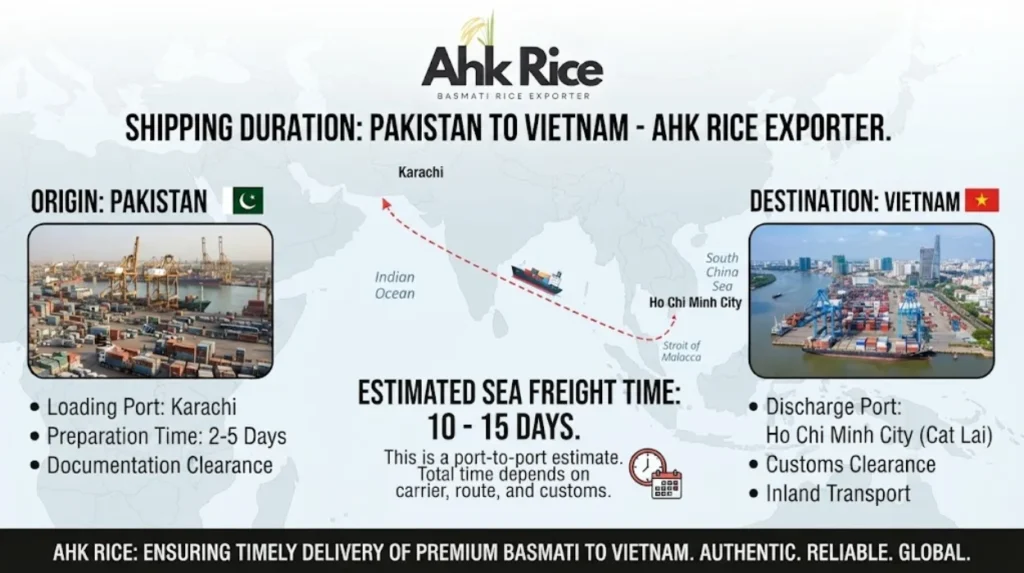
Karachi-to-Vietnam sea transit commonly requires about 14–20 days, with Ho Chi Minh City and Hai Phong serving as practical destination options. Here is why: Pakistan exporters can dispatch containerised cargo from Karachi toward Vietnam’s principal commercial ports.
Ho Chi Minh City suits southern Vietnam distribution and major foodservice centres. Hai Phong provides access to northern distribution networks and Hanoi-area buyers.
Actual delivery time includes more than ocean transit. Buyers should allow additional time for container booking, port handling, customs clearance, inspection, and local delivery.
A practical commercial schedule is:
| Stage | Typical planning period |
|---|---|
| Specification confirmation | 1–2 days |
| Sample approval | 3–10 days |
| Production and packing | 5–10 days |
| Container booking and loading | 2–5 days |
| Sea transit | 14–20 days |
| Destination clearance | Buyer-dependent |
Vietnam should therefore be planned as a specification-to-delivery project rather than a simple freight transaction.
What does the rice sample process cost?
AHK Rice can provide Super Kernel samples up to 20 kg for evaluation, while the buyer covers courier shipping and applicable phytosanitary charges. Here is why: sample approval should confirm physical quality before the buyer commits to commercial volume.
The sample process should follow a controlled sequence:
- Define the variety and required grade.
- Confirm the grain specification including length, moisture, broken percentage, and processing type.
- Request the sample with the intended packaging and application.
- Dispatch the sample after preparation and export checks.
- Test the sample for cooking performance and physical quality.
- Approve the COA against the commercial specification.
- Confirm the commercial quotation and Incoterm.
- Approve the production lot before container loading.
Courier pricing changes according to sample weight, destination, service level, and customs requirements. A fixed Vietnam courier amount should therefore be confirmed against the buyer’s delivery address.
The free Super Kernel sample reduces the product-testing barrier, while the buyer retains responsibility for courier and applicable phytosanitary charges.
What factors affect Pakistani rice pricing for Vietnam?
Vietnam pricing depends on variety, processing grade, grain length, broken percentage, moisture, packaging, quantity, freight, inspection, and Incoterm. Here is why: FOB pricing alone does not represent the buyer’s final landed procurement cost.
1121 generally commands a premium because of its long-grain and aromatic positioning. Super Kernel competes through aroma and value. 1509 competes through yield economics and price-sensitive applications.
Packaging also changes the quotation. Bulk PP bags, retail packs, private-label packaging, and printed consumer bags carry different production and handling requirements.
Freight must also be calculated separately. A Vietnam buyer should compare FOB Karachi with CFR or CIF pricing using the same quantity, specification, destination port, and payment terms.
The correct buying decision is therefore based on landed cost per usable tonne, not headline FOB price.
How should Vietnamese buyers choose between 1121, Super Kernel, and 1509?
Choose 1121 for premium positioning, Super Kernel for aromatic value, and 1509 for cost-sensitive long-grain applications. Here is why: the three varieties address different commercial priorities.
| Buyer priority | Recommended variety | Primary reason |
|---|---|---|
| Premium restaurant use | 1121 | Long grain and aroma |
| Specialty retail | 1121 | Premium consumer positioning |
| Aromatic value | Super Kernel | Traditional Basmati character |
| Catering | 1509 Golden Sella | Parboiled handling |
| Cost-sensitive distribution | 1509 | Competitive procurement economics |
Vietnamese buyers should request samples from the intended grade before placing a container order. A 20 kg evaluation sample provides a practical basis for cooking tests, appearance checks, packaging review, and laboratory verification.
How do buyers get started with AHK Rice?
Start with a precise specification, approve a sample, verify documents, confirm landed cost, and then release the commercial order. Here is why: specification-led procurement reduces quality disputes and keeps the shipment aligned with the buyer’s intended market.
The starting information should include variety, processing type, grain length, broken percentage, moisture requirement, quantity, bag size, destination port, and preferred Incoterm.
AHK Rice can then prepare the appropriate product specification and commercial quotation. The buyer evaluates the sample and documentation before approving the final lot.
Vietnam’s market is competitive, but Pakistani Basmati has an identifiable niche. Current shipment records demonstrate established Pakistan-to-Vietnam trade, while Basmati data shows meaningful Pakistani supplier participation.
The decision is straightforward: use 1121 for premium demand, Super Kernel for aromatic value, and 1509 for cost-sensitive applications. AHK Rice provides the specification-led sourcing and export workflow required to move from sample approval to container shipment.
For a Vietnam-specific specification and export quotation, submit your requirements through AHK Rice’s request-a-quote page.
Frequently Asked Questions
Which Pakistani rice variety is best for Vietnam?
1121 Basmati is the strongest premium option.
Super Kernel provides aromatic value at a competitive position.
1509 targets cost-sensitive long-grain applications.
The final choice depends on buyer application.
Sample approval should precede container procurement.
Does Vietnam import Basmati rice from Pakistan?
Yes, Vietnam imports Pakistani Basmati rice.
Volza records Pakistan among the leading Basmati origins.
Pakistan represented 51% of recorded Basmati shipments in one dataset.
Shipment records also show Pakistani Basmati transactions.
This confirms an established niche trade route.
How long does Pakistan-to-Vietnam rice shipping take?
Sea transit commonly takes about 14–20 days.
Karachi is the principal Pakistani loading point.
Ho Chi Minh City serves southern distribution.
Hai Phong serves northern distribution.
Clearance and local delivery require additional planning.
What does an AHK Rice sample cost?
AHK Rice can provide Super Kernel samples up to 20 kg.
The product sample itself can be supplied for evaluation.
The buyer covers courier shipping.
Applicable phytosanitary charges are also buyer-paid.
Final courier costs depend on destination and sample weight.
What documents should Vietnamese rice buyers verify?
Buyers should verify the commercial invoice and packing list.
The certificate of origin should match the shipment.
The COA should match the approved rice specification.
Inspection and phytosanitary documents should meet destination requirements.
Packaging and labelling should match the agreed import specification.