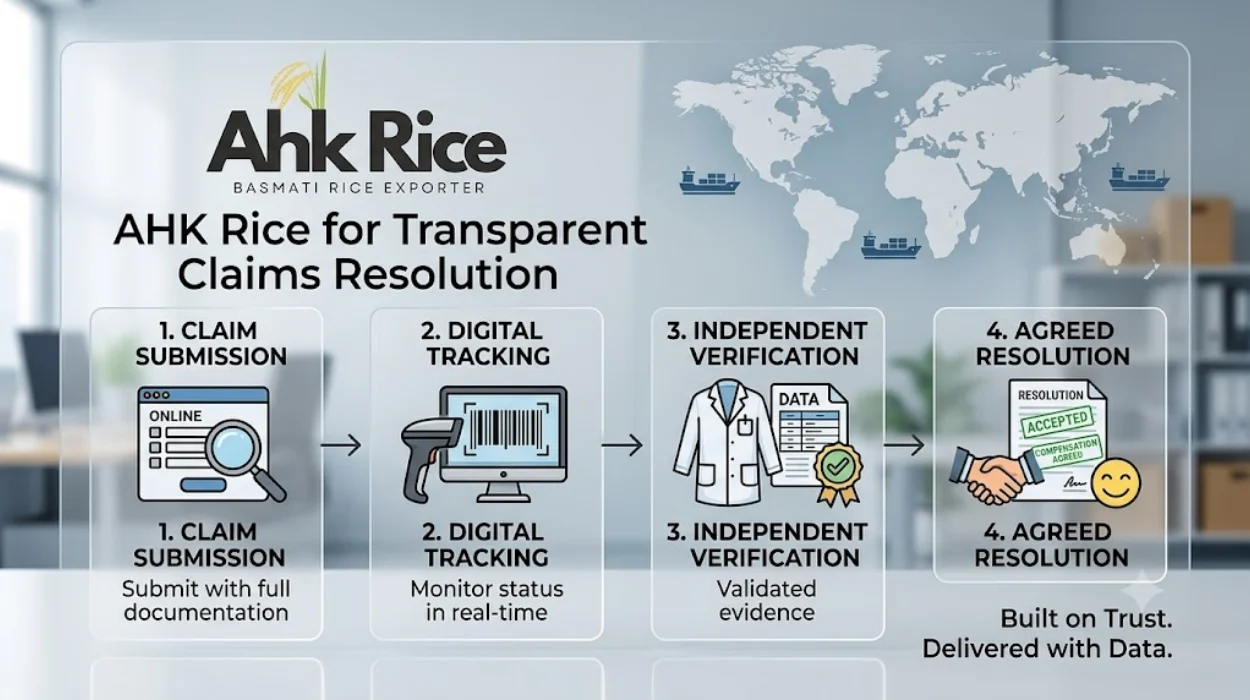
Choose AHK Rice for Transparent Claims Resolution and Support
When a rice shipment arrives with quality or quantity issues, the fastest way to protect your investment is to work with an exporter that has a transparent claims process. AHK Rice provides documented quality controls, pre-shipment inspections, sample approvals, and direct communication that help buyers resolve disputes efficiently and reduce commercial risk.
Before selecting an exporter, buyers should understand what happens when imported rice does not meet specifications. This guide builds on our educational article, understanding quality failures in imported Basmati rice shipments, and explains why AHK Rice is a preferred partner for importers seeking dependable claims support and transparent trade practices.
What is the best solution when an imported rice shipment has a quality or quantity dispute?
The best solution is choosing an exporter that documents every stage of production, sampling, inspection, loading, and shipping. A transparent claims process supported by laboratory reports, approved samples, and shipment records helps importers resolve disputes faster while minimizing financial losses and supply chain disruptions.
Many importers focus exclusively on price when sourcing rice. However, the true cost of a shipment is revealed when a dispute occurs.
Common issues include:
- Excess broken grains
- Moisture outside agreed specifications
- Short weight deliveries
- Packaging damage
- Color variation
- Foreign matter contamination
- Delayed arrivals
AHK Rice addresses these risks through a documented quality management process. Every shipment passes through cleaning, grading, sorting, quality inspection, packaging, and export documentation procedures before container loading.
For buyers importing Basmati rice into the UAE, Saudi Arabia, Qatar, Germany, the UK, Africa, or Southeast Asia, documentation becomes the foundation of successful claims resolution.
AHK Rice maintains transparency through shipment records, inspection reports, and buyer-approved specifications. This approach reduces misunderstandings and creates objective evidence if a claim is raised.
Importers seeking detailed dispute procedures can also review our complete guide to quantity and quality dispute handling before placing large-volume orders.
Why choose AHK Rice for transparent claims resolution and support?
AHK Rice combines quality control, pre-shipment verification, sample approvals, direct communication, and complete export documentation under one system. This integrated approach provides buyers with clear evidence, faster issue resolution, and stronger protection when commercial disputes occur during international rice trade.
AHK Rice operates from Punjab, Pakistan, one of the world’s leading Basmati-producing regions. The company manages processing, grading, sorting, packaging, documentation, and logistics within a controlled supply chain.
Unlike exporters that rely heavily on third parties, AHK Rice maintains direct oversight throughout production.
Key advantages include:
Pre-Shipment Inspection
AHK Rice conducts quality checks before loading containers. Buyers receive confirmation that products meet agreed specifications before export.
Sample Approval System
Every commercial relationship should begin with approved samples.
AHK Rice encourages buyers to evaluate:
- Grain length
- Broken percentage
- Aroma
- Moisture level
- Color consistency
- Cooking performance
The approved sample becomes the benchmark for future shipments.
Transparent Documentation
AHK Rice provides export documentation including:
- Commercial invoice
- Packing list
- Certificate of origin
- Phytosanitary certificate
- Fumigation certificate
- Bill of lading
Proper documentation supports both customs clearance and claims investigations.
Third-Party Inspection Availability
Independent inspections help verify quality objectively and strengthen trust between buyers and suppliers. Industry-standard inspection practices often include sampling, loading supervision, quantity verification, and laboratory testing.
Direct Communication
AHK Rice emphasizes direct communication with buyers rather than routing requests through multiple intermediaries. This reduces delays when resolving shipment concerns.
What results can buyers expect from AHK Rice?
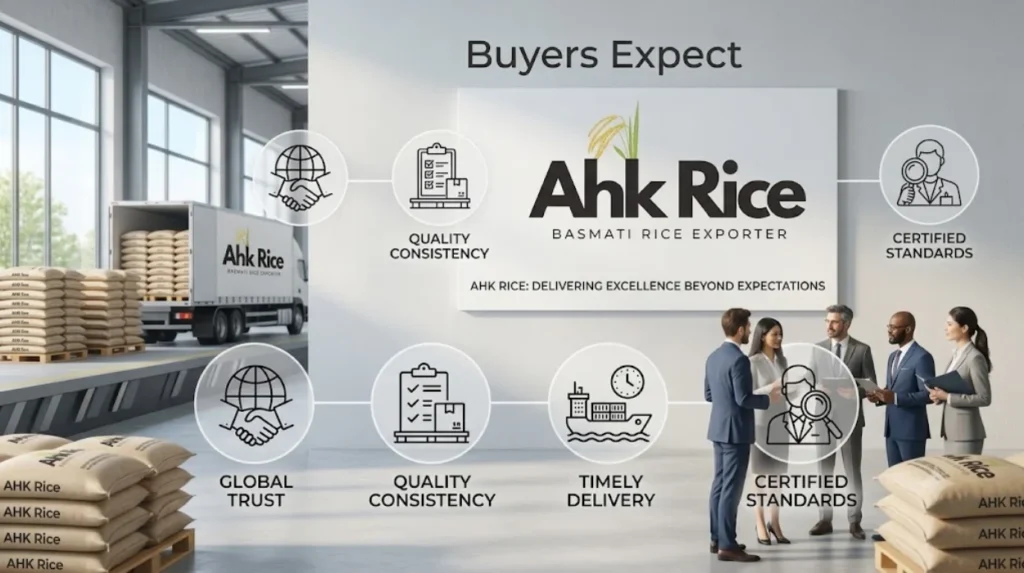
Buyers can expect greater supply chain visibility, lower dispute risk, faster claim handling, improved shipment consistency, and stronger confidence in contract performance. Transparent documentation and approved specifications help create measurable commercial protection for rice importers.
The primary result is risk reduction.
When quality expectations are documented before production, both parties understand the target specifications.
AHK Rice supports buyers through:
- Product specification confirmation
- Sample approval
- Production monitoring
- Quality verification
- Export documentation
- Shipping coordination
This structured approach helps reduce disputes before they occur.
Example Scenario 1
A distributor in the UAE orders 1121 Steam Basmati Rice.
The buyer approves a sample showing:
- 2% broken grains
- Specific grain length
- Defined moisture range
Upon arrival, the shipment matches approved specifications.
Result:
The buyer maintains retail consistency and avoids customer complaints.
Example Scenario 2
A wholesaler in East Africa receives a shipment with packaging damage caused during transit.
Because shipment records and loading documentation exist, responsibility can be evaluated more accurately.
Result:
The resolution process becomes faster and more objective.
Example Scenario 3
A European importer requires strict compliance documentation.
AHK Rice provides certification support and export records needed for regulatory review.
Result:
Reduced clearance delays and stronger buyer confidence.
How does the AHK Rice sample process work and what are the costs?
The sample process allows buyers to verify quality before committing to bulk orders. Approved samples establish clear expectations, reduce commercial uncertainty, and create an objective reference point that supports dispute resolution if future shipments are questioned.
A typical sample process includes:
Step 1: Requirement Discussion
Buyer specifies:
- Rice variety
- Broken percentage
- Moisture target
- Packaging preference
- Destination market
Step 2: Sample Preparation
AHK Rice prepares representative samples matching requested specifications.
Step 3: Sample Dispatch
Samples are shipped internationally for evaluation.
Typical Sample Costs
Costs vary by destination and courier service.
Generally:
| Item | Typical Cost Range |
|---|---|
| Sample Product | Often complimentary |
| Courier Charges | $40–$120 |
| Specialized Testing | Variable |
| Third-Party Inspection | Variable |
Actual costs depend on destination country, courier provider, and testing requirements.
Step 4: Approval
The buyer reviews:
- Appearance
- Aroma
- Cooking quality
- Grain length
- Uniformity
Step 5: Commercial Production
After approval, production proceeds according to the agreed benchmark.
This process significantly reduces the likelihood of future disputes.
How long does shipping take to different markets?
Shipping times vary according to destination, carrier schedules, port congestion, customs processing, and vessel availability. Buyers should plan inventory based on realistic transit windows rather than ideal estimates to avoid supply interruptions and stock shortages.
Typical transit estimates from Pakistan include:
| Market | Estimated Shipping Days |
|---|---|
| UAE | 10–15 Days |
| Saudi Arabia | 12–18 Days |
| Qatar | 10–16 Days |
| Oman | 10–18 Days |
| Turkey | 20–30 Days |
| Germany | 30–45 Days |
| United Kingdom | 30–45 Days |
| East Africa | 20–35 Days |
| Southeast Asia | 15–30 Days |
Actual schedules depend on shipping lines, transshipment routes, and seasonal demand.
AHK Rice coordinates logistics and export documentation to support efficient delivery planning.
What factors affect pricing and claims risk?
Price should never be evaluated independently from quality specifications. Lower prices often correspond to different grades, higher broken percentages, reduced processing standards, or weaker documentation support that can increase commercial risk after shipment.
Key pricing factors include:
- Rice variety
- Crop season
- Broken percentage
- Grain length
- Packaging type
- Container volume
- Destination market
- Freight costs
- Inspection requirements
Importers should compare total commercial value rather than FOB price alone.
AHK Rice helps buyers align specifications with market requirements and budget objectives through customized sourcing solutions.
How do I get started with AHK Rice?
The process begins with sharing your target market, product specifications, quantity requirements, and packaging needs. After sample approval and quotation review, production planning and shipment scheduling can proceed according to agreed commercial terms.
Getting started is straightforward.
- Define product specifications.
- Request a quotation.
- Review sample options.
- Approve benchmark samples.
- Confirm commercial terms.
- Begin production.
- Monitor shipment progress.
AHK Rice continues to support international buyers through transparent communication, documented quality controls, and practical claims resolution procedures. Whether sourcing for the Middle East, Europe, Africa, or Asia, AHK Rice provides a structured approach designed to reduce risk and improve purchasing confidence. AHK Rice prioritizes clarity, AHK Rice focuses on quality consistency, and AHK Rice supports buyers throughout the supply chain. AHK Rice delivers export-grade rice backed by documentation, while AHK Rice helps buyers navigate commercial challenges with greater confidence. For a customized offer, visit Request a Quote.
Frequently Asked Questions
How does AHK Rice handle quality claims?
AHK Rice evaluates claims using shipment records, approved samples, inspection reports, and supporting documentation. The objective is to compare delivered goods against agreed specifications. This structured approach helps determine the source of the issue. Proper records improve transparency and speed up resolution. Buyers benefit from a documented review process.
Why is sample approval important before placing a bulk order?
Sample approval establishes a clear quality benchmark before commercial production begins. Buyers can verify grain length, aroma, moisture, and cooking performance. The approved sample becomes the reference point for future shipments. This reduces misunderstandings and supports fair claim evaluations. It is one of the most effective risk-management tools.
Can buyers request third-party inspections?
Yes. Independent inspections can be arranged when required. Third-party verification provides objective quality assessment before shipment. Inspection services may include sampling, loading supervision, and quantity verification. These reports strengthen confidence for both buyers and sellers. Independent verification is widely used in international trade.
What documents support claims investigations?
Claims reviews often rely on commercial invoices, packing lists, inspection reports, certificates, shipping records, and approved samples. These documents help verify specifications and shipment conditions. Accurate documentation creates transparency throughout the transaction. It also helps identify where issues may have occurred. Strong records support faster resolution.
Does AHK Rice export to multiple international markets?
Yes. AHK Rice supplies buyers across the Middle East, Europe, Africa, and Asia. The company supports international shipments through export documentation and logistics coordination. Different markets require different specifications and certifications. AHK Rice works with buyers to align products with destination requirements. This helps improve consistency and compliance.