2% vs 5% Broken Basmati Rice: Which Grade Suits UAE Retail, HoReCa and Wholesale?
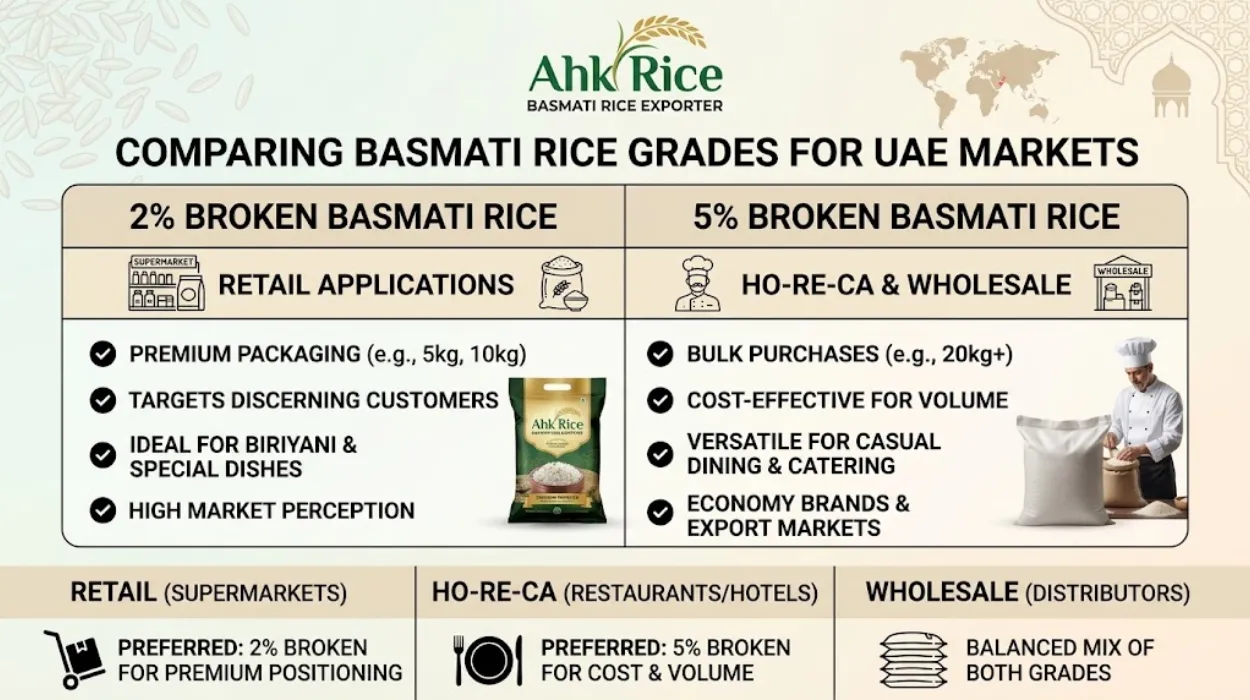
2% broken Basmati rice suits UAE premium retail and buyers prioritising whole-kernel appearance, while 5% broken Basmati rice suits cost-conscious wholesalers, restaurants and bulk foodservice operators seeking a balance between presentation and purchasing cost. The correct grade depends on the buyer’s target market, cooking requirements, retail positioning and acceptable broken-kernel percentage.
UAE rice importers need to compare broken percentage alongside grain length, aroma, moisture, processing method, packaging and landed cost. Understanding Pakistani Basmati rice grades and export specifications helps buyers evaluate 1121, Super Kernel and 1509 varieties against retail, hospitality and wholesale requirements. A lower broken percentage improves visual consistency, but it does not automatically guarantee better aroma, cooking performance or overall value.
AHK Rice is a trusted Pakistani Basmati rice exporter based in Punjab, supplying 1121, Super Kernel and 1509 varieties to more than 15 countries. Its export process covers sourcing, milling, grading, packaging and shipment coordination. For UAE buyers, the practical objective is to select a grade that meets the intended use, protects the product’s market positioning and delivers a commercially workable cost per tonne.
What are 2% and 5% broken Basmati rice grades?
Broken Basmati rice grades describe the proportion of kernels classified as broken within a rice lot. A 2% broken specification permits a lower broken-kernel proportion than a 5% specification, making the former more suitable for appearance-sensitive applications. Buyers must confirm the measurement method and contractual tolerances before comparing supplier quotations.
Broken rice consists of kernel fragments produced during harvesting, handling, milling or subsequent processing. The percentage generally represents the broken fraction by weight, although the buyer and supplier must confirm the applicable grading method. A 2% broken specification allows less broken material than a 5% specification under the same measurement standard.
A commercial specification should also define grain length, variety, moisture, foreign matter, damaged kernels and processing type. A shipment described as 2% broken does not necessarily have longer grains or stronger aroma than every 5% broken alternative. Those characteristics depend on the variety, raw material quality, processing controls and agreed product specification.
For example, a UAE retailer selling premium 1121 Basmati may prioritise long, uniform grains and an attractive cooked appearance. A restaurant purchasing rice for daily meal preparation may accept a 5% broken specification if it meets the kitchen’s cooking and portioning requirements at a competitive price.
How do different broken Basmati rice specifications compare?
The main difference between 2% and 5% broken Basmati rice is the balance between whole-kernel presentation, acceptable processing yield and purchase economics. Both grades can serve commercial buyers, but each must meet the variety-specific cooking, appearance and quality standards required by its sales channel.
| Specification attribute | 2% broken Basmati | 5% broken Basmati |
|---|---|---|
| Broken-kernel limit | Lower broken fraction | Higher broken fraction |
| Whole-kernel appearance | Better suited to premium presentation | Suitable for standard retail and foodservice when approved |
| Product positioning | Premium retail and appearance-led products | Value-focused retail, wholesale and HoReCa |
| Purchase economics | Typically commands a premium when other specifications are comparable | Can offer a lower purchase cost when other specifications are comparable |
| Grain length | Must be specified separately | Must be specified separately |
| Aroma and cooking quality | Depends on variety and processing | Depends on variety and processing |
| Quality verification | Requires agreed broken percentage, sampling and inspection | Requires the same agreed testing and inspection controls |
The table compares commercial positioning rather than a universal price list. Actual quotations depend on the Basmati variety, white or parboiled processing, grain length, crop and stock conditions, order volume, packaging and shipment terms.
Buyers should also distinguish broken percentage from grain length. A long-grain 1121 shipment with 5% broken kernels can still have longer intact grains than a different variety with 2% broken kernels. Likewise, 1509 and Super Kernel require their own variety-specific specifications.
The most reliable comparison uses the same variety, processing method, packing weight, order quantity and Incoterm. Comparing a 2% broken 1121 Steam quotation with a 5% broken 1509 White quotation does not isolate the commercial impact of broken percentage.
What rice grades are available for UAE retail, HoReCa and wholesale?
UAE importers can evaluate 1121, Super Kernel and 1509 Basmati in white, steam or parboiled forms, depending on supplier availability. The appropriate broken percentage depends on the product’s target price, expected cooked appearance, menu requirements and customer expectations.
1. 1121 Basmati rice
1121 Basmati is associated with extra-long grain characteristics and elongated cooked kernels. Premium grocery brands, specialist rice retailers and upscale foodservice buyers often prioritise intact grains for biryani, pulao and presentation-led meals. A 2% broken specification supports that positioning, particularly when grain length and cooking performance are verified.
A 5% broken 1121 grade remains an option for wholesale distribution and commercial kitchens that value 1121’s grain characteristics but operate under tighter cost limits. The buyer should confirm that the agreed specification delivers the expected balance of whole grains and fragments.
2. Super Kernel Basmati rice
Super Kernel is a traditional aromatic Pakistani Basmati variety valued for its characteristic aroma and cooked texture. Ethnic grocery stores, South Asian wholesalers and restaurants can compare both broken percentages according to the retail segment or kitchen application.
A 2% broken specification fits premium branded packs and buyers seeking consistent whole-kernel presentation. A 5% broken specification can suit everyday household packs and restaurants where the cost per prepared serving carries greater weight than a small difference in visual uniformity.
3. 1509 Basmati rice
1509 Basmati offers buyers another long-grain option for volume-oriented distribution and foodservice. Its commercial appeal depends on the variety’s grain characteristics, processing format, availability and price relative to competing grades.
UAE wholesalers can assess 5% broken 1509 for price-sensitive channels, catering and bulk restaurant supply. Retailers selling premium-looking rice can request a 2% broken specification if the price difference supports their intended selling price and margin.
Which broken rice grade suits the UAE market?
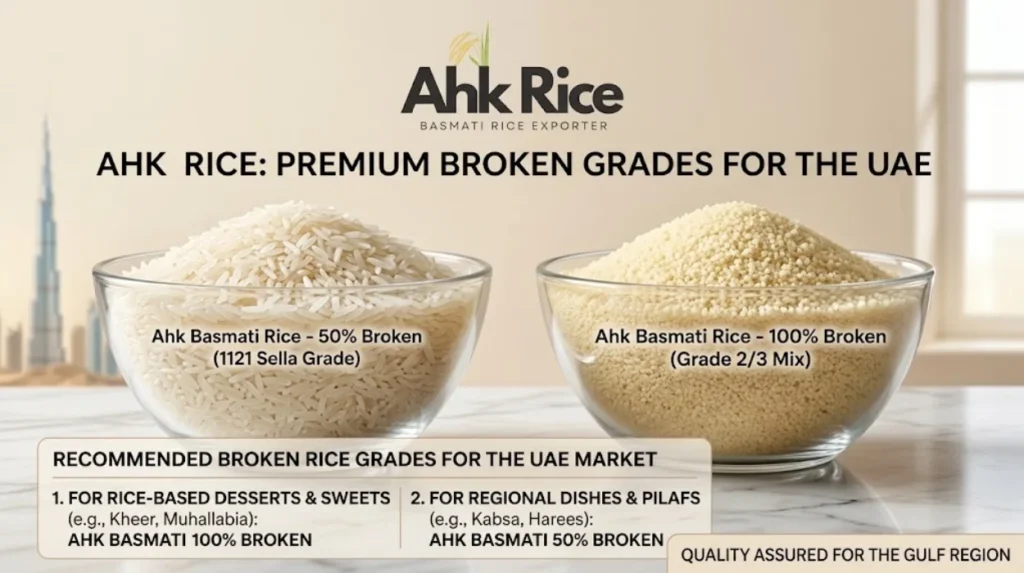
The best grade for UAE buyers depends on the sales channel rather than broken percentage alone. Premium retail generally benefits from stricter whole-kernel control, while high-volume wholesalers and restaurants can prioritise total cost, cooking consistency and reliable supply when their customers accept the specification.
UAE premium retail
Premium supermarkets, specialist grocery shops and private-label brands depend on product appearance, clear labelling and consistent quality between shipments. A 2% broken grade supports these requirements by limiting the proportion of broken kernels.
For example, a retailer selling 5 kg packs of premium 1121 Basmati can use a lower broken-kernel limit as one part of its quality proposition. The commercial decision should also consider aroma, grain length, cooking performance, packaging quality and shelf presentation.
UAE HoReCa and institutional foodservice
HoReCa refers to hotels, restaurants and catering businesses. These buyers evaluate rice by its performance in the kitchen, portion yield, holding characteristics and cost per meal.
A restaurant producing biryani in large batches may prefer 2% broken rice when intact grains are essential to its presentation. A staff canteen or catering operator serving everyday meals may choose 5% broken rice when the approved sample meets its requirements and lowers purchasing costs.
Golden Sella and other parboiled formats should be assessed separately because processing affects colour, texture and handling characteristics. Broken percentage alone does not determine how well rice holds during service.
UAE wholesale and distribution
Wholesalers supply supermarkets, independent grocers, restaurants and smaller distributors. Their buying decisions balance resale price, customer expectations, stock turnover and supplier reliability.
A distributor serving multiple customer segments can maintain separate specifications: 2% broken for premium retail accounts and 5% broken for value-oriented wholesale or foodservice customers. This approach reduces the risk of paying for premium specifications when the end customer does not require them.
How do prices per metric tonne compare between 2% and 5% broken rice?
A 2% broken Basmati specification can cost more per metric tonne than a comparable 5% broken specification because it requires tighter control of the broken-kernel proportion. The actual price premium varies by variety, processing, order size, packaging, quality requirements and shipment terms.
There is no single fixed price difference between the two grades across the UAE market. Buyers should request quotations for identical product specifications before deciding whether the lower broken percentage justifies its additional cost.
| Cost factor | 2% broken grade | 5% broken grade |
|---|---|---|
| Purchase price | Often higher for an otherwise comparable lot | Often lower for an otherwise comparable lot |
| Premium retail margin | Can support premium positioning | Depends on the retail price and customer acceptance |
| Foodservice economics | Useful where presentation justifies the extra cost | Useful where approved quality and lower acquisition cost matter |
| Wholesale resale | Fits premium distribution contracts | Fits value-led and volume-driven accounts |
| Cost comparison basis | USD per metric tonne on the same terms | USD per metric tonne on the same terms |
To compare offers, request the price in USD per metric tonne and identify whether it is FOB Karachi, CFR or CIF Jebel Ali, or another agreed delivery basis. FOB generally covers the seller’s obligations up to loading at the named port. CIF includes cost, insurance and freight to the named destination port under the applicable Incoterms rules. CFR includes cost and freight but does not require the seller to procure insurance for the buyer.
For a useful purchasing calculation, subtract the 5% broken quotation from the 2% broken quotation to establish the premium per tonne. Then calculate that difference against the buyer’s expected selling price, product positioning and projected sales volume. A lower purchase price does not automatically produce a higher profit if the grade fails to meet the customer’s requirements.
Does 2% broken Basmati rice have a longer shelf life than 5% broken rice?
Broken percentage alone does not determine Basmati rice shelf life. Both grades can maintain commercial quality under appropriate storage conditions, provided moisture, packaging integrity, warehouse hygiene and stock rotation are controlled. Processing type and product-specific storage guidance also affect the recommended shelf life.
Whole and broken kernels can differ in their exposure to handling damage and environmental conditions. However, a 2% broken lot does not automatically remain fresh longer than a 5% broken lot. Shelf life depends on the full product and storage specification rather than one grading measurement.
UAE importers should confirm the manufacturing or packing date, best-before period, storage instructions and packaging requirements with their supplier. Warehouses should protect rice from moisture, pests, direct sunlight and contamination. Stock rotation using first-in, first-out procedures helps distributors manage inventory and reduce avoidable losses.
White, steam and parboiled Basmati products may have different quality and storage considerations. Buyers should therefore obtain product-specific documentation instead of applying one assumed shelf-life figure to every variety and processing method.
For retail, sealed packaging and traceable batch information help protect quality throughout distribution. For HoReCa, bulk bags require dry storage, secure closure after opening and routine inspection. For wholesale, warehouse conditions and expected stock turnover should form part of the supplier evaluation.
What are the advantages and disadvantages of each grade?
The 2% broken grade prioritises whole-kernel appearance, while the 5% broken grade offers greater flexibility for cost-conscious purchasing. Neither specification is universally superior; the correct choice depends on the buyer’s quality threshold, customer segment and financial targets.
| Grade | Advantages | Disadvantages | Example application |
|---|---|---|---|
| 2% broken | Lower broken fraction; supports premium presentation | Can involve a higher purchase price | Premium 1121 retail packs |
| 2% broken | Useful for presentation-led dishes | Premium may not create additional value for every customer | Upscale hotel or restaurant biryani |
| 5% broken | Potentially lower purchase cost | Higher permitted broken fraction | Value-focused grocery distribution |
| 5% broken | Flexible for volume purchasing | May not meet strict premium appearance requirements | Large-scale catering and staff meals |
The principal advantage of 2% broken rice is greater control over whole-kernel presentation. Retailers can use it to meet a demanding product specification, but they still need to verify grain length, aroma, purity and cooking performance. Paying for 2% broken rice is less beneficial when the customer does not notice or value the difference.
The principal advantage of 5% broken rice is purchasing flexibility. A distributor can allocate it to customers whose requirements do not justify a premium grade. The trade-off is that the higher broken-kernel allowance may not satisfy every private-label contract or presentation-sensitive application.
For both grades, the supplier must deliver the contracted specification. A nominal 2% broken product that fails inspection is not preferable to a properly documented 5% broken product. Independent inspection, agreed sampling procedures and clear acceptance criteria reduce disputes.
Which grade works best for different UAE buyer requirements?
Choose 2% broken Basmati when premium appearance is a defined selling requirement. Choose 5% broken when customers accept the higher broken fraction and the purchase saving supports the business model. Confirm the variety, processing format, inspection criteria and landed cost before placing a bulk order.
The following decision framework connects each buyer’s priorities to a practical purchasing choice.
| Decision factor | Recommended approach | Reason |
|---|---|---|
| Premium retail presentation | Start with 2% broken | Supports a lower broken-kernel allowance |
| Everyday retail and value packs | Compare both grades | Customer expectations and shelf price determine value |
| Hotels and presentation-led restaurants | Test 2% broken | Whole-kernel appearance can matter in finished dishes |
| Catering and high-volume kitchens | Evaluate 5% broken | Cost and cooking performance can outweigh appearance |
| Wholesale and distribution | Segment by customer demand | Separate specifications support different selling prices |
Before confirming an order, buyers should evaluate a physical sample using their intended cooking method. The test should cover raw grain appearance, aroma, washing behaviour, cooking consistency, cooked grain separation and the proportion of broken kernels after preparation. Results should be recorded against the buyer’s acceptance criteria.
A sample is not a substitute for a contractual specification. The purchase agreement should define the variety, processing method, broken percentage, moisture limit, grain length, packaging, inspection process and remedies for non-conformity. This provides a consistent standard for both the approved sample and the shipment.
How should UAE importers verify a supplier before ordering?
UAE importers should approve a representative sample, confirm the complete product specification, review the supplier’s quality documents and agree on shipment terms before purchasing bulk Basmati rice. These checks help ensure the delivered grade matches the commercial requirements established during sourcing.
A practical sourcing process includes five steps:
- Define the grade: Specify 2% or 5% broken, variety, processing type, grain length and moisture limit.
- Request a quotation: Compare the same quantity, packaging format, Incoterm and destination across suppliers.
- Approve a sample: Evaluate raw and cooked rice against written acceptance criteria.
- Confirm inspection and documentation: Agree on sampling, quality certificates, shipment documents and any required third-party inspection.
- Approve the shipment plan: Confirm production readiness, packing, loading arrangements, transit estimates and destination requirements.
AHK Rice coordinates sourcing, processing, grading, custom packaging and export logistics for international buyers. UAE distributors should specify their intended sales channel before selecting a grade, because premium retail and bulk foodservice can require different purchasing criteria.
For distributors preparing a bulk procurement order, the next step is to evaluate sourcing low-broken Pakistani Basmati rice in bulk for UAE distribution. The quotation should identify the agreed broken percentage and all other specifications so that price comparisons reflect equivalent products.
FAQs about 2% vs 5% broken Basmati rice
Is 2% broken Basmati rice better than 5% broken rice?
2% broken Basmati has a lower permitted proportion of broken kernels, making it suitable for buyers who prioritise whole-grain appearance. A 5% broken grade can offer better purchasing economics for customers who accept the higher broken fraction.
Which broken Basmati rice grade is best for UAE restaurants?
Both grades can suit UAE restaurants. Choose 2% broken for presentation-led dishes such as premium biryani, and evaluate 5% broken for high-volume meals where the approved sample meets cooking and quality requirements.
Is 5% broken Basmati rice suitable for retail packaging?
Yes. A 5% broken grade can suit everyday and value-focused retail products when it meets the brand’s specifications and local labelling requirements. Premium brands may prefer a lower broken percentage to maintain a more uniform appearance.
Does 2% broken rice cost more per metric tonne?
A comparable 2% broken grade often carries a price premium over 5% broken rice. The actual difference depends on variety, processing, availability, quantity, packaging and delivery terms. Buyers should compare written quotations on the same basis.
Does broken percentage affect cooked grain length?
Broken kernels generally remain fragments during cooking, while intact kernels can elongate according to the rice variety and processing method. Broken percentage alone does not establish the elongation performance of the intact grains.