How Processing and Storage Preserve Basmati Aroma from Pakistani Mill to UAE Shelf
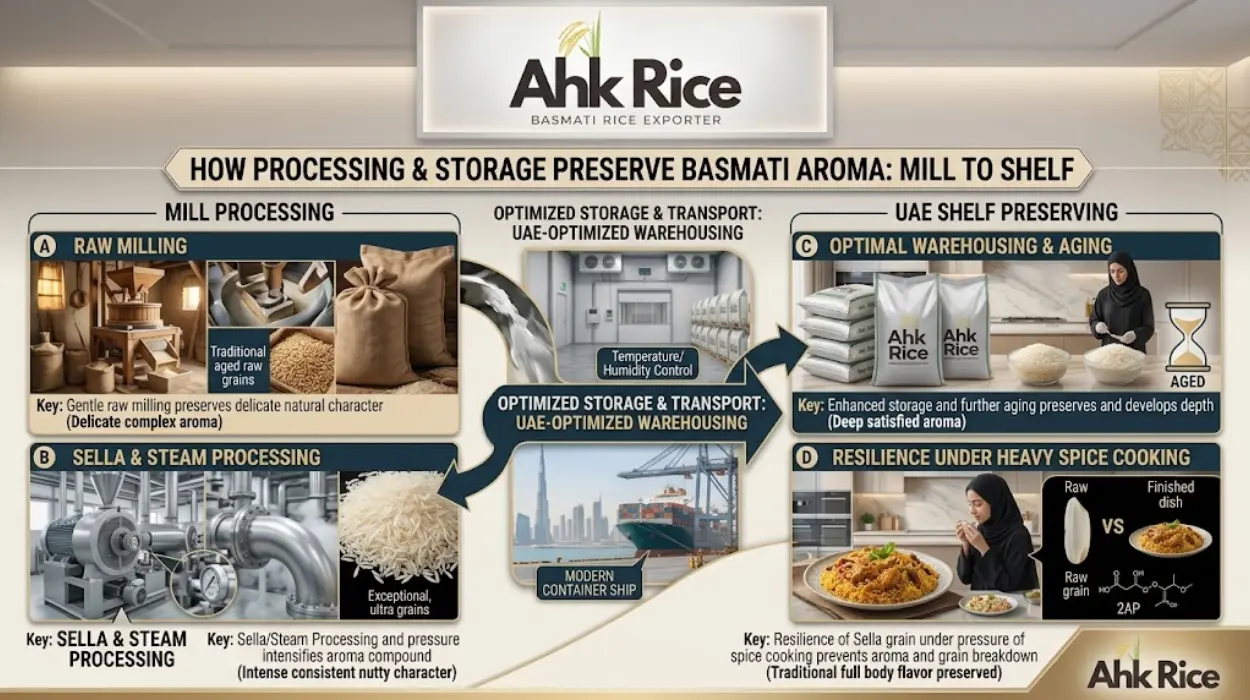
Controlled drying, careful milling, moisture management, and moisture-resistant packaging preserve Pakistani Basmati rice aroma more effectively than relying on variety selection alone. For UAE importers, the strongest approach combines suitable rice grades with hygienic handling, sealed packaging, and temperature-controlled storage practices throughout distribution.
The journey from a Pakistani rice mill to a UAE retail shelf exposes aromatic rice to several quality risks. Milling can damage grains, excessive moisture can encourage deterioration, and heat, humidity, and unsuitable packaging can reduce product quality. Understanding how Pakistani Basmati rice develops its aroma and distinctive grain characteristics helps buyers compare processing methods, storage systems, and grade specifications before choosing a supplier.
AHK Rice is a Pakistani Basmati rice exporter based in Punjab, supplying 1121, Super Kernel, and 1509 varieties to more than 15 countries. Its export workflow covers processing, grading, packaging, and shipment coordination. For UAE buyers, the objective is to select a combination of grain characteristics, processing controls, and packaging that maintains the expected cooking performance until the product reaches consumers.
What are the available solutions for preserving Basmati aroma?
The main solutions are controlled drying, gentle milling, effective grading, moisture-resistant packaging, hygienic warehousing, and monitored transport. Each method protects a different part of rice quality, so importers achieve better results by combining controls rather than depending on a single preservation technique.
Basmati aroma comes largely from 2-acetyl-1-pyrroline, a naturally occurring volatile compound associated with the characteristic fragrance of aromatic rice. Variety, growing conditions, grain maturity, and post-harvest handling influence aroma intensity. Processing and storage protect the aroma already present in the grain; they do not create an authentic varietal fragrance in ordinary rice.
The principal preservation solutions include the following:
- Controlled drying: Reduces moisture to a suitable storage level without unnecessary heat exposure or uneven drying.
- Gentle milling: Removes husk and bran while limiting broken grains, friction, and excessive heat.
- Optical and mechanical grading: Removes discoloured grains, foreign material, and other defects that affect consistency.
- Moisture-resistant packaging: Limits moisture exchange and protects rice from odours, dust, and handling damage.
- Clean, dry warehousing: Reduces exposure to humidity, pests, contamination, and strong external odours.
- Managed transportation: Protects containerised rice from water ingress, condensation, and prolonged exposure to damaging conditions.
These measures work together. A well-processed batch can deteriorate in a damp warehouse, while premium packaging cannot correct poor milling, unsuitable moisture levels, or inconsistent raw material.
How do processing methods compare when preserving rice aroma?
Controlled drying and careful milling protect the grain before dispatch, while packaging and storage preserve its condition during distribution. UAE importers should compare each method by aroma retention, grain integrity, operational cost, and suitability for the expected storage and retail environment.
Processing and storage specification comparison
| Attribute | Controlled drying and milling | Packaging and storage |
|---|---|---|
| Main purpose | Preserve grain integrity and prepare rice for storage | Protect quality throughout transport and distribution |
| Aroma protection | Limits unnecessary heat exposure and handling damage | Reduces exposure to moisture, external odours, and contamination |
| Moisture management | Establishes a suitable moisture level before packing | Helps prevent moisture ingress and condensation-related damage |
| Grain appearance | Gentle milling and grading maintain a consistent appearance | Strong packaging reduces handling damage and spillage |
| Equipment needs | Dryers, milling equipment, graders, and moisture meters | Suitable packing machinery, clean warehouses, and inspection tools |
| Cost drivers | Energy, milling yield, grading, and quality control | Packaging material, warehouse conditions, handling, and freight |
| Main limitation | Cannot prevent later deterioration if storage is poor | Cannot restore aroma or grain quality already lost during processing |
Controlled drying versus excessive heat
Drying removes excess moisture and prepares rice for safe storage. The objective is to achieve a consistent moisture level without unnecessary thermal stress. Excessive heat can damage grain quality, while uneven drying creates differences between individual grains and increases the risk of deterioration during storage.
Exporters should measure moisture using calibrated equipment rather than relying on appearance or touch. A moisture level around 12–13% is a common commercial target for milled rice, subject to the buyer’s specification, storage conditions, and applicable requirements. The agreed shipment specification should determine the final acceptance limit.
Gentle milling versus aggressive milling
Milling removes the husk and, where applicable, the bran layers to produce the required rice presentation. Excessive friction can generate heat and increase breakage. Broken grains affect appearance and cooking consistency, particularly in premium retail and restaurant applications.
Gentle milling, appropriate machine settings, and grading reduce these risks. Importers should review broken-grain percentages, foreign matter, grain-length distribution, and visual uniformity alongside aroma. A fragrant batch with inconsistent grain sizes may still fail a premium retail specification.
Standard packaging versus moisture-resistant packaging
Packaging creates the protective barrier between rice and its environment. Standard woven polypropylene bags provide practical strength for wholesale handling, while suitable inner liners or laminated packaging improve moisture protection. Retail packs can use food-contact-compliant multilayer materials selected for the intended storage period and distribution conditions.
The correct solution depends on the shipment route, warehouse conditions, packaging format, and expected turnover. Packaging must meet destination requirements and remain intact during handling. No packaging material guarantees aroma retention if rice enters the bag with excessive moisture or remains exposed to heat and poor storage conditions.
Which Basmati varieties suit UAE market requirements?
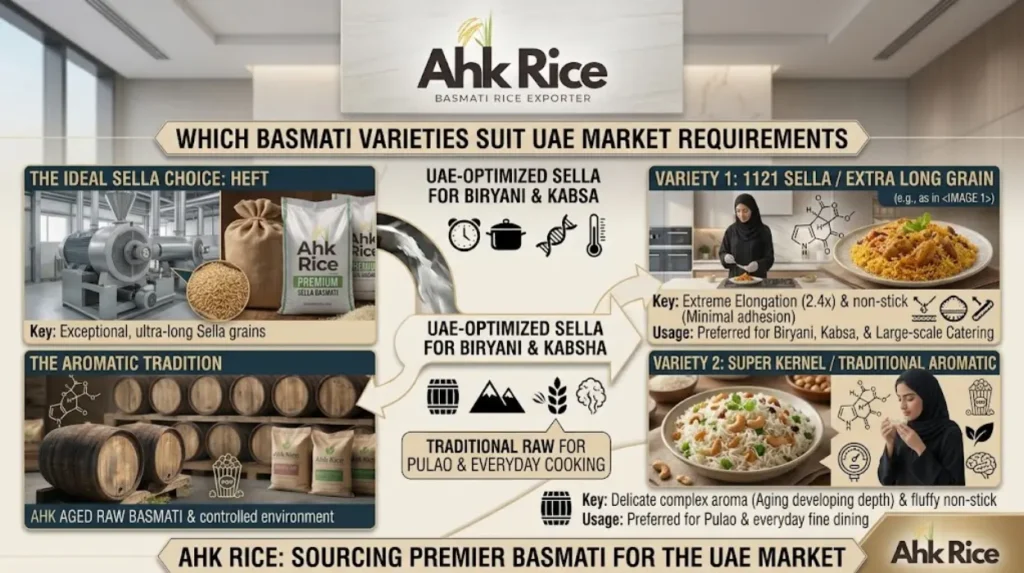
1121 suits premium long-grain positioning, Super Kernel supports traditional aromatic retail and wholesale demand, and 1509 serves buyers prioritising commercial efficiency. The best choice depends on target customers, cooking expectations, grade consistency, purchase price, and the distributor’s required retail or foodservice positioning.
Product specifications vary by crop, processing method, grade, and contract. Confirm all measurements against the supplier’s approved specification sheet.
| Comparison attribute | 1121 Basmati | Super Kernel Basmati | 1509 Basmati |
|---|---|---|---|
| Main commercial strength | Exceptional long-grain presentation | Traditional aroma and familiar Basmati character | Yield efficiency and competitive bulk positioning |
| Typical buyer | Premium retailers, caterers, and foodservice distributors | Ethnic retailers and aromatic rice wholesalers | Price-conscious wholesalers and institutional buyers |
| Grain specification | Long grain with strong cooked elongation | Traditional Basmati grain and aroma profile | Long-grain format with commercially attractive yield |
| Processing options | White, Steam, Golden Sella, and other agreed grades | Raw, Steam, or other available agreed grades | White and Steam grades, subject to supplier availability |
| Aroma positioning | Premium aromatic experience | Traditional aromatic positioning | Aromatic rice positioned around commercial value |
| Storage priority | Protect grain integrity and fragrance | Maintain aroma and consistent moisture | Preserve cooking consistency and bulk-grade quality |
| Buying priority | Grain length, elongation, broken percentage, and price | Aroma, purity, grain uniformity, and price | Yield, grade, broken percentage, and landed cost |
These varieties should not be treated as interchangeable simply because all originate from Pakistan. Buyers should request the exact processing type, raw and cooked grain characteristics, moisture level, broken percentage, and packaging details before comparing quotations. The selected grade must match the product description used on retail labels and commercial documentation.
How do UAE and South Asian market requirements differ?
UAE importers need stronger attention to hot-climate storage, distribution turnover, and packaging performance, while South Asian buyers often place additional emphasis on familiar varietal identity and established cooking preferences. Both markets require reliable specifications, but the balance between storage protection, presentation, and cost differs by channel.
Region 1: UAE retail, wholesale, and foodservice
The UAE connects importers, distributors, supermarkets, restaurants, and re-export businesses. Products can move through several storage and handling stages before reaching consumers. Warehouses and transport vehicles that experience high temperatures, humidity, or poor ventilation create additional risks for rice quality.
Premium retail buyers generally prioritise uniform grains, recognizable aroma, cooking consistency, and attractive packaging. Restaurant and catering buyers focus on dependable batch performance, grain separation, cooked elongation, and predictable supply. Bulk wholesalers may place greater weight on price per metric tonne, bag strength, broken-grain limits, and repeat-order consistency.
Importers should request moisture specifications, packaging construction, lot identification, and a clear shelf-life statement. Warehouse operators should keep bags dry, off the floor, away from walls where condensation can occur, and separated from chemicals or strongly scented products. Stock rotation using first-expiry-first-out procedures supports consistent quality.
Region 2: Pakistan and South Asian distribution
South Asian buyers commonly recognise 1121, Super Kernel, and 1509 as distinct commercial choices. Their purchasing decisions often reflect established household preferences, traditional recipes, retail positioning, and familiarity with particular cooked-grain characteristics.
1121 frequently serves premium biryani and long-grain applications. Super Kernel supports traditional aromatic rice positioning. 1509 gives distributors another option where purchase economics and suitable cooking performance matter more than the highest premium-grade positioning.
Storage remains important in both regions. Dry, hygienic warehouses, suitable packaging, and stock rotation protect quality regardless of the destination. The UAE adds particular importance to preventing moisture ingress and managing the temperature and humidity differences encountered during inland distribution.
How do prices per metric tonne and shelf life compare?
Price depends on variety, processing, grade, broken percentage, moisture, packing, quantity, and delivery terms, while shelf life depends on the product specification and actual storage conditions. Compare like-for-like quotations and validated shelf-life periods instead of assuming that one variety or packaging format always lasts longer.
Indicative price comparison
The following is a buying framework, not a live UAE quotation. FOB prices cover delivery to the agreed port of shipment under the contract terms; CIF prices also include cost, insurance, and freight to the named destination port.
| Variety | Price positioning | Main price drivers | Buyer evaluation |
|---|---|---|---|
| 1121 Basmati | Premium | Grain length, processing type, aroma, and grade | Pay for verified premium specifications |
| Super Kernel Basmati | Traditional aromatic mid-to-premium positioning | Purity, broken percentage, moisture, and packing | Compare the approved grade with the target selling price |
| 1509 Basmati | Often value-oriented | Processing yield, grade, demand, and order volume | Evaluate cost against required cooking performance |
For an accurate price-per-MT comparison, request three quotations with identical quantities, packaging, inspection terms, and Incoterms. A lower FOB price does not automatically produce the lowest landed cost in the UAE. Freight, insurance, port charges, customs-related costs, and local distribution affect the final figure.
Shelf-life comparison
| Storage or packaging condition | Practical implication |
|---|---|
| Clean, dry warehouse with intact packaging | Supports consistent storage quality |
| Moisture-resistant packaging with sound seals | Reduces exposure to humid ambient air |
| High humidity or water-damaged bags | Raises the risk of deterioration and mould |
| Direct sunlight or prolonged heat exposure | Can accelerate quality changes |
| Strong external odours or chemical storage nearby | Creates contamination and odour-transfer risks |
White and parboiled Basmati products have different processing characteristics, so shelf life should follow the supplier’s validated product specification. Properly stored milled white rice commonly carries a commercial shelf-life declaration around 12–24 months, depending on processing and packaging. This is a general industry range, not a guarantee for every shipment. Buyers must verify the actual date marking, storage instructions, and applicable UAE requirements.
What are the advantages and disadvantages of each preservation strategy?
No single preservation method protects every quality attribute. Controlled processing reduces initial defects, suitable packaging limits environmental exposure, and disciplined warehousing maintains product condition. Buyers should select controls according to their distribution risks and commercial requirements.
| Strategy | Advantages | Disadvantages | Best example |
|---|---|---|---|
| Controlled drying | Establishes suitable storage moisture | Requires calibrated equipment and energy | Export batches intended for extended distribution |
| Gentle milling and grading | Improves appearance and reduces broken grains | Adds processing and inspection costs | Premium 1121 retail packs |
| Moisture-resistant packaging | Limits moisture exchange and protects the product | Higher material cost than basic bags | Rice distributed through humid UAE warehouses |
| Climate-managed warehousing | Reduces exposure to excessive heat and humidity | Requires operating discipline and additional expense | Premium inventory with slower turnover |
| Lot testing and documentation | Improves traceability and specification verification | Requires sampling, records, and inspection costs | Private-label orders and repeat wholesale contracts |
The most cost-effective strategy is to prevent defects before they require corrective action. For example, an importer purchasing Super Kernel for premium retail should prioritise aroma consistency, grain uniformity, moisture control, and suitable packaging. A bulk buyer purchasing 1509 for institutional kitchens should also evaluate cooking yield, broken percentage, price per tonne, and reliable replenishment.
What factors should UAE importers use to select a supplier?
UAE importers should compare documented specifications, representative samples, processing controls, packaging suitability, traceability, and landed cost before approving a supplier. A structured evaluation reduces quality disputes and makes it easier to reproduce the approved product in subsequent shipments.
AHK Rice provides Pakistani Basmati varieties with processing, custom packaging, and export coordination. Buyers evaluating a Pakistani Basmati rice export service should use the same documented acceptance criteria for every supplier rather than relying on product descriptions alone.
Five-row decision framework
| Decision factor | What to verify | Why it matters |
|---|---|---|
| 1. Variety and grade | 1121, Super Kernel, or 1509; processing type and grain specification | Matches the product to the intended market |
| 2. Aroma and cooking performance | Sample fragrance, cooked elongation, texture, and grain separation | Confirms suitability for retail or foodservice |
| 3. Quality parameters | Moisture, broken percentage, purity, foreign matter, and agreed testing | Establishes measurable acceptance criteria |
| 4. Packaging and storage | Bag material, liner, seal integrity, lot coding, and storage instructions | Reduces deterioration during transport and warehousing |
| 5. Commercial terms | Price per MT, Incoterm, quantity, shipment schedule, documents, and claims procedure | Clarifies landed cost and contractual responsibilities |
How should buyers approve a shipment?
Start with a written specification sheet identifying the variety, processing type, grain length, broken percentage, moisture limit, packing format, and applicable food-safety requirements. Request a representative sample and cook it using a repeatable method. Record fragrance before and after cooking, cooked elongation, grain separation, texture, and appearance.
Once the sample passes, approve the specification in writing and agree on the inspection procedure. The pre-shipment lot should match the approved sample and contract parameters. Buyers should also establish how discrepancies will be documented and resolved before the goods leave Pakistan.
For commercial shipments, the documentation package should match the destination’s current import rules and the buyer’s contract. Applicable documents can include the commercial invoice, packing list, certificate of origin, phytosanitary documentation, and other certificates or test reports required for the particular shipment.
The strongest approach combines controlled processing in Pakistan with suitable packaging and disciplined storage in the UAE. Buyers should approve the variety, aroma, moisture, broken percentage, and cooking performance before loading. Importers should then maintain intact packaging, dry warehouses, stock rotation, and documented quality checks throughout distribution.
AHK Rice supports this process through sourcing, grading, packaging, and export coordination for 1121, Super Kernel, and 1509 Basmati rice. A documented specification and approved sample give importers a practical basis for evaluating quality, comparing offers, and maintaining consistency across repeat orders.
FAQs about preserving Pakistani Basmati aroma
What preserves Basmati rice aroma during export?
Controlled drying, careful milling, moisture-resistant packaging, hygienic storage, and appropriate transportation preserve aroma. The rice must begin with a suitable varietal aroma and meet the agreed quality specification before packing.
What moisture level should UAE importers request?
A moisture limit of around 12–13% is a common commercial target for milled rice. Buyers should confirm the exact contractual limit and ensure the product complies with applicable requirements and the supplier’s storage recommendations.
Which Pakistani Basmati variety is best for UAE premium retail?
1121 is suitable for premium long-grain positioning, while Super Kernel appeals to buyers seeking traditional Basmati aroma. The final choice depends on customer preferences, cooking tests, grade consistency, and the retail price target.
How long does Pakistani Basmati rice remain suitable for sale?
Shelf life depends on the rice type, processing, packaging, and storage conditions. Milled rice commonly carries a declared shelf life of around 12–24 months under suitable conditions, but importers must follow the actual product label and validated supplier specification.
Does vacuum packaging preserve Basmati aroma better than standard bags?
Vacuum packaging changes the atmosphere inside a pack and can limit some quality changes, but it is not automatically the best commercial option. Suitable food-grade packaging, effective seals, correct moisture, and storage practices matter more than the packaging label alone.
How can an importer verify aroma before loading?
Request a representative commercial sample, conduct a standardised cooking test, and document fragrance, elongation, texture, and grain separation. Approve the specification in writing and arrange pre-shipment inspection when required by the contract.