What Are the Main Certifications for a Pakistani Basmati Rice Exporter?
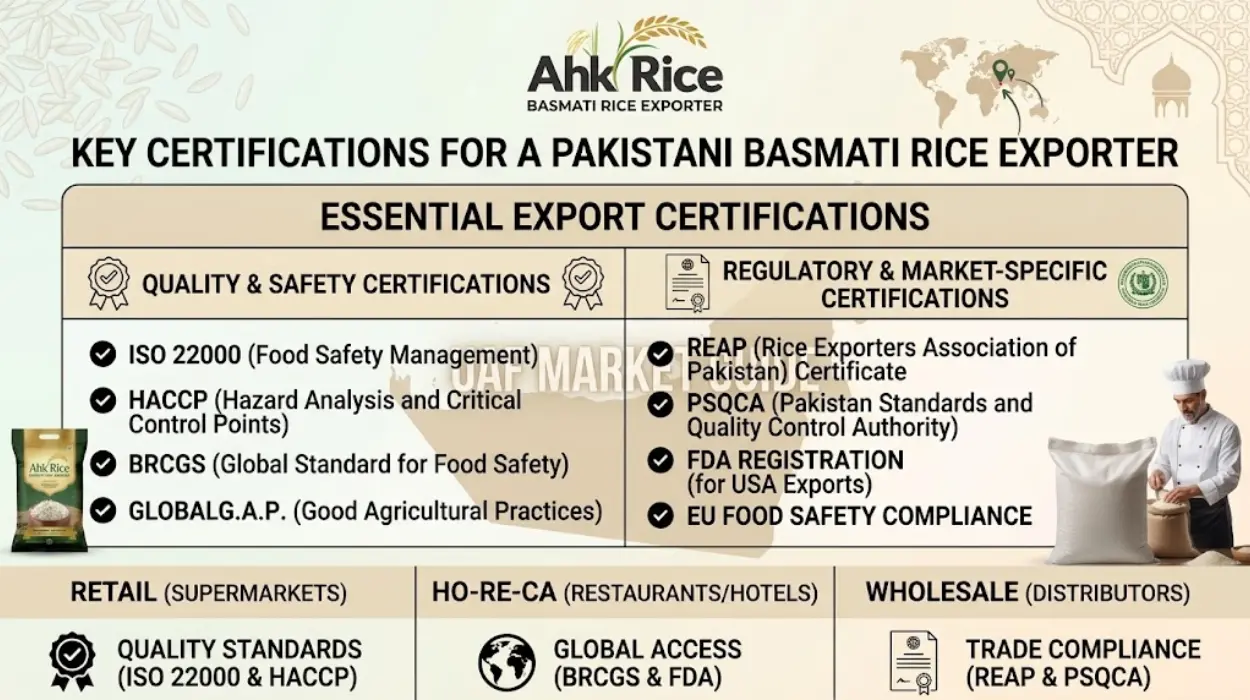
Pakistani Basmati rice exporters use food safety certifications, management system standards, and product-specific documents to demonstrate control over processing and export operations. ISO 22000, HACCP, BRCGS, and FSSC 22000 serve different purposes, while legal export documents and destination-specific requirements support shipment approval.
A certification confirms that an organization or facility meets a defined standard within a specific scope. It does not automatically guarantee that every rice shipment meets every buyer’s requirements. Importers examine the certification’s validity, the certified facility, the activities covered, and the product specifications.
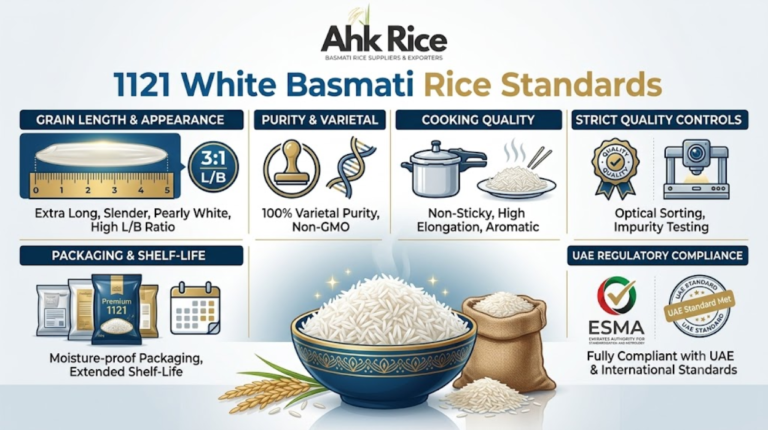
Pakistani Basmati rice is primarily cultivated in Punjab, where suitable soil, climate, and irrigation support aromatic varieties. Exporters supply varieties such as 1121, Super Kernel, and 1509 Basmati rice to international markets. Each variety has distinct grain characteristics, processing requirements, and commercial uses.
Food safety certification becomes relevant when rice moves through procurement, milling, grading, sorting, storage, packing, and dispatch. Importers assess whether these activities operate under documented controls that reduce contamination risks and maintain product consistency.
Not every certification is compulsory for every exporter. Applicable Pakistani regulations, destination-country laws, buyer contracts, and retailer policies determine which standards and documents are necessary.
How Do Food Safety Certifications Work in Rice Exporting?
Food safety certification follows a structured process that identifies hazards, establishes controls, documents procedures, and verifies implementation through audits. A certification body evaluates the defined system against a standard, issues a certificate when requirements are met, and conducts follow-up assessments.
For a Pakistani Basmati rice exporter, the process begins with mapping the supply chain. This includes paddy sourcing, raw rice storage, milling, polishing, grading, sorting, packing, warehousing, and loading.
The exporter identifies biological, chemical, and physical hazards. Examples include insects, pesticide residues, mycotoxins, stones, metal fragments, and contamination from unsuitable packaging materials.
The facility then establishes procedures for cleaning, pest management, equipment maintenance, employee hygiene, supplier approval, and traceability. Staff maintain records to demonstrate that these controls operate consistently.
An independent certification body audits the management system when third-party certification is required. The auditor reviews records, inspects operations, interviews employees, and evaluates compliance with the relevant standard.
Certification does not replace shipment-specific inspection. A buyer still checks the agreed grain length, broken percentage, moisture, purity, packaging, and laboratory results against the purchase contract.
Which Food Safety Certifications Are Relevant to Pakistani Basmati Rice Exporters?
Four widely discussed food safety frameworks are HACCP, ISO 22000, BRCGS Food Safety, and FSSC 22000. HACCP focuses on hazard control, ISO 22000 establishes a management system, BRCGS addresses product safety and quality, and FSSC 22000 adds scheme-specific requirements.
HACCP: Hazard Analysis and Critical Control Points
HACCP is a preventive food safety system that identifies hazards and establishes controls at relevant stages of production. It is based on 7 principles, including hazard analysis, identifying critical control points, setting critical limits, monitoring, corrective action, verification, and recordkeeping.
In rice processing, HACCP planning examines contamination risks during handling, milling, grading, storage, and packing. For example, a facility assesses whether metal detection is necessary and defines how equipment checks and rejected product are managed.
HACCP is a system, not a universal certificate that automatically authorizes rice exports. Legal requirements and buyer policies determine whether documented HACCP implementation or third-party certification is necessary.
ISO 22000: Food Safety Management Systems
ISO 22000 specifies requirements for a food safety management system across the food chain. ISO 22000:2018 integrates HACCP principles with management responsibilities, communication, prerequisite programmes, and continual improvement.
A rice mill uses this framework to establish food safety objectives, evaluate risks, manage operational controls, and retain evidence of performance. The system connects day-to-day hygiene practices with management review and corrective action.
ISO 22000 certification demonstrates conformity of the audited management system to the standard. It does not certify that every grain meets a particular premium grade or that a shipment satisfies every importing country’s regulations.
BRCGS Food Safety
BRCGS Food Safety is a certification standard used in food manufacturing, processing, and packing. It addresses product safety, integrity, legality, quality, and operational controls. Its requirements are relevant to facilities supplying food retailers, branded products, and food-sector customers.
A rice packing facility serving a supermarket’s private-label programme faces requirements beyond basic product handling. These include documented procedures, supplier management, site security, traceability, corrective action, and audit readiness.
BRCGS becomes particularly relevant when a retailer, distributor, or brand owner specifies it in the supplier approval process. It is not automatically compulsory for every Pakistani rice exporter.
FSSC 22000: Food Safety System Certification
FSSC 22000 is a certification scheme built around ISO 22000, applicable sector-specific prerequisite programme requirements, and additional scheme requirements. It provides a structured approach to food safety management for eligible organizations across the food supply chain.
For a rice processor, the applicable scope and technical requirements depend on the activities performed at the facility. Certification involves implementing the relevant requirements, completing audits, correcting nonconformities, and maintaining the system.
FSSC 22000 suits organizations that need a comprehensive food safety management framework recognized by customers seeking this scheme. Buyers must still confirm that the certificate covers the actual manufacturing or processing site and relevant activities.
What Key Components Must a Rice Exporter Control?
A reliable food safety system combines supplier approval, hazard analysis, hygiene, process controls, traceability, testing, and corrective action. These components connect farm sourcing with finished-product dispatch, helping exporters identify contamination risks, investigate complaints, and demonstrate compliance with agreed product specifications.
The first component is supplier and raw material control. Exporters establish purchasing specifications for paddy or milled rice and assess suppliers against defined requirements. Records identify the variety, source, intake date, and relevant inspection results.
The second component is facility hygiene and pest management. Cleaning schedules, pest-control records, employee hygiene rules, and equipment maintenance reduce contamination risks. Storage areas also require suitable housekeeping and moisture management.
The third component is processing and grading control. Milling, polishing, colour sorting, and grading affect product appearance and consistency. Operators monitor the relevant settings and verify output against the required grade.
The fourth component is testing and verification. Risk-based checks address moisture, broken grains, foreign matter, and relevant chemical or microbiological hazards. Laboratory tests are selected according to product risks, destination regulations, and buyer specifications.
The fifth component is traceability and documentation. Lot codes connect incoming material, processing records, packaging batches, finished stock, and dispatch documents. This allows the exporter to investigate a nonconforming lot and identify affected shipments.
The sixth component is corrective action. When a check fails, staff record the issue, control affected stock, investigate the cause, and document the action taken. Verification confirms that the corrective measure works.
What Is the Difference Between Certification and Export Documentation?
Certification demonstrates conformity with a defined standard, while export documents support legal clearance, product identification, and shipment-specific compliance. Pakistani rice exporters must distinguish voluntary or buyer-required management certifications from official certificates and documents required by the destination country.
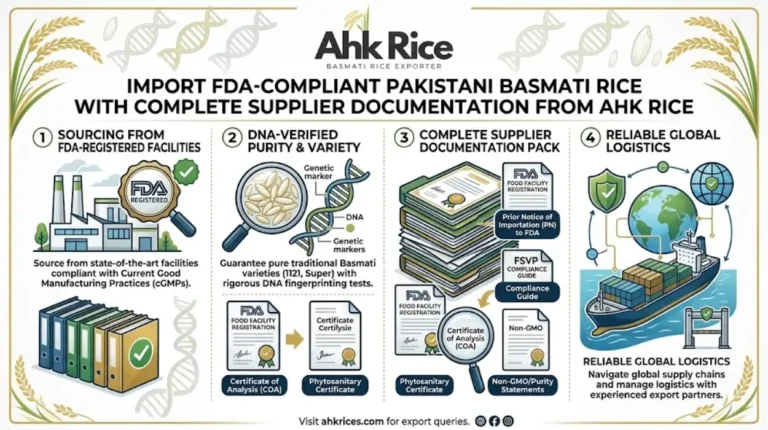
A phytosanitary certificate addresses plant health requirements under the applicable importing-country rules. Pakistan’s Department of Plant Protection handles export phytosanitary procedures, including inspection, sampling, treatment where required, and certification.
Other documents depend on the transaction and destination. Examples include a commercial invoice, packing list, certificate of origin, laboratory report, fumigation or treatment certificate where applicable, and transport documents.
A Certificate of Analysis (COA) records test results for a defined sample or lot. Buyers use it to evaluate specified parameters, such as moisture, broken percentage, grain dimensions, or relevant contaminants. Its contents depend on the contract and testing programme.
A phytosanitary certificate is not a substitute for ISO 22000 or HACCP. Likewise, an ISO certificate does not replace a required phytosanitary certificate, import permit, or customs declaration.
Exporters must verify current requirements for each destination before dispatch. The relevant authority, import permit, product classification, packaging, and shipment route determine the applicable documentation.
What Benefits Do These Certifications Provide?
Food safety certifications help exporters formalize risk management, improve operational consistency, and provide buyers with independently assessed evidence of system controls. Their value depends on the certificate’s scope, implementation quality, customer recognition, and relevance to the target market’s purchasing requirements.
The first benefit is stronger risk management. Documented procedures help facilities prevent recurring problems and respond consistently when a hazard or process failure occurs.
The second benefit is buyer confidence. Importers can evaluate an established food safety system alongside product samples, laboratory reports, and commercial terms. This reduces uncertainty during supplier qualification.
The third benefit is improved traceability. Recorded lot numbers and processing details support faster investigations when a buyer reports contamination, incorrect packaging, or a specification mismatch.
The fourth benefit is access to specific supply chains. Supermarket groups, private-label brands, and large food distributors sometimes require particular third-party certifications before approving a supplier. The required scheme depends on their procurement policy.
The fifth benefit is operational discipline. Internal audits, staff training, maintenance schedules, and corrective action records help management identify weaknesses before they affect a shipment.
Certification does not guarantee higher prices, automatic market access, or zero rejected shipments. Exporters must maintain product quality, satisfy regulatory requirements, and deliver against the agreed contract.
Which Certifications Matter for Different Rice Export Markets?
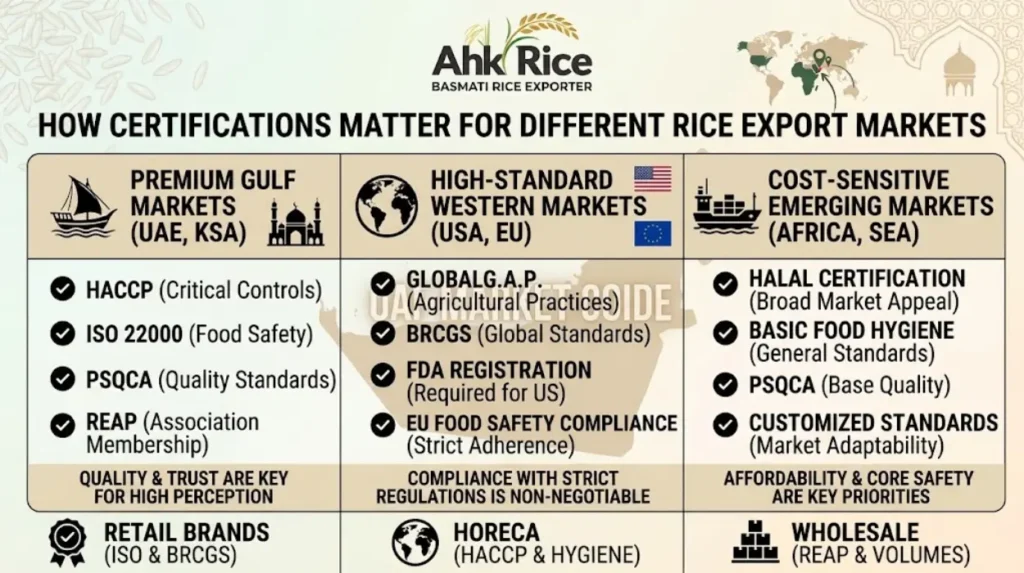
The relevant certification depends on the buyer, product category, facility, and destination requirements. UAE distributors, European retailers, North American importers, and institutional food buyers apply different supplier approval criteria, so exporters must verify each customer’s requirements before selecting a certification scheme.
United Arab Emirates
UAE rice importers assess food safety documentation, product specifications, labelling, and applicable import requirements. Wholesale distributors and foodservice buyers also examine consistency across repeated shipments.
An importer supplying a major supermarket chain can require BRCGS Food Safety or FSSC 22000 as a supplier approval condition. Another importer purchasing bulk rice can prioritize HACCP-based controls, laboratory reports, and legally required documentation.
European markets
European buyers assess applicable food legislation, traceability, contaminant limits, and official control requirements. Retailers frequently establish additional certification and audit expectations for their approved suppliers.
A Pakistani exporter supplying packaged 1121 Basmati to a private-label retailer must distinguish the retailer’s certification policy from statutory food safety requirements. Both apply when the contract and law require them.
United States and Canada
North American importers evaluate applicable food safety rules, facility obligations, product documentation, and buyer-specific standards. In the United States, requirements under the Food Safety Modernization Act depend on the activity, facility, and applicable exemptions.
A third-party certificate supports supplier assessment but does not automatically satisfy every regulatory obligation. Importers and exporters must verify the requirements applying to the particular transaction.
GCC and Asian wholesale markets
Importers across Gulf and Asian markets evaluate commercial grade, price, packaging, food safety controls, and shipment documentation. Requirements differ by country and buyer.
For example, a distributor purchasing 1509 Basmati in 25 kg bags has different commercial priorities from a premium retailer selling 1121 Basmati in 5 kg branded packs. Both require product specifications that match the contract, regardless of the certification selected.
What Common Certification Problems and Misconceptions Should Exporters Avoid?
The most common mistakes involve treating certifications as interchangeable, relying on expired certificates, overlooking facility scope, and confusing management certification with product approval. Exporters should verify certificate authenticity, applicable requirements, audit status, and shipment-specific documents before accepting an order.
One misconception is that every rice exporter must hold all four major certifications. No universal rule requires every exporter to possess HACCP, ISO 22000, BRCGS, and FSSC 22000 simultaneously. Applicable laws and buyer contracts determine the actual requirements.
Another problem is assuming that a certificate covers every warehouse, mill, or packing facility owned by a company. Certification applies to the organization and scope identified in the certificate. Buyers should verify the listed site and activities.
A third mistake is treating certification as a replacement for laboratory testing. Food safety systems establish controls, but risk-based testing remains important for checking relevant hazards and contractual parameters.
A fourth mistake is ignoring renewal and audit requirements. Exporters must maintain procedures, records, and corrective actions throughout the certification cycle. A certificate that is suspended, expired, or outside the required scope does not provide the expected assurance.
A fifth mistake is overlooking grain quality. Food safety certification does not establish whether a shipment is 1121 Steam, 1121 Golden Sella, Super Kernel, or 1509 White. Variety identity, processing type, grain dimensions, moisture, broken percentage, and purity require separate specifications and verification.
How Should an Exporter Choose the Right Certification?
An exporter should begin with destination regulations and target-buyer requirements, then assess its facility, existing controls, and certification budget. Selecting the standard that matches the intended supply chain avoids unnecessary duplication and focuses resources on demonstrable food safety performance.
Use this sequence to make the decision:
- Confirm legal obligations. Identify the importing country’s food safety, plant health, labelling, and documentation requirements.
- Ask buyers about approval criteria. Confirm whether the buyer accepts HACCP-based controls or requires ISO 22000, BRCGS, or FSSC 22000.
- Assess the facility. Review hygiene, pest control, supplier management, testing, traceability, and documented procedures.
- Select the appropriate scheme. Compare scope, customer recognition, audit requirements, implementation costs, and ongoing maintenance.
- Verify certification. Use the relevant certification body’s records or official scheme directory where available. Check validity, site details, and scope.
- Maintain shipment compliance. Match every consignment to the approved product specification, applicable test results, packaging requirements, and export documents.
For UAE-focused readers, the next step is to understand how these standards differ in practice. The guide on [ISO 22000, HACCP, BRCGS and FSSC 22000 for UAE rice importers]([Insert Link to MOFU Article]) can explain the distinctions and help buyers evaluate supplier documentation.
Food safety certification is one part of export readiness. Consistent processing, transparent records, suitable packaging, and compliance with destination rules remain essential to delivering Pakistani Basmati rice successfully.
Frequently Asked Questions
Is ISO 22000 mandatory for Pakistani Basmati rice exporters?
No universal requirement makes ISO 22000 mandatory for every Pakistani rice exporter. Applicable regulations, importing-country rules, and buyer contracts determine whether certification is necessary.
What is the difference between HACCP and ISO 22000?
HACCP identifies food safety hazards and establishes preventive controls. ISO 22000 incorporates HACCP principles into a broader food safety management system with management responsibilities, communication, prerequisite programmes, and continual improvement.
Is FSSC 22000 better than BRCGS for rice exporters?
Neither standard is universally better. FSSC 22000 provides a structured food safety management certification scheme, while BRCGS Food Safety also addresses product integrity, legality, and quality. The buyer’s requirements determine the appropriate choice.
Does a food safety certificate replace a phytosanitary certificate?
No. Food safety certification assesses a management system against a defined standard. A phytosanitary certificate addresses plant health requirements for applicable exports under the importing country’s rules.
Which documents should a UAE rice importer request?
A UAE importer should confirm the applicable import documentation, product specifications, laboratory reports, certificate validity, and shipment records. Depending on the transaction, documents include a phytosanitary certificate, commercial invoice, packing list, and certificate of origin.