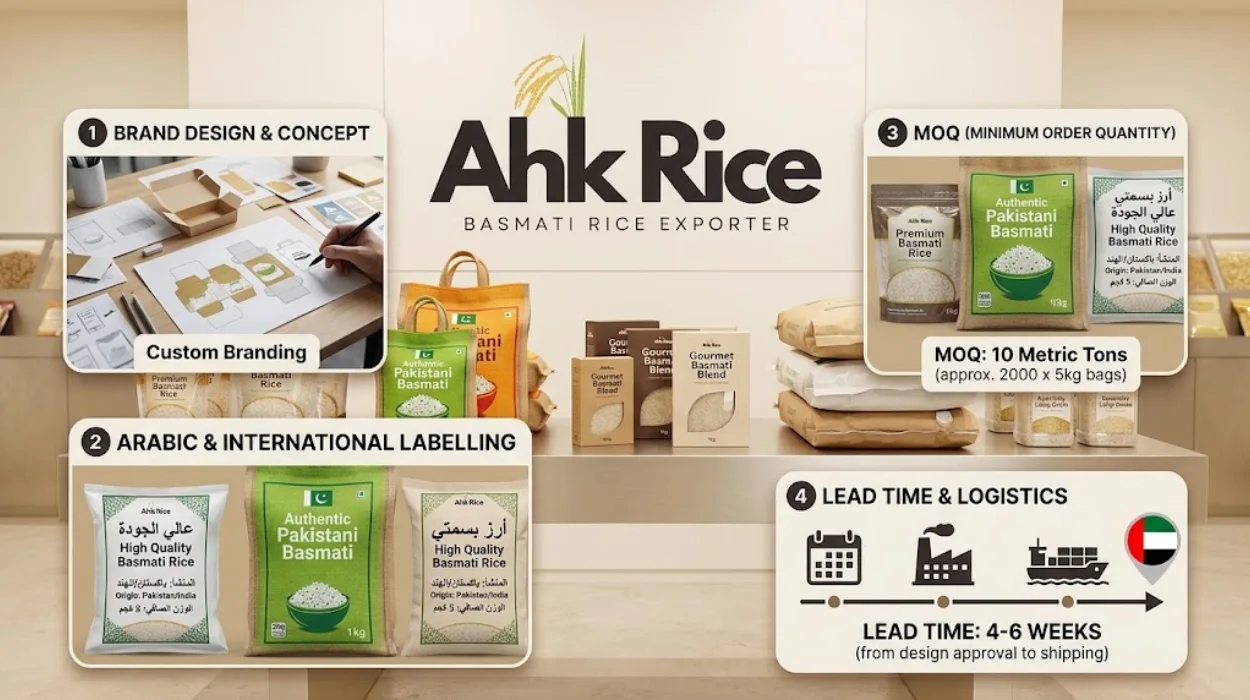
Private Label Basmati Rice Process: Design, Arabic Labelling, MOQ and Lead Time for UAE Brands
Private label Basmati rice is best suited to UAE brands that want control over product positioning, packaging and customer loyalty, while bulk branded imports suit businesses prioritising speed and established consumer recognition. The right model depends on order volume, target customers, packaging costs, compliance requirements and replenishment frequency.
For new importers, understanding what private label Basmati rice is and how it works establishes the foundation for evaluating suppliers, product specifications and packaging options. UAE retailers, wholesalers, distributors and foodservice operators must then compare private label production methods, Arabic labelling, minimum order quantities (MOQs), pricing and delivery schedules before approving a commercial order.
What Are the Available Private Label Basmati Rice Solutions?
UAE businesses can launch private label rice through ready-made packaging, custom printed bags, contract packing or bulk imports packed locally. Each approach offers a different balance of investment, flexibility, brand control and production time. The appropriate option depends on sales volume and distribution strategy.
Private label rice means rice produced, processed or packed for sale under a buyer’s own brand rather than the supplier’s consumer-facing brand. The buyer defines the product positioning, pack sizes, design and commercial requirements, while the supplier manages agreed sourcing, processing and packing activities.
The main options are:
1. Ready-made packaging with private labels
The supplier uses an existing suitable bag and applies the buyer’s approved label or sticker. This model reduces initial artwork and printing commitments. It works for market testing, small retail launches and distributors who want to validate demand before investing in custom packaging.
Its main limitation is differentiation. Competitors may use similar packaging, and stickers can provide less shelf impact than professionally printed bags. Label material, placement and durability must also suit the packaging surface and distribution conditions.
2. Custom printed packaging
The supplier packs rice into bags printed with the buyer’s brand identity, product information and approved Arabic and other required language content. This approach creates a more consistent retail presentation.
Custom printing can require higher minimum quantities, artwork approval, printing-cylinder or plate charges, and additional production time. These costs make it more appropriate for brands with established demand or a planned launch across multiple stores.
3. Bulk rice with local packing in the UAE
The importer purchases rice in bulk and arranges packing through an eligible local facility. This approach can support local distribution planning and different retail pack sizes. However, the importer must assess local packing charges, facility capabilities, traceability, regulatory responsibilities and handling costs.
Local packing does not automatically eliminate import documentation or food compliance requirements. The importer must confirm the applicable arrangements with UAE authorities and the packing partner.
4. Contract packing through an export supplier
A supplier coordinates rice sourcing, grading, processing, bag production and export shipment under an agreed specification. This reduces the number of separate parties the buyer manages.
AHK Rice is a trusted Pakistani Basmati rice exporter based in Punjab, supplying 1121, Super Kernel and 1509 varieties to more than 15 countries. Its end-to-end processing, custom packaging and export coordination model supports buyers evaluating an integrated sourcing arrangement. Businesses can review its Basmati rice sourcing and export services when comparing supplier capabilities.
How Do Private Label Packaging Approaches Compare?
Ready-made bags usually minimise initial packaging commitments, custom printed bags strengthen brand identity, and local packing offers flexibility in distribution. Comparing seven commercial attributes reveals the trade-offs in cost, order size, lead time, compliance and operational control.
| Attribute | Ready-made bags and labels | Custom printed bags | Bulk rice with UAE packing |
|---|---|---|---|
| Initial investment | Generally lower | Higher artwork and printing setup costs | Bulk purchase plus local packing setup |
| MOQ | Depends on supplier and labelling arrangement | Often driven by bag printer and production batch | Depends on bulk order and packing facility |
| Lead time | Usually shorter after label approval | Longer due to artwork, printing and production | Depends on import and local packing schedules |
| Brand differentiation | Moderate | High | High with suitable printed packaging |
| Pack-size flexibility | Limited by available bag sizes | Agreed sizes subject to supplier capability | Depends on local facility and packaging supply |
| Quality control | Rice and label checks | Rice, packaging and print checks | Bulk rice, handling and finished-pack checks |
| Operational responsibility | Shared with supplier | Shared under agreed production terms | Greater coordination by importer |
The table provides a decision framework, not a universal cost or time guarantee. MOQs and production schedules vary with rice variety, bag material, printing method, production capacity and shipping arrangements. Buyers should request a written quotation that separates rice, packaging, setup, inspection and freight costs.
Which Basmati Rice Varieties Suit UAE Private Label Brands?
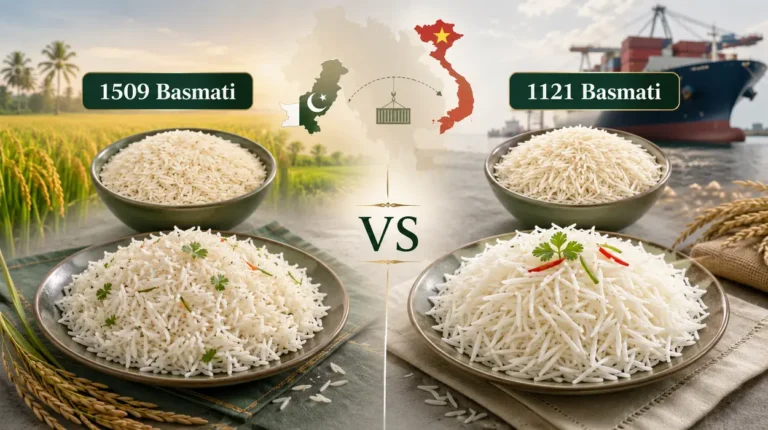
1121 Basmati suits premium retail and foodservice positioning, Super Kernel serves traditional aromatic rice segments, and 1509 supports value-conscious and high-volume channels. Buyers should match grain characteristics, cooking performance and price targets to the customers they intend to serve.
1121 Basmati rice
1121 is recognised for its long grain and pronounced cooked-grain elongation. It suits premium supermarket shelves, specialist South Asian grocery stores, biryani-focused foodservice and private label brands seeking a premium product identity.
Buyers can evaluate Steam, Golden Sella, Creamy Sella, Brown and broken-rice formats according to their product range. Each format requires its own specification and processing agreement. The label should accurately identify the variety and processing type.
Super Kernel Basmati rice
Super Kernel is a traditional aromatic Pakistani Basmati variety associated with Punjab. It fits brands targeting consumers who value traditional aroma, familiar cooking characteristics and a balance between quality and purchase price.
Commercial specifications should define raw grain length, moisture, broken percentage, purity and the required cooking profile. Buyers should approve a representative sample before confirming production.
1509 Basmati rice
1509 is a practical option for buyers prioritising commercial value, high-volume distribution and consistent supply planning. Its grain characteristics and price positioning can support everyday retail, wholesale and selected foodservice segments.
Steam and Golden Sella versions serve different product needs. Buyers should evaluate cooked texture, colour, aroma and holding performance instead of selecting solely on the basis of raw grain length.
How Do MOQ, Price per MT and Shelf Life Compare?
MOQ, price per metric tonne and shelf life must be evaluated together because a lower purchase price does not guarantee lower total cost. Packaging commitments, storage conditions, stock turnover and the buyer’s target market determine the commercial value of each arrangement.
Minimum order quantity
MOQ is the smallest quantity a supplier accepts for a specific product or production arrangement. Rice MOQ and packaging MOQ are separate variables. A supplier may accept a particular rice volume but require a larger quantity of custom printed bags because the printer manufactures them in production batches.
For example, a new retailer may prefer labelled stock for a trial launch. A distributor serving several supermarkets may justify custom printed packaging through larger recurring orders. Neither model has a universal MOQ; obtain separate written thresholds for rice, bags and finished packs.
Price per metric tonne
The price per metric tonne (MT) depends on the rice variety, processing method, grain length, broken percentage, moisture, quantity, packaging, inspection and delivery terms.
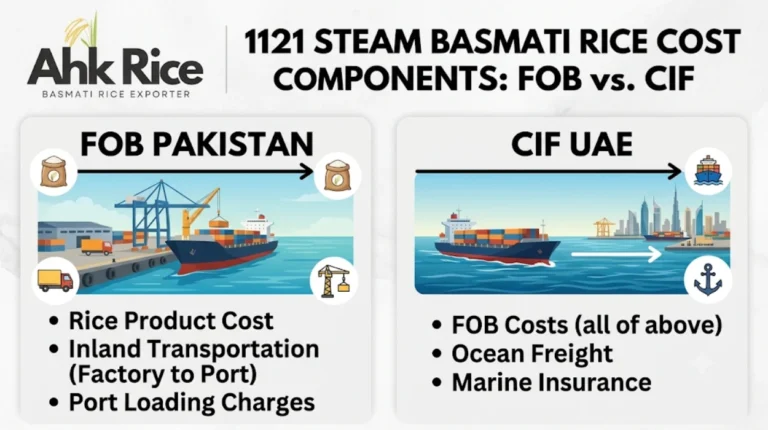
A useful comparison separates the supplier’s rice and packing quotation from freight, insurance, port charges, customs duties, local handling and distribution costs. FOB Karachi and CIF destination-port quotations are not directly equivalent because their included transport and insurance responsibilities differ.
For planning, compare three supplier quotations using the same variety, grade, pack size, quantity and Incoterm. Request current prices rather than relying on an old market benchmark. The UAE landed cost should reflect the actual shipping route, shipment size and agreed responsibilities.
Shelf life and storage
Shelf life is the period during which rice retains its expected quality under stated storage conditions. It is not determined by packaging design alone. Initial moisture, processing quality, packaging integrity, warehouse humidity, temperature, pest control and stock rotation all influence storage performance.
Ask the supplier for the declared shelf life, production or packing date information, storage instructions and any applicable date-marking requirements. Do not print an unsupported shelf-life claim.
| Decision factor | Option A | Option B | Best application |
|---|---|---|---|
| Launch investment | Labelled existing bags | Custom printed bags | Existing bags for early-stage market testing |
| Order commitment | Lower packaging commitment | Larger print batch may be required | Custom printing when recurring demand supports it |
| Brand positioning | Standard presentation | Distinctive retail identity | Custom printing for established brand development |
| Supply coordination | More limited packaging changes | Integrated rice and packaging planning | Contract packing for fewer supplier handoffs |
| Inventory strategy | Small test range | Planned recurring production | Match order volume to sales and replenishment capacity |
What Arabic Labelling Requirements Should UAE Rice Brands Check?
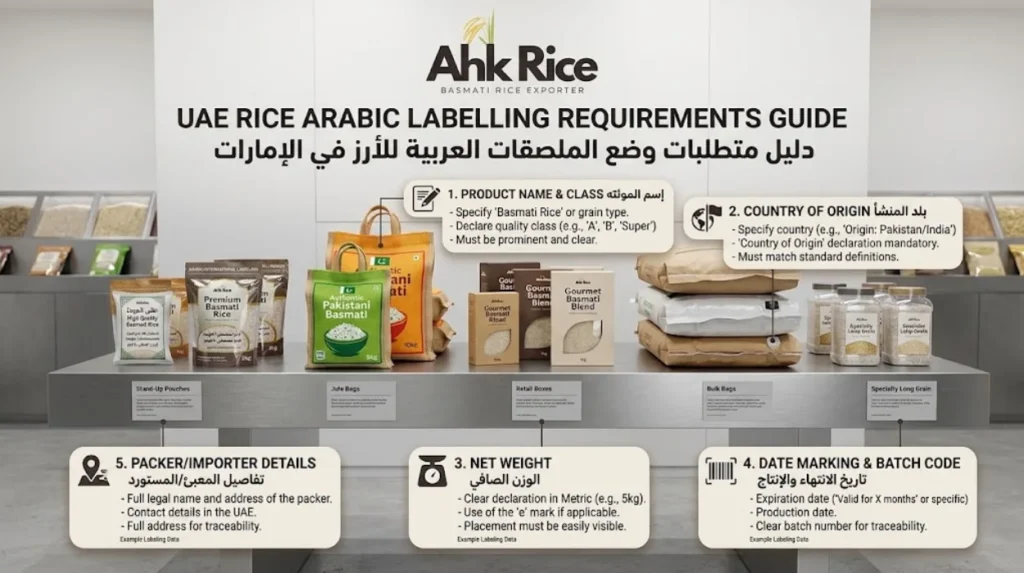
UAE rice labels must meet the applicable food labelling and import requirements before commercial distribution. Buyers should verify Arabic content, product identity, net quantity, origin, date information, storage instructions and importer details with the relevant authority before printing packaging.
Arabic labelling is a core planning task, not a final design adjustment. The importer should confirm the current requirements with the relevant UAE food control authority and customs or import channel for the intended emirate and product.
The artwork review should cover:
- Product name: Identify the rice accurately, including the variety and processing type where required.
- Ingredients: Confirm the correct declaration for the product and any additional ingredients, if applicable.
- Net quantity: State the package quantity using the required units and format.
- Country of origin: Declare origin accurately and consistently with the shipment documents.
- Date marking: Apply the required production, packing, expiry or best-before information, as applicable.
- Storage instructions: Provide appropriate directions based on the product and validated shelf-life conditions.
- Importer information: Include the responsible UAE importer or other required business details.
- Arabic text: Verify translation, readability, placement and consistency with the approved product information.
The final checklist must reflect the rules applicable to the specific product and emirate. Registration, label assessment and import approval procedures can differ by authority and product circumstances. A supplier’s previous label approval does not automatically approve a new brand or revised artwork.
How Does the Private Label Basmati Rice Process Work?
A reliable private label process moves from buyer requirements to sample approval, packaging artwork, compliance checks, production, inspection and shipment. Written acceptance at each stage prevents avoidable changes to grain specifications, printed bags, delivery schedules and final landed cost.
Step 1: Define the commercial brief. Specify the target customer, variety, processing type, grain length, broken percentage, moisture limit, pack sizes, order quantity and destination. Include the preferred Incoterm and target delivery window.
Step 2: Request supplier quotations. Ask for separate prices for rice, packaging, printing setup, inspection and freight where applicable. Confirm MOQ, payment terms, quotation validity and the documents included in the export arrangement.
Step 3: Evaluate samples. Request a sample matching the intended commercial specification. Check raw grain appearance, aroma, purity and cooking performance. Agree on the testing method and obtain written approval before moving to production.
Step 4: Approve the packaging design. Finalise brand artwork, bag material, dimensions, pack weight and print colours. Review Arabic text and all mandatory declarations with the responsible UAE compliance team. Approve a final proof before authorising printing.
Step 5: Confirm production and inspection. Issue a purchase order that records the approved specification and packaging version. Agree on the inspection scope, sampling method, certificate requirements and process for handling non-conforming goods.
Step 6: Prepare export documentation and shipment. Confirm the commercial invoice, packing list, transport document, certificate of origin and applicable phytosanitary or other required certificates. Document requirements depend on the product and destination rules. Coordinate dispatch against the agreed shipment schedule.
Step 7: Receive and monitor stock. Check quantities, packaging integrity, lot identification and supporting documents on arrival. Record customer feedback and sales velocity to plan the next order.
What Lead Time Should UAE Brands Expect?
Private label lead time combines sample approval, artwork approval, bag production, rice processing, inspection, export documentation and sea freight. Existing packaging generally reduces setup work, while custom printing adds a production dependency that buyers must confirm before promising a launch date.
A planning schedule should distinguish supplier production time from port-to-port transit and final UAE delivery. These are separate stages, and a supplier’s factory-ready date is not the same as the date stock becomes available for sale.
For an initial order, allow time for sample dispatch and assessment, artwork corrections, Arabic label review, packaging procurement, processing, inspection and vessel scheduling. Repeat orders can move faster when the approved rice specification and artwork remain unchanged and packaging stock is available.
Request a milestone schedule with target dates for sample approval, artwork sign-off, bag readiness, production completion, inspection, vessel departure and expected arrival. Ask the supplier to identify dependencies and explain how a delay in artwork or packaging affects shipment. Confirm actual transit time against the selected sailing rather than using a generic shipping estimate.
What Are the Pros and Cons of Private Label Basmati Rice?
Private labelling gives UAE businesses greater control over brand identity, product specifications and retail presentation, but it also creates packaging commitments and compliance responsibilities. The benefits are strongest when buyers validate demand, document specifications and plan repeat orders before scaling.
| Approach | Advantages | Disadvantages | Example |
|---|---|---|---|
| Ready-made bags with labels | Lower initial setup and easier testing | Less distinctive shelf presentation | A small retailer tests demand for 5 kg packs |
| Custom printed bags | Stronger brand recognition and consistent design | Printing costs and possible higher MOQ | A distributor launches a branded supermarket range |
| Local UAE packing | Potential flexibility in pack sizes and local stock planning | Extra handling, packing and coordination costs | An importer supplies several retail formats |
| Export supplier contract packing | Integrated sourcing, processing and shipment coordination | Requires detailed supplier verification and clear contracts | A wholesaler imports recurring container shipments |
The best approach is the one that fits the buyer’s actual sales pattern. A business testing a new product should avoid committing to packaging volumes that exceed realistic demand. A growing distributor should calculate the total cost of repeat production, stockholding and replenishment rather than comparing bag prices alone.
How Should UAE Buyers Choose a Private Label Rice Supplier?
Choose a supplier through documented specifications, representative samples, transparent quotations, compliance coordination and a realistic production schedule. The supplier must demonstrate control over sourcing, grading, packaging and shipment documentation rather than relying on brand promises or price alone.
Use these five checks before placing a commercial order:
- Product consistency: Confirm the variety, grain length, moisture, broken percentage and agreed testing criteria.
- Packaging capability: Verify available bag materials, pack sizes, print methods and packaging MOQ.
- Compliance support: Establish who prepares and checks label content, product documents and inspection arrangements.
- Commercial transparency: Compare equivalent quotations, payment terms, Incoterms and all additional charges.
- Delivery reliability: Obtain a milestone schedule and agree on how production changes, delays and quality discrepancies are handled.
The purchase contract should identify the approved sample, specification sheet, packaging artwork, order quantity, inspection method, payment milestones and shipment documents. This creates a shared reference if the delivered product differs from the agreed requirements.
Frequently Asked Questions
What is the MOQ for private label Basmati rice in the UAE?
There is no single MOQ for every supplier. The minimum depends on rice volume, packaging type, bag size and printing method. Request separate minimum quantities for rice, printed bags and finished packs before comparing quotations.
Is Arabic labelling mandatory for private label rice in the UAE?
Food labelling must comply with the applicable UAE requirements, including relevant Arabic-language provisions. Importers should verify the current rules, required declarations and approval process with the competent authority before printing commercial packaging.
How much does private label Basmati rice cost per MT?
The price depends on variety, grade, processing, quantity, packaging, inspection and Incoterm. Request comparable written quotations and calculate the UAE landed cost, including freight, insurance where applicable, import charges and local handling.
How long does private label rice production take?
The schedule depends on sample approval, artwork review, packaging availability, production capacity, inspection and vessel schedules. Obtain a written timeline that separates factory production from sea transit and final delivery.
Which Basmati variety is best for a UAE private label?
1121 suits premium long-grain positioning, Super Kernel targets traditional aromatic Basmati customers, and 1509 supports value-focused and high-volume segments. The final choice should follow sample testing, target pricing and the intended retail or foodservice application.
Can a UAE importer use custom printed rice bags?
Yes, subject to supplier capability, packaging specifications and applicable UAE food labelling requirements. The buyer should approve the final artwork, Arabic text, pack weight and required declarations before the supplier author