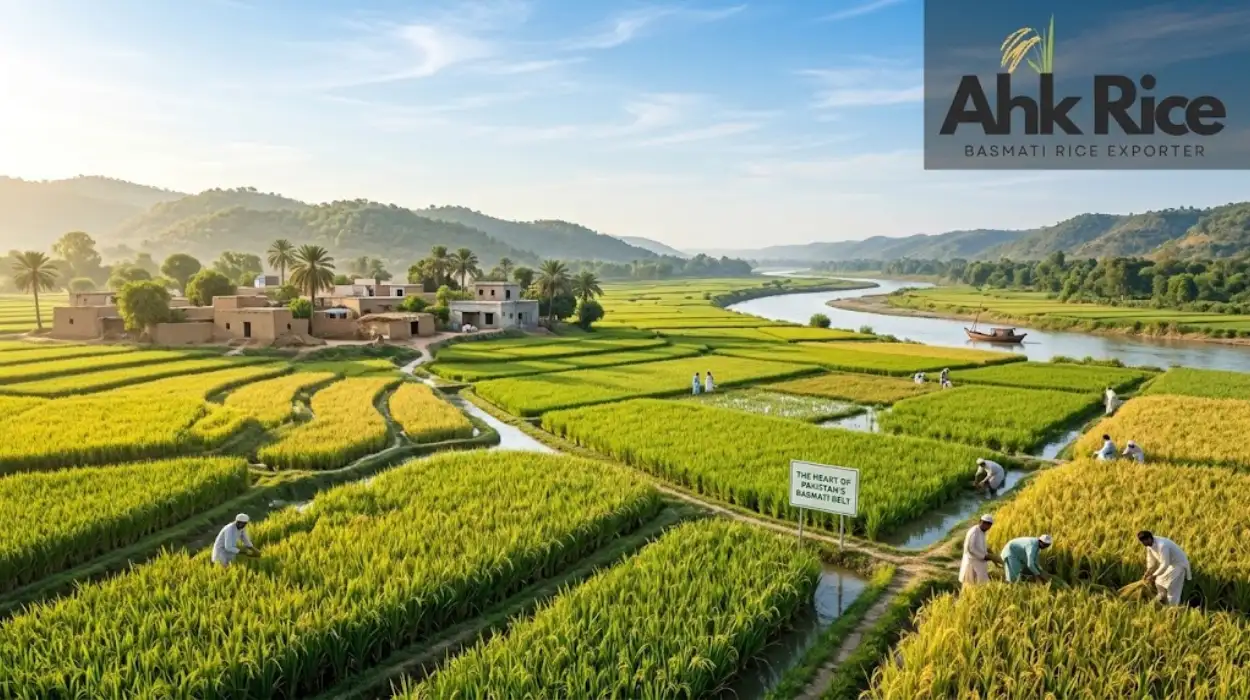
What Is Pakistani Basmati Rice and Where Is It Grown?
Pakistani Basmati rice grows mainly in Punjab, Pakistan, where fertile alluvial soils, seasonal monsoon rainfall, irrigation networks and warm growing conditions support its cultivation. Major growing areas include Gujranwala, Hafizabad, Sheikhupura, Narowal and Sialkot, known for traditional Basmati production.
Pakistani Basmati is a long-grain aromatic rice associated with Punjab’s agricultural landscape. The word Basmati describes a fragrant rice type valued for its distinctive aroma, slender grains and characteristic elongation during cooking. Its quality reflects the interaction between rice genetics, growing conditions, harvesting practices and post-harvest handling.
Punjab forms the centre of Pakistan’s Basmati-producing region. Farmers cultivate rice in districts connected to the province’s extensive irrigation infrastructure and established agricultural supply chains. These areas supply paddy to rice mills, where processors remove the husk and bran to produce market-ready rice.
The Basmati belt is not a single farm or administrative zone. It is a wider agricultural region with differences in soil composition, water availability, temperature and farming practices. These differences influence crop performance, grain maturity and consistency.
Pakistani Basmati reaches domestic consumers and international buyers through several stages, from seed selection and field preparation to milling, grading, packaging and export. Understanding its growing geography explains why origin, variety and processing specifications matter when assessing rice quality.
How Do Punjab’s Climate and Geography Support Basmati Cultivation?
Punjab supports Basmati cultivation through warm summer temperatures, seasonal monsoon rainfall, fertile river-deposited soils and irrigation supplied by canals and groundwater. These conditions support crop establishment, flowering and grain development, while local farming practices help maintain the characteristic qualities associated with Basmati.
Basmati cultivation depends on the timing and interaction of environmental conditions. Rice requires sufficient warmth, water and sunlight throughout its growing cycle. Punjab’s summer growing season generally provides these conditions, although rainfall distribution and water availability vary between districts and years.
Climate and temperature
Basmati is commonly planted during the Kharif season, which begins in late spring or early summer. Farmers select planting dates according to the variety, local weather, water supply and agricultural schedule. Many traditional Basmati crops mature before the cooler winter season.
Temperature affects germination, vegetative growth, flowering and grain filling. Excessive heat during flowering can reduce successful grain formation. Appropriate temperatures during grain development support maturity and grain quality.
Soil composition
Much of Punjab’s agricultural land contains alluvial soils formed from river-deposited sediments. These soils often contain mixtures of sand, silt and clay, with fertility and drainage varying by location. Well-managed fields provide the nutrients, moisture retention and root conditions required for rice production.
Soil characteristics influence nutrient availability and water management. Farmers adjust fertiliser applications and irrigation practices to field conditions rather than treating every district as identical.
Rivers and irrigation
Punjab’s agricultural system draws on the Indus River basin and its tributaries, including the Chenab, Ravi and Jhelum. Canals distribute irrigation water across extensive farming areas. Groundwater supplements canal supplies in many locations.
Reliable irrigation matters because rice needs adequate water during important growth stages. Water management also affects production costs, soil conditions and environmental sustainability. Farmers therefore coordinate irrigation with rainfall, crop development and local water availability.
Which Districts Form Pakistan’s Main Basmati Growing Belt?
Pakistan’s main Basmati growing belt lies in Punjab, particularly Gujranwala, Hafizabad, Sheikhupura, Narowal and Sialkot. These districts have established rice-growing traditions, irrigation access and agricultural supply networks that connect paddy farmers with local mills and rice markets.
Each district contributes to Punjab’s rice economy through farming, harvesting, storage and trade. However, soil conditions, irrigation access, seed selection and cultivation methods differ across individual farms. Geographic origin provides useful context, but it does not independently guarantee a particular grain length or aroma.
Gujranwala
Gujranwala is an established agricultural and commercial centre in Punjab. Rice farming forms part of its surrounding rural economy, while nearby processing and trading networks connect growers with rice mills. These connections support the movement of harvested paddy from farms into commercial supply chains.
Hafizabad
Hafizabad is widely associated with Pakistan’s rice trade and processing industry. Rice cultivation, milling and wholesale activity contribute to its agricultural identity. The district’s established commercial infrastructure helps connect farmers, mill operators and buyers seeking different rice grades.
Sheikhupura
Sheikhupura lies within Punjab’s important agricultural region and supports rice cultivation alongside other crops. Access to irrigation and agricultural inputs helps farmers manage seasonal production. Rice from the wider area enters supply chains serving domestic markets and export-oriented processors.
Narowal and Sialkot
Narowal and Sialkot are also associated with rice cultivation in northeastern Punjab. Their agricultural conditions support seasonal rice production, although individual field characteristics vary. Together with other districts, they contribute to the wider geography of Pakistani Basmati farming.
How Is Pakistani Basmati Rice Grown and Processed Step by Step?
Pakistani Basmati rice moves through seed selection, nursery preparation, transplanting or direct seeding, irrigation, crop management, harvesting, drying, milling, grading and packaging. Each stage affects grain integrity, moisture, cleanliness and consistency, determining whether the finished product meets its intended market specifications.
Rice quality begins before milling. Cultivation decisions influence crop uniformity, grain maturity and the amount of broken rice produced during processing. Post-harvest handling then determines how effectively the harvested crop retains its physical and commercial quality.
1. Seed selection and field preparation
Farmers select a variety suited to the growing area, maturity period and intended market. Traditional Basmati varieties and newer long-grain types have different agronomic and grain characteristics.
Farmers prepare fields by levelling the soil, controlling weeds and managing water. Good field preparation supports more uniform crop establishment and simplifies irrigation.
2. Nursery establishment and planting
Many farmers raise rice seedlings in nurseries before transplanting them into prepared fields. Other production systems use direct seeding. The method depends on local practices, labour availability, water conditions and the selected variety.
Plant spacing and crop establishment influence competition for sunlight, nutrients and water. Appropriate management encourages healthy plant growth and helps farmers maintain the crop through its development stages.
3. Irrigation and crop management
Farmers manage water throughout vegetative growth, flowering and grain filling. They also monitor weeds, insects, diseases and nutrient deficiencies. Fertiliser use follows field requirements and crop condition rather than a single universal schedule.
Good crop management supports grain development and limits avoidable losses. Excessive nitrogen, unsuitable irrigation or poorly timed crop treatments can affect yield and grain quality.
4. Harvesting and drying
Farmers harvest rice when the crop reaches suitable maturity. Harvesting too early produces immature grains, while delayed harvesting increases exposure to weather, shattering and field losses.
The harvested crop is paddy rice, meaning the grain still has its protective outer husk. Drying reduces moisture to a level suitable for safe storage and milling. Controlled drying helps prevent spoilage and limits grain cracking.
5. Milling and grading
Rice mills clean the paddy and remove the husk. Further milling removes the bran layers to produce white rice, while brown rice retains its bran. Milling systems separate whole kernels from broken grains and remove unwanted material.
Processors grade rice according to commercial requirements, including grain length, broken percentage, moisture, foreign matter and appearance. Buyers specify acceptable limits in contracts because grading terminology and tolerances vary between suppliers and markets.
6. Packaging and shipment preparation
Finished rice is packed in bags selected for the destination and distribution channel. Common formats include 5 kg and 10 kg retail bags and 25 kg or 50 kg bulk bags.
Export shipments require suitable packaging, lot identification and the documentation applicable to the destination. Storage and container loading procedures protect the product against moisture, contamination and physical damage during transport.
Which Pakistani Basmati Rice Varieties and Grades Are Available?
Pakistan’s principal commercial Basmati offerings include 1121, Super Kernel, and 1509 Basmati rice, supplied in different processing forms and quality grades. Buyers compare grain length, aroma, broken percentage, moisture, colour, cooking performance and packaging to select rice for retail, catering or wholesale distribution.
A rice variety identifies the type of crop and its characteristic grain properties. A grade describes the product’s measured quality and commercial specification. These terms are related but not interchangeable: two shipments of the same variety can have different broken percentages, moisture levels or grain-length distributions.
1121 Basmati
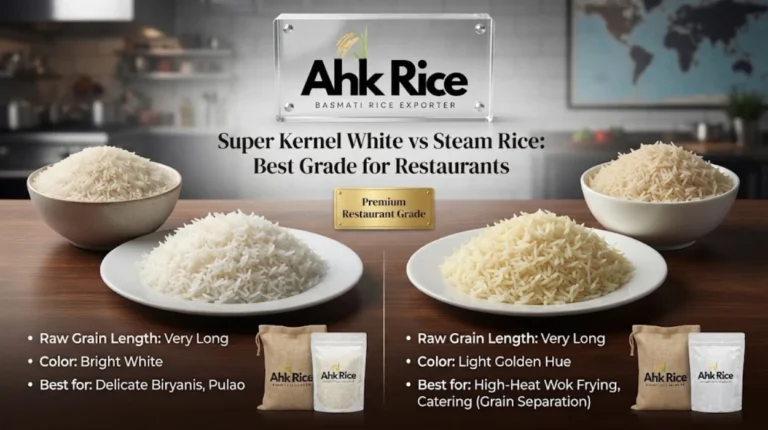
1121 is recognised for its exceptionally long slender grains and strong elongation during cooking. It is available in different processing forms, including white rice, Steam, Golden Sella, Creamy Sella, Brown and broken grades, depending on supplier capability.
Premium retail brands, restaurants and catering businesses often evaluate 1121 for its cooked appearance and presentation. Buyers still need a defined specification because grain length, aroma, processing and broken percentage differ between lots.
Super Kernel Basmati
Super Kernel is a traditional Pakistani Basmati type associated with characteristic fragrance, slender grains and familiar cooking qualities. It serves retail, wholesale and foodservice buyers looking for aromatic rice with consistent cooking performance.
Commercial requirements include raw grain length, moisture, broken percentage and the proportion of damaged or discoloured kernels. A pre-shipment sample provides a practical way to assess cooking performance before approving a bulk order.
1509 Basmati
1509 is an early-maturing, long-grain variety valued for its production efficiency and commercial versatility. Its shorter crop duration compared with many traditional Basmati varieties makes it relevant to farmers managing seasonal production decisions.
Export offerings include white and Steam rice, with other processing options dependent on the supplier. Buyers commonly evaluate 1509 for bulk distribution, foodservice and price-sensitive retail channels.
Common processing and commercial grades
- White rice: Rice milled to remove the bran layers, producing a pale appearance.
- Steam rice: Rice processed using steaming before or during the milling sequence, according to the mill’s method.
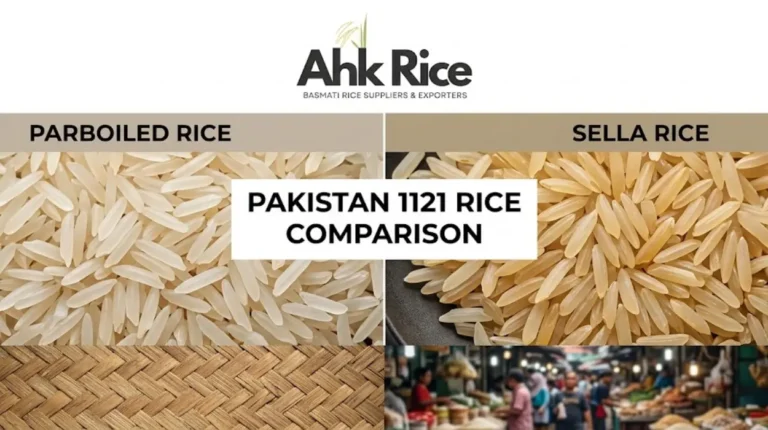
- Sella rice: Parboiled rice that undergoes soaking, heat treatment and drying before milling. Golden Sella retains a golden colour after processing.
- Creamy Sella: Parboiled rice with a cream-toned appearance.
- Brown rice: Rice with the bran layer retained after husking.
- Broken rice: Kernels that fall below the applicable whole-grain length standard.
These categories describe processing or kernel condition, not a single universal quality grade. Buyers should define the variety, processing type, broken percentage and inspection tolerances in the purchase specification.
What Benefits Does Punjab’s Basmati Belt Provide to Rice Buyers?
Punjab’s established Basmati belt connects agricultural production with experienced rice mills, grading facilities, storage infrastructure and export supply chains. This regional network supports variety selection, processing consistency, bulk procurement and access to different commercial grades for domestic and international buyers.
The first benefit is access to multiple varieties. Importers can compare 1121, Super Kernel and 1509 according to their target customers, required grain characteristics and purchasing budgets. Different processing options also allow buyers to choose between white, Steam and Sella rice.
The second benefit is an established processing ecosystem. Rice mills clean, mill, sort and grade paddy before supplying finished rice. Modern optical sorters identify certain discoloured or defective kernels, while length graders and screening equipment help processors achieve defined specifications.
The third benefit is supply-chain connectivity. Farmers, traders, mills, packaging providers, inspection companies and freight operators contribute different services. This structure supports commercial orders ranging from retail-packed products to bulk shipments for distributors and foodservice businesses.
Origin remains one factor in quality assessment. Buyers must also evaluate the actual shipment, its specifications, traceability and compliance documentation before making a purchasing decision.
Which International Markets Import Pakistani Basmati Rice?
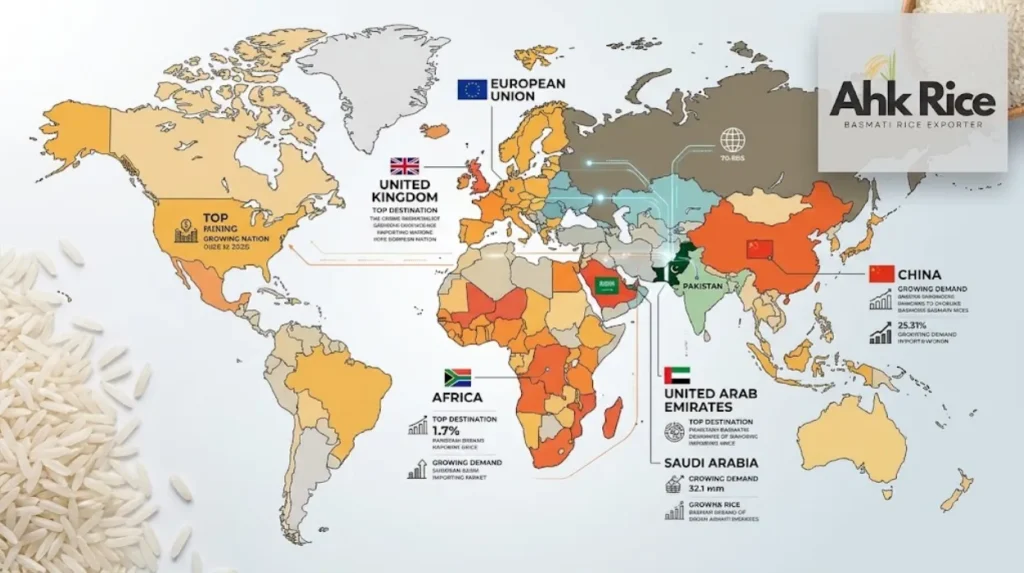
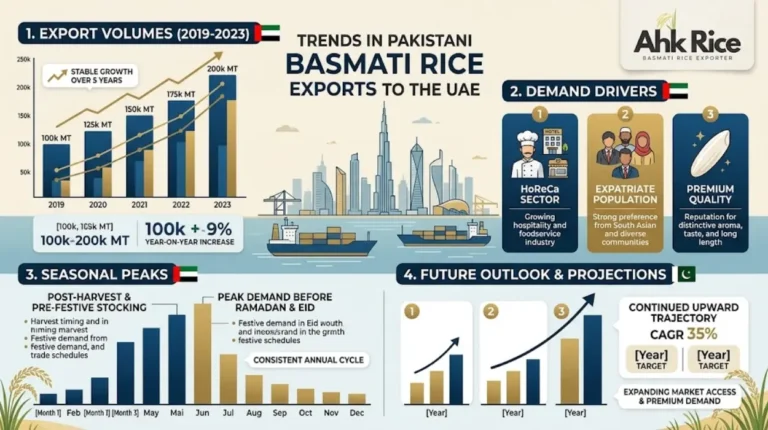
Pakistani Basmati rice serves international markets across the Middle East, Europe, North America, Africa and Asia. Import demand varies by country, consumer preferences, food regulations and distribution channels, with buyers selecting varieties and processing grades suited to local retail and foodservice requirements.
Middle East
The United Arab Emirates and Saudi Arabia are important destinations for Pakistani rice. Distributors supply supermarkets, ethnic grocery stores, restaurants, hotels and wholesale customers.
The UAE also operates as a regional trading and re-export hub. Buyers assess aroma, cooking performance, packaging quality and compliance with applicable food import requirements. Long-grain varieties such as 1121 and Super Kernel serve premium segments, while 1509 can suit buyers prioritising value and bulk supply.
Europe and the United Kingdom
European importers source Basmati for ethnic grocery retail, mainstream supermarkets and foodservice. Product acceptance depends on commercial quality, accurate labelling, traceability and applicable food-safety requirements.
Importers must assess pesticide residue limits, contaminant controls and any additional official checks applying to their product and country of entry. Supplier documentation should match the actual consignment and relevant regulations.
North America
The United States and Canada have established markets for South Asian rice products. Buyers include ethnic food distributors, retailers, restaurant suppliers and private-label businesses.
Importers compare grain appearance, cooking characteristics, packaging formats and landed costs. Food import requirements, labelling rules and documentation must be confirmed before shipment.
Africa and Asia
Markets across Africa and Asia purchase Pakistani rice according to local demand, price points and food preferences. Requirements differ between destinations, so exporters must verify permitted products, packaging specifications and import documentation for each country.
Actual demand changes over time. Export statistics and destination-specific import records provide stronger evidence of market size than assumptions based only on regional popularity.
Which Certifications and Documents Apply to Pakistani Basmati Rice Exports?
Pakistani Basmati rice exports require documentation based on the destination, shipment type and applicable regulations. Common requirements include commercial invoices, packing lists, transport documents, certificates of origin and phytosanitary documents where applicable, alongside relevant food-safety controls and buyer-specified inspections.
Certification requirements depend on the importing country and the role of each party in the supply chain. No single certificate automatically guarantees acceptance in every market.
Food-safety management
ISO 22000 is an international food-safety management system standard. HACCP identifies and controls significant food-safety hazards through a structured preventive approach. Buyers often request evidence of food-safety controls, but the applicable certification and audit requirements depend on the transaction.
Phytosanitary and origin documentation
A phytosanitary certificate addresses applicable plant-health requirements when required by the destination. A certificate of origin identifies the declared origin of the goods under the relevant certification process.
The exporter and importer should confirm the current documentary requirements before loading. Additional laboratory reports, inspection certificates or declarations depend on the product and destination.
Labelling and traceability
Retail packaging generally needs accurate product identification, net weight, origin and date information, alongside any language or other particulars required by local law. Bulk packaging and retail products can have different requirements.
Lot numbers and production records help trace a shipment back through processing and supply records. Buyers should approve artwork and mandatory label details before commercial printing.
What Common Misconceptions Affect Understanding of Pakistani Basmati Rice?
Several misconceptions confuse rice origin, variety, grade and quality. Punjab’s growing regions do not guarantee identical grain characteristics, extra-long grains do not alone prove superior quality, and a variety name does not replace measurable specifications, traceability or destination-specific compliance checks.
Misconception 1: All rice from Punjab is Basmati
Punjab produces multiple rice types. Basmati represents a particular category associated with characteristic fragrance and grain properties. The crop variety and declared product identity must be verified rather than inferred from the province of origin alone.
Misconception 2: Longer grains always mean better rice
Grain length matters for specific market segments, especially buyers seeking elongated cooked grains. However, quality also depends on aroma, kernel integrity, maturity, moisture, purity and cooking performance. A buyer’s specification determines which attributes matter most.
Misconception 3: All Basmati varieties cook identically
1121, Super Kernel and 1509 have different grain and cooking characteristics. Processing methods also influence colour, texture and cooking behaviour. A representative sample provides a better basis for approval than the variety name alone.
Misconception 4: A certificate guarantees every shipment is compliant
Certificates apply to defined systems, products, facilities or consignments. Their scope, validity and issuing authority matter. Importers must confirm that the documents cover the actual shipment and satisfy the destination’s current requirements.
Misconception 5: Growing location alone determines aroma
Aroma reflects genetic characteristics and is also affected by crop maturity, handling, storage and processing. Geography provides important agricultural context, but it cannot independently establish the quality of a particular consignment.
How Can Buyers Evaluate Pakistani Basmati Rice by Origin and Specification?
Buyers should evaluate Pakistani Basmati rice through its declared variety, growing origin, processing type, measurable quality parameters, sample performance and destination requirements. Combining these checks provides a clearer basis for comparing suppliers, approving specifications and managing the risks associated with bulk procurement.
A practical evaluation begins with the product specification. Buyers identify whether they need 1121, Super Kernel or 1509, then define the processing type, raw grain length, broken percentage, moisture limit and packaging format.
The next step is sample evaluation. A representative sample allows buyers to inspect grain appearance, assess aroma and test cooking behaviour. For commercial orders, the approved sample should correspond to the agreed product specification and shipment requirements.
Documentation review follows. Buyers verify supplier details, lot identification, inspection arrangements and the documents required by the importing country. They also confirm the agreed Incoterm, shipment schedule and responsibility for freight, insurance and destination charges.
Punjab’s Basmati belt explains the agricultural foundation of Pakistani aromatic rice. Understanding its districts, growing conditions, varieties and processing stages helps buyers distinguish geographical origin from measurable product quality.
Recommended internal link placement
Insert the MOFU article link in the climate and geography section, immediately after the paragraph explaining Punjab’s warm temperatures, alluvial soils and irrigation networks. This creates a natural transition from the TOFU article’s overview of the growing region to a deeper explanation of how environmental conditions influence grain length and aroma.
Suggested contextual anchor text: How Punjab’s climate, soil and river water shape Basmati’s grain and aroma
Replace the placeholder with the published MOFU article URL before publishing.
Frequently Asked Questions
Where is most Pakistani Basmati rice grown?
Most Pakistani Basmati rice is grown in Punjab, particularly in established rice-producing districts such as Gujranwala, Hafizabad, Sheikhupura, Narowal and Sialkot.
Why is Punjab suitable for Basmati cultivation?
Punjab combines warm growing-season temperatures, fertile alluvial soils, irrigation networks and established rice-farming practices. These conditions support crop growth and grain development.
Which Basmati rice varieties are grown in Pakistan?
Major commercial varieties include 1121, Super Kernel and 1509. They differ in maturity, grain characteristics, cooking performance and commercial applications.
How is Pakistani Basmati rice processed?
Processing generally includes paddy cleaning, husk removal, milling, grading, sorting and packaging. Parboiled products such as Sella rice undergo additional soaking, heat treatment and drying before milling.
Which countries import Pakistani Basmati rice?
Pakistani Basmati serves markets in the Middle East, Europe, North America, Africa and Asia. Import requirements and preferred varieties vary by destination.
Which certifications are required for Pakistani Basmati exports?
Requirements depend on the destination and shipment. Relevant documents and controls include food-safety evidence, certificates of origin, phytosanitary certificates where applicable, and required inspection or laboratory reports.