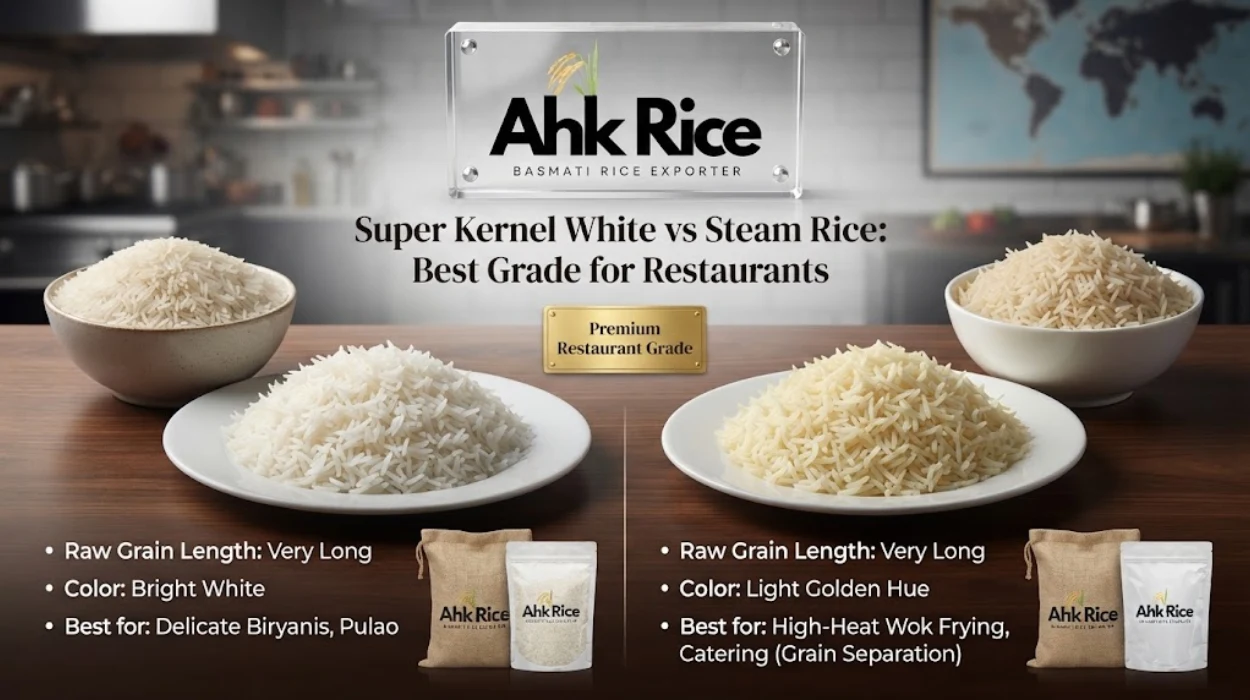
Super Kernel White vs Steam Rice: Best Grade for Restaurants
Super Kernel Steam is generally the stronger restaurant grade for high-volume kitchens, while Super Kernel White suits menus prioritizing faster cooking and a softer texture. Here is why: steam processing strengthens grain structure and separation, while white milling produces a softer, faster-cooking grain.
Restaurant procurement should start with the cooking requirement, not the lowest quotation. A useful foundation is this Super Kernel Basmati rice grain length and cooking guide, which explains the variety, grain dimensions, aroma, processing, and cooking profile.
Super Kernel Basmati is a traditional aromatic rice variety cultivated in Punjab, Pakistan. The variety commonly measures about 7.0–7.4 mm before cooking. Steam processing applies controlled heat before milling, while White Rice is milled and polished without that steaming stage.
For restaurants, the difference appears during cooking, holding, reheating, and service. Steam rice provides firmer grains and stronger separation. White rice provides a softer bite and shorter preparation cycles. The correct grade depends on menu design, kitchen volume, and service method.
What are the available Super Kernel rice solutions for restaurants?
Restaurants have two primary Super Kernel solutions: White Rice for soft, fast-cooking dishes and Steam Rice for firm, separate grains during high-volume service. Here is why: both use the same underlying Basmati variety, but processing changes moisture behavior, texture, cooking tolerance, and commercial application.
Super Kernel White Rice
Super Kernel White Rice is raw-milled Basmati rice. The paddy undergoes cleaning, dehusking, polishing, grading, and sorting. The resulting grain has a clean white appearance and natural Basmati aroma.
White rice provides a softer cooked texture. This profile suits restaurants serving plain rice, pulao, curry meals, and dishes where tenderness matters more than extended holding.
Public export specifications place Super Kernel White around 7.2 mm average raw grain length, with cooked length exceeding 16 mm in one current commercial specification.
Super Kernel Steam Rice
Super Kernel Steam Rice is heat-treated before final milling. Steam processing uses soaking, steaming, drying, dehusking, polishing, grading, and sorting to stabilize the grain.
Steam rice produces firmer grains with stronger resistance to breakage. AHK’s published specification for Super Kernel Steam lists 7.0–7.2 mm average grain length, ≤12% moisture, and ≤3% broken grains for the referenced market specification.
Steam rice therefore suits biryani kitchens, catering operations, buffet service, and restaurants requiring consistent grain separation across large batches.
The two processing solutions serve different kitchen requirements, so the next comparison focuses on measurable specifications.
How do Super Kernel White and Steam Rice compare?
Super Kernel White emphasizes softness and shorter cooking, while Steam emphasizes firmness, grain separation, and holding stability. Here is why: processing changes the grain structure without changing the underlying Super Kernel variety.
| Attribute | Super Kernel White | Super Kernel Steam |
|---|---|---|
| Rice variety | Super Kernel Basmati | Super Kernel Basmati |
| Processing | Raw milled and polished | Steam-treated before milling |
| Raw grain length | About 7.2 mm | About 7.0–7.2 mm |
| Cooked texture | Soft and fluffy | Firm and separate |
| Broken specification | 0–2% common premium range | Up to 3% in referenced AHK specification |
| Moisture | Around 12–13.5% | ≤12–14% depending on specification |
| Restaurant application | Plain rice, curry meals, pulao | Biryani, buffet, catering, high-volume service |
Super Kernel White and Steam can both deliver aromatic Basmati performance. Their commercial distinction comes from processing and cooking behavior. Public specifications show Super Kernel White at around 7.2 mm, while AHK’s Indonesia specification gives Steam at 7.0–7.2 mm.
The specification table shows why raw grain length alone does not determine restaurant suitability. Texture, broken percentage, moisture, and service conditions also influence procurement.
How does processing change restaurant performance?
White processing removes the husk and polishes the grain directly. Steam processing adds a controlled heat stage before milling. That heat changes the grain structure and increases firmness after cooking.
Parboiling and steam-related treatments are widely used to produce firmer, less sticky rice. Foodservice applications value this characteristic because cooked grains must remain intact during preparation and service.
Restaurant kitchens therefore evaluate more than appearance. Procurement teams should test cooked yield, grain separation, cooking time, holding performance, and broken grains before approving a commercial grade.
The processing difference establishes the technical comparison. The next question is how these grades fit specific restaurant markets.
Which grade works best for Middle Eastern restaurants?
Super Kernel Steam fits Middle Eastern restaurants that serve biryani, mandi, pulao, buffets, and large rice portions requiring firm, separate grains. Here is why: steam processing supports structural stability during bulk cooking, serving, and holding.
Middle Eastern restaurants often operate high-volume rice kitchens. Large batches must maintain appearance from cooking through service. Steam rice supports this requirement through a firmer cooked structure.
What grade should Gulf restaurants consider?
Super Kernel Steam fits restaurants serving biryani and rice-centered meals. The firm grain structure helps preserve separation during bulk preparation.
Super Kernel White fits restaurants emphasizing softer rice served immediately after cooking. It also suits menus where rice absorbs sauces and gravies.
The GCC remains an important destination for Pakistani Basmati. Public shipment data records Super Kernel White exports to Saudi Arabia and the UAE, demonstrating established commercial movement into Gulf markets.
How should Gulf buyers compare price?
Public 2026 commercial listings place Super Kernel White around US$1,165–1,205 per MT FOB Karachi for an indicative export specification.
Steam pricing depends on crop year, processing specification, broken percentage, packaging, inspection, and destination. A single public AHK destination page lists a much lower Vietnam figure, showing why buyers should not treat an isolated web quotation as a universal 2026 benchmark.
For Gulf procurement, compare identical specifications on the same Incoterm. A White quotation at US$1,180 per MT cannot be fairly compared with Steam at another port or with different packaging.
What shelf-life planning suits Gulf restaurants?
Dry white rice has a USDA FoodKeeper best-quality window of about 2 years unopened under ordinary pantry conditions.
Parboiled rice research also demonstrates extended storage potential under controlled packaging. One study measured approximately 21.7–26.4 months under specified packaging and storage conditions.
High Gulf temperatures make storage management important. Restaurants should store bags away from moisture, direct heat, pests, and contaminated materials. Warehouse temperature and packaging quality determine practical inventory performance.
The Gulf comparison shows why Steam often fits high-volume service. The next market demonstrates a different procurement pattern.
Which grade works best for Southeast Asian restaurants?
Super Kernel White suits Southeast Asian restaurants emphasizing softer rice and immediate service, while Steam suits kitchens needing firm grains for fried rice, biryani, catering, and batch preparation. Here is why: kitchen workflow determines whether softness or structural stability creates greater value.
Southeast Asian restaurant menus vary widely. Rice may serve as a daily staple, a fried-rice base, or part of specialized biryani and catering menus.
Which grade suits Indonesian foodservice?
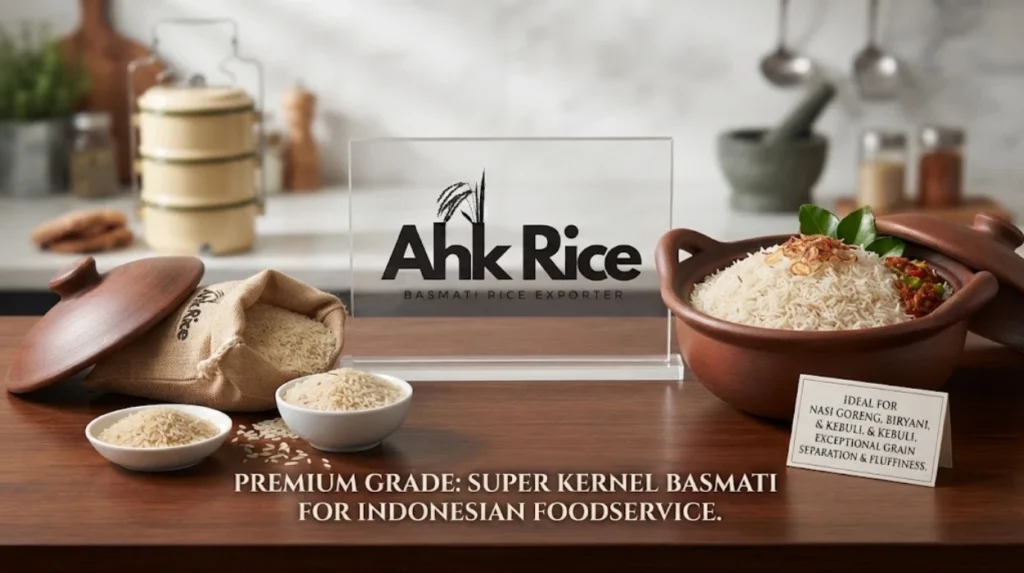
Super Kernel Steam provides firm grains and non-sticky cooking performance. AHK’s Indonesia specification lists ≤12% moisture, ≤3% broken grains, and nil foreign matter for its referenced Steam product.
Super Kernel White provides a softer cooked profile. This makes it suitable for restaurants serving rice directly after preparation.
Indonesia also demonstrates the importance of packaging. Restaurants can procure bulk formats such as 25 kg or 50 kg bags, while distributors can use smaller retail packs. Public commercial listings show Super Kernel available across these packaging formats.
How should Southeast Asian buyers compare price per MT?
Price comparison should use the same basis. FOB Karachi, CNF, and CIF prices represent different commercial costs.
A public 2026 listing gives Super Kernel White at approximately US$1,165–1,205 per MT FOB Karachi.
Steam quotations should be requested against the same grain length, broken percentage, moisture, packing, and shipment terms. This approach prevents a lower specification from appearing cheaper.
How should restaurants compare shelf life?
White rice carries the general dry-rice storage benchmark of around 2 years unopened under appropriate pantry conditions.
Steam or parboiled rice can also maintain commercial quality for extended periods. Research has recorded shelf-life ranges above 21 months under controlled packaging conditions.
Restaurants should therefore use rotation dates rather than assuming one processing method automatically has unlimited storage advantages.
The Southeast Asian comparison confirms that menu and inventory practices matter as much as grade. The next section converts these differences into practical procurement cases.
Which method works best for different restaurant cases?
Steam works best for high-volume biryani and buffet operations, while White works best for immediate-service menus seeking soft texture and simpler preparation. Here is why: each processing method produces a different balance of firmness, cooking tolerance, and service performance.
High-volume biryani kitchens
Super Kernel Steam provides stronger grain integrity during bulk cooking. Large batches remain more visually consistent during serving.
Fine-dining restaurants
Super Kernel White can provide a softer, delicate texture. Steam remains suitable where presentation requires distinct, firm grains.
Buffet restaurants
Super Kernel Steam provides a stronger fit. Buffet rice remains exposed to serving conditions for longer periods than freshly plated rice.
Catering companies
Super Kernel Steam supports bulk preparation and transportation. Firm grains tolerate larger production batches and repeated handling.
Curry-focused restaurants
Super Kernel White fits meals where rice receives sauces and gravies. Softer grains provide a different eating experience.
These use cases show that no single processing grade fits every restaurant. The final selection requires a structured procurement framework.
What are the pros and cons of Super Kernel White and Steam Rice?
White offers softer texture and straightforward cooking, while Steam offers stronger grain separation and batch-service tolerance. Here is why: each advantage also creates a corresponding trade-off in commercial kitchen performance.
| Grade | Pros | Cons | Example |
|---|---|---|---|
| White | Soft texture, direct milling, fast preparation | Less structural tolerance during prolonged holding | Curry restaurant |
| White | Natural aroma, clean appearance | Greater attention needed during bulk cooking | Immediate table service |
| Steam | Firm grains, strong separation | Longer preparation process | Biryani kitchen |
| Steam | Better batch handling | Firmer bite may not suit every menu | Buffet operation |
| Steam | Strong foodservice profile | Processing specification can raise procurement cost | Catering company |
White becomes attractive when texture and immediate service dominate. Steam becomes attractive when batch consistency and grain separation dominate.
The best decision therefore depends on operational priorities rather than product naming alone.
What factors should restaurants use before selecting a grade?
Restaurants should evaluate cooking time, grain separation, broken percentage, moisture, price per MT, shelf life, and menu application before approving a Super Kernel grade. Here is why: these factors directly affect food cost, yield, kitchen efficiency, and customer experience.
| Decision factor | White Rice | Steam Rice |
|---|---|---|
| Cooking speed | Higher priority | Moderate priority |
| Grain separation | Moderate | High priority |
| Soft texture | High priority | Moderate |
| Bulk cooking | Moderate | High priority |
| Buffet holding | Moderate | High priority |
Cooking time
Cooking time affects kitchen throughput. Restaurants with continuous orders benefit from a predictable cooking schedule.
Grain separation
Grain separation affects plate appearance. Biryani and pulao operations often prioritize distinct kernels.
Broken percentage
Broken grains influence presentation and cooked yield. Lower broken specifications generally support premium foodservice applications.
Moisture
Moisture affects storage stability. Buyers should verify moisture through a certificate of analysis.
Price per MT
Price should be compared on identical specifications. Packaging, inspection, freight, and Incoterms must remain consistent.
Shelf life
Shelf life affects inventory planning. Restaurants with slow consumption need stronger stock rotation controls.
Menu application
Menu application remains the final filter. A curry restaurant and a buffet restaurant do not require identical rice behavior.
This framework turns technical specifications into a practical restaurant purchasing decision.
How should restaurants evaluate a Super Kernel rice sample?
Restaurants should cook both grades under the same recipe, measure yield, inspect separation, record holding performance, and compare total food cost before approving bulk supply. Here is why: laboratory specifications cannot fully represent a restaurant’s cooking equipment and service workflow.
Start with equal sample weights. Use the same water ratio and cooking vessel for both samples.
Measure raw weight and cooked weight. Record the final yield for each grade.
Inspect grain separation immediately after cooking. Record the percentage of visibly broken or clumped grains.
Hold cooked rice under normal restaurant conditions. Check texture at 30, 60, and 120 minutes.
Calculate cost per cooked kilogram. This converts the MT quotation into a meaningful kitchen metric.
AHK Rice supplies Super Kernel, 1121, and 1509 Basmati varieties and provides end-to-end processing, custom packaging, and export coordination for international buyers. Product specifications should be finalized against the restaurant’s required grade, packaging, inspection standard, and destination.
A controlled sample test provides the bridge between technical comparison and commercial procurement.
What is the practical solution for restaurant buyers?
Choose Super Kernel Steam for high-volume biryani, buffet, and catering operations; choose Super Kernel White for softer immediate-service meals and menus centered on tenderness. Here is why: processing determines the balance between grain firmness, cooking behavior, holding tolerance, and restaurant workflow.
Restaurant buyers should not select a grade from grain length alone. Super Kernel White and Steam use the same variety but create different cooking outcomes.
A specification-led purchase should define grain length, broken percentage, moisture, purity, packaging, crop year, inspection requirements, and delivery terms.
The final quotation should also state FOB, CNF, or CIF terms clearly. This ensures the buyer compares equivalent commercial offers rather than headline prices.
Restaurants requiring repeated supply should also establish an approved sample. Every future shipment can then be checked against the same reference specification.
For larger procurement programs, the next commercial step is a detailed review of Super Kernel Basmati Rice Wholesale Price Per Ton 2026, including quotation structure and bulk purchasing considerations.
Frequently Asked Questions
Is Super Kernel Steam better than White Rice for restaurants?
Super Kernel Steam suits restaurants requiring firm, separate grains during bulk cooking and holding. Super Kernel White suits restaurants requiring softer texture and faster preparation. Menu type determines the appropriate grade.
What is the grain length of Super Kernel Basmati?
Super Kernel commonly measures around 7.0–7.4 mm before cooking. Commercial specifications vary by crop, processing method, and contract tolerance. Buyers should approve the exact grain-length range before shipment.
Which Super Kernel rice is better for biryani?
Super Kernel Steam generally suits biryani production because its firmer structure supports grain separation during batch cooking. White Rice also works for biryani when the restaurant prefers a softer texture and immediate service.
What is the approximate Super Kernel White price per MT in 2026?
One current public commercial listing gives Super Kernel White at approximately US$1,165–1,205 per MT FOB Karachi. Actual contract pricing depends on specification, crop, packaging, inspection, quantity, and shipment terms.