How Punjab’s Climate, Soil and River Water Create Basmati’s Long Grain and Aroma
Punjab-origin Basmati offers the strongest combination of traditional aroma, elongated grain characteristics and established export varieties, while the best sourcing approach depends on crop origin, milling specifications, water management and the buyer’s destination-market requirements. Climate and soil create the growing conditions, but variety selection, harvesting, drying and milling determine how consistently those characteristics reach international buyers.
Understanding these factors helps importers distinguish genuine origin-based quality from marketing claims. This is particularly important when comparing 1121, Super Kernel, and 1509 Basmati rice, Basmati rice for retail, wholesale distribution and foodservice. The educational guide, how Pakistani Basmati rice grows and develops its distinctive quality, provides a useful starting point for understanding the relationship between growing conditions and finished grain characteristics.
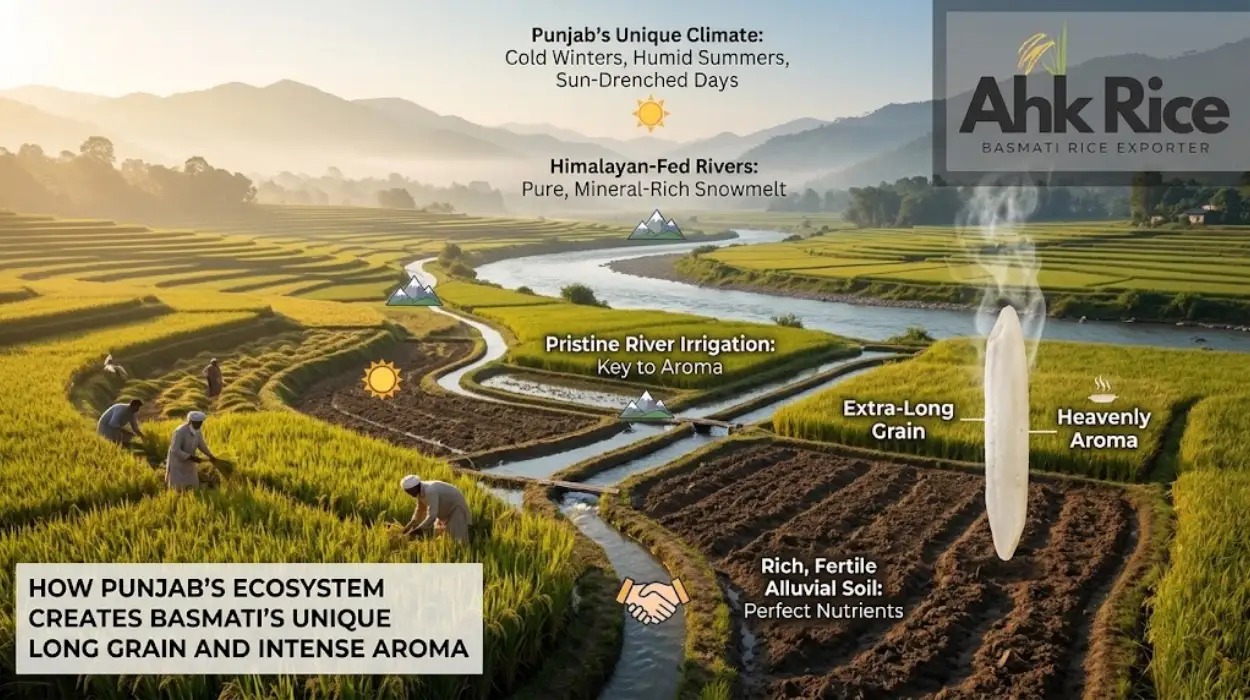
Punjab’s rice-growing environment includes fertile alluvial soils, seasonal monsoon rainfall, warm growing temperatures and irrigation supported by the Indus River system. These conditions influence crop development, grain filling and aromatic characteristics. They do not guarantee identical results across every farm or harvest. Buyers need to evaluate the variety, cultivation practices, processing controls and documented specifications together.
What makes Punjab’s climate suitable for Basmati rice?
Punjab’s climate supports Basmati cultivation through warm growing-season temperatures, seasonal rainfall and sufficient sunshine for crop development. These conditions influence flowering, grain filling and aromatic quality, while suitable irrigation and harvest timing help maintain grain integrity.
Basmati rice grows during the warm season and requires an appropriate balance of temperature, sunlight and water. Punjab’s seasonal climate supports vegetative growth, flowering and grain maturation. Temperature patterns during grain filling affect the development of the endosperm, which forms the structure of the milled rice grain.
Night temperatures, humidity and rainfall patterns also influence crop performance. Excessive heat during sensitive growth stages can disrupt grain filling, while heavy rainfall near maturity can increase lodging, disease pressure and harvesting difficulties. Lodging occurs when rice plants bend or fall before harvest, making grain collection more difficult.
Climate therefore establishes the potential for quality rather than guaranteeing it. Two farms growing the same variety can produce different grain dimensions, moisture levels and milling outcomes because of differences in sowing dates, field management, crop maturity and post-harvest handling.
For importers, the practical lesson is to assess a supplier’s actual grain specifications and batch consistency rather than treating Punjab’s climate as sufficient proof of premium quality.
How do Punjab’s soil and river water influence Basmati quality?
Punjab’s alluvial soils provide a foundation for rice cultivation through their mineral content, water-retention characteristics and agricultural fertility. Irrigation from the Indus River system supports crop water requirements, while drainage, soil salinity and nutrient management influence plant health and grain development.
Alluvial soil develops from sediments deposited by rivers over time. Much of Punjab’s agricultural land contains alluvial soils that support cereal production. Their texture and fertility vary by location, so soil testing remains important when planning rice cultivation.
Rice needs adequate water throughout critical growth stages. Punjab’s canal networks and groundwater resources support irrigation, with the wider Indus Basin supplying the region’s agricultural water system. Reliable water management helps maintain crop growth during periods of insufficient rainfall.
However, more water does not automatically produce better Basmati. Poor drainage, excessive irrigation and saline soil can affect root development and crop performance. Water availability also varies by location and season, making efficient irrigation important for agricultural productivity.
Soil fertility management matters because excessive nitrogen application can increase vegetative growth and lodging risk. Balanced nutrient management supports crop development without relying on the assumption that more fertiliser always produces better grain.
Aroma also requires careful interpretation. Basmati’s characteristic fragrance is associated with aromatic compounds, particularly 2-acetyl-1-pyrroline (2AP). Genetic variety is a major determinant of this characteristic. Growing conditions, maturity and post-harvest handling can influence the final quality, but river water alone does not create Basmati’s aroma.
What are the available solutions for sourcing Punjab-origin Basmati?
Importers can source Punjab-origin Basmati through variety-based procurement, farm or collection-point traceability, mill-level quality control and integrated farm-to-port documentation. The strongest approach combines verified origin with measurable specifications, representative samples and shipment-level records.
Buyers generally evaluate four sourcing approaches. Each offers a different balance of cost, control and documentation.
1. Variety-based procurement
This approach begins with selecting a rice variety that fits the intended market. 1121 Basmati is known for its long grain and cooked elongation. Super Kernel serves buyers seeking traditional Basmati aroma and familiar grain characteristics. 1509 offers another long-grain option for buyers evaluating procurement cost, yield and market positioning.
Variety-based procurement simplifies initial comparisons, but the variety name alone does not establish purity, broken percentage or finished quality.
2. Farm or collection-point traceability
Farm-level traceability records the growing location and connects harvested paddy with subsequent handling. Collection-point records identify where paddy from participating growers enters the supply chain.
This approach improves origin visibility. Its effectiveness depends on reliable lot identification and controls that prevent unrelated varieties or origins from entering the same batch without documentation.
3. Mill-level quality assurance
Mill-level control focuses on cleaning, dehusking, whitening or parboiling where specified, grading and packing. Buyers can assess grain length, moisture, broken percentage, foreign matter and relevant food-safety test results.
This approach offers direct evidence of the product delivered, although mill records alone do not prove the precise farm where the crop originated.
4. Integrated farm-to-port traceability
An integrated system connects origin records, procurement lots, processing batches, inspection results, packing details and shipping documents. This approach provides the clearest documented relationship between the agricultural source and the exported consignment.
For buyers evaluating AHK Rice’s Pakistani Basmati sourcing and export services, the relevant procurement questions include variety availability, processing specifications, custom packaging, shipment documentation and the evidence available for tracing each consignment.
How do different Basmati sourcing approaches compare?
Integrated traceability offers the broadest visibility, while variety-based procurement provides a simpler starting point and mill-level testing verifies the finished product. Importers should combine origin records, laboratory evidence and contractual specifications instead of relying on one quality indicator.
| Attribute | Variety-based procurement | Farm or collection traceability | Mill-level quality control | Integrated farm-to-port |
|---|---|---|---|---|
| Main focus | Variety selection | Agricultural origin | Finished rice quality | Origin through shipment |
| Origin evidence | Supplier declaration | Farm and collection records | Mill intake records | Linked lot documentation |
| Grain specification | Agreed variety profile | Depends on additional testing | Measured grain attributes | Measured and documented |
| Aroma assessment | Variety expectation and sample | Crop identity plus sample | Sample-based assessment | Sample and batch controls |
| Cost structure | Lower administrative burden | Additional recordkeeping | Testing and processing costs | Highest coordination burden |
| Traceability depth | Basic | Agricultural stage | Processing stage | Multiple supply-chain stages |
| Best application | Initial sourcing comparison | Origin-sensitive procurement | Quality-focused buying | Auditable export programmes |
These approaches are not mutually exclusive. A strong procurement programme uses variety selection to establish the product requirement, traceability to document origin, and mill-level controls to verify the finished rice. Integrated farm-to-port documentation connects these activities into one auditable record.
Which Basmati varieties suit different buyer requirements?
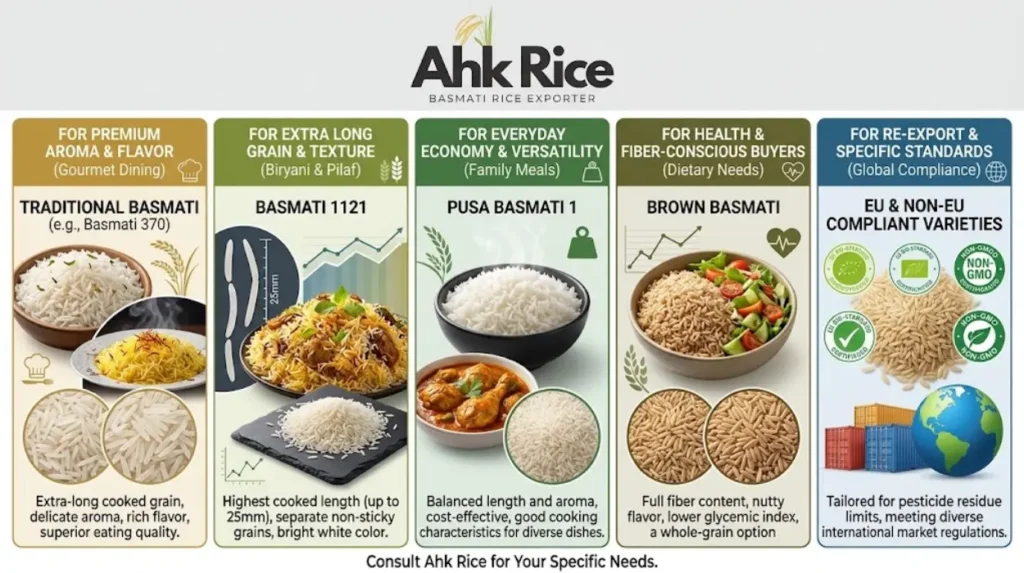
1121 suits buyers prioritising exceptional grain length and cooked elongation, Super Kernel suits markets seeking traditional Pakistani Basmati characteristics, and 1509 suits buyers comparing long-grain presentation with procurement economics. Final selection requires sample testing and agreed commercial specifications.
1121 Basmati
1121 is widely selected for its elongated raw grain and pronounced elongation during cooking. It fits premium retail, foodservice and distribution programmes where long, separate grains support the product’s market positioning. Buyers should specify whether they require Steam, Golden Sella, Creamy Sella or another agreed processing form.
Super Kernel Basmati
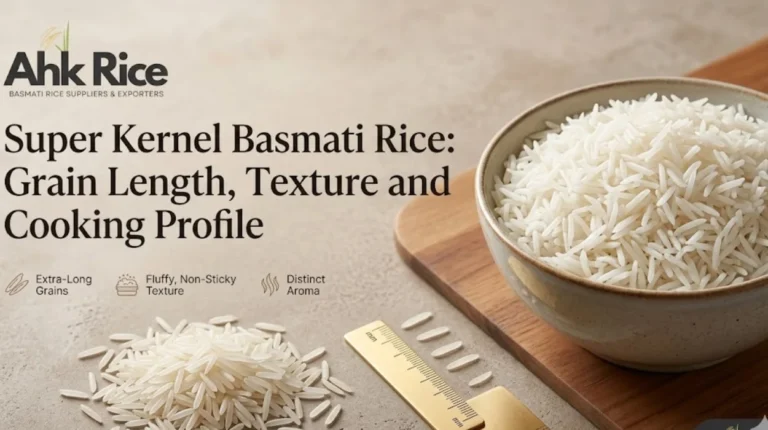
Super Kernel is associated with traditional Pakistani Basmati aroma and long-grain characteristics. It suits buyers who prioritise aromatic identity and familiar cooking performance. Grain dimensions, moisture, broken percentage and aroma should be checked against the agreed grade rather than assumed from the variety name.
1509 Basmati
1509 is a long-grain variety valued in commercial sourcing for its crop-cycle characteristics and procurement options. It can suit price-conscious retail and foodservice programmes when its cooking performance meets buyer requirements. Raw grain length and processing grade must be verified for each offered lot.
How do the USA and Gulf markets compare on grade, price and shelf life?
USA and Gulf buyers both require consistent quality, but their purchasing priorities differ by channel, packaging and price positioning. Compare grade preferences and landed cost using equivalent specifications, while determining shelf life from the product, packaging, storage conditions and supplier’s validated declaration.
USA market
The United States supports specialist South Asian grocery retail, mainstream ethnic-food distribution, private-label products and foodservice. Buyers serving premium segments often evaluate 1121 for its grain elongation and Super Kernel for its traditional aroma. The appropriate choice depends on customer expectations, cooking tests and retail price positioning.
Importers need clear product identity, lot traceability, compliant food labelling and relevant import documentation. Testing and entry requirements depend on the product and applicable US regulations. Buyers should confirm requirements with their customs broker and relevant authorities before shipping.
Gulf market
Gulf markets, including the UAE and Saudi Arabia, serve retail, wholesale, catering and restaurant channels. 1121 and Super Kernel can support premium aromatic rice segments, while 1509 can compete where price and consistent bulk supply influence purchasing decisions. Golden Sella is relevant for buyers seeking parboiled rice for particular catering and foodservice applications.
Gulf buyers should assess hot-weather warehousing, moisture protection, package durability and destination-specific labelling. Requirements differ by country and sales channel, so the importer must confirm the applicable rules before printing packaging.
Price per metric tonne
There is no single reliable USA-versus-Gulf price comparison without a quotation date, grade, processing type, volume and Incoterm. A meaningful comparison uses the same specification and pricing basis.
| Cost factor | USA procurement | Gulf procurement |
|---|---|---|
| Product price | Depends on variety, grade and volume | Depends on variety, grade and volume |
| Freight and insurance | Route, port and shipment dependent | Route, port and shipment dependent |
| Import charges | Confirm US classification and applicable duties | Confirm destination-specific duties and fees |
| Packaging | Retail or bulk specification | Retail, wholesale or foodservice specification |
| Final comparison | Landed cost per MT | Landed cost per MT |
Compare supplier prices on the same FOB, CFR or CIF basis. Then calculate landed cost using the relevant freight, insurance, duties, clearance and local delivery expenses. An apparently cheaper FOB offer may not produce the lowest delivered cost.
Shelf-life comparison
Shelf life is not determined by destination alone. White milled rice and properly processed parboiled rice can have different storage characteristics, while moisture, packaging integrity, temperature and warehouse pests affect product condition. The supplier’s declared shelf life must match the actual product and validated storage conditions.
For both the USA and Gulf, buyers should request production or packing dates, batch identification, moisture specifications, packaging details and the supplier’s shelf-life basis. Use a documented expiry or best-before declaration that complies with destination-market requirements. Do not assign an unsupported shelf-life period simply because the rice is Basmati.
What are the pros and cons of each sourcing method?
Farm traceability improves origin verification, mill testing establishes finished-product quality, and integrated documentation strengthens accountability across the supply chain. Each method has costs and limitations, so buyers should select controls according to product risk, customer expectations and contract requirements.
| Method | Advantages | Limitations | Example |
|---|---|---|---|
| Variety-based sourcing | Simple product comparison | Variety name does not prove grade | Comparing 1121 and 1509 quotations |
| Farm traceability | Better agricultural origin records | Requires reliable grower and lot records | Verifying Punjab sourcing |
| Mill quality control | Measures physical product characteristics | Does not independently prove farm origin | Testing moisture and broken percentage |
| Integrated traceability | Connects origin, processing and shipment | Requires coordination and recordkeeping | Linking a purchase lot to export documents |
The strongest option for a US importer building a repeatable private-label programme is integrated traceability supported by independent testing where appropriate. A smaller wholesaler can begin with mill-level specifications and credible origin records, then expand its traceability requirements as volumes and customer obligations increase.
Which factors should buyers use to make the final decision?
Buyers should evaluate origin evidence, grain specifications, cooking performance, total landed cost and shipment documentation together. A sourcing decision becomes defensible when every critical requirement appears in the purchase contract and the delivered batch can be checked against the agreed specification.
| Decision factor | Question to ask | Evidence to request |
|---|---|---|
| Origin | Does the rice originate from the declared Punjab sourcing area? | Supplier declaration and available lot records |
| Product quality | Does the batch meet the agreed grade? | Specification sheet and representative sample |
| Cooking performance | Does the rice meet the intended recipe and customer expectations? | Cooking test results |
| Commercial value | What is the full delivered cost per metric tonne? | Itemised quotation and freight estimate |
| Traceability | Can the shipment be linked to its processing and packing records? | Batch records, inspection documents and shipping paperwork |
Buyers should also agree on inspection procedures, acceptable tolerances, packaging, payment terms and responsibility for nonconforming goods before confirming an order. Independent inspection can provide additional assurance when required by the contract or the buyer’s risk policy.
How can importers verify farm-to-port traceability for USA distribution?
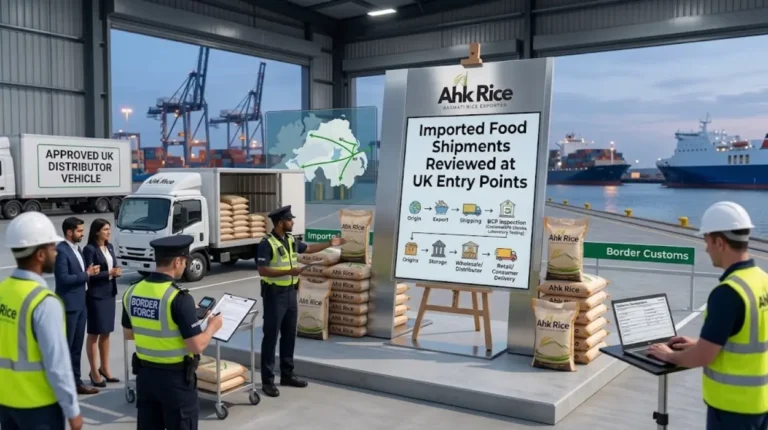
Importers should require a documented chain connecting the declared agricultural origin with procurement, processing, packing and shipment records. Batch identifiers, consistent product specifications and applicable food-safety documentation make verification more practical than relying on a general claim of Punjab origin.
A workable verification process follows five steps:
- Confirm the origin: Obtain the supplier’s declared sourcing region and available procurement records.
- Identify the product: Record the variety, processing type, grade, raw grain length, moisture and broken percentage.
- Verify the sample: Test cooking performance and inspect physical characteristics before approving the commercial specification.
- Match the batch: Connect processing and packing records to the agreed purchase order and shipment lot.
- Review export documentation: Confirm the commercial invoice, packing list, transport document, certificate of origin where applicable, and any required inspection or phytosanitary documents.
US importers should establish the applicable FDA food-facility registration, prior notice and Foreign Supplier Verification Program responsibilities with their customs broker and compliance team. Requirements depend on the importer’s role, product and applicable exemptions. A supplier’s certificate does not replace the importer’s own regulatory obligations.
For a buyer seeking a documented supply arrangement, the decision-focused next step is to evaluate the proposed Punjab-origin Basmati sourcing programme for USA distribution with farm-to-port traceability. Confirm the available records and contractual controls before treating traceability as verified.
Punjab’s climate, alluvial soils and irrigation resources support the cultivation of aromatic, long-grain Basmati, but export quality depends on more than geography. Variety selection, crop management, milling, moisture control and reliable documentation determine whether the finished product meets a buyer’s requirements.
For importers serving the USA and Gulf markets, the most effective sourcing strategy combines origin verification, measurable grain specifications, cooking tests and a transparent landed-cost comparison. Integrated farm-to-port traceability provides the strongest framework for buyers who need repeatable quality and documented supply-chain accountability.
Frequently asked questions
Does Punjab’s soil create Basmati’s aroma?
Punjab’s soil supports crop growth, but aroma is primarily associated with the rice variety’s genetics and aromatic compounds such as 2-acetyl-1-pyrroline. Growing conditions and post-harvest handling also influence the quality perceived in the finished rice.
Why is Punjab known for long-grain Basmati rice?
Punjab has established Basmati-growing areas, suitable seasonal growing conditions and a long history of rice cultivation and processing. Varieties such as 1121 and Super Kernel are recognised for their long-grain characteristics and aromatic qualities.
Which Punjab-origin Basmati variety is best for US importers?
1121 is suitable for buyers prioritising long-grain presentation and cooked elongation. Super Kernel suits aromatic Basmati programmes, while 1509 offers an alternative for buyers comparing price and cooking performance. Samples and specifications should determine the final choice.
How can an importer verify Pakistani Basmati origin?
Request supplier declarations, procurement records, batch identification, processing documentation and a certificate of origin where applicable. Check whether the documents consistently identify the product and shipment. Independent verification provides additional assurance when required.
What determines the export price per metric tonne?
Variety, processing type, grain length, broken percentage, moisture, order volume, packaging, inspection requirements and Incoterms affect the quotation. Freight, insurance, duties and destination charges determine the final landed cost.
How should Basmati rice shelf life be assessed?
Use the supplier’s validated shelf-life declaration for the specific product and packaging. Consider moisture, storage temperature, warehouse hygiene and packaging integrity. Confirm that date marking and storage instructions meet destination requirements.
Is farm-to-port traceability the same as a certificate of origin?
No. A certificate of origin identifies a product’s declared country of origin under the applicable rules. Farm-to-port traceability connects records across sourcing, processing, packing and shipment. The two serve related but different purposes.