Super Kernel Basmati Rice: Grain Length, Texture and Cooking Profile
Super Kernel Basmati Rice is a long-grain aromatic rice variety cultivated in Pakistan that delivers 7.0–7.4 mm raw grain length, a soft texture after cooking, and a distinctive natural aroma. Here is why: the variety develops in the Himalayan foothill region of Punjab, where soil composition, irrigation water, and climate support long-grain development and aromatic compound formation.
Super Kernel Basmati Rice remains one of the most recognized traditional Basmati varieties in international rice trade. Importers source it for retail packaging, food service distribution, hospitality sectors, and household consumption because it balances grain appearance, cooking performance, and affordability.
Pakistan cultivates Super Kernel Basmati primarily in the Basmati-growing belt of Punjab. The region produces grains with characteristic elongation, aroma, and texture that differentiate Basmati rice from ordinary long-grain rice.
What Is Super Kernel Basmati Rice?
A traditional Pakistani Basmati variety with 7.0–7.4 mm grain length, natural aroma, soft texture, and strong cooking elongation.
Super Kernel Basmati Rice is a premium aromatic rice variety cultivated in Pakistan’s Basmati-producing regions. The variety belongs to the Basmati family and exhibits the characteristics that define authentic Basmati rice, including long grains, fragrance, and elongation during cooking.
Super Kernel Basmati Rice develops its aroma from naturally occurring aromatic compounds. The most important compound is 2-acetyl-1-pyrroline, which creates the distinctive fragrance associated with premium Basmati rice.
Super Kernel Basmati Rice differs from extra-long grain varieties such as 1121 Basmati. The variety offers slightly shorter raw grain dimensions but delivers a softer mouthfeel after cooking. Many consumers prefer this texture for daily meals and traditional rice dishes.
Super Kernel Basmati Rice serves domestic and export markets. Countries in the Middle East, Europe, North America, Africa, and Asia import the variety for both retail and food service sectors.
With the definition of Super Kernel Basmati Rice established, the next question is how the grain develops from cultivation to export-ready rice.
How Does Super Kernel Basmati Rice Reach Consumers?
The rice passes through cultivation, harvesting, drying, milling, grading, quality testing, packaging, and export preparation before reaching buyers.
Super Kernel Basmati Rice begins its journey in agricultural fields across Punjab, Pakistan. Farmers cultivate the crop during the Kharif season using irrigation systems connected to regional water networks.
Cultivation Stage
Cultivate seedlings in prepared nurseries. Transplant young plants into flooded fields. Irrigate fields according to crop requirements. Monitor pest activity through field inspections. Harvest mature paddy when moisture reaches suitable levels.
The cultivation cycle typically lasts between 120 and 140 days. During this period, the grain develops its characteristic length, aroma, and starch composition.
Post-Harvest Stage
Harvest the paddy. Dry harvested grain to target moisture levels. Store paddy under controlled conditions. Inspect moisture consistency before milling.
Controlled drying prevents grain cracking and preserves milling quality. Proper storage also protects grain aroma and appearance.
Processing Stage
Clean the paddy. De-husk the grain. Separate brown rice. Polish the kernels. Sort by length. Grade by quality. Inspect final output. Package approved lots. Load export containers.
Rice mills use optical sorters, graders, and laboratory testing equipment to maintain consistency. Quality control teams inspect physical appearance, moisture levels, broken percentage, and foreign matter content before shipment.
The processing sequence explains how the rice reaches market standards. The next question concerns the specific characteristics that define its grain length, texture, and cooking profile.
What Are the Grain Length, Texture, and Cooking Characteristics?
Raw grain length ranges between 7.0–7.4 mm, cooked grains elongate significantly, and the texture remains soft with separate kernels.
Grain length represents one of the most important specifications for rice buyers. Super Kernel Basmati Rice offers a long and slender appearance that appeals to retail and food service markets.
Grain Length
Raw grain length generally falls between 7.0 and 7.4 millimeters. The grains maintain a slender shape that contributes to visual appeal before and after cooking.
Rice buyers often evaluate grain dimensions because longer grains command higher acceptance in premium rice categories.
Texture
Cooked Super Kernel Basmati Rice produces a soft texture. The kernels remain separate rather than sticky. This characteristic supports applications where grain definition matters.
Soft texture distinguishes Super Kernel Basmati Rice from several firmer long-grain alternatives. Consumers frequently choose it for traditional rice meals because of this eating quality.
Cooking Profile
Cook the rice with appropriate water ratios. Allow grains to absorb moisture evenly. Maintain controlled cooking temperatures.
Cooked grains elongate considerably and retain structural integrity. The rice develops a pleasant aroma during cooking and produces a fluffy presentation suitable for serving.
These physical characteristics explain buyer demand. The next question focuses on the grades available in commercial trade.
What Grades of Super Kernel Basmati Rice Are Available?
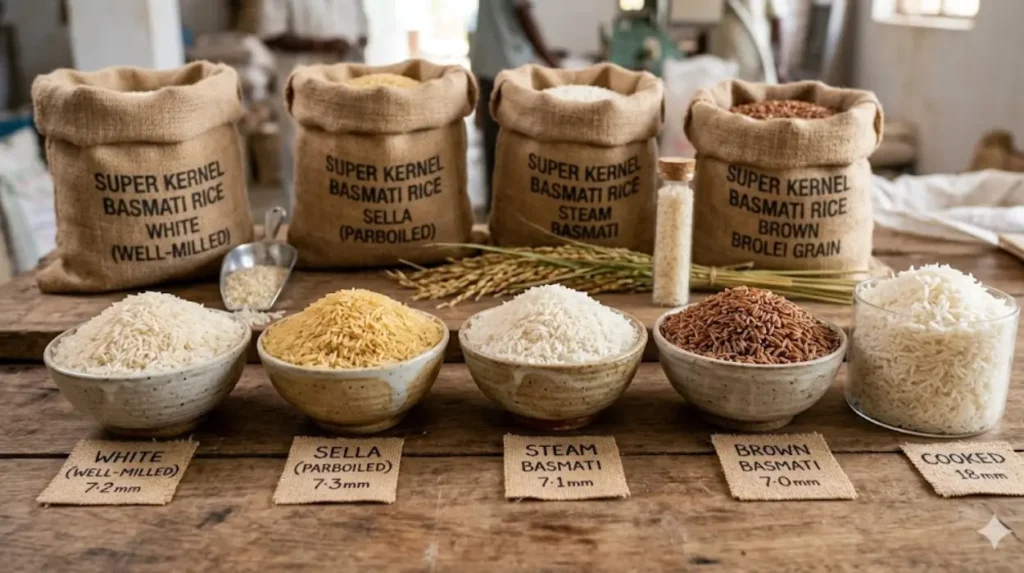
Exporters supply multiple grades based on purity, broken percentage, processing level, and buyer specifications.
Buyers evaluating different processing grades for food service operations often compare appearance, yield, and serving performance. A detailed breakdown is available in our guide on choosing the right Super Kernel specification for restaurant and catering operations.
Super Kernel Basmati Head Rice
Head Rice contains a high percentage of whole kernels. Retail brands and premium distributors frequently select this grade because appearance remains consistent throughout packaging.
Super Kernel Basmati Sortex Rice
Sortex Rice undergoes advanced optical sorting. Colour sorting equipment removes discolored grains and foreign material to improve uniformity.
Super Kernel Basmati Steam Rice
Steam Rice receives controlled steam treatment during processing. The method improves grain strength while maintaining natural colour characteristics.
Super Kernel Basmati Parboiled Rice
Parboiled Rice undergoes soaking, steaming, and drying before milling. The process enhances grain durability and reduces breakage during handling.
Super Kernel Basmati Broken Rice
Broken Rice contains fragmented kernels generated during milling. Food processors, rice flour manufacturers, and industrial users commonly source this grade.
Grade selection depends on market requirements. Understanding those markets helps explain global demand patterns.
Which Countries Import Super Kernel Basmati Rice?
Middle Eastern, European, African, North American, and Asian markets import Super Kernel Basmati Rice for retail and food service consumption.
Pakistan ranks among the world’s largest Basmati exporters. Super Kernel Basmati Rice contributes significantly to export volumes (source: Pakistan Bureau of Statistics, FY2024-25).
Middle East
Countries including the United Arab Emirates, Saudi Arabia, Qatar, and Oman import substantial quantities of Pakistani Basmati rice.
Food service operators, catering companies, and supermarkets drive demand in these markets.
Europe
The United Kingdom, Germany, and other European countries import Basmati rice for ethnic food retail channels and mainstream supermarket distribution.
European buyers place strong emphasis on quality assurance, traceability, and compliance documentation.
North America
The United States and Canada maintain demand through multicultural consumer populations and specialty food retailers.
Africa and Asia
Countries across East Africa and Southeast Asia import Super Kernel Basmati Rice for retail sales and hospitality sectors.
Market demand explains global trade activity. The next question concerns certifications and quality standards.
What Certifications Apply to Super Kernel Basmati Rice?
Export-grade Super Kernel Basmati Rice commonly complies with food safety, quality management, and phytosanitary requirements.
Certification verifies that rice meets defined standards for safety, quality, and international trade.
Food Safety Certifications
Food Safety Management Systems establish procedures for hazard control, traceability, and production monitoring.
Examples include:
- ISO 22000 Certification
- HACCP Certification
- Food Safety Management Documentation
Quality Management Certifications
Quality management systems standardize production procedures and inspection protocols.
Examples include:
- ISO 9001 Certification
- Product Testing Reports
- Quality Verification Records
Export Documentation
Export shipments require supporting documents before international dispatch.
Examples include:
- Phytosanitary Certificate
- Certificate of Origin
- Commercial Invoice
- Packing List
- Fumigation Certificate
- Bill of Lading
Certification frameworks help maintain buyer confidence. The next question examines practical benefits and applications.
What Benefits and Use Cases Define Super Kernel Basmati Rice?
The rice offers aroma, grain separation, visual appeal, cooking consistency, and versatility across multiple food applications.
Super Kernel Basmati Rice combines several characteristics that support commercial and consumer use.
Benefits
Aroma enhances dining experiences. Grain elongation improves plate presentation. Soft texture increases consumer acceptance. Kernel separation supports premium appearance. Consistent quality simplifies food preparation.
These benefits create value across retail and food service environments.
Use Cases
Restaurants prepare biryani dishes. Catering companies serve banquet meals. Retail brands package consumer products. Hotels include Basmati rice in buffet menus. Households cook daily rice dishes.
Examples include chicken biryani, mutton pulao, vegetable rice, buffet service meals, and family dining preparations.
Applications demonstrate versatility. The final question addresses common misconceptions surrounding the variety.
What Common Misconceptions Exist About Super Kernel Basmati Rice?
Super Kernel Basmati Rice is not identical to 1121 Basmati, not all long-grain rice is Basmati, and aroma alone does not determine quality.
Several misconceptions affect rice purchasing decisions.
Misconception: All Long-Grain Rice Is Basmati
Long grain refers to physical dimensions. Basmati refers to a specific rice category with defined aroma, elongation, and heritage characteristics.
Many long-grain varieties lack authentic Basmati fragrance and cooking performance.
Misconception: Longer Grains Always Mean Better Quality
Quality evaluation includes aroma, texture, purity, milling standards, moisture content, and cooking results.
A longer grain alone does not define superior quality.
Misconception: All Basmati Varieties Cook the Same Way
Different Basmati varieties produce different textures. Super Kernel Basmati Rice generally cooks softer than several extra-long grain alternatives.
Misconception: Aroma Determines Commercial Grade
Commercial grading evaluates multiple factors. Grain length, broken percentage, colour consistency, moisture levels, and purity all influence grade classification.
Understanding these misconceptions provides a complete picture of Super Kernel Basmati Rice. The variety remains one of Pakistan’s most recognized traditional Basmati exports because it combines long grains, natural aroma, soft texture, and dependable cooking performance.
Frequently Asked Questions
What is the average grain length of Super Kernel Basmati Rice?
Super Kernel Basmati Rice typically has a raw grain length of 7.0 to 7.4 mm. After cooking, the grains elongate significantly while maintaining a slender shape and separate appearance.
How is Super Kernel Basmati Rice different from 1121 Basmati Rice?
Super Kernel Basmati Rice has a slightly shorter grain than 1121 Basmati Rice. Super Kernel offers a softer texture after cooking, while 1121 Basmati generally produces longer cooked grains and a firmer texture.
Which dishes are best suited for Super Kernel Basmati Rice?
Super Kernel Basmati Rice works well in biryani, pulao, steamed rice dishes, buffet meals, and traditional South Asian recipes. Its aroma and grain separation improve both presentation and eating quality.
Which countries import Super Kernel Basmati Rice?
Major importers include the United Arab Emirates, Saudi Arabia, Qatar, Oman, the United Kingdom, the United States, Canada, and several African and Asian countries. These markets import the variety for retail and food service use.
What certifications are commonly required for Super Kernel Basmati Rice exports?
Export shipments commonly require ISO 22000, HACCP, phytosanitary certification, certificate of origin, fumigation certification, and other quality compliance documents depending on the destination market.