HTS Codes, Import Duties and CBP Entry Documents for Basmati Rice in the USA
Correct tariff classification, accurate customs valuation, and complete entry documentation determine how efficiently Pakistani Basmati rice clears US customs. Importers should verify the applicable Harmonized Tariff Schedule (HTS) code, calculate duties using the current tariff schedule, and coordinate US Customs and Border Protection (CBP) entry with Food and Drug Administration (FDA) requirements before shipment.
For a broader overview of the regulatory process, connect this article with your educational guide on US customs requirements for importing Pakistani Basmati rice. Importers comparing suppliers should evaluate documentation readiness alongside grain quality, packaging, shipment terms, and landed cost. AHK Rice is a Pakistani Basmati rice exporter based in Punjab, supplying 1121, Super Kernel, and 1509 Basmati rice varieties to international buyers. Its Pakistani Basmati rice export service provides a relevant starting point for buyers planning commercial shipments.
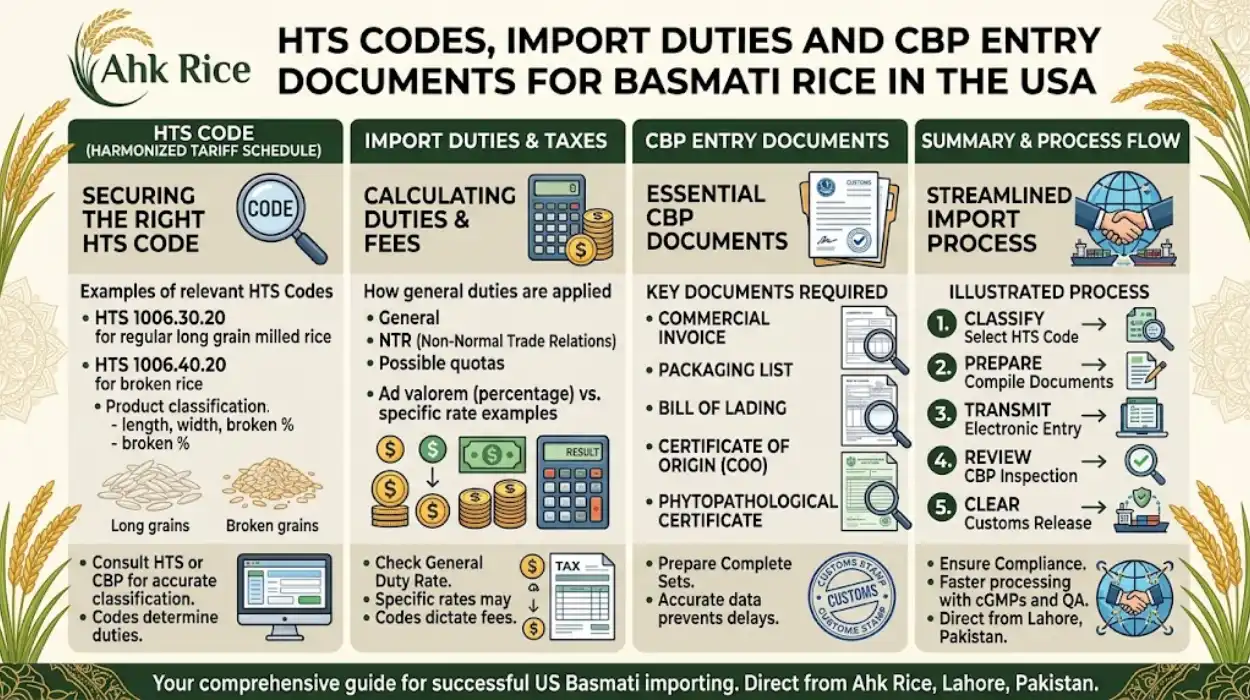
What HTS Codes Apply to Basmati Rice Imported into the USA?
The applicable HTS code depends on the rice’s processing state, product description, and tariff classification rules. Importers must distinguish paddy, brown, milled, and broken rice before selecting the complete US tariff number. Verify the current schedule before filing the customs entry.
The Harmonized Tariff Schedule of the United States classifies imported merchandise and establishes applicable tariff rates. Its rice provisions fall under heading 1006, but the correct subheading depends on the product’s condition and characteristics. The US International Trade Commission (USITC) publishes the official schedule and its revisions.
| Rice category | Classification starting point | What the importer must verify |
|---|---|---|
| Paddy or rough rice | HTS heading 1006.10 | Rice remains in its husk |
| Brown or husked rice | HTS heading 1006.20 | Husk removed, bran layer retained |
| Milled white rice | HTS heading 1006.30 | Milling condition and applicable subheading |
| Broken rice | Relevant provision under heading 1006 | Whether the product meets the tariff definition |
| 1121 Basmati rice | Classification based on processing state | Whether it is brown, milled, or another covered form |
| Super Kernel Basmati rice | Classification based on processing state | Product condition, description, and applicable statistical suffix |
| 1509 Basmati rice | Classification based on processing state | Whether the shipment is white, brown, or parboiled rice |
These categories are starting points, not substitutes for a complete classification. Product names such as 1121, Super Kernel, Steam, and Golden Sella describe commercial varieties or processing methods. They do not independently establish a complete HTS number.
A customs broker should confirm the applicable ten-digit US classification using the product specification, milling condition, parboiling process, and current tariff schedule. The invoice must include an adequate description, quantity, value, and the appropriate tariff subheading.
How Do US Import Duties Affect Pakistani Basmati Rice?
Import duty depends on the confirmed tariff classification, the applicable rate, customs value, and any additional measures in force on the entry date. Calculate the complete landed cost before agreeing on a selling price, and verify the current tariff treatment for Pakistani-origin rice.
The general duty rate appears in the HTS column for normal trade relations, while special rates apply only when the listed conditions are satisfied. The applicable rate must be checked against the current schedule rather than copied from an older shipment or another country’s tariff treatment.
Importers should separate the following cost components:
- Customs duty: The amount assessed under the applicable tariff provision.
- Additional tariffs: Any additional measures legally applicable to the product’s origin and entry date.
- Customs processing charges: Applicable government fees associated with the entry.
- Customs brokerage: Fees for classification support, entry filing, and customs coordination.
- Port and terminal charges: Costs associated with handling, storage, and cargo release.
- Inland transportation: Delivery from the arrival port to the warehouse or distribution center.
The calculation must use the correct customs value and applicable duty method. Some tariff provisions use a percentage of customs value, while others use a specific amount per unit of quantity. The HTS entry identifies the applicable method.
For example, an importer purchasing 20 metric tonnes of rice must not calculate the duty solely from the supplier’s FOB price without checking the customs valuation rules and applicable tariff provision. The importer should have the customs broker confirm the correct entered value, tariff rate, and additional charges before approving the purchase order.
Important: Do not publish a fixed duty percentage for Pakistani Basmati rice without verifying the applicable HTS line and additional measures on the intended entry date. Tariff changes can alter the final landed cost even when the supplier’s quoted price remains unchanged.
What CBP Entry Documents Are Required for Commercial Rice Shipments?
Commercial rice imports require a consistent set of transaction, transport, and customs records. The importer or its broker uses these documents to establish the product description, value, quantity, shipment details, and right to make entry. Additional records depend on the shipment and applicable regulations.
The principal documents include:
- Commercial invoice: Identifies the exporter, importer, product, quantity, unit price, total value, currency, and agreed trade terms.
- Packing list: Shows package counts, net and gross weights, bag sizes, and shipment configuration.
- Bill of lading: Records the ocean shipment, shipper, consignee, cargo details, and transport arrangement.
- Entry documentation: Includes the applicable CBP release filing and entry summary, commonly associated with CBP Forms 3461 and 7501, as applicable to the entry procedure.
- Customs bond: Provides the required financial security for applicable entries.
- Importer identification information: Supports the importer’s customs account and entry filing.
- Supporting origin and product records: Includes a certificate of origin or other evidence when required by the buyer, customs process, or applicable rule.
CBP identifies the commercial invoice as a key entry document and requires sufficient information to identify the merchandise, its quantity and value, and the appropriate HTS subheading. The bill of lading records shipment information and is submitted through the relevant carrier reporting process.
The exporter and importer should reconcile the invoice, packing list, and transport document before the cargo departs. Product descriptions should remain consistent. If the invoice states 1121 Steam Basmati rice in 5 kg retail bags, the packing list should not describe the shipment as bulk brown rice.
The US importer or customs broker remains responsible for ensuring that the entry is filed correctly. Exporter-provided paperwork supports the filing but does not replace the importer’s legal obligations.
What FDA Requirements Apply to Imported Basmati Rice?
CBP clearance and FDA compliance are separate parts of the import process. Food importers must address applicable facility registration, Prior Notice, food safety, labeling, and Foreign Supplier Verification Program obligations. A complete customs entry alone does not establish FDA compliance.
The US Food and Drug Administration regulates imported food under applicable federal food laws. Food offered for import must meet US requirements, and FDA may inspect or detain shipments that do not comply. FDA explains that food facility registration and Prior Notice are key parts of the import process.
Rice importers should coordinate four areas.
Food facility registration: The relevant foreign facilities must meet applicable registration requirements, subject to the rules and exemptions governing the particular operation.
Prior Notice: FDA must receive the required notification before the food arrives. The permitted submission window and deadline depend on the transportation method and filing system. Importers should coordinate this step with the carrier or broker.
Foreign Supplier Verification Program (FSVP): The FSVP importer generally verifies that its foreign supplier and imported food meet applicable US food safety requirements. This involves supplier evaluation, hazard analysis, verification activities, corrective action where necessary, and records. The importer should determine the applicable requirements and exemptions before shipment.
Food labeling and safety records: Retail packaging and food safety documentation must match the intended US market and product. Buyers should establish applicable labeling, traceability, and testing requirements before approving artwork or production.
The exporter can support the buyer with product specifications, supplier information, lot identification, and available quality documentation. The US importer must coordinate the applicable regulatory filings and retain records required under US law.
How Do Different Customs Clearance Approaches Compare?
Importers generally choose between managing documentation internally, appointing a licensed customs broker, or using a coordinated exporter-importer-broker workflow. The best option depends on shipment volume, regulatory experience, product complexity, and the buyer’s ability to verify documents before dispatch.
| Comparison attribute | In-house filing | Customs broker | Coordinated shipment workflow |
|---|---|---|---|
| Classification | Importer researches and verifies HTS code | Broker assists with classification | Exporter supplies specifications; importer and broker verify classification |
| Duty calculation | Importer calculates and checks rates | Broker calculates based on confirmed classification and value | Cost estimate is reviewed before order confirmation |
| Document preparation | Importer collects all records | Broker identifies entry-document requirements | Exporter prepares commercial and shipping documents; importer coordinates filings |
| FDA coordination | Importer manages applicable filings | Broker may support electronic filing and coordination | Importer, exporter, and broker allocate responsibilities before shipment |
| Cost structure | Internal staff time plus external charges | Brokerage fee plus applicable government and logistics costs | Coordination effort plus brokerage and logistics charges |
| Control | Direct control over internal processes | Specialist support with less internal filing work | Shared checkpoints and documented responsibilities |
| Best use case | Experienced importers with established procedures | Importers needing customs expertise | First-time buyers and businesses seeking repeatable shipments |
A broker does not automatically assume every importer responsibility. The importer must provide accurate information, maintain required records, and confirm that food safety obligations are assigned to the correct party.
The coordinated workflow provides the strongest operational structure for many commercial rice purchases because it connects product specifications, classification, customs valuation, FDA readiness, and shipping documents before departure. It also gives each party a defined role.
Which Approach Works Best for Different US Market Regions?
Import strategy should reflect the destination’s distribution model, buyer requirements, product grade, and landed-cost target. West Coast and East Coast shipments can require different logistics planning, while tariff classification and federal food import requirements remain tied to the product and applicable US rules.
West Coast: California and Pacific Distribution
California ports provide access to West Coast importers, ethnic grocery distributors, foodservice suppliers, and regional warehouses. Buyers serving these channels often evaluate 1121 Basmati for long-grain presentation and premium retail positioning, Super Kernel for traditional aroma and value, and 1509 for price-conscious distribution.
The actual grade depends on the buyer’s specification rather than the port. Importers should compare the supplier’s quotation, freight, port costs, inland transport, and applicable customs charges. Shelf-life planning should use the product’s validated storage conditions and packaging specifications, not a universal number.
For example, a distributor importing 1121 Steam rice in 5 kg retail bags should confirm the exact variety, processing state, net weight, packaging materials, label artwork, and customs description before the supplier loads the container.
East Coast: New York, New Jersey, and Atlantic Distribution
East Coast gateways serve importers distributing to northeastern grocery chains, wholesalers, restaurants, and foodservice operators. Buyers may prioritize premium 1121, aromatic Super Kernel, or 1509 according to their customer base and price position.
The same seven-part review applies: classification, tariff rate, customs value, entry documents, FDA requirements, shipping costs, and storage planning. Importers should compare total delivered cost to their warehouse instead of comparing FOB prices alone.
Neither region automatically receives a different federal rice duty because of its port location. The correct tariff treatment depends on the product and applicable import rules. Port selection influences freight, handling, congestion exposure, and domestic delivery costs.
How Should Buyers Compare Price per Metric Tonne and Shelf Life?
Price per metric tonne should be calculated from a current supplier quotation and the buyer’s actual shipment terms. The following framework compares the main commercial options without presenting invented market prices.
| Decision factor | Premium 1121 Basmati | Super Kernel Basmati | 1509 Basmati |
|---|---|---|---|
| Typical positioning | Premium long-grain retail and foodservice | Traditional aroma and balanced value | Price-conscious and high-volume distribution |
| Supplier price per MT | Obtain a current grade-specific quote | Obtain a current grade-specific quote | Obtain a current grade-specific quote |
| Duty per MT | Apply verified HTS treatment to the shipment | Apply verified HTS treatment to the shipment | Apply verified HTS treatment to the shipment |
| Shelf-life planning | Confirm packaging, storage conditions, and product specification | Confirm packaging, storage conditions, and product specification | Confirm packaging, storage conditions, and product specification |
| Best comparison method | Premium selling price versus landed cost | Aroma, quality consistency, and landed cost | Purchase economics, cooking performance, and turnover |
Do not assign one fixed shelf life to every Basmati variety. Actual shelf life depends on processing, moisture, packaging integrity, storage temperature, humidity, and the manufacturer’s validated specification. The buyer should obtain the product’s declared shelf life and storage instructions before purchase.
For a useful comparison, calculate:
Landed cost per MT = product cost + applicable duty + freight and insurance + customs and port charges + brokerage + inland transport, divided by the imported net metric tonnes.
Apply each cost according to the relevant Incoterm and avoid double-counting expenses already included in the supplier’s quotation.
What Are the Pros and Cons of Each Import Method?
Internal filing offers direct control, customs brokers provide specialist support, and coordinated workflows improve document consistency. Each method has trade-offs involving staff time, fees, oversight, and the risk of preventable errors. Choose the method that matches your team’s experience and shipment frequency.
In-house filing
The advantage is direct control over classification records, broker communications, and entry data. Experienced importers with established compliance teams can integrate customs tasks into their existing systems. The disadvantage is the time needed to maintain tariff knowledge and coordinate food import requirements. A classification mistake can affect duty calculations and delay release.
Customs broker
A broker helps manage entry filing, tariff review, customs valuation questions, and communication with CBP. This option is useful for importers that lack dedicated customs staff. Brokerage adds cost, and the importer must still supply accurate records and meet its own legal obligations. Broker appointment does not guarantee release or eliminate FDA review.
Coordinated workflow
The exporter prepares accurate commercial and shipping documents, the importer manages its regulatory responsibilities, and the broker verifies classification and entry requirements. This approach reduces inconsistencies between the product, invoice, packing list, and shipping data. It requires early communication and clear responsibility for every filing.
For example, if the final invoice lists a different net weight from the packing list, a pre-shipment document check can identify the discrepancy before the broker submits the entry. Correcting the records early is more efficient than resolving the same issue after arrival.
What Factors Should Importers Check Before Confirming a Shipment?
A reliable import decision combines tariff accuracy, document consistency, FDA readiness, total landed cost, and product suitability. Confirm these elements before the supplier dispatches the cargo. This process gives the importer a clear cost estimate and a documented plan for customs clearance.
Use this five-row decision framework:
| Decision factor | Question to resolve | Action before shipment |
|---|---|---|
| HTS classification | Does the code match the actual rice processing state? | Have the importer or broker verify the current HTS provision |
| Import duty | Is the rate current for the product’s origin and entry date? | Confirm applicable rates and additional measures |
| Entry documents | Do the invoice, packing list, and bill of lading agree? | Reconcile product description, quantity, weights, and values |
| FDA compliance | Are applicable Prior Notice, facility registration, and FSVP duties addressed? | Assign responsibilities and verify required records |
| Landed cost and shelf life | Does the shipment meet the buyer’s margin and storage needs? | Calculate total delivered cost and confirm the product specification |
Importers should also confirm the shipping term, payment conditions, inspection requirements, packaging details, and expected transport schedule. A supplier quotation should identify what is included and excluded so the buyer can compare offers consistently.
For repeat orders, preserve the approved product specification and document checklist. Review them whenever the rice variety, processing method, packaging, supplier, or regulatory requirements change.
How Can Importers Prepare Customs-Ready Rice Shipments?
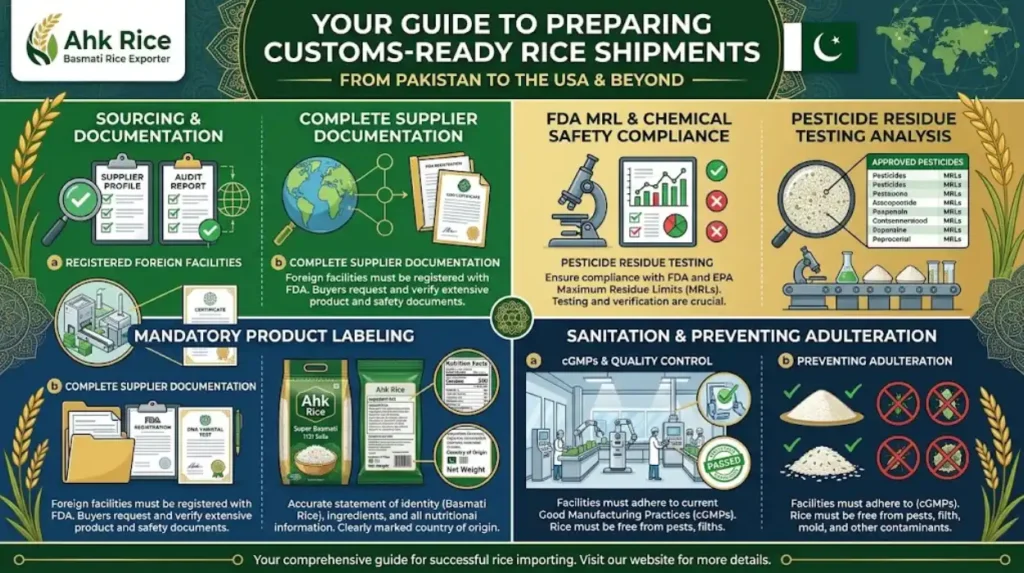
Customs readiness starts before loading. Importers should approve the product specification, confirm tariff classification and duty treatment, assign FDA responsibilities, reconcile commercial documents, and provide the broker with complete shipment information before arrival.
AHK Rice supplies Pakistani Basmati rice varieties including 1121, Super Kernel, and 1509, with processing, packaging, and export coordination for international buyers. US importers should communicate their required variety, processing type, broken percentage, moisture limits, packaging format, quantity, and destination before requesting a quotation.
A practical pre-shipment sequence is:
- Confirm the product grade, processing state, and packaging.
- Obtain a written quotation with clear Incoterms and shipment terms.
- Have the US importer or broker verify the HTS classification and applicable duty.
- Confirm FDA-related responsibilities, including Prior Notice and applicable FSVP requirements.
- Review the commercial invoice, packing list, and transport instructions.
- Confirm the final documents and shipment details before dispatch.
- Send the completed information to the customs broker for entry preparation.
This workflow does not guarantee immediate release, because CBP and FDA retain their respective inspection and enforcement powers. It does, however, give the buyer a structured way to identify missing information before cargo arrival.
The most suitable import method is the one that combines correct classification, transparent landed-cost calculations, accurate documents, and clear responsibility for food compliance. For a first shipment, importers should resolve these points before approving production or booking freight.
Frequently Asked Questions
What is the HTS code for Basmati rice imported into the USA?
Basmati rice generally falls under HTS heading 1006. The complete classification depends on whether the rice is brown, milled, broken, or in another processing state. Importers should verify the applicable subheading in the current US tariff schedule.
What import duty applies to Pakistani Basmati rice?
The applicable duty depends on the confirmed tariff classification and the tariff measures in effect when the shipment enters the United States. Importers should verify the current rate and calculate the total landed cost before placing an order.
Which documents are required to clear rice through US customs?
Common documents include a commercial invoice, packing list, bill of lading, applicable CBP entry filings, and customs bond documentation when required. Additional information or permits may apply depending on the shipment and regulatory requirements.
Does imported Basmati rice require FDA Prior Notice?
Yes. Commercial food shipments generally require FDA Prior Notice unless an applicable exemption applies. The notice must be submitted and confirmed within the prescribed timeframe before arrival.
Is FSVP mandatory for US rice importers?
FSVP generally applies to importers of food for human consumption unless a regulatory exemption applies. The responsible importer must determine the applicable requirements and maintain the necessary supplier verification records.
Can a Pakistani rice exporter handle all US customs clearance?
An exporter can prepare commercial invoices, packing lists, product specifications, and other supporting records. However, the US importer remains responsible for its applicable import obligations. A customs broker can assist with entry filing and classification.
How should importers compare Basmati rice prices per metric tonne?
Compare supplier prices alongside applicable duties, freight, insurance, port charges, brokerage, and inland transport. Calculate the total landed cost per metric tonne using consistent shipment terms and the actual net quantity imported.
How long does US customs clearance take for Basmati rice?
The timeline depends on entry accuracy, documentation readiness, port operations, and any CBP or FDA examination. Complete documentation helps prevent avoidable errors, but no exporter or broker can guarantee release within a fixed period.