Phytosanitary Certificate, Certificate of Origin, Bill of Lading and Commercial Invoice Explained
For USA rice imports, the best export documentation strategy combines a phytosanitary certificate, certificate of origin, bill of lading, and commercial invoice with consistent shipment details and applicable US import compliance records. Each document serves a different legal, commercial, or logistical purpose, and accuracy across the complete document set reduces customs delays, inspection problems, and payment disputes.
Understanding how export documents work together helps importers compare suppliers, evaluate documentation procedures, and prepare for their first shipment. Buyers sourcing Pakistani Basmati rice also need to understand the export documentation requirements for international rice buyers, including the purpose of each certificate and the information that must match across records. The requirements differ by destination, commodity, and shipment circumstances, so US importers must verify the applicable rules before dispatch.
For a rice importer, documentation quality is part of supplier evaluation. A competitive quotation does not guarantee a smooth customs clearance process. Buyers need accurate product descriptions, consistent quantities, correct country-of-origin information, and documents issued by the appropriate authorities or commercial parties. The following comparison explains the four principal documents, alternative documentation approaches, market differences, and the factors that determine the most suitable export process.
What are the four main export documents for a Pakistani rice shipment?
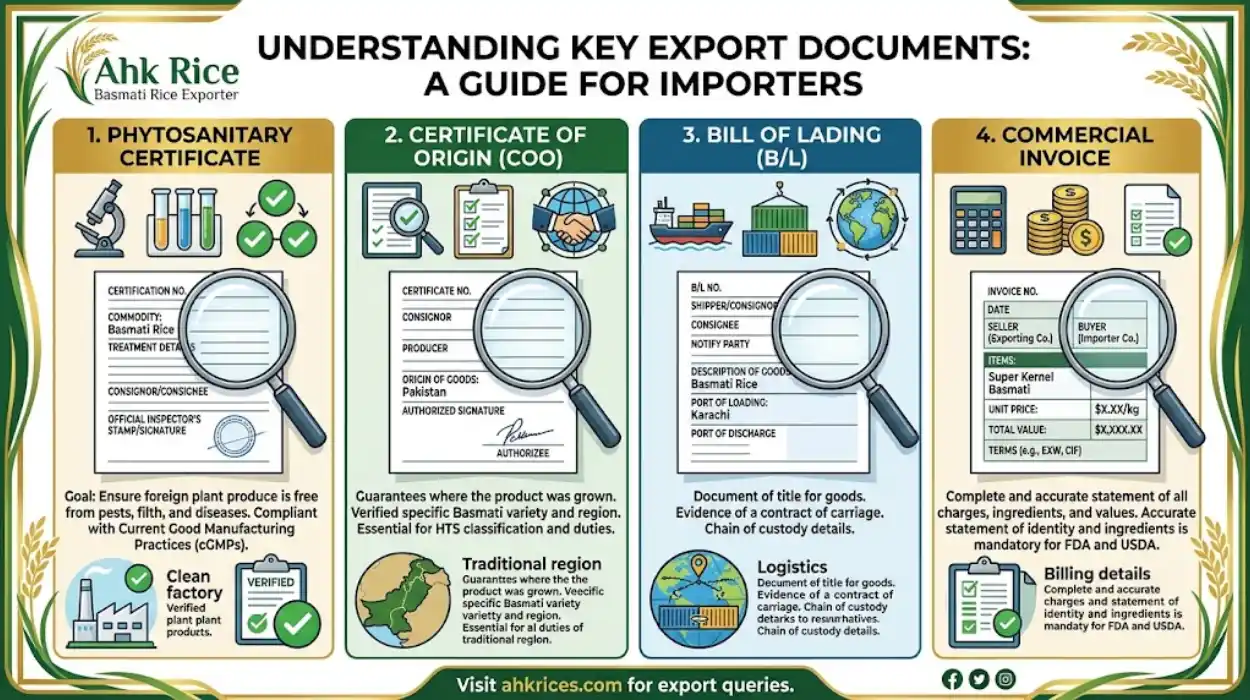
A phytosanitary certificate addresses plant-health requirements, a certificate of origin identifies where rice originates, a bill of lading records carriage and receipt of cargo, and a commercial invoice establishes the transaction details. Together, these documents support different parts of international rice trade.
1. Phytosanitary Certificate
A phytosanitary certificate is an official document issued by an authorized plant protection authority to certify that a plant product meets the applicable phytosanitary requirements. For rice exports, it addresses plant-health conditions imposed by the importing country. The relevant authority in Pakistan is the Department of Plant Protection, subject to the applicable export procedure.
The certificate is not a general guarantee of food safety, pesticide compliance, or product quality. US importers must verify the applicable requirements with the United States Department of Agriculture’s Animal and Plant Health Inspection Service (USDA APHIS) and the relevant US import authorities. Requirements depend on the commodity, processing, origin, and intended use.
2. Certificate of Origin
A Certificate of Origin identifies the country in which the goods originate under the applicable origin rules. For Pakistani Basmati rice, it supports the declaration that the product originates in Pakistan. The issuing body depends on the applicable procedure and destination requirements.
Importers use origin information for customs declarations, trade statistics, and verification of product claims. A certificate of origin does not automatically establish eligibility for preferential tariffs. Any tariff preference depends on the relevant trade arrangement and rules of origin.
3. Bill of Lading
A Bill of Lading (B/L) is a transport document issued by the carrier or its agent after cargo is received for shipment or loaded, depending on the document type. It records essential shipping information, including the shipper, consignee, vessel, ports, cargo description, and shipment details.
A negotiable original bill of lading can also serve as a document of title, depending on its terms. A sea waybill is generally non-negotiable and does not perform the same document-of-title function. Importers must select the appropriate transport document according to the payment arrangement, cargo release requirements, and contractual terms.
4. Commercial Invoice
A commercial invoice records the sale between exporter and importer. It identifies the seller, buyer, product description, quantity, unit price, total value, currency, and applicable delivery terms. Customs authorities use invoice information when assessing the declared transaction and determining customs value under the relevant rules.
For rice, the description should identify the variety and processing type accurately, such as 1121 Steam Basmati rice or 1509 Golden Sella Basmati rice. The invoice should reflect the actual transaction and agree with the packing list, shipping instructions, and other relevant records.
How do the four export documents compare?
The documents differ in issuing authority, primary purpose, and role in clearance. Phytosanitary certificates address plant health, certificates of origin establish origin, bills of lading document transport, and commercial invoices record sale value and transaction details.
| Comparison attribute | Phytosanitary Certificate | Certificate of Origin | Bill of Lading | Commercial Invoice |
|---|---|---|---|---|
| Primary purpose | Confirms applicable plant-health requirements | Identifies country of origin | Records carriage and cargo receipt | Records sale and transaction value |
| Main issuer | Authorized plant protection authority | Authorized issuing body | Carrier or shipping agent | Exporter or seller |
| Main information | Commodity, origin, inspection or treatment details when applicable | Exporter, goods, and origin details | Shipper, consignee, ports, cargo, and vessel | Buyer, seller, quantity, price, and currency |
| Typical trade function | Supports phytosanitary compliance | Supports origin declarations | Supports transport and cargo release | Supports customs valuation |
| Timing | Before shipment or as required by the import procedure | According to destination and transaction requirements | At or after cargo receipt/loading, depending on type | Prepared for the sale and export transaction |
| Common error | Missing or incorrect required declaration | Incorrect origin details | Inconsistent consignee or cargo information | Incorrect value, quantity, or product description |
| Main consequence of an error | Inspection delays or regulatory non-compliance | Origin verification problems | Cargo release or document-control delays | Customs queries, valuation issues, or payment disputes |
These documents are complementary rather than interchangeable. A commercial invoice cannot replace a phytosanitary certificate, and a bill of lading cannot independently establish that rice satisfies plant-health requirements. The exact documents required for a shipment depend on the importing country’s rules, the product, and the agreed shipping and payment arrangements.
What documentation approaches can rice exporters use?
Exporters can manage documents internally, coordinate preparation through a freight forwarder and customs broker, or use an integrated export-management process. The best approach depends on shipment complexity, destination requirements, staff expertise, and the need for consistent document control.
Approach 1: Exporter-managed documentation
The exporter prepares the commercial invoice, coordinates the packing list, supplies shipping instructions, and obtains the applicable certificates. This approach provides direct control over the information supplied to the buyer and carrier.
Its advantage is visibility: the exporter can check product specifications, quantities, and contractual details at each stage. Its disadvantage is the administrative burden. A team unfamiliar with US import requirements can overlook a document requirement or submit inconsistent information.
Approach 2: Freight forwarder and customs broker coordination
A freight forwarder arranges cargo movement and shipping documentation. A customs broker assists with customs entry and applicable clearance procedures within the scope of its authorization. The importer remains responsible for ensuring that its legal obligations are met.
This approach benefits businesses that lack an internal logistics team. Experienced service providers can identify missing shipping information and coordinate deadlines. However, they do not automatically guarantee product admissibility or replace certificates that must be issued by authorized government bodies.
Approach 3: Integrated export documentation control
An integrated approach connects order confirmation, product specifications, packing records, certificates, shipping instructions, and final documents through a single review process. The exporter, importer, forwarder, and broker work from consistent shipment data.
This approach is especially useful for repeat rice orders and shipments involving multiple product grades or packaging formats. It reduces avoidable discrepancies by establishing a final document checklist and assigning responsibility for each record. It also gives buyers a clearer process for reviewing draft documents before final issuance.
How do export documentation requirements differ between the USA and the UAE?
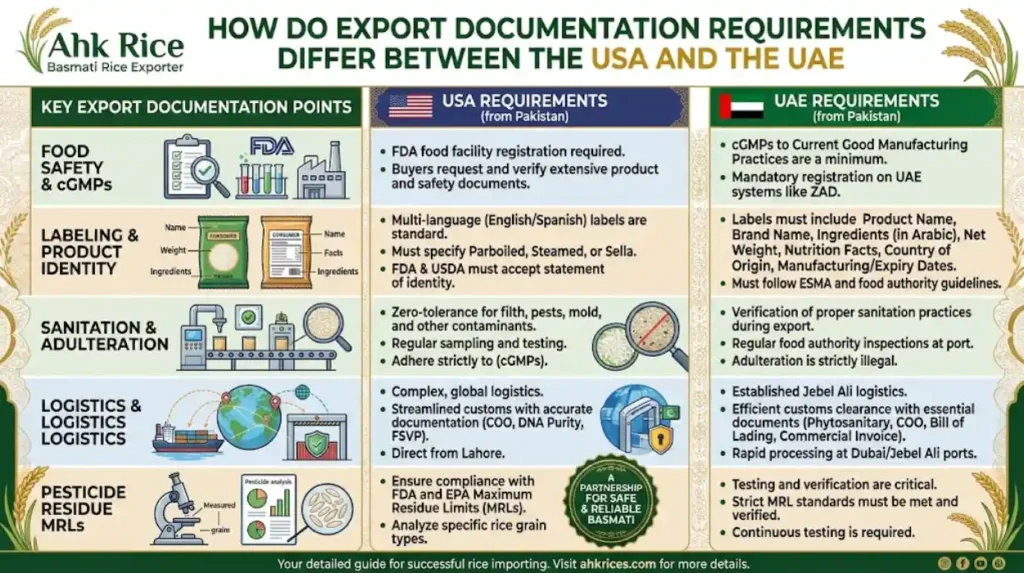
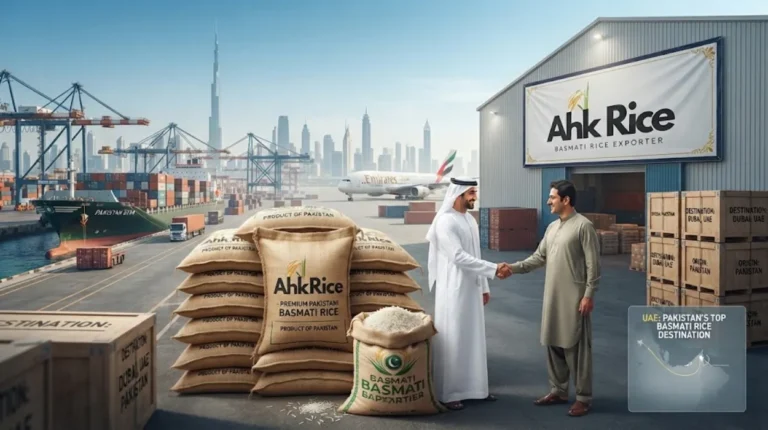
US and UAE rice imports require destination-specific compliance checks, even when the same four export documents support both shipments. US importers must assess USDA and FDA requirements, while UAE importers must verify applicable plant-health, customs, and food-labeling requirements.
United States market
US importers must consider the requirements administered by the USDA Animal and Plant Health Inspection Service, the US Food and Drug Administration (FDA), and US Customs and Border Protection (CBP). The precise requirements depend on the rice product, its processing, and the import circumstances.
For applicable shipments, the importer must establish whether a phytosanitary certificate is required under USDA APHIS rules. The importer must also confirm the applicable FDA food-facility registration, Prior Notice, and Foreign Supplier Verification Program (FSVP) obligations. These requirements are distinct from the four export documents discussed above.
The commercial invoice must state the actual transaction details. The certificate of origin must accurately identify the origin, and the bill of lading must match the shipping instructions and cargo information. Product descriptions should distinguish varieties and processing methods, such as 1121 Steam, 1121 Golden Sella, Super Kernel, and 1509 Basmati rice.
Price comparison: There is no single fixed US import price per metric tonne for these documents or rice grades. Buyers should compare supplier quotations using the same variety, quality specifications, packing format, shipment quantity, and Incoterm. FOB Karachi and CIF destination-port quotations include different cost components, so comparing them without adjustment produces misleading results.
Shelf-life comparison: Export documents do not determine rice shelf life. Shelf life depends on the product, moisture, processing, packaging, storage conditions, and the manufacturer’s validated specifications. US buyers should establish the declared shelf life and remaining shelf life required at arrival rather than assume a universal duration.
United Arab Emirates market
UAE importers must verify the current requirements of the relevant UAE authorities and the emirate through which the shipment enters. Applicable checks may involve customs declarations, plant-health documentation, food-product registration, and compliant labeling.
For packaged Basmati rice, buyers should confirm that the label meets the applicable UAE and GSO requirements, including mandatory information, language, origin, net weight, and production or expiry details where required. The exact requirements depend on the product and the current rules.
The commercial invoice and packing list should agree on the rice variety, package count, net weight, and gross weight. The bill of lading should match the agreed consignee and destination details. Origin and phytosanitary documents must meet the applicable import procedure.
Price comparison: UAE buyers should compare equivalent FOB or CIF quotations in US dollars per metric tonne. Grade, broken percentage, moisture, packaging, order volume, and freight influence the final landed cost. A lower FOB price does not necessarily produce a lower landed cost in Dubai or another UAE port.
Shelf-life comparison: UAE buyers should pay particular attention to packaging integrity, moisture control, warehouse conditions, and remaining shelf life on arrival. High temperatures and humidity increase the importance of suitable storage and moisture-resistant packaging. Importers should agree on minimum remaining shelf life and supporting product specifications before shipment.
| Decision factor | USA | UAE |
|---|---|---|
| Regulatory checks | Confirm USDA APHIS, FDA, and CBP requirements applicable to the shipment | Confirm applicable UAE plant-health, customs, and food requirements |
| Product identification | Match rice variety, processing, quantity, and origin across records | Match variety, package details, weights, and origin |
| Price evaluation | Compare equivalent FOB or CIF quotations and US entry costs | Compare equivalent FOB or CIF quotations and UAE landing costs |
| Shelf-life planning | Confirm declared and required remaining shelf life | Confirm remaining shelf life and suitable storage for hot, humid conditions |
| Documentation control | Coordinate exporter records with importer, broker, and carrier | Coordinate exporter records with importer, broker, and relevant authorities |
Which documentation method works best for different rice importers?
Exporter-managed documentation suits experienced businesses with established compliance procedures. Freight forwarder coordination benefits importers that need logistics support, while integrated documentation control suits repeat orders requiring consistent specifications, multiple approvals, and reliable shipment records.
A first-time importer of Pakistani Basmati rice benefits from coordinated document review before cargo dispatch. The importer should appoint a customs broker where appropriate, identify regulatory requirements early, and agree on the required documents with the exporter. The exporter should confirm that the commercial invoice, packing list, product description, and shipping instructions use consistent information.
An established distributor handling regular containers benefits from a standardized documentation checklist. Repeated shipments of 1121, Super Kernel, or 1509 rice can use consistent product-description templates while retaining shipment-specific quantities, values, batch details, and certificate information. Standardization reduces administrative repetition without replacing checks for each shipment.
A private-label buyer needs additional coordination between product specifications, packaging artwork, label approval, and shipment documents. The label must not contradict the declared country of origin or product identity. The importer should approve the packaging and required product information before production and dispatch.
For businesses evaluating an export partner, AHK Rice provides Pakistani Basmati rice sourcing, processing, custom packaging, and export coordination. Buyers should assess the supplier’s ability to provide accurate shipment information, coordinate required certificates, and communicate document status before cargo dispatch. The buyer must still verify its own destination-specific import obligations.
What are the advantages and disadvantages of each approach?
Exporter-managed preparation offers direct control but requires expertise. Third-party coordination adds logistics knowledge but depends on clear communication. Integrated document control improves consistency but requires defined responsibilities, early planning, and a reliable review process.
Exporter-managed preparation
Advantages: The exporter controls product descriptions, prices, quantities, and commercial records. Direct oversight helps maintain consistency between the purchase order, invoice, packing list, and shipping instructions.
Disadvantages: Staff must understand the applicable procedures and deadlines. For example, an exporter that enters the wrong consignee details may create avoidable corrections to shipping documents.
Freight forwarder and broker coordination
Advantages: Experienced providers support cargo scheduling, transport documentation, and customs-entry preparation. They help coordinate information among the exporter, carrier, and importer.
Disadvantages: Separate parties can work from different versions of shipment data. A forwarder cannot independently issue every government certificate, and a broker’s involvement does not transfer all legal obligations away from the importer.
Integrated document control
Advantages: A single checklist, document register, and approval process improve visibility. Draft invoices and shipping instructions can be reviewed against the purchase order before final documents are issued.
Disadvantages: The process requires disciplined communication and clear ownership. If the buyer changes packaging, quantity, or consignee details late in the order, several records may need updating.
For example, a shipment of 25 metric tonnes of 1121 Steam Basmati rice should use a consistent product description and quantity across the commercial invoice, packing list, and transport instructions. The exporter must also coordinate any required phytosanitary documentation and certificate of origin. The final bill of lading must reflect the actual shipment and agreed transport arrangements.
What factors should buyers check before approving export documents?
Buyers should verify regulatory requirements, document consistency, product specifications, shipment terms, certificate validity, and responsibility for corrections before dispatch. A documented approval process helps identify discrepancies while changes remain manageable and reduces avoidable clearance and cargo-release delays.
Use these five decision factors when comparing exporters:
- Regulatory responsibility: Establish which documents the exporter supplies, which authorities issue certificates, and which import declarations the buyer or its broker must complete.
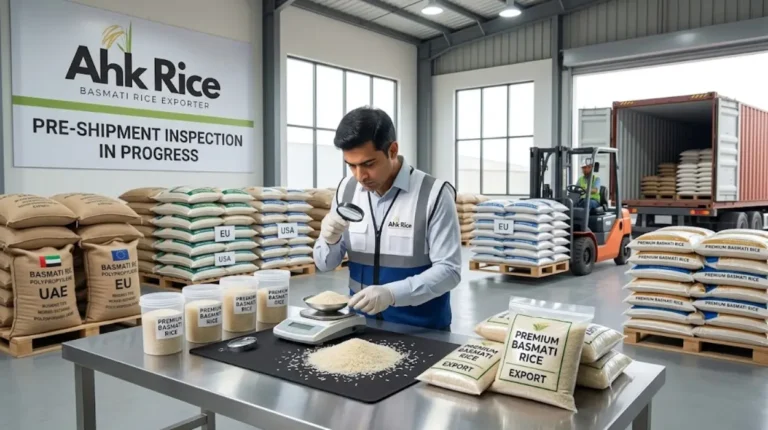
- Product specification: Confirm the variety, processing method, grade, moisture limit, broken percentage, packaging, and quantity against the purchase order.
- Commercial accuracy: Check the invoice currency, unit price, total value, delivery terms, and buyer and seller details.
- Shipping consistency: Match the packing list, consignee, ports, cargo description, and shipping instructions. Review draft transport documents before final issuance when available.
- Approval and correction process: Assign responsibility for reviewing each document, communicating discrepancies, and obtaining corrected versions when required.
Buyers should also confirm the applicable inspection, testing, and treatment requirements before shipment. A phytosanitary certificate does not replace food-safety documentation, and a certificate of origin does not independently establish tariff eligibility. Each record must serve its intended purpose.
How can importers prevent common export documentation errors?
Importers can prevent common errors by confirming destination requirements before loading, using one approved shipment-data record, reviewing draft commercial documents, and assigning responsibility for every required certificate. Final checks should cover names, quantities, origin, product descriptions, and shipping details.
The most frequent problems arise when documents are prepared independently. Different product descriptions, incorrect weights, mismatched consignee details, or outdated shipping instructions can trigger customs questions and administrative corrections.
A practical pre-shipment checklist should include:
- Confirm the destination country’s current import requirements.
- Verify whether a phytosanitary certificate is required for the specific rice product.
- Confirm the accepted certificate-of-origin procedure.
- Check the invoice against the purchase order and agreed Incoterm.
- Reconcile the packing list with package counts and declared weights.
- Confirm shipping instructions and consignee details before the bill of lading is finalized.
- Check whether the importer must complete separate customs, FDA, or other regulatory filings.
- Retain the final approved document set and communicate any amendments to the relevant parties.
For US-bound rice, the importer should coordinate with its customs broker and relevant authorities before dispatch. This is particularly important when a shipment involves new suppliers, different processing methods, or packaging intended for retail sale.
Frequently Asked Questions
Is a phytosanitary certificate mandatory for every rice shipment to the USA?
No. The requirement depends on the commodity and applicable USDA APHIS import conditions. Importers should verify the rules for the specific rice product and country of origin before shipment.
What is the difference between a certificate of origin and a phytosanitary certificate?
A certificate of origin identifies the country of origin under applicable rules. A phytosanitary certificate addresses plant-health requirements. One establishes origin information; the other supports compliance with applicable plant-health conditions.
Can a commercial invoice replace a bill of lading?
No. A commercial invoice records the sale, including product details and transaction value. A bill of lading documents the transport arrangement and cargo receipt. They perform different functions.
Who issues the bill of lading for Pakistani rice exports?
The carrier or its authorized agent issues the bill of lading according to the shipment arrangement. The exporter provides the shipping instructions and cargo information required to prepare the document.
How much do rice export documents cost per metric tonne?
There is no universal documentation charge per metric tonne. Costs depend on applicable certificates, inspection requirements, handling arrangements, shipment size, and service-provider fees. Buyers should request an itemized quotation and confirm which charges are included.
How long does rice export documentation take?
The time depends on certificate requirements, inspection scheduling, document preparation, carrier deadlines, and any corrections. Exporters should confirm the expected timeline with the relevant authorities and logistics providers before setting the loading schedule.
Does a certificate of origin guarantee lower US import duties?
No. It supports origin verification but does not automatically qualify the shipment for preferential tariffs. The applicable tariff classification, origin rules, and current US trade measures determine the treatment.
What documents should a first-time US rice importer request?
The importer should establish the applicable requirements with its broker and relevant authorities. The core commercial and shipping records commonly include a commercial invoice, packing list, and bill of lading, alongside any required certificates and separate regulatory filings.
How should buyers choose an export documentation partner?
Reliable export documentation depends on accurate records, clear responsibilities, and destination-specific compliance checks. The phytosanitary certificate, certificate of origin, bill of lading, and commercial invoice each serve a distinct purpose. Their information must remain consistent with the actual product, transaction, and shipment.
For importers buying Pakistani Basmati rice, the most suitable approach combines early regulatory verification, product-specification approval, coordinated shipping arrangements, and a final document review. Buyers should compare suppliers on documentation control as well as price, quality, packaging, and delivery terms.
For a USA-bound order, importers evaluating the next step can review Let AHK Rice Handle the Complete Export Paperwork for Your USA Rice Order before deciding on a supplier and shipment process.
Frequently Asked Questions
Is a phytosanitary certificate mandatory for every rice shipment to the USA?
No. The requirement depends on the commodity and applicable USDA APHIS import conditions. Importers should verify the rules for the specific rice product and country of origin before shipment.
What is the difference between a certificate of origin and a phytosanitary certificate?
A certificate of origin identifies the country of origin under applicable rules. A phytosanitary certificate addresses plant-health requirements. One establishes origin information; the other supports compliance with applicable plant-health conditions.
Can a commercial invoice replace a bill of lading?
No. A commercial invoice records the sale, including product details and transaction value. A bill of lading documents the transport arrangement and cargo receipt. They perform different functions.
Who issues the bill of lading for Pakistani rice exports?
The carrier or its authorized agent issues the bill of lading according to the shipment arrangement. The exporter provides the shipping instructions and cargo information required to prepare the document.
How much do rice export documents cost per metric tonne?
There is no universal documentation charge per metric tonne. Costs depend on applicable certificates, inspection requirements, handling arrangements, shipment size, and service-provider fees. Buyers should request an itemized quotation and confirm which charges are included.
How long does rice export documentation take?
The time depends on certificate requirements, inspection scheduling, document preparation, carrier deadlines, and any corrections. Exporters should confirm the expected timeline with the relevant authorities and logistics providers before setting the loading schedule.
Does a certificate of origin guarantee lower US import duties?
No. It supports origin verification but does not automatically qualify the shipment for preferential tariffs. The applicable tariff classification, origin rules, and current US trade measures determine the treatment.
What documents should a first-time US rice importer request?
The importer should establish the applicable requirements with its broker and relevant authorities. The core commercial and shipping records commonly include a commercial invoice, packing list, and bill of lading, alongside any required certificates and separate regulatory filings.