What Pesticide Residue Limits Apply to Rice Imported into the USA?
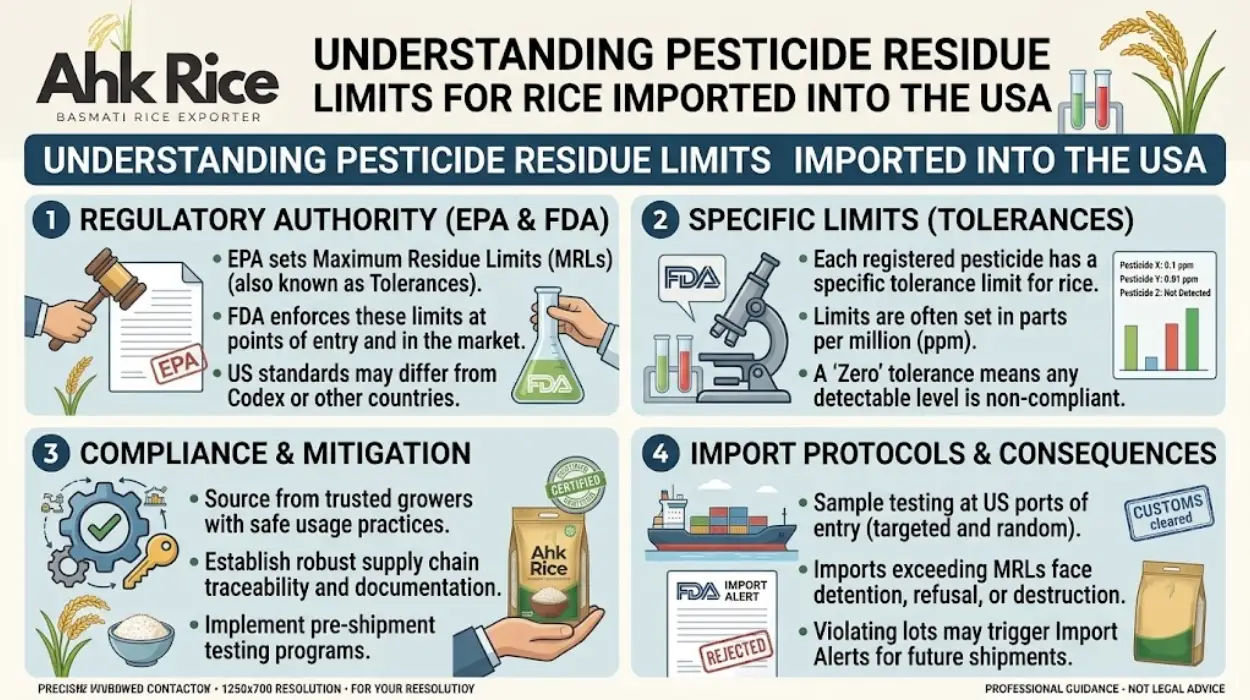
Pesticide residue limits for rice imported into the USA are established by the US Environmental Protection Agency (EPA). Every pesticide residue must comply with the applicable federal tolerance or an approved exemption. The US Food and Drug Administration (FDA) monitors imported rice for compliance.
What Are Pesticide Residue Limits for Rice Imported into the USA?
Pesticide residue limits define the maximum legally permitted amount of a specific pesticide remaining in or on rice. The EPA establishes these limits in parts per million (ppm). Imported rice must meet the same applicable requirements as domestically produced rice.
A pesticide residue is a small amount of a chemical or its breakdown products remaining after agricultural pest control. Farmers use pesticides to manage insects, weeds, and fungal diseases that threaten rice production.
The United States regulates these residues under Section 408 of the Federal Food, Drug, and Cosmetic Act. EPA tolerances are published in Title 40 of the Code of Federal Regulations, Part 180.
A tolerance applies to a particular pesticide and food commodity. There is no single universal residue limit covering every pesticide in rice.
For example, a laboratory finding of 0.05 ppm has no universal pass-or-fail meaning without identifying the pesticide, the applicable rice commodity, and the corresponding US tolerance.
When no applicable tolerance or exemption exists, detectable residues can trigger enforcement action even when the measured concentration is low.
How Does the US Pesticide Residue Control System Work?
The US system combines EPA tolerance setting with FDA monitoring of imported foods. EPA determines the legal residue limits, while FDA collects samples, analyzes pesticide residues, and takes enforcement action when imported rice violates applicable federal requirements.
The process involves five stages.
1. Pesticide application during rice cultivation
Rice growers apply permitted agricultural chemicals according to local regulations and product instructions. These treatments control insects, weeds, and crop diseases.
However, permission to use a pesticide in Pakistan does not automatically establish permission for its residue on rice imported into the United States.
2. EPA tolerance assessment
EPA evaluates pesticide toxicity, expected dietary exposure, residue data, and other relevant scientific evidence. It establishes a tolerance when the statutory safety standard is satisfied.
The tolerance specifies the permitted residue concentration for the relevant food commodity.
3. Harvesting and processing
Harvested paddy passes through operations such as drying, milling, polishing, grading, and sorting. These processes prepare rice for export, but they do not guarantee that pesticide residues fall below US limits.
4. Laboratory testing
A laboratory analyzes a representative sample using validated analytical methods. The results identify detected pesticides and their concentrations.
The laboratory compares those results with applicable US tolerances or exemptions.
5. FDA import monitoring
FDA monitors imported foods and takes regulatory action against noncompliant products. Depending on the circumstances, a shipment faces detention, refusal of admission, or other enforcement measures.
What Are the Key Components of Rice Pesticide Compliance?
Rice pesticide compliance depends on chemical-specific tolerances, suitable laboratory methods, representative sampling, traceable production records, and accurate documentation. Importers must evaluate every relevant pesticide result against the current US requirement rather than relying on a general certificate of quality.
Five components support an effective compliance program.
- EPA tolerances: These establish the maximum legally permitted residue concentration for a pesticide on a specified food commodity.
- Analytical testing: Laboratory methods identify pesticide residues and measure their concentrations, including low-level findings.
- Sampling procedures: Representative samples help assess the tested lot. A single sample does not automatically establish the condition of every bag or container.
- Supplier traceability: Farm, harvest, processing, and lot records help investigators trace the product through the supply chain.
- Compliance documentation: Laboratory reports, product specifications, and relevant supplier records support the importer’s food safety verification process.
The Foreign Supplier Verification Programs (FSVP) regulation also applies to covered US food importers. Importers must establish and follow risk-based procedures to verify that foreign suppliers meet applicable US food safety requirements.
A laboratory report supports a compliance decision, but it does not replace the importer’s broader responsibilities.
Which Pesticide Residues Must Rice Importers Check?
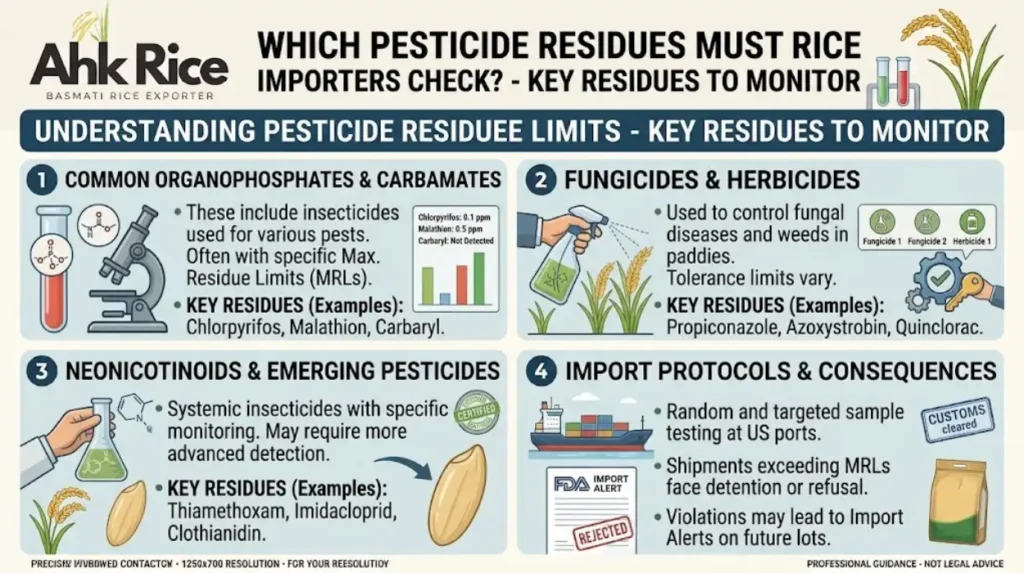
Importers should select pesticide tests according to the rice’s agricultural history, origin, supplier controls, and destination requirements. Each detected chemical requires comparison with its applicable US tolerance or exemption, including verification that no prohibited residue is present.
Rice residue testing commonly covers several pesticide categories.
| Pesticide category | Purpose in agriculture | Compliance consideration |
|---|---|---|
| Insecticides | Control insects that damage rice plants or stored grain | Verify the tolerance for each relevant active ingredient |
| Herbicides | Control weeds competing with rice crops | Check chemical-specific limits for the applicable commodity |
| Fungicides | Manage fungal diseases during cultivation | Compare findings against the applicable US requirements |
| Storage and post-harvest treatments | Control pests during storage or handling | Assess permitted uses and relevant residue requirements |
| Other agricultural chemicals | Address specific production or handling risks | Determine whether a tolerance or exemption applies |
This table identifies pesticide categories, not a list of chemicals automatically required in every rice test.
The appropriate laboratory panel depends on a documented risk assessment. An importer should not assume that a test covering several dozen pesticides includes every relevant chemical.
The testing laboratory should confirm its analytical scope, reporting limits, and suitability for the rice matrix. The importer should also confirm that the analytical reporting limit is appropriate for the applicable US tolerance.
What Benefits Does Pesticide Residue Testing Provide?
Pesticide residue testing helps importers identify noncompliant rice before distribution, evaluate supplier performance, and maintain documented food safety controls. When combined with traceability and preventive measures, testing supports informed purchasing decisions and reduces the risk of regulatory delays.
Testing provides four practical benefits.
First, it identifies residue problems before rice reaches retail shelves or foodservice kitchens. Early detection allows importers to investigate a lot before committing it to distribution.
Second, it supports supplier verification. Buyers compare laboratory results across consignments to assess whether agricultural controls and sourcing practices remain consistent.
Third, testing improves traceability. When a laboratory detects a residue above the applicable limit, the importer can investigate the affected production lot and identify related shipments.
Fourth, documented testing supports communication between importers, suppliers, laboratories, and food safety personnel.
Testing alone does not guarantee compliance. A supplier needs preventive agricultural controls, suitable storage practices, reliable records, and corrective procedures.
How Do Pesticide Residue Requirements Apply to Pakistani Basmati Rice?
Pakistani Basmati rice entering the United States must comply with applicable US pesticide tolerances regardless of its variety, aroma, grain length, or processing method. Exporters and importers should verify chemical-specific limits and maintain traceable records for each shipment.
Pakistan produces Basmati rice primarily in Punjab, including rice-growing areas around Hafizabad, Gujranwala, Sheikhupura, Narowal, and Sialkot.
Export varieties include 1121 Basmati, Super Kernel, and 1509 Basmati. These varieties serve different retail, wholesale, and foodservice requirements.
Their commercial differences do not create separate pesticide residue standards.
For example, a shipment of 1121 Steam Basmati must meet the applicable US requirements just as a shipment of Super Kernel Raw Basmati does.
Processing methods also require careful consideration. Steam processing and parboiling change the rice’s physical characteristics, but neither process automatically establishes that pesticide residues comply with federal tolerances.
Exporters should maintain records linking the finished rice to its production lot, processing date, laboratory sample, and shipment documentation.
US importers should assess supplier controls and verify that the testing program addresses the relevant agricultural risks.
For a more detailed understanding of export testing, buyers can review [EPA tolerances, MRL testing and aflatoxin checks for Pakistani Basmati exports] to understand how pesticide compliance and other food safety checks fit into an export shipment’s preparation.
What Is the Difference Between Pesticide Residues and Aflatoxins?
Pesticide residues and aflatoxins are different food safety hazards. Pesticide residues originate from agricultural chemicals, while aflatoxins are toxic compounds produced by certain molds. Each hazard requires appropriate assessment, testing, and compliance with its applicable US requirements.
Pesticide residues arise when chemicals used in agricultural production or handling remain on or in food.
Aflatoxins are mycotoxins associated with certain Aspergillus molds. Their formation depends on factors such as contamination, temperature, and moisture conditions.
Both hazards require preventive controls, but they are not interchangeable.
A pesticide residue report does not establish that rice meets applicable aflatoxin requirements. Likewise, an aflatoxin test does not demonstrate pesticide compliance.
Importers should use separate, risk-based testing plans for these hazards. They should also distinguish pesticide requirements from other food safety controls, including applicable limits for contaminants and relevant microbiological hazards.
This distinction matters when reviewing supplier certificates. A document stating that rice passed a pesticide panel does not prove that every other food safety requirement has been satisfied.
What Common Problems and Misconceptions Affect Rice Imports?
The most common compliance mistakes involve applying foreign residue limits to US imports, assuming every pesticide has the same threshold, relying on incomplete laboratory panels, and treating processing as a substitute for testing. Importers should verify current requirements before approving shipments.
Four misconceptions create avoidable risks.
Misconception 1: Pakistani agricultural approval guarantees US acceptance.
A pesticide permitted for agricultural use in Pakistan does not automatically qualify its residues for US imports. The residue must comply with the applicable US tolerance or exemption.
Misconception 2: Every pesticide has the same maximum residue limit.
Each pesticide and commodity combination requires a specific regulatory check. A limit established for another crop does not automatically apply to rice.
Misconception 3: Washing, polishing, or steaming guarantees compliance.
Processing changes the physical characteristics of rice, but it does not guarantee the removal of every pesticide residue. Compliance requires suitable evidence.
Misconception 4: A certificate of analysis guarantees entry into the United States.
A certificate of analysis (COA) records specified laboratory findings. Its value depends on sample representativeness, analytical methods, testing scope, and the requirements assessed. FDA retains its regulatory authority over imported food.
How Can Importers Verify Current US Pesticide Limits Before Shipment?
Importers should identify each pesticide of concern, check its current EPA tolerance or exemption, confirm the applicable rice commodity, and commission suitable laboratory testing. They should review the findings against federal requirements before shipment approval and maintain supporting records.
Use this practical verification sequence:
- Identify the rice variety, processing type, origin, and production lot.
- Obtain the supplier’s pesticide-use information and relevant traceability records.
- Identify the chemicals requiring analysis through a documented risk assessment.
- Consult EPA’s current tolerance resources and the electronic Code of Federal Regulations, Title 40, Part 180.
- Select a laboratory with appropriate methods and reporting limits.
- Review every reported result against the applicable US requirement.
- Investigate noncompliant findings and document corrective action before making a shipment decision.
- Maintain the laboratory report and supplier verification records for the importer’s compliance system.
The official EPA pesticide tolerance resources provide access to regulatory information. The electronic Code of Federal Regulations provides the current legal text for applicable tolerances.
US pesticide compliance is a chemical-specific requirement, not a generic quality grade. Importers who combine current regulatory checks, representative laboratory testing, and traceable supplier records establish a stronger basis for accepting Pakistani Basmati rice shipments.
Frequently Asked Questions
Who sets pesticide residue limits for rice imported into the USA?
The US Environmental Protection Agency (EPA) establishes pesticide tolerances for food. The Food and Drug Administration (FDA) monitors most imported foods, including rice, for compliance with applicable requirements.
What is the maximum pesticide residue limit for rice in the USA?
There is no single limit for every pesticide. The permitted concentration depends on the specific chemical, the applicable rice commodity, and the current EPA tolerance or exemption.
Does Pakistani Basmati rice need pesticide residue testing before export to the USA?
Testing should be based on the importer’s food safety verification program, the relevant risks, and applicable requirements. Importers should establish suitable testing and verification procedures for their suppliers.
What happens if imported rice exceeds an EPA pesticide tolerance?
Noncompliant rice can face FDA enforcement action, including detention or refusal of admission. The appropriate response depends on the findings and the applicable regulatory circumstances.
Are pesticide residues and aflatoxins the same?
No. Pesticide residues originate from agricultural chemicals, while aflatoxins are toxic compounds produced by certain molds. They require different analytical tests and separate compliance assessments.