Do USA Retailers Require Halal or Kosher Certified Basmati Rice?
Halal and kosher certification is not a universal legal requirement for Pakistani Basmati rice sold in the United States. Most conventional rice products do not require either certification under general federal food-import rules. However, individual retailers, distributors, institutional buyers, and specialty grocery chains set their own purchasing requirements. Understanding these distinctions helps importers select the correct rice grade, processing method, documentation, and certification before placing an order.
What Are Halal and Kosher Certifications for Basmati Rice?
Halal certification verifies that a food meets the requirements of Islamic dietary law, while kosher certification verifies compliance with Jewish dietary law. Neither certification is universally mandatory for ordinary Basmati rice imports into the United States, although individual buyers require them.
Halal means permissible under Islamic law. A halal certifier evaluates ingredients, processing aids, production practices, and relevant contamination risks. For plain rice, the assessment focuses on the grain’s ingredients, handling, processing equipment, and storage arrangements.
Kosher means compliant with Jewish dietary requirements, known as kashrut. A kosher certification organization evaluates ingredients, equipment, processing conditions, and other requirements under its specific standards. Some kosher-observant consumers accept certain unprocessed grains without certification, while others purchase only products bearing a recognized kosher symbol.
Pakistani Basmati rice is a long-grain aromatic rice grown primarily in Punjab. Popular commercial varieties include 1121 Basmati, Super Kernel Basmati, and 1509 Basmati. Exporters supply these varieties as white, steam-processed, parboiled, or brown rice, depending on the product specification.
Certification requirements depend on the product, the intended market, and the buyer’s purchasing policy. A plain bag of white Basmati rice and a seasoned instant-rice product do not necessarily have the same certification requirements.
Do USA Retailers Legally Require Halal or Kosher Certified Rice?
United States federal law does not impose a blanket halal or kosher certification requirement on imported plain Basmati rice. Retailers establish additional purchasing conditions, while importers remain responsible for food safety, applicable labeling rules, and other relevant import requirements.
The US Food and Drug Administration (FDA) oversees applicable requirements for imported conventional foods, including rice. Importers must ensure that food is safe, properly labeled, and compliant with applicable regulations. Relevant requirements include facility registration where applicable, prior notice of incoming shipments, and applicable Foreign Supplier Verification Program obligations.
The FDA does not issue a general halal or kosher certificate for imported rice. Instead, businesses obtain religious certification through independent certification organizations when their buyers or market strategies require it.
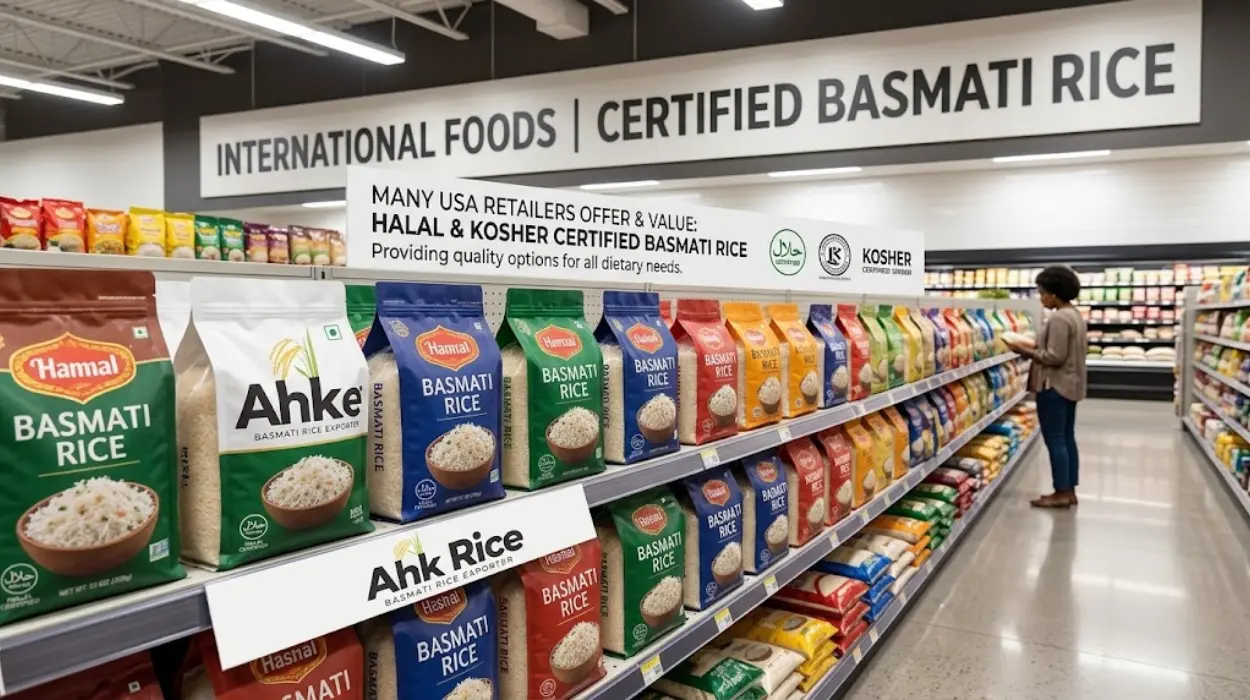
Retailer policies create an important distinction between legal compliance and commercial acceptance. A conventional supermarket can purchase compliant Basmati rice without requiring religious certification. A halal-focused supermarket can require halal documentation as a condition of supply. A kosher grocery chain can demand approval from a specific kosher certifier.
Importers should confirm these requirements before production and packaging. Securing certification after printing packaging or shipping a container creates avoidable costs and delays.
How Does Halal Certification Work for Pakistani Basmati Rice?
Halal certification begins with selecting a qualified certification body and reviewing the rice’s ingredients, processing equipment, storage, and handling. The certifier evaluates compliance, conducts required assessments, and issues documentation according to its certification program.
The process normally follows these steps:
- Application: The exporter submits company information, product details, manufacturing locations, and processing records.
- Ingredient review: The certifier examines ingredients and processing aids. Plain rice has a simpler ingredient profile than flavored or fortified rice products.
- Facility assessment: The certifier reviews processing equipment, cleaning procedures, storage areas, and controls for preventing contamination.
- Documentation review: The exporter provides relevant production records, supplier information, and procedures required by the certification program.
- Inspection or audit: The certifier performs the assessment required by its program. The scope depends on the product and facility.
- Certification decision: The certifier evaluates the evidence and issues a certificate when its requirements are satisfied.
- Ongoing compliance: The exporter maintains records and completes renewal assessments or additional inspections as required.
For Pakistani Basmati rice, certification scope matters. A certificate covering one facility, product category, or processing method does not automatically cover every product sold under the same brand.
Importers should verify the certificate’s validity, product coverage, facility details, and acceptance by the intended retailer. They should also confirm whether the retailer requires a specific certification organization.
How Does Kosher Certification Work for Pakistani Basmati Rice?
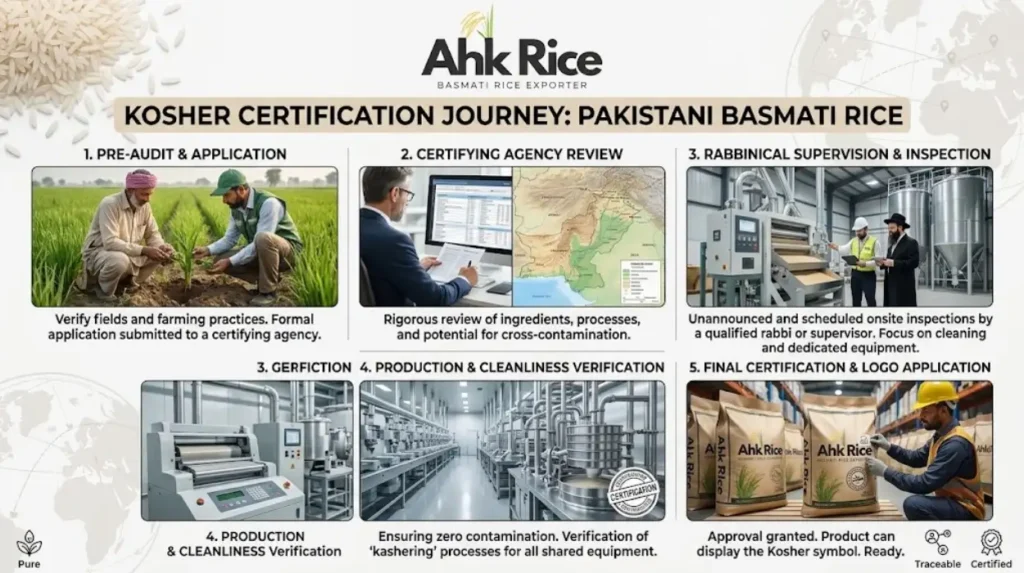
Kosher certification evaluates whether rice production complies with the requirements of the selected kosher authority. The process examines ingredients, equipment, processing conditions, and facility practices, with the exact requirements determined by the certifier and product category.
Plain, unseasoned rice has fewer ingredient-related concerns than prepared rice containing flavorings, oils, or other additions. However, processing conditions and equipment remain relevant to a certification assessment.
A typical process includes:
- Certifier selection: The exporter identifies a kosher certification organization accepted by the target retailer.
- Product application: The exporter submits the product name, ingredients, facility details, and processing information.
- Equipment evaluation: The certifier reviews relevant machinery, shared production lines, and cleaning procedures.
- Facility inspection: The certifier assesses the plant when required under its program.
- Approval and marking: The exporter receives authorization to use the applicable kosher symbol when the requirements are met.
- Continued supervision: The exporter follows the certification agreement and completes required renewals or inspections.
Kosher symbols identify the certification organization or program. Retailers and consumers do not automatically treat every symbol as interchangeable. Some buyers accept particular certifiers, while others follow their own approved lists.
Exporters should confirm the retailer’s acceptance criteria before paying certification fees or printing a symbol on packaging.
Which Key Components Determine Rice Certification Requirements?
Rice certification requirements depend on ingredients, processing methods, equipment, facility controls, packaging claims, and the destination buyer’s standards. Plain rice generally has fewer ingredient-related complications than seasoned products, but the final decision rests with the relevant certifier and buyer.
Five components deserve attention.
1. Rice variety and grade: 1121, Super Kernel, and 1509 identify commercial rice varieties or market categories. Grain length, broken percentage, moisture, aroma, and milling quality determine commercial specifications, not halal or kosher status.
2. Processing method: White, steam, parboiled, and brown rice undergo different processing steps. Steam treatment and parboiling do not automatically make rice halal-certified or kosher-certified.
3. Ingredients and processing aids: Plain rice contains fewer ingredients than instant or seasoned rice. Added flavorings, oils, or other ingredients require additional review when relevant to the certification standard.
4. Production and storage controls: Equipment use, cleaning, shared production lines, and storage arrangements form part of the assessment when relevant to the certifier’s requirements.
5. Packaging and claims: Certification marks must accurately represent the product’s approved status. Exporters should use the authorized symbol and follow the certifier’s rules for packaging, product names, and claims.
These components should be documented before production begins. A clear specification sheet and accurate facility records help prevent discrepancies between the product, certificate, and retail packaging.
What Benefits Do Halal and Kosher Certifications Provide to US Rice Importers?
Halal and kosher certifications help importers meet specific retailer requirements, communicate religious-dietary suitability, and access specialty food markets. Their commercial value depends on customer demand, certification recognition, and the costs associated with maintaining approval.
For importers, certification can support access to halal grocery stores, kosher retailers, specialty distributors, and selected foodservice accounts. It also provides documented evidence that the product has been assessed under a defined certification program.
For retailers, recognized certification can simplify product selection for customers who follow particular dietary requirements. Clear labeling helps consumers identify products that meet their purchasing preferences.
For exporters, certification can strengthen product positioning when a buyer specifically requires it. It also encourages consistent documentation of ingredients, processing methods, and facility practices.
Certification does not replace food-safety controls. A halal or kosher certificate does not independently establish compliance with every FDA import requirement, pesticide-residue limit, contaminant standard, or labeling rule. Importers must manage these obligations separately.
Which US Retailers and Businesses Require Certified Basmati Rice?
Certification requirements vary by retail channel. Conventional supermarkets often evaluate price, quality, safety, and supply reliability, while halal-focused stores, kosher retailers, and selected institutional buyers can require certification as a condition of purchase.
Common purchasing situations include:
- Conventional supermarkets: Buyers typically assess product specifications, food-safety documentation, packaging, pricing, and dependable supply. Religious certification depends on the retailer’s policy.
- Halal grocery stores: Buyers serving Muslim consumers often prioritize halal-certified products and documentation from an accepted certifier.
- Kosher supermarkets: Buyers catering to kosher-observant customers can require a recognized kosher symbol and valid certification.
- Online grocery platforms: Requirements depend on the seller, marketplace rules, and how the product is marketed.
- Restaurants and caterers: Requirements depend on customer expectations, kitchen policies, and the contract with the supplier.
- Institutional food programs: Some procurement specifications explicitly require certification for designated products. Buyers must follow the applicable contract or program rules.
Before quoting a shipment, the importer should request written confirmation of certification requirements. The buyer should identify the accepted certifier, required product scope, packaging claims, and documentation needed before delivery.
What Common Misconceptions Cause Problems with Certified Rice Imports?
The main mistakes involve assuming certification is universally mandatory, treating halal and kosher as interchangeable, using unauthorized certification marks, and confusing religious certification with food-safety compliance. Importers prevent these problems by confirming buyer requirements before production and shipment.
Misconception 1: Every US rice retailer requires certification. Federal rules do not impose a universal halal or kosher certification requirement on plain imported rice. Individual retailers establish their own conditions.
Misconception 2: Halal certification automatically qualifies rice as kosher. The two systems follow different religious requirements and certification procedures. One certificate does not replace the other.
Misconception 3: Natural rice always qualifies without review. Plain rice has a simple ingredient profile, but processing, equipment, and consumer standards still affect certification decisions.
Misconception 4: Any certification logo is acceptable. Retailers can require approval from a particular certifier. Exporters must verify that the organization and product scope satisfy the buyer’s policy.
Misconception 5: Religious certification replaces FDA compliance. Imported rice remains subject to applicable US food-safety and labeling requirements regardless of its religious certification status.
Misconception 6: Certification can be added to packaging without authorization. Exporters must obtain the relevant certifier’s approval before using its protected logo or claiming certified status.
A written compliance checklist should cover the buyer’s certification policy, product specification, packaging artwork, certificate validity, and shipment documents. This approach reduces rejected labels, unnecessary expenses, and avoidable order delays.
How Should Importers Decide Whether to Request Certified Pakistani Basmati Rice?
Importers should start with the retailer’s written purchasing specification, identify the required certification authority, and confirm product and facility coverage. They should then coordinate certification, packaging, food-safety documentation, and shipment planning before approving the order.
The decision process begins with the sales channel. A conventional retail buyer without religious-certification requirements can prioritize grain quality, price, packaging, and supply consistency. A specialty retailer can require halal or kosher certification before approving the product.
The next step is to finalize the rice specification. Importers should define the variety, processing method, grain length, broken percentage, moisture limit, bag size, and annual quantity. For example, a buyer sourcing 1121 Steam Basmati in 5 kg retail bags needs a specification that covers both the grain and the finished product.
The importer should then confirm certification scope, review the label, and assemble the documents required for the transaction. Relevant records include product specifications, certificates where required, invoices, packing lists, and applicable import documentation.
For a detailed explanation of certification procedures, facility assessments, and documentation for Pakistani rice shipments, read the guide on [how halal and kosher certification works for Pakistani Basmati rice exports]. This related resource expands on the certification process beyond the initial retail purchasing decision.
A successful import program aligns four elements: product quality, applicable US regulatory compliance, retailer-specific certification requirements, and reliable supply documentation. Confirming these elements before production gives importers a clearer basis for purchasing decisions and helps prevent avoidable compliance costs.
Frequently Asked Questions
Is halal certification mandatory for Basmati rice imported into the USA?
No. Halal certification is not a universal federal requirement for imported plain Basmati rice. Individual retailers, distributors, and institutional buyers can require certification as a purchasing condition.
Does Basmati rice need kosher certification in the USA?
Not universally. Plain rice has a simple ingredient profile, but kosher requirements depend on the product, processing conditions, the certifier’s standards, and the retailer’s purchasing policy.
Can Pakistani Basmati rice carry both halal and kosher certifications?
Yes. A product can hold both certifications when it independently satisfies the requirements of the relevant halal and kosher certification organizations.
Which Pakistani Basmati varieties can US importers purchase with certification?
Importers can source varieties such as 1121 Basmati, Super Kernel Basmati, and 1509 Basmati. Certification availability depends on the exporter, facility, product, and certification scope.
Does halal certification replace FDA import requirements?
No. Halal certification does not replace applicable FDA food-safety, facility registration, prior notice, labeling, or importer verification obligations.