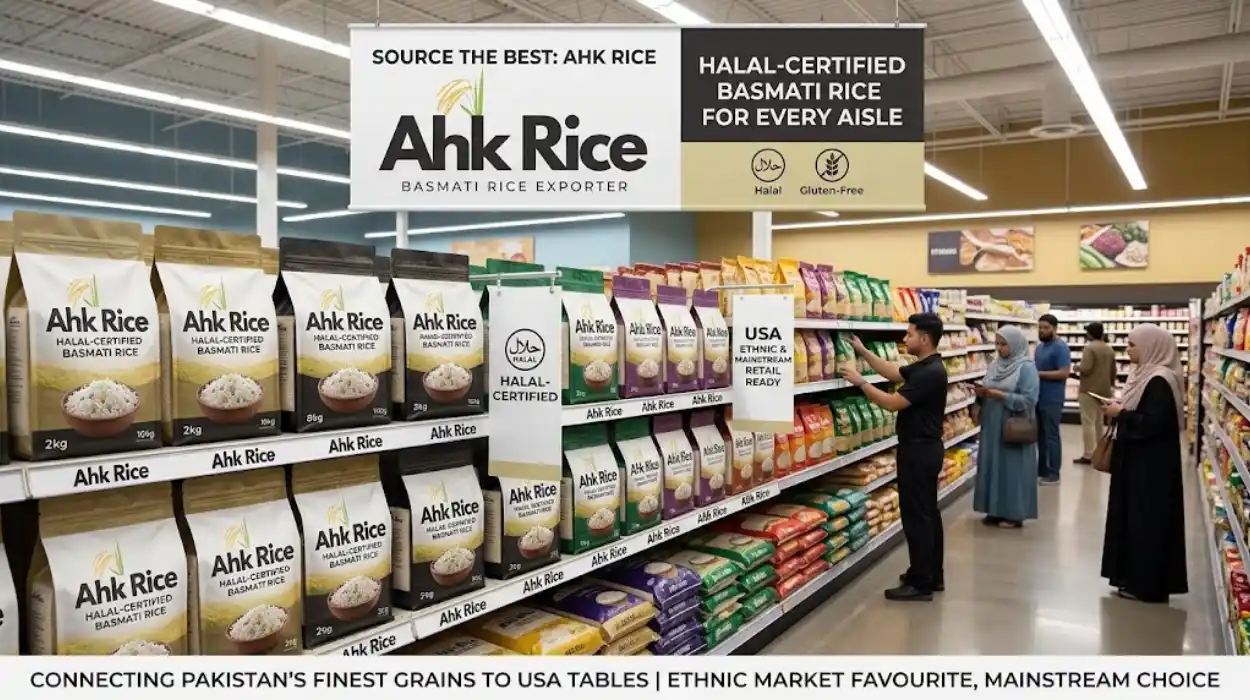
Source Halal-Certified Basmati Rice from AHK Rice for USA Ethnic and Mainstream Retail
The best solution is to source Pakistani Basmati rice from an exporter that can document product origin, provide verifiable halal certification when required, meet agreed grain specifications, and coordinate export documentation. Retailers should approve certificates, packaging, and product samples before confirming commercial orders.
USA retailers need rice that meets consumer expectations, purchasing specifications, and applicable food-import requirements. Ethnic grocery stores often prioritize authentic Pakistani origin, aroma, grain length, and cooking performance. Mainstream supermarkets may also require consistent grading, attractive packaging, private-label options, and reliable replenishment.
Halal certification adds another consideration. Although plain rice is naturally halal, retailers may request certification covering the product, processing facility, handling procedures, or supply chain. Buyers should confirm the scope, validity, issuing organization, and acceptance of the certificate rather than assuming every halal document satisfies their requirements.
For background, retailers can review whether USA retailers require halal or kosher certified Basmati rice, using the relevant educational article on halal and kosher requirements as their research starting point. Buyers should distinguish voluntary retailer requirements from mandatory import regulations before selecting a supplier.
The practical solution is to establish a written product specification, verify certification documents, approve a representative sample, and agree on packaging, shipment terms, and inspection requirements before production.
Why Choose AHK Rice for Pakistani Basmati Rice Supply?
AHK Rice supplies Pakistani Basmati rice from Punjab and supports buyers with product selection, processing specifications, packaging coordination, and export documentation. Buyers can evaluate 1121, Super Kernel, and 1509 varieties against their retail positioning, certification requirements, target pricing, and distribution plans.
Retailers need a supplier that can translate purchasing requirements into measurable specifications. AHK Rice provides a starting point for importers seeking Pakistani-origin Basmati rice for ethnic grocery distribution, mainstream retail, foodservice, and private-label programs.
Explore the AHK Rice export and supply service to assess available varieties and discuss commercial requirements.
The main product options serve different purchasing objectives:
- 1121 Basmati: Suitable for premium retail positioning where long grains, aroma, and cooked elongation are important. Buyers can specify white, steam, or parboiled Golden Sella options according to market demand.
- Super Kernel Basmati: Appropriate for retailers seeking traditional Pakistani Basmati character, aroma, and a recognizable product for South Asian consumers.
- 1509 Basmati: Offers an alternative for buyers balancing grain appearance, cooking performance, and purchasing costs. White and processed variants can be evaluated against the intended retail or foodservice application.
AHK Rice can discuss grain length, moisture, broken percentage, sorting, packing, and shipment requirements before an order is finalized. Actual specifications depend on the selected variety and agreed grade.
Buyers should request written confirmation of halal certification availability for the exact product and processing arrangement. They should also verify whether the certificate covers the exporter, mill, product, and relevant handling activities. A supplier’s general statement about halal suitability is not a substitute for the documentation required by a particular retailer.
How Does Halal Certification Work for Pakistani Basmati Rice Exports?
Halal certification verifies compliance with the requirements defined by the issuing certification body and the certificate’s scope. For plain Basmati rice, buyers should check processing, handling, cross-contact controls, and document validity while confirming whether their retailer requires formal certification.
Rice is a plant-based food, but commercial processing environments may handle other ingredients or products. Retailers therefore assess more than the grain itself. They may request evidence covering facility procedures, storage, packaging materials, processing aids, and segregation controls.
Importers should examine the certificate’s issuing organization, validity dates, covered products, facility address, and scope. They should confirm that the certificate applies to the specific rice being purchased rather than another product manufactured at the same facility.
For a deeper explanation, read how halal and kosher certification works for Pakistani Basmati rice exports. This comparison-focused resource can help procurement teams understand the differences between certification requirements and determine which documents to request.
Halal and kosher certification are separate systems. A halal certificate does not automatically establish kosher compliance, and kosher certification does not automatically establish halal compliance. Buyers serving both customer groups should assess each requirement independently.
For USA shipments, importers must also address applicable food safety and entry requirements. Depending on the transaction, these may include FDA facility registration where applicable, prior notice, Foreign Supplier Verification Program responsibilities, and compliant food labeling. Halal certification does not replace these obligations.
Before production, AHK Rice and the buyer should confirm the required documents, certificate acceptance criteria, product specifications, and label wording. The buyer should approve the final documentation package before shipment wherever practicable.
What Product Specifications Should USA Retailers Confirm Before Ordering?
USA retailers should approve a written specification covering variety, grain length, moisture, broken percentage, processing type, packaging, and applicable food-safety requirements. Certification documents and the approved sample should match the product being supplied to prevent discrepancies during receiving and distribution.
Specifications turn a general purchasing request into an enforceable commercial agreement. They also help the exporter determine the appropriate processing and packing arrangements.
| Specification | What the buyer should confirm |
|---|---|
| Variety | 1121, Super Kernel, or 1509 |
| Processing | White, Steam, Golden Sella, or another agreed grade |
| Grain length | Target raw-grain length and measurement method |
| Moisture | Contractual maximum appropriate to the product |
| Broken percentage | Maximum permitted broken grains |
| Sorting | Single or double Sortex, if specified |
| Certification | Required halal certificate and verification details |
| Packaging | Retail bags, bulk sacks, or private-label packs |
| Labeling | Product identity, origin, net weight, dates, and applicable declarations |
| Inspection | Agreed sampling, testing, and inspection procedures |
For example, a premium ethnic retailer may choose 1121 Steam Basmati in 5 kg bags, while a wholesale distributor may prefer 25 kg or 50 kg sacks. These are illustrative purchasing configurations, not guarantees of stock availability or regulatory acceptance.
AHK Rice should confirm the final specification and available packaging before issuing a commercial offer. Any claim about grain length, moisture, broken percentage, certification, or inspection must match the actual contracted grade.
What Results Can Retailers Expect From the Right Supplier?
A well-defined sourcing process improves specification control, purchasing transparency, and shipment planning. Retailers can reduce avoidable discrepancies by approving samples, verifying certificates, finalizing labels, and documenting inspection criteria before production rather than resolving differences after the rice arrives.
The principal result is greater control over product consistency and import readiness. A documented specification helps purchasing teams compare suppliers on equivalent terms instead of relying on variety names or broad quality claims.
Retailers can also align product selection with their customer segments. Premium 1121 may suit stores emphasizing long-grain presentation, while Super Kernel can support traditional Pakistani Basmati positioning. A suitable 1509 grade may serve buyers prioritizing a different balance of product characteristics and cost.
Packaging decisions affect the retail experience and the economics of distribution. Smaller packs support consumer-facing shelves, while larger sacks can serve wholesalers and institutional customers. Private-label orders require additional coordination of artwork, printed packaging, label approval, and minimum production quantities.
No exporter can guarantee retail sales, uninterrupted supply, or a specific profit margin without considering the buyer’s market conditions. Results depend on landed cost, customs clearance, distribution expenses, competition, product acceptance, and reorder planning.
AHK Rice buyers should therefore evaluate the commercial offer against the full landed cost rather than the FOB price alone. Freight, insurance where applicable, inspection, customs brokerage, duties, inland transportation, and warehousing can change the final economics significantly.
How Much Does Halal-Certified Basmati Rice Cost?
The final price depends on variety, grade, processing, order quantity, packaging, certification requirements, inspection, and delivery terms. Buyers should request a written quotation based on the exact specification and destination instead of relying on a generic per-tonne price.
Several variables influence the total purchasing cost:
- Rice variety and grade: Premium grain specifications and particular processing options can change the price per metric tonne.
- Processing and sorting: Steam, Golden Sella, and additional sorting requirements may affect production costs.
- Certification: Buyers should clarify whether existing certification covers the product or whether additional audits, documentation, or verification are necessary.
- Packaging: Printed retail bags and custom private-label packaging can cost more than standard bulk sacks.
- Order volume: Container quantity, production requirements, and packaging minimums affect commercial pricing.
- Shipping terms: FOB and CIF quotations allocate freight, insurance, and responsibilities differently. Other agreed Incoterms may also be appropriate.
- Destination requirements: Testing, inspection, documentation, and import procedures may add costs.
A practical quotation should identify the product, grade, packing, quantity, unit price, Incoterm, shipment window, payment terms, and applicable documentation. It should also state any charges excluded from the offer.
For example, an importer purchasing retail-ready 1121 Basmati should compare the complete cost of rice, printed bags, export handling, freight, and destination charges against the expected wholesale selling price. This gives procurement teams a more useful decision basis than comparing rice prices alone.
AHK Rice can evaluate these requirements when preparing a product-specific quotation. Final prices and certification arrangements must be confirmed directly for the requested order.
How Long Does Shipping Take From Pakistan to the USA and Other Markets?
Shipping time depends on the destination port, vessel schedule, transshipment, customs procedures, and inland delivery. USA buyers should plan separately for production, port handling, ocean transit, and import clearance rather than treating the vessel’s transit time as the complete delivery period.
For planning purposes, buyers can use the following indicative ocean-transit ranges from Pakistan. These are estimates, not guaranteed delivery commitments, and actual schedules must be confirmed with the freight provider.
| Destination market | Indicative ocean transit |
|---|---|
| USA East Coast | Approximately 25–40 days |
| USA West Coast | Approximately 30–45 days |
| UAE | Approximately 5–12 days |
| Saudi Arabia | Approximately 7–18 days |
| Malaysia | Approximately 12–22 days |
| Morocco | Approximately 20–35 days |
Transit ranges vary by routing, port pair, carrier, and transshipment. They exclude production lead time, export clearance, destination customs clearance, and final delivery.
For USA imports, buyers should allow additional time for documentation review, customs processing, examination, or testing where required. Seasonal congestion and vessel changes can also affect arrival dates.
AHK Rice should confirm the proposed shipment window and available routing before the buyer commits to a retail launch or replenishment date. Importers should maintain enough inventory to cover reasonable shipping and clearance delays.
How Does the Rice Sample Process Work, and What Does It Cost?
The sample process begins with product selection and a written specification, followed by sample preparation, cooking evaluation, and commercial approval. Buyers should confirm sample quantity, courier charges, any applicable certification or phytosanitary costs, and delivery arrangements before dispatch.
A practical sample-to-order process includes five stages.
Stage 1: Define the requirement. The buyer identifies the variety, processing type, target grain specifications, packaging concept, destination, and certification requirements. This prevents an unsuitable sample from being evaluated.
Stage 2: Confirm sample availability. AHK Rice confirms the available grade, sample quantity, preparation timeline, and shipping arrangements. A sample of up to 20 kg of Super Kernel Basmati may be offered under the applicable sampling arrangement, subject to confirmation.
Stage 3: Confirm costs. The buyer should establish who pays for courier shipping, documentation, and any applicable phytosanitary charges. These expenses vary by shipment, destination, courier, and regulatory requirements. They should not be assumed to be included in the rice price.
Stage 4: Test and approve. The buyer assesses aroma, grain appearance, cooking performance, texture, and consistency. Commercial buyers should also compare the sample with the written specification and request relevant certification documents.
Stage 5: Confirm the order. After approval, both parties finalize the commercial specification, packaging, quantity, price, payment terms, inspection arrangements, and shipment schedule.
Sample approval does not automatically guarantee that every production lot will be identical. The purchase contract should define tolerances, inspection procedures, and remedies for material nonconformity.
How Can USA Retailers Start an Order With AHK Rice?
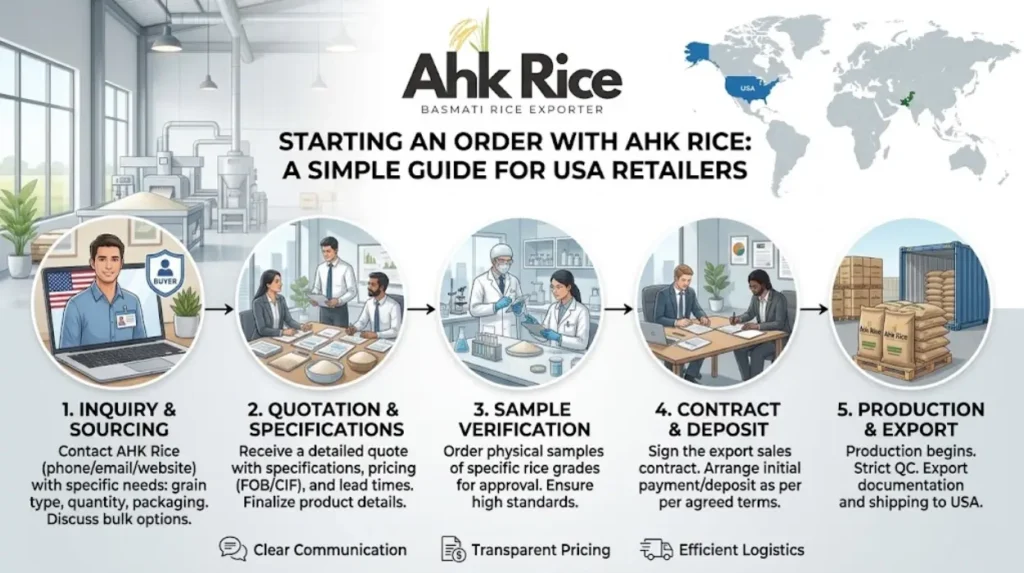
USA retailers can begin by submitting their product specifications, target order quantity, packaging requirements, destination port, and halal documentation criteria. A written quotation, document review, sample evaluation, and agreed shipment plan establish the basis for a controlled first order.
Before requesting a quotation, prepare the following information:
- Product: Select 1121, Super Kernel, or 1509 Basmati and specify the processing type.
- Quality: Define grain length, moisture, broken percentage, sorting, and other measurable requirements.
- Certification: State the required halal certification scope and any retailer-specific verification conditions.
- Packaging: Provide pack sizes, bag material, label requirements, and private-label artwork specifications.
- Quantity: Specify the required tonnage or container quantity and expected reorder frequency.
- Destination: Identify the USA port, delivery location, and preferred Incoterm.
- Compliance: Confirm applicable import, food safety, labeling, and inspection requirements with the responsible importer and regulatory advisers.
AHK Rice can then assess the requested product and provide a commercial proposal for review. Before payment or shipment, the buyer should verify the supplier’s documents, approve the final specification, and confirm the contract terms.
For retailers entering the Pakistani Basmati market, the strongest decision is not simply to choose the lowest quotation. It is to select a supplier whose product specifications, certification evidence, packaging arrangements, and shipment commitments fit the intended sales channel.
To discuss your required grade, halal documentation, sample arrangements, packaging, and USA shipment terms, request a quotation from AHK Rice.
Frequently Asked Questions
Is halal certification mandatory for Basmati rice imports into the USA?
Halal certification is not a universal federal requirement for plain Basmati rice. Retailers, distributors, or specific customers may require it commercially. Importers must separately meet applicable USA food safety, customs, and labeling requirements.
Which Pakistani Basmati variety is best for USA retail?
1121 suits premium long-grain positioning, while Super Kernel appeals to buyers seeking traditional Pakistani Basmati characteristics. 1509 offers another option for price-conscious or volume-focused programs. Final selection depends on customer demand, product specifications, and landed cost.
Can AHK Rice provide halal certification documents?
Buyers should request confirmation of the applicable certificate, issuing body, validity, and product scope from AHK Rice before ordering. The certificate must cover the relevant product and processing arrangement and meet the buyer’s acceptance criteria.
How much does a Basmati rice sample cost?
Sample costs depend on the quantity, product, courier service, destination, and applicable documentation or phytosanitary charges. AHK Rice should confirm the sample arrangement and payable expenses before dispatch. Buyers should also establish whether the sample cost is refundable or credited against an order.
How long does a Basmati rice shipment take to reach the USA?
Indicative ocean transit is approximately 25–45 days, depending on the destination coast, route, and carrier. Production, port handling, customs clearance, and final delivery require additional time. Buyers should confirm the shipment schedule before planning inventory or retail promotions.