Get FDA Label-Compliant Basmati Rice Packaging Designed and Printed by AHK Rice
USA rice importers need packaging that protects product quality, communicates accurate product information, and meets applicable FDA food-labeling and US Customs country-of-origin marking requirements. Choosing the right packaging supplier before production helps prevent label corrections, printing waste, shipment delays, and costly relabelling.
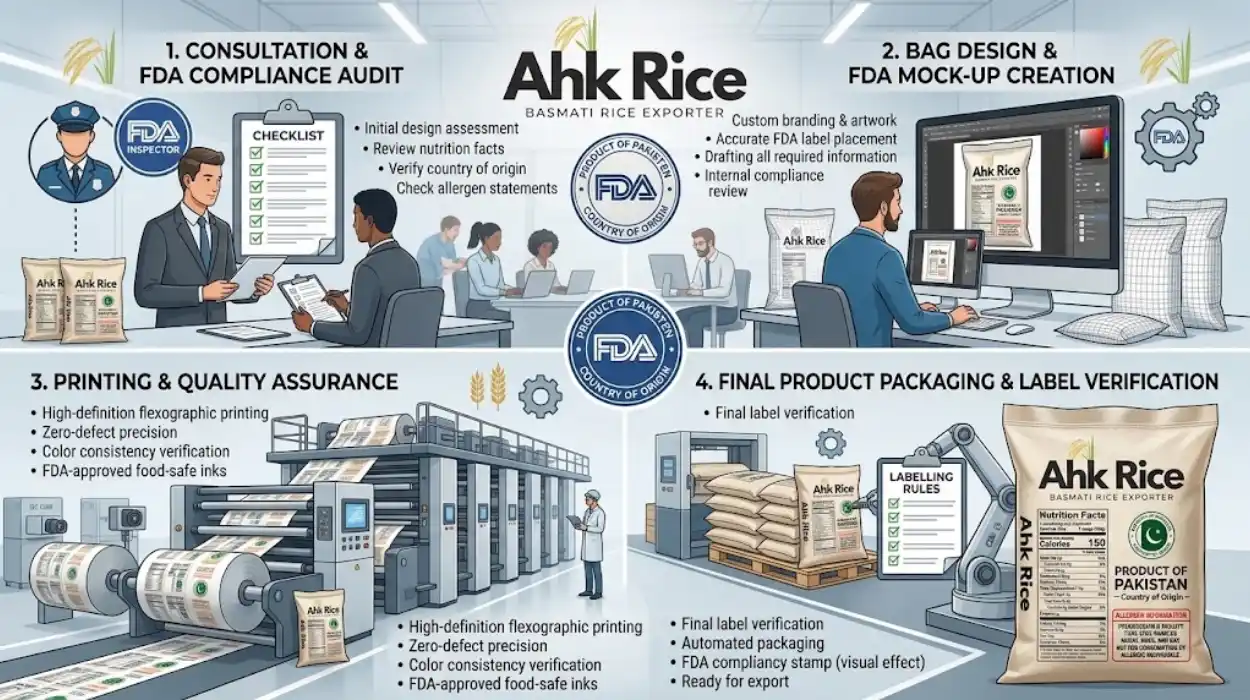
Before selecting a packaging format, review what labelling rules apply to Basmati rice sold in the USA. AHK Rice helps importers coordinate Pakistani Basmati rice specifications, packaging requirements, label information, and export preparation for commercial orders. Buyers can establish their packaging specifications before approving artwork and confirming shipment quantities.
What Is the Best Solution for FDA-Compliant Basmati Rice Packaging?
The best solution combines accurate US-market label information, suitable food packaging, verified product specifications, and artwork approval before printing. Importers should confirm regulatory requirements before production because incorrect declarations can result in relabelling expenses, import complications, and delayed product distribution.
Basmati rice packaging must do more than display an attractive brand design. Each bag must communicate the correct product identity, quantity, origin, and other applicable information. The final label must accurately describe the rice inside the package.
For importers purchasing Pakistani Basmati rice, the packaging process should begin with five decisions:
- Product identification: Confirm whether the product is 1121, Super Kernel, or 1509 Basmati rice.
- Processing type: Specify white, Steam, Golden Sella, or another applicable variety and processing description.
- Pack size: Select retail or commercial formats according to distribution requirements.
- Label content: Confirm ingredients, nutrition information, origin marking, business details, and other applicable declarations.
- Artwork approval: Check every label element against the approved product specification before printing.
FDA requirements apply to imported food products within its jurisdiction. Most packaged foods require compliant labelling, although specific exemptions and exceptions exist. FDA does not generally pre-approve food labels, so responsibility for compliance remains with the relevant businesses.
Country-of-origin marking is also important. Pakistani-origin rice must carry appropriate origin marking under applicable US Customs requirements. A statement such as “Product of Pakistan” can communicate origin when used correctly.
Importers should also establish whether their specific product qualifies for any nutrition-labeling exemption. Plain rice, rice containing additional ingredients, and prepared rice products can have different labeling considerations.
Why Choose AHK Rice for Basmati Rice Packaging?
AHK Rice supports commercial buyers seeking Pakistani Basmati rice with coordinated product specifications, packaging requirements, and export preparation. Buyers can discuss retail bags, wholesale sacks, private-label artwork, and shipment quantities before approving a production order.
AHK Rice supplies Pakistani Basmati rice to international markets, including 1121, Super Kernel, and 1509 varieties. The company works with buyers to establish product requirements, packaging formats, and shipment specifications.
This coordination matters because packaging information must match the actual product. A bag describing 1121 Steam rice should not be used for a different variety or processing type without correcting the approved artwork.
For USA distribution, importers can establish a packaging specification covering the following elements:
| Packaging requirement | What buyers should confirm |
|---|---|
| Product name | Correct Basmati variety and processing type |
| Net quantity | Accurate declared weight and applicable units |
| Country of origin | Appropriate marking identifying Pakistan |
| Nutrition information | Applicable Nutrition Facts requirements or exemption |
| Ingredients | Accurate declaration based on the actual formulation |
| Allergen information | Assessment of added ingredients and relevant cross-contact risks |
| Business details | Appropriate manufacturer, packer, distributor, or importer information |
| Packaging material | Food-contact suitability for the intended use |
| Batch identification | Traceability information appropriate to the product and supply process |
The exact requirements depend on the product, packaging format, and applicable regulations. Buyers should have their US regulatory adviser review the final artwork before printing.
AHK Rice can discuss packaging specifications alongside the rice order. This approach helps importers coordinate product selection, artwork approval, bag quantities, and shipment preparation through one commercial workflow.
What Results Can Buyers Expect from Correct Packaging?
A properly controlled packaging process reduces avoidable artwork errors, supports consistent retail presentation, and improves alignment between product specifications and shipment documents. It also gives importers a defined approval record before committing to printed packaging and commercial inventory.
The expected outcome depends on how thoroughly the importer confirms the requirements before production.
Consider a US distributor preparing to introduce 5 kg Pakistani Basmati rice bags into independent grocery stores. The distributor needs a recognizable brand, consistent bag specifications, accurate origin information, and suitable nutrition labeling.
The distributor first confirms the rice variety and grade. The packaging team then develops artwork containing the agreed product name, net quantity, origin statement, and applicable declarations.
Before printing, the buyer reviews the artwork against the product specification and regulatory checklist. Corrections are completed before the printer produces the final bags.
This workflow can help prevent common problems, including:
- Incorrect Basmati variety descriptions.
- Country-of-origin information that is missing or improperly presented.
- Nutrition information that does not match the applicable requirements.
- Unsupported claims about quality, health, or certification.
- Incorrect net quantity or inconsistent product information.
- Packaging artwork that differs from the approved commercial specification.
Correct packaging does not guarantee that a shipment will clear US entry. FDA import requirements, facility registration where applicable, prior notice, product admissibility, and other import obligations must also be addressed.
Importers should confirm that their supply arrangements cover the required documentation and that the responsible parties understand their regulatory obligations.
How Much Does FDA-Compliant Basmati Rice Packaging Cost?
Packaging costs depend on bag material, dimensions, printing method, order quantity, artwork complexity, and the selected rice specification. Buyers should request a quotation based on their actual requirements because printing, packaging, product, and freight charges vary by order.
A useful quotation separates the major cost components rather than presenting packaging as one unexplained amount.
| Cost factor | Effect on the quotation |
|---|---|
| Bag material | Material grade and barrier properties affect unit cost |
| Bag size | Dimensions and weight capacity affect material consumption |
| Printing | Colours, artwork complexity, and printing method affect production costs |
| Order quantity | Minimum order requirements and production volume affect unit economics |
| Custom artwork | Design preparation, revisions, and prepress requirements may add costs |
| Rice variety | Product grade, processing type, and quantity affect the rice price |
| Packaging format | Retail bags and larger commercial sacks have different specifications |
| Shipping | Freight, insurance, destination charges, and delivery arrangements affect landed cost |
Custom printing may require a minimum order quantity. Buyers should confirm whether the quoted amount includes artwork preparation, printing plates or setup, packaging production, filling, and export preparation.
Importers should also distinguish the packaging quotation from the complete landed cost. The landed cost can include the rice purchase, packaging, inland transport, export handling, international freight, insurance, customs-related charges, duties, and domestic delivery.
The final cost depends on the agreed Incoterm and the services included in the supplier’s quotation.
AHK Rice can assess the requested rice variety, packaging format, and order volume to establish the information needed for a commercial quotation. Buyers should confirm all charges, minimum quantities, production timelines, and payment terms before approving the order.
How Does the Basmati Rice Packaging Sample Process Work?
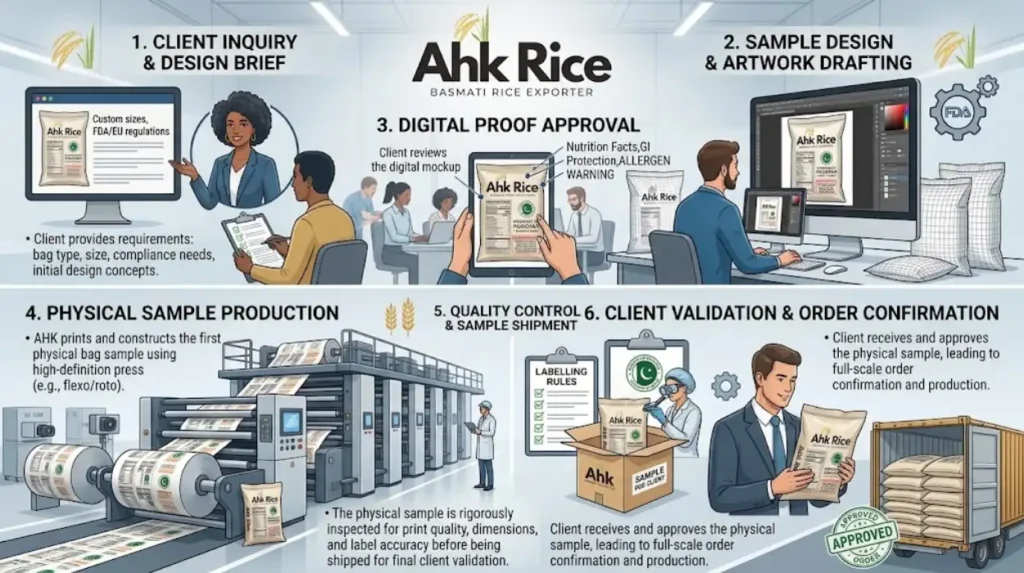
The sample process begins with product and packaging requirements, followed by sample availability, courier arrangements, buyer evaluation, and approval of the commercial specification. Sample charges, courier costs, and any applicable documentation fees should be confirmed before dispatch.
A sample helps the buyer assess the rice before committing to a larger order. Packaging artwork may require a separate review because a rice sample does not automatically represent the final printed bag.
The recommended process includes five steps.
Step 1: Submit the product requirements.
Identify the preferred Basmati variety, processing type, grade, target order quantity, and destination in the USA. Specify whether the order requires standard packaging or a private-label design.
Step 2: Confirm sample availability and charges.
Ask AHK Rice to confirm the available sample quantity, sample terms, dispatch method, and applicable charges. The buyer should receive a breakdown of the sample price, courier cost, and any applicable documentation or handling fees.
Step 3: Arrange courier dispatch.
Confirm the delivery address, courier service, estimated transit time, and any requirements affecting the sample shipment. The buyer should verify whether additional charges apply before authorizing dispatch.
Step 4: Evaluate the rice and packaging specifications.
Assess the sample for grain appearance, aroma, cooking performance, and suitability for the intended market. Review the proposed packaging format and artwork separately, including the declared product name, origin, net quantity, and applicable nutrition information.
Step 5: Approve the commercial order.
Once the product and packaging specifications are agreed, confirm the order quantity, final artwork, production schedule, payment terms, shipping arrangement, and required export documentation.
What Does the Sample Cost?
There is no single sample cost applicable to every order. The total depends on the sample quantity, courier destination, shipping method, and any applicable preparation or documentation charges.
For budgeting, request an itemized quotation showing:
- Rice sample charge, if applicable.
- Courier or freight charge.
- Packaging sample or artwork-related charges, if applicable.
- Any applicable documentation or handling fees.
- Estimated dispatch and delivery time.
Do not assume that a commercial production bag will be included with a rice sample. Confirm whether the supplier can provide a physical packaging sample, digital artwork proof, or both.
The buyer should approve the sample terms before dispatch. Commercial production should begin only after the product specifications and packaging artwork have been reviewed and approved.
How Long Does Shipping from Pakistan to the USA Take?
Commercial rice shipments from Pakistan to the USA commonly require several weeks by sea, while air freight is faster but generally more expensive. Actual delivery depends on the destination, carrier schedule, routing, customs processing, and inland transportation arrangements.
For initial planning, buyers can use these indicative ranges:
| Shipping arrangement | Indicative transit time |
|---|---|
| Sea freight to East Coast destinations | Approximately 30–45 days |
| Sea freight to West Coast destinations | Approximately 30–45 days |
| Air freight | Often several days to around two weeks |
These figures are planning estimates, not guaranteed delivery times. The actual route and service must be confirmed with the freight provider.
Sea freight is generally more suitable for bulk commercial rice orders because of its capacity and cost structure. Air freight can suit urgent samples or smaller shipments when the additional cost is justified.
Importers should allow additional time for order preparation, packaging production, container loading, export clearance, arrival procedures, and final delivery. FDA review or customs examination can also affect release timing.
The shipping schedule should therefore be agreed before a retail launch or promotional campaign. Buyers should not treat the vessel transit estimate as the complete door-to-door delivery period.
How Can US Importers Get Started with AHK Rice?
Start by confirming the rice variety, packaging format, order quantity, destination, and label requirements. Then request a product quotation, agree on sample arrangements, review the proposed artwork, and approve the commercial specification before production and shipment.
A clear initial brief helps AHK Rice evaluate the order without unnecessary revisions.
Include the following information in your enquiry:
- Destination: US state, delivery location, and preferred port where known.
- Rice specification: 1121, Super Kernel, or 1509, including the required processing type.
- Order quantity: Estimated tonnage and preferred packaging quantities.
- Bag requirements: Retail or wholesale format, bag weight, material, and printing preferences.
- Label requirements: Brand details, country-of-origin declaration, nutrition information, and other applicable declarations.
- Sample requirements: Desired sample quantity and delivery address.
- Shipping preference: FOB, CIF, or another agreed Incoterm.
- Target timeline: Required delivery window and any planned retail launch date.
Before committing, ensure that the product specification, artwork, price, production schedule, and shipment terms are documented. Have the final label reviewed by a qualified US regulatory professional where necessary.
AHK Rice can then assess the requested specifications and provide a quotation based on the agreed product, packaging, and shipment requirements.
For US importers, the practical objective is to establish packaging requirements before printing, approve the correct rice specification, and coordinate the order around realistic production and delivery schedules.
To discuss your Basmati rice variety, custom packaging, sample requirements, and US shipment specifications, request a quotation from AHK Rice.
Frequently Asked Questions
Does Basmati rice packaging need FDA approval?
FDA generally does not pre-approve food labels or individual imported food products. Importers must ensure that applicable labeling and import requirements are met. FDA may inspect imported food shipments. Buyers should have their final artwork reviewed before printing.
What information should appear on Basmati rice bags sold in the USA?
The label should include the applicable product identity, net quantity, and other required declarations. Imported rice also needs appropriate country-of-origin marking. Nutrition Facts, ingredients, and business information must be assessed according to the product and applicable rules. The exact requirements depend on the product and packaging.
Can AHK Rice provide custom-printed Basmati rice packaging?
AHK Rice can discuss custom packaging requirements alongside a commercial rice order. Buyers should confirm available bag formats, printing options, minimum quantities, and production lead times. Artwork should be approved before printing. Availability and final costs depend on the order specifications.
How much does a Basmati rice packaging sample cost?
The cost depends on sample availability, quantity, courier destination, and any applicable handling or documentation fees. Printed packaging samples may have separate costs. Request an itemized quotation before dispatch. Confirm the delivery estimate and any additional charges in advance.
How long does Basmati rice take to ship from Pakistan to the USA?
Sea freight commonly takes several weeks, with an indicative transit range of around 30–45 days for many routes. Air freight is generally faster. Customs procedures, carrier schedules, and inland delivery can extend the total timeline. Confirm the actual schedule with the freight provider.