Pakistani Basmati vs Local Indonesian Rice: Grain, Aroma, Texture and Cooking Use
Pakistani Basmati offers longer grains, distinctive natural aroma and greater cooked-grain separation, while Indonesian local rice provides familiar everyday texture, domestic availability and economical pricing. The right choice depends on customer expectations, cooking applications, distribution costs and target market positioning.
Indonesian rice buyers comparing imported and domestic varieties need to evaluate more than the raw grain. Grain dimensions, aroma retention, water absorption, cooked texture, processing methods and storage performance determine the final product’s commercial value. This educational guide to Pakistani Basmati rice and Indonesian Beras introduces the differences between the two rice categories, helping importers, distributors and foodservice operators identify the right procurement strategy.
What are the available solutions for Indonesian rice buyers?
Indonesian buyers have two principal choices: locally produced rice for everyday consumption and imported Pakistani Basmati for aromatic, long-grain applications. Within Pakistani Basmati, 1121, Super Kernel, and 1509 provide different combinations of grain length, aroma, texture and commercial value.
1. Indonesian local rice
Indonesian local rice, commonly called Beras, includes varieties such as Ciherang, IR64, Mekongga and Inpari. These varieties serve Indonesia’s everyday household consumption and domestic foodservice markets.
Ciherang and IR64 are established varieties with slender grains and relatively soft, fluffy cooked textures. Indonesian agricultural information places many widely cultivated domestic varieties within the 20–25% amylose range. This characteristic supports the familiar texture preferred in everyday Indonesian meals. pertanian.go.id+1
Local rice provides three commercial advantages:
- Established consumer familiarity.
- Domestic agricultural and milling supply chains.
- Easier replenishment through local wholesalers and distributors.
2. Pakistani 1121 Basmati
1121 Basmati Extra Long Grain Steam Rice – 1121 Basmati Steam Rice
1121 Basmati is an extra-long-grain aromatic variety cultivated in Pakistan’s Punjab region. Its raw grain commonly measures approximately 8.30–8.50 mm in commercial specifications.
Its principal advantage is cooked-grain elongation. Properly cooked 1121 produces long, slender grains with good separation. It suits premium biryani, restaurant menus, catering and specialty retail.
Indonesian buyers can evaluate three important processing formats:
- 1121 White for traditional Basmati presentation.
- 1121 Steam for firmer cooked grains.
- 1121 Golden Sella for stronger kernels and foodservice applications.
3. Pakistani Super Kernel Basmati
Super Kernel is a traditional Pakistani aromatic Basmati variety. Its raw grain generally measures approximately 7.20–7.60 mm, depending on the commercial specification.
It provides a balance between traditional Basmati aroma, slender grain appearance and procurement value. It suits premium household consumption, ethnic grocery stores and restaurants serving aromatic rice dishes.
4. Pakistani 1509 Basmati
1509 Basmati is a long-grain Pakistani variety with a raw grain length commonly around 8.00–8.30 mm.
It offers an alternative to 1121 for buyers seeking long-grain presentation and efficient commercial positioning. Its Steam and Golden Sella formats suit restaurant kitchens, catering operations and wholesale distribution.
How do Pakistani Basmati and Indonesian local rice compare?
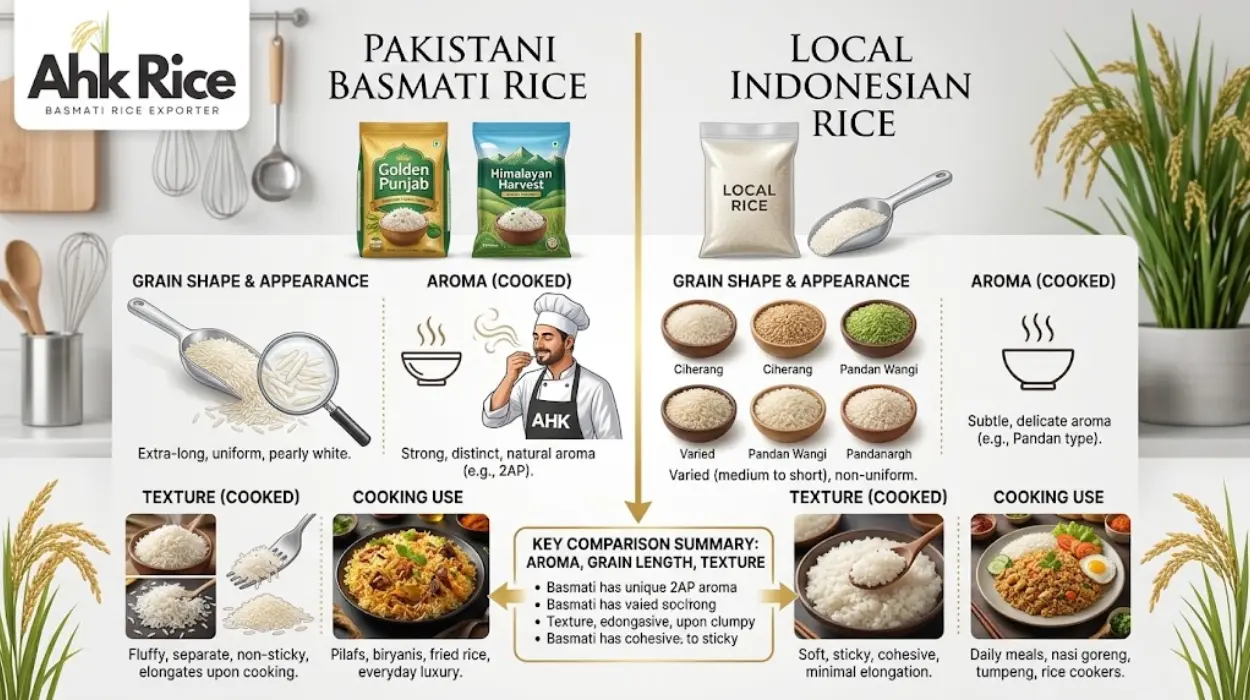
Pakistani Basmati leads in distinctive aroma, extra-long grain presentation and elongated cooked-grain appearance. Indonesian local rice leads in everyday consumer familiarity, domestic sourcing and established household cooking preferences. Buyers should compare seven measurable attributes before selecting a supply category.
Seven-attribute specification comparison
| Attribute | Pakistani Basmati | Indonesian local rice |
|---|---|---|
| Grain length | Approximately 7.20–8.50 mm across varieties | Varies by domestic variety |
| Grain shape | Long, slender and elongated | Slender to medium, depending on variety |
| Aroma | Distinctive natural Basmati fragrance | Generally milder |
| Amylose | Varies by variety and processing | Common varieties often around 20–25% |
| Cooked texture | Separate, elongated grains | Commonly soft and fluffy |
| Cooking applications | Biryani, pilaf and premium rice dishes | Everyday meals and local dishes |
| Commercial positioning | Premium and specialty segments | Mainstream household consumption |
These are category-level comparisons. Actual performance depends on variety, crop quality, milling, storage, moisture and cooking method. AHK Rice+2
Grain length and physical appearance
Raw grain length is an important distinction between Pakistani Basmati varieties. 1121 provides the longest grain among the three principal varieties discussed here, followed by 1509 and Super Kernel.
Indonesian local varieties have different physical characteristics. Ciherang, for example, is classified as a slender, long-grain variety. However, it does not provide the same commercial grain profile as extra-long 1121 Basmati.
Importers should measure average grain length and broken percentage rather than relying exclusively on product descriptions.
Aroma and flavour
Natural aroma is one of the most recognizable Basmati characteristics. Pakistani Basmati develops its distinctive fragrance through its variety and growing environment.
Local Indonesian rice generally provides a milder aroma that complements everyday meals. This difference creates separate customer expectations rather than making one category universally superior.
Restaurants selling aromatic biryani and specialty rice dishes can use Basmati as a product differentiator. Domestic rice remains suitable for customers who prefer familiar everyday flavours.
Cooking texture and water absorption
Pakistani Basmati produces elongated, relatively separate cooked grains when prepared correctly. Soaking, washing, water ratios and cooking temperature influence the final texture.
Indonesian local varieties commonly produce softer and fluffier rice. This texture supports everyday meals served with vegetables, meat, fish and traditional Indonesian dishes.
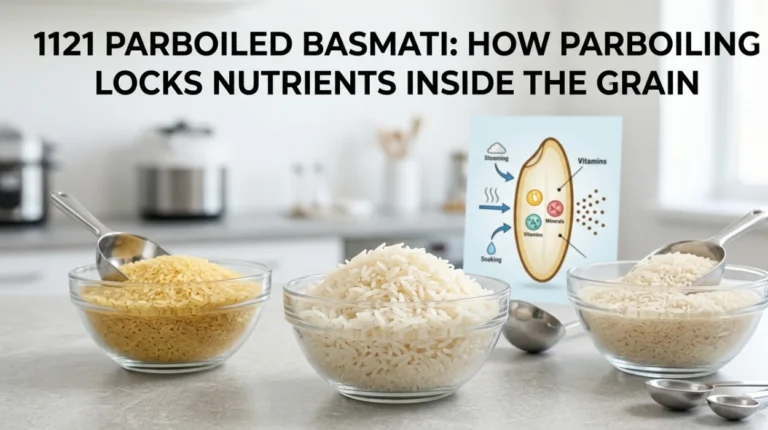
Steam and Sella processing further change Basmati cooking behaviour. Parboiled Golden Sella generally provides firmer kernels and greater grain separation, while white Basmati offers a different traditional cooked appearance.
How do Indonesian market regions differ in rice preferences and prices?
Java and Greater Jakarta provide a useful market for premium retail, wholesalers and specialty restaurants, while Bali and eastern Indonesia offer opportunities through tourism, hotels and foodservice distribution. Grade selection and pricing must reflect regional demand, local rice benchmarks and imported landed costs.
Region 1: Java and Greater Jakarta
Jakarta and surrounding commercial centres contain supermarkets, wholesale distributors, hotels and international restaurants. These channels provide opportunities for imported aromatic rice alongside established domestic rice products.
Recommended purchasing positions include:
- 1121 Steam: Premium restaurants and biryani operators requiring long, separate grains.
- Super Kernel White: Specialty grocery stores and customers seeking traditional Basmati aroma.
- 1509 Steam: Foodservice buyers seeking long-grain performance with competitive procurement economics.
The domestic premium-rice HET benchmark for Java, Lampung and South Sumatra was Rp14,900/kg under the relevant 2025 price schedule, equivalent to Rp14.9 million per MT. The medium-rice ceiling was Rp13.5 million per MT. 2025 (In IDR. / Kg.)+1
Region 2: Bali and eastern Indonesia
Bali’s tourism and hospitality sector provides a different commercial opportunity. Hotels, resorts, international restaurants and catering companies can require specialty rice for particular menus.
Recommended product positions include:
- 1121 Golden Sella: Catering and bulk cooking applications.
- 1121 Steam: Premium restaurant presentation.
- Super Kernel Sella: Aromatic rice programs requiring a firmer cooked texture.
- 1509 Steam: Commercial restaurant and foodservice requirements.
Buyers distributing into Maluku and Papua must also consider longer domestic distribution routes and regional price differences.
Under the cited 2025 price schedule, Maluku and Papua had premium-rice HET benchmarks of Rp15,800/kg, equivalent to Rp15.8 million per MT. Their medium-rice benchmark was Rp15.5 million per MT. 2025 (In IDR. / Kg.)+1
Price per MT: Pakistani imports versus Indonesian rice
The following figures provide a transparent market benchmark, not a live supplier quotation.
| Price indicator | Price per MT | Basis |
|---|---|---|
| Indonesian Java premium rice | Rp14,900,000 | 2025 HET |
| Indonesian Java medium rice | Rp13,500,000 | 2025 HET |
| Indonesian Papua premium rice | Rp15,800,000 | 2025 HET |
| Indonesian Papua medium rice | Rp15,500,000 | 2025 HET |
| Pakistani-origin rice imports | Approximately US$405 | 2025 aggregate CIF import unit value |
The Pakistani-origin figure uses Indonesia’s 2025 BPS customs statistics: 49,373 tonnes of imports valued at US$19.9791 million. Dividing import value by net weight gives approximately US$404.7 per MT. It covers all rice imported from Pakistan, not exclusively Basmati. BPS-Statistics Indonesia+1
Important procurement distinction: These figures are not directly equivalent. Indonesian HET figures represent domestic retail price ceilings, whereas the Pakistani figure represents an aggregate customs import value. A Basmati buyer must obtain a grade-specific FOB or CIF quotation and calculate freight, insurance, duties, clearance, local handling and distribution costs before comparing margins.
How does shelf life compare between Pakistani Basmati and Indonesian rice?
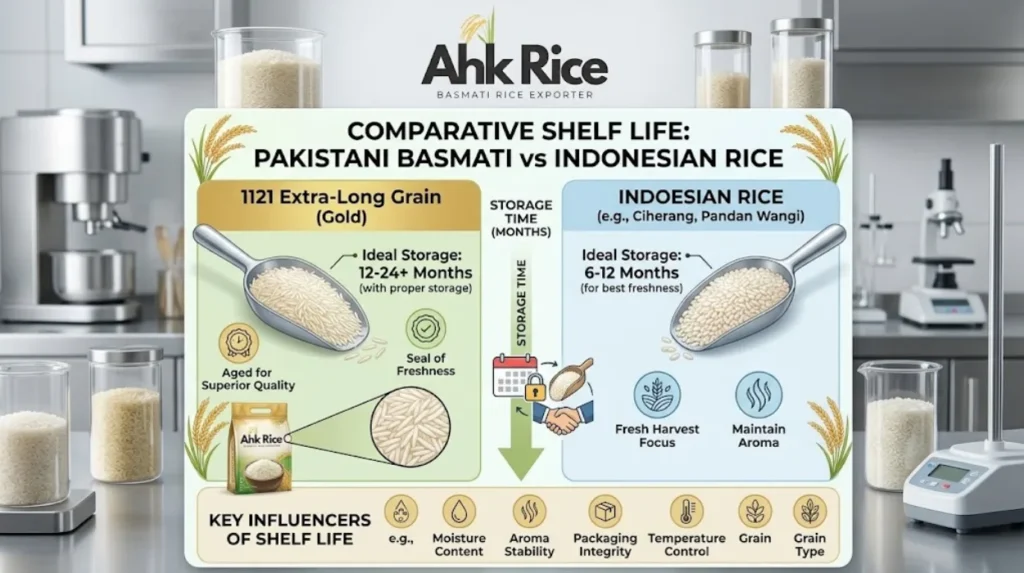
Shelf life depends more on moisture, processing, packaging and warehouse conditions than country of origin. Properly stored polished white rice can retain quality for extended periods, while aged Basmati uses controlled storage before sale to develop its cooking characteristics.
Pakistani Basmati and Indonesian polished white rice both require protection from moisture, insects, heat and contamination.
For commercial procurement, buyers should distinguish three concepts:
- Crop age: The period since harvesting.
- Aging period: Controlled storage used to develop Basmati cooking characteristics.
- Remaining shelf life: The period during which packaged rice retains acceptable quality under specified storage conditions.
AHK Rice can discuss aged Basmati programs with storage periods around 12–24 months, depending on the variety and specification.
For both imported and local rice, dry, sealed and temperature-controlled storage protects quality. Utah State University Extension recommends using opened white rice within one to two years as a storage reference. This is not a universal commercial expiry date. USU+1
For Indonesian importers, warehouse ventilation, humidity control, pest management and stock rotation remain essential. First-in, first-out inventory management helps distributors prevent extended storage and deterioration.
Which rice works best for different Indonesian customer segments?
The best rice depends on the customer’s cooking requirements and selling channel. Local rice suits mainstream household consumption, 1121 suits premium restaurants and retail, Super Kernel serves aromatic Basmati demand, and 1509 supports buyers seeking long-grain performance with controlled procurement costs.
| Customer segment | Recommended rice | Main reason |
|---|---|---|
| Everyday households | Indonesian local rice | Familiar texture and domestic availability |
| Premium supermarkets | 1121 White or Steam | Long grain and premium presentation |
| Biryani restaurants | 1121 Steam or Golden Sella | Elongation and grain separation |
| Ethnic grocery distributors | Super Kernel White | Traditional Basmati aroma |
| Hotels and catering | 1121 or 1509 Golden Sella | Firmness and bulk cooking performance |
When should buyers choose Indonesian local rice?
Local rice is appropriate when customers prioritize everyday affordability, familiar taste and regular domestic replenishment.
Supermarkets targeting mainstream households can maintain local rice as their core category. Restaurants serving traditional Indonesian meals can also use domestic varieties because their familiar cooked texture matches customer expectations.
When should buyers choose Pakistani Basmati?
Pakistani Basmati suits businesses targeting customers who value aroma, elongated grains and specialty rice dishes.
For example, a Jakarta restaurant specializing in biryani can differentiate its menu through 1121 Steam. A specialty grocery distributor can position Super Kernel as an aromatic imported product.
Pros and cons of both rice categories
Indonesian local rice
Advantages
- Established domestic supply networks.
- Familiar everyday cooking characteristics.
- No international ocean freight requirement.
- Suitable for mainstream household demand.
Disadvantages
- Does not provide the same characteristic Basmati aroma.
- Grain elongation differs from extra-long Basmati.
- Premium aromatic rice positioning requires a different product category.
Pakistani Basmati
Advantages
- Distinctive natural aroma.
- Long and slender grain presentation.
- Different processing options for specific cooking applications.
- Opportunities for premium retail and restaurant positioning.
Disadvantages
- International shipping and import procedures increase procurement complexity.
- Landed costs depend on freight, insurance, duties and distribution.
- Buyers must manage foreign supplier coordination and shipment lead times.
What factors should Indonesian importers consider before purchasing?
Importers should evaluate grain specifications, aroma, cooking performance, landed cost and storage requirements before selecting a rice supplier. A five-factor decision framework prevents buyers from choosing solely on price and helps match each variety to its intended customer segment.
Five-row decision framework
| Decision factor | What buyers should check | Recommended approach |
|---|---|---|
| Grain quality | Length, broken percentage and purity | Approve a physical sample |
| Aroma and texture | Fragrance, elongation and separation | Conduct a cooking test |
| Procurement cost | FOB, freight, insurance and landed cost | Compare equivalent specifications |
| Storage performance | Moisture, packaging and crop age | Establish warehouse controls |
| Supply consistency | Production, inspection and documentation | Use a written commercial specification |
1. Verify grain specifications
Buyers should request a technical specification identifying variety, average grain length, moisture, broken percentage, foreign matter and milling quality.
A specification for 1121 should not automatically become the specification for Super Kernel or 1509. Each variety requires separate quality parameters.
2. Conduct a cooking test
A physical sample helps buyers assess aroma, grain separation, water absorption, elongation and cooked texture.
Restaurant buyers should prepare samples using their actual kitchen equipment and recipes. This makes the evaluation more relevant than relying on raw grain appearance alone.
3. Compare total landed cost
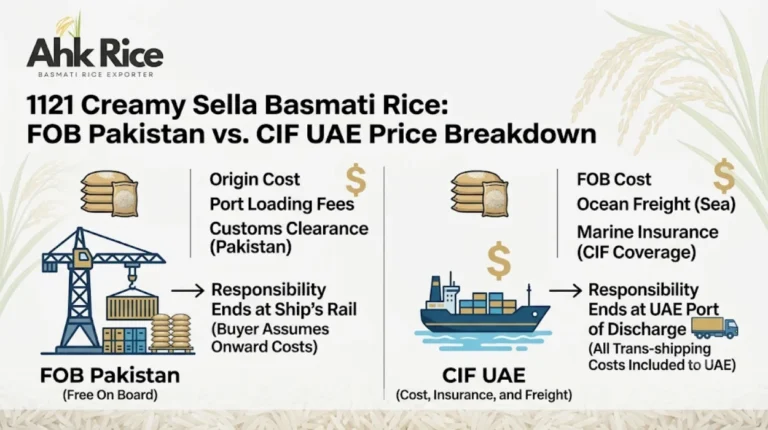
Importers should calculate the cost of receiving rice at their Indonesian warehouse rather than comparing FOB Karachi with local wholesale or retail prices.
The calculation should include:
- FOB rice price.
- Ocean freight and insurance.
- Applicable import duties and taxes.
- Customs clearance and port handling.
- Inland transportation.
- Warehouse and distribution costs.
4. Check packaging and storage
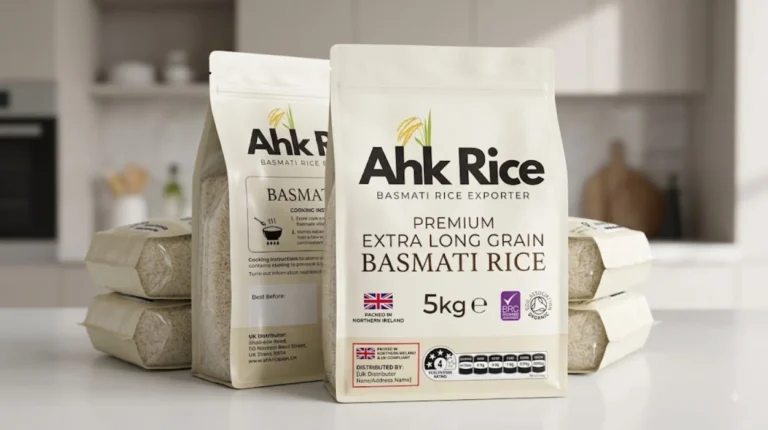
Packaging should match the intended channel. Retail distributors may require smaller branded bags, while wholesalers and institutional kitchens often require larger commercial formats.
Moisture protection, food-grade packaging, clear batch identification and suitable warehouse conditions protect product quality.
5. Confirm supplier consistency
A reliable exporter should maintain consistency between the approved sample and the commercial shipment.
Buyers should establish quality tolerances, inspection procedures, packaging details, shipment documents and payment terms before confirming an order.
How can AHK Rice support Indonesian Basmati procurement?
AHK Rice supports Indonesian buyers through Pakistani Basmati sourcing, processing, grading, custom packaging and export coordination. Its 1121, Super Kernel and 1509 varieties provide different options for importers serving premium retailers, wholesalers, restaurants and catering businesses.
AHK Rice operates from Punjab, Pakistan, and supplies Basmati rice to more than 15 countries. Its export operations cover product selection, processing, grading, packaging and shipment preparation.
Indonesian importers can explore the available Pakistani Basmati rice export options for Indonesia according to their required variety and commercial specifications.
The sourcing process begins with identifying the buyer’s preferred rice category. The importer specifies 1121, Super Kernel or 1509, followed by the required White, Steam or Sella processing format.
The next step involves sample evaluation. Buyers examine raw grain dimensions, appearance, aroma, cooking performance and consistency. After approval, the commercial specification becomes the reference for bulk processing and shipment preparation.
AHK Rice also coordinates export documentation and custom packaging requirements. Indonesian buyers should confirm the applicable import permissions, food-safety requirements, product documentation and customs procedures with their licensed importer and relevant authorities before shipment.
A structured procurement process gives buyers greater control over product quality and supply expectations.
Pakistani Basmati and Indonesian local rice serve different consumer requirements. Local rice remains appropriate for everyday household consumption, while Pakistani Basmati creates opportunities in premium retail, specialty grocery, restaurants and hospitality.
For Indonesian importers, 1121 offers extra-long grain presentation, Super Kernel provides traditional Basmati aroma, and 1509 offers another commercially attractive long-grain option. Steam and Golden Sella processing further help buyers match cooking requirements.
AHK Rice provides Indonesian buyers with access to Pakistani Basmati varieties, processing options, custom packaging and export coordination. The most effective purchasing decision combines sample approval, technical specifications, landed-cost calculations and consistent shipment quality.
Frequently Asked Questions
Is Pakistani Basmati better than Indonesian local rice?
Pakistani Basmati is better suited to aromatic rice dishes, premium presentation and long-grain applications. Indonesian local rice is more suitable for everyday meals requiring familiar soft and fluffy texture. The better option depends on cooking purpose and customer preference.
Which Pakistani Basmati variety is best for Indonesian restaurants?
1121 Steam is suitable for restaurants prioritizing extra-long grains and premium presentation. Super Kernel suits aromatic rice menus, while 1509 Steam provides another long-grain option for commercial kitchens.
Is Pakistani Basmati more expensive than Indonesian rice?
Pakistani Basmati generally occupies a different commercial category from mainstream domestic rice. Its final price depends on variety, processing, quality, freight, import costs and packaging. Buyers should compare landed costs rather than FOB prices alone.
Which Basmati rice is best for Indonesian biryani?
1121 Steam and 1121 Golden Sella are suitable options for biryani because of their long-grain presentation and cooked-grain separation. Super Kernel Sella is another option for buyers prioritizing traditional Basmati aroma.
What is the difference between 1121 and Super Kernel Basmati?
1121 has a longer raw grain, commonly around 8.30–8.50 mm. Super Kernel generally measures around 7.20–7.60 mm. Both provide aromatic Basmati characteristics, but 1121 emphasizes extra-long grain presentation while Super Kernel offers a traditional aromatic profile.