What Is Sortex Color Sorting and Why Does It Matter for Export Basmati?
Sortex color sorting is an optical rice-cleaning process that identifies and removes discoloured grains, defective kernels, and unwanted foreign materials using high-speed cameras, digital image processing, and pneumatic air jets. It improves the visual purity, consistency, and commercial presentation of export-quality Basmati rice.
Pakistani Basmati rice exporters use optical sorting technology to prepare 1121, Super Kernel, and 1509 Basmati rice varieties for international markets. The process helps maintain uniform grain appearance, reduces visible defects, and supports buyer-specific quality specifications.
Basmati rice grows mainly in the fertile Punjab region of Pakistan, particularly districts such as Hafizabad, Gujranwala, Sheikhupura, Narowal, and Sialkot. After harvesting, paddy undergoes drying, husking, milling, polishing, grading, and optical sorting before export packaging.
Understanding Sortex technology helps importers evaluate rice purity, processing standards, and the difference between ordinary machine cleaning and advanced optical inspection.
What Is Sortex Color Sorting in Basmati Rice?
Sortex color sorting is an automated optical inspection process that separates acceptable rice kernels from defective grains using cameras, lighting, computer-based recognition, and compressed-air ejectors. It improves visual consistency by removing unwanted colours, damaged kernels, and detectable foreign materials.
SORTEX is a product brand associated with Bühler’s optical sorting technology. The term is widely used in the rice industry when discussing advanced optical sorting equipment.
Unlike conventional cleaning machines, which separate materials according to physical characteristics such as size, weight, and density, optical sorters inspect individual grains according to their visual properties.
The machine identifies differences between acceptable white or golden rice kernels and unwanted materials. These include yellow grains, black spots, immature kernels, stained grains, and other visible defects.
For Pakistani Basmati, this process is particularly important because premium rice markets expect uniform colour, clean presentation, and consistent quality throughout a shipment.
Sortex sorting applies to different Basmati varieties, including:
- 1121 Basmati: Long-grain rice available in Steam, Golden Sella, Creamy Sella, Brown, and broken grades.
- Super Kernel Basmati: Aromatic Pakistani rice supplied in different processing and commercial grades.
- 1509 Basmati: A long-grain variety available in Steam, Golden Sella, and other market-specific specifications.
The optical sorting stage improves visual purity but does not independently establish grain length, aroma, cooking quality, or pesticide compliance.
How Does Sortex Color Sorting Work Step by Step?
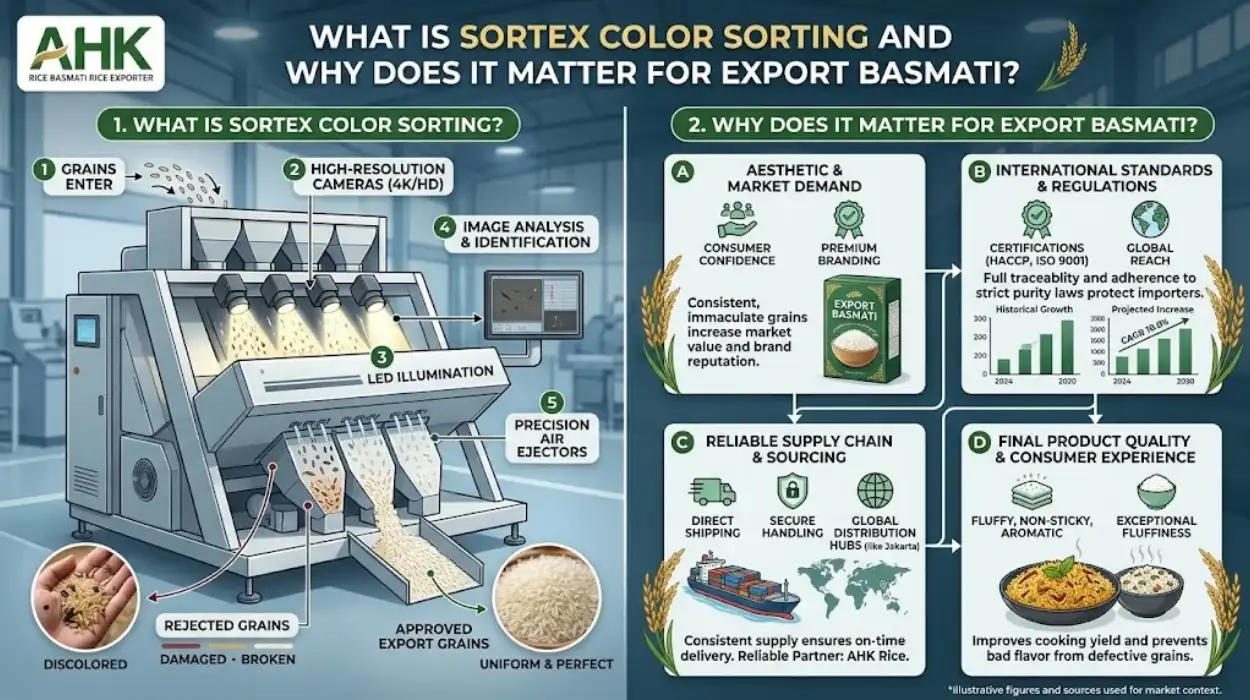
Sortex sorting works by feeding cleaned rice through an inspection chamber, capturing grain images, identifying unacceptable colour patterns, and removing selected kernels through compressed-air jets. The accepted rice continues through the production line for quality inspection and packaging.
The process involves several coordinated operations.
1. Pre-Cleaning and Rice Preparation
Milled rice enters the cleaning section after husking, whitening, and preliminary grading.
Pre-cleaning removes larger unwanted materials, including stones, straw, dust, husk, and other agricultural debris.
This preparation prevents excessive contamination inside the optical sorting chamber. It also improves the accuracy of camera inspection.
2. Controlled Grain Feeding
A vibrating feeder distributes rice evenly across the machine’s feeding system.
The rice travels through inclined channels or chutes. These channels create a controlled stream of individual grains for inspection.
Consistent feeding prevents overlapping kernels and improves the machine’s ability to identify defects.
3. Camera and Lighting Inspection
High-resolution cameras inspect the moving rice under controlled lighting conditions.
The imaging system identifies colour differences between acceptable grains and defective materials. Depending on the machine configuration, additional technologies inspect shape, size, and difficult-to-detect foreign materials.
For example, a yellowish grain passing through a stream of white Basmati rice receives a different visual classification from an acceptable kernel.
4. Digital Defect Recognition
The machine’s processing system compares captured images against predefined acceptance and rejection settings.
Operators configure sensitivity according to the rice variety, colour, processing type, and buyer specifications.
The system classifies inspected material into accepted and rejected categories.
5. Pneumatic Ejection
Compressed-air ejectors remove grains identified as defective.
Each ejector releases a short, controlled burst of air when the sorting system detects an unacceptable kernel.
The rejected material enters a separate collection channel, while accepted rice continues through the production line.
6. Final Inspection and Quality Control
Processed rice undergoes additional inspection to verify the sorting result.
Quality teams examine representative samples for remaining discoloured grains, foreign materials, broken percentages, and other contractual specifications.
The finished product then moves towards weighing, packing, sealing, and shipment preparation.
What Are the Key Components of a Sortex Color Sorting Machine?
A Sortex machine combines feeding equipment, optical cameras, lighting systems, image-processing software, pneumatic ejectors, and separate collection channels. Each component performs a specific function to identify defective grains and maintain consistent separation throughout rice processing.
The main components include:
1. Feeding System
The feeding system controls the quantity and movement of rice entering the inspection chamber.
Vibratory feeders and distribution channels maintain an even flow of individual kernels.
2. Optical Cameras
High-speed cameras capture images of individual grains during movement.
Colour cameras detect visible differences, including yellow, brown, black, and other unwanted colour patterns.
3. Lighting System
Specialised LED lighting illuminates rice kernels during inspection.
Consistent lighting improves the visibility of subtle colour differences and helps cameras distinguish acceptable grains from defective ones.
4. Image-Processing Software
The software analyses captured images and applies programmed rejection criteria.
Modern systems also use advanced algorithms and automated calibration to improve sorting accuracy.
5. Pneumatic Ejectors
Air nozzles remove rejected grains from the accepted rice stream.
Accurate ejector timing reduces the accidental removal of good kernels.
6. Collection Channels
Separate collection channels receive accepted rice and rejected materials.
This separation prevents removed contaminants from returning to the finished product.
What Are the Benefits of Sortex Sorting for Export Basmati Rice?
Sortex sorting improves the appearance, visual purity, and consistency of export Basmati by removing detectable colour defects and unwanted materials. It supports premium presentation, reduces visible impurities, and helps processors meet the appearance specifications agreed with international rice importers.
Its main benefits include:
1. Improved Grain Appearance
Uniform colour gives Basmati rice a cleaner and more consistent appearance.
This matters for supermarkets, wholesalers, private-label brands, and food distributors that sell rice in transparent or retail-ready packaging.
2. Removal of Discoloured Grains
Optical sorting identifies defective kernels such as yellow grains, black-spotted rice, brown-stained grains, and other unwanted colour variations.
Removing these materials improves the visual quality of the finished product.
3. Better Foreign Material Separation
Depending on the machine’s detection capabilities, optical sorting also identifies certain foreign materials, including glass fragments, stones, and unwanted seeds.
However, optical sorting does not replace metal detection, laboratory testing, or other food-safety controls.
4. Consistent Export Quality
Processors can establish repeatable sorting settings for different rice varieties and commercial specifications.
This supports consistent appearance across production batches and container shipments.
5. Reduced Good-Grain Waste
Accurate image recognition and ejector timing help prevent acceptable grains from entering the rejected material stream.
This improves product recovery and reduces unnecessary processing losses.
6. Better Retail Presentation
Retailers require rice that looks consistent from one package to another.
Sortex processing helps maintain the appearance expected in premium Basmati retail products.
Which Basmati Rice Grades and Products Use Sortex Sorting?
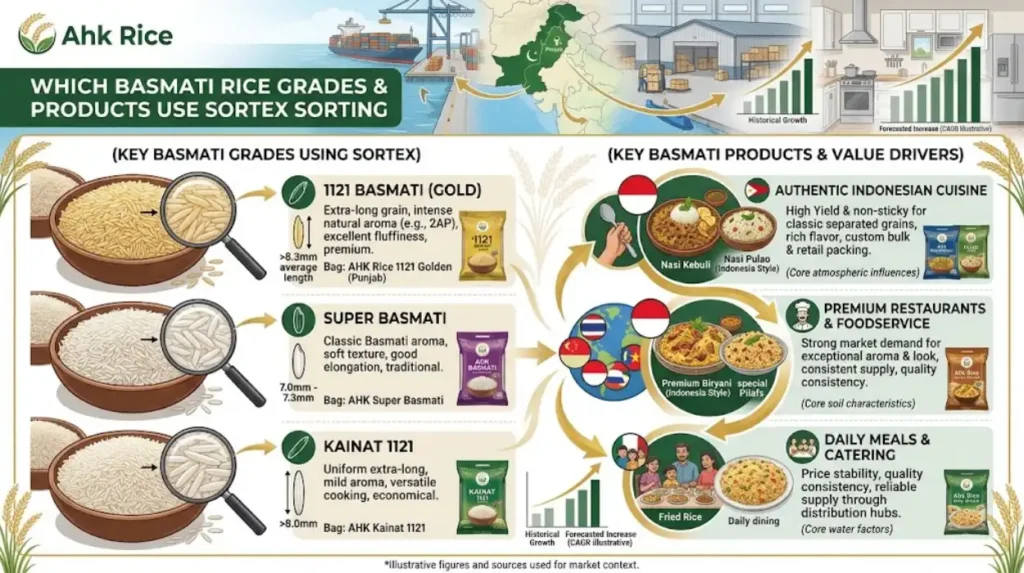
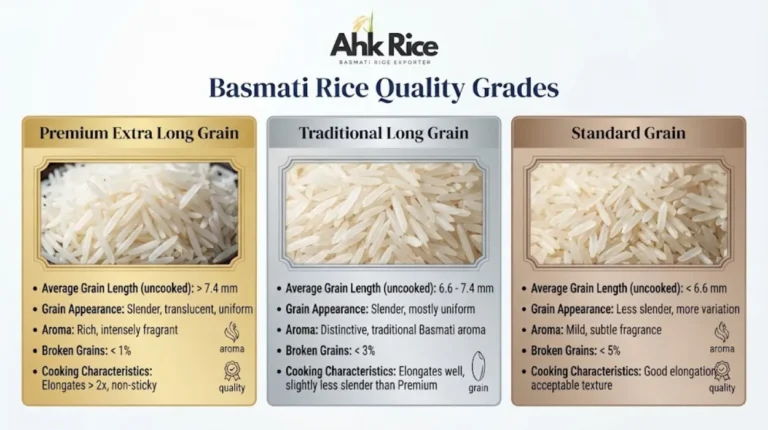
Sortex sorting applies to different Basmati varieties and processing categories, including 1121, Super Kernel, and 1509. It improves their visual purity but does not create separate commercial grades, which depend on grain length, broken percentage, moisture, processing type, and buyer specifications.
Pakistani Basmati processors use optical sorting across several product categories.
1121 Basmati Rice
1121 is recognised for its extra-long grain characteristics and cooking elongation.
Its commercial varieties include:
- 1121 Steam Basmati.
- 1121 Golden Sella Basmati.
- 1121 Creamy Sella Basmati.
- 1121 Brown Basmati.
- 1121 Broken Rice.
Sortex processing removes visible colour defects from these products according to their individual appearance requirements.
Super Kernel Basmati Rice
Super Kernel is an aromatic Pakistani Basmati variety associated with Punjab.
Commercial processing includes raw, Steam, and Sella products, depending on the buyer’s requirements.
Optical sorting improves the appearance of finished kernels and supports consistent retail and wholesale presentation.
1509 Basmati Rice
1509 is a high-yielding, shorter-duration Basmati variety.
Its commercial processing categories include:
- 1509 Steam.
- 1509 Golden Sella.
- 1509 White.
- 1509 Broken.
Its long grain characteristics make uniform visual presentation important for wholesale distribution and foodservice applications.
A critical distinction exists between Sortex sorting and mechanical grading. A Sortex machine removes selected defects according to programmed criteria, while length graders and other equipment classify rice according to physical measurements.
Which International Markets Require Sortex-Processed Basmati Rice?
International Basmati importers evaluate visual purity, grain consistency, broken percentage, moisture, food safety, and packaging according to their market requirements. Sortex-processed rice serves retail, wholesale, distribution, and foodservice channels across major rice-importing regions.
Different markets prioritise different commercial specifications.
1. Indonesia
Indonesian rice importers evaluate grain appearance, cleanliness, product consistency, and applicable import requirements.
Importers purchasing Pakistani Basmati for specialist distribution require clear specifications covering grain variety, processing type, broken percentage, and visual defects.
2. United Arab Emirates
The UAE imports Pakistani Basmati for supermarkets, wholesalers, restaurants, and regional re-export businesses.
Premium 1121 and Super Kernel varieties benefit from consistent appearance and controlled processing.
3. Saudi Arabia
Saudi Arabian distributors and foodservice buyers require consistent rice quality for retail and large-scale catering.
Sortex processing helps maintain uniform appearance across bulk orders.
4. United Kingdom
UK importers supply ethnic supermarkets, mainstream grocery retailers, wholesalers, and foodservice businesses.
Consistent colour, accurate product descriptions, and compliant packaging are important commercial requirements.
5. United States
American importers evaluate product specifications, food safety documentation, labelling, and applicable FDA requirements.
Sortex sorting supports visual quality control but does not replace regulatory compliance or laboratory analysis.
What Certifications and Quality Standards Apply to Sortex-Processed Basmati?
Sortex processing is a quality-control operation, not a certification. Export Basmati must satisfy applicable food-safety, contaminant, hygiene, labelling, and importing-country requirements. Recognised management systems and independent laboratory testing provide additional evidence of production controls.
Several standards and certifications are relevant to international rice exports.
- ISO 22000: A food safety management system standard covering food-chain safety controls.
- HACCP: A preventive system that identifies and controls biological, chemical, and physical food-safety hazards.
- ISO 9001: A quality management system standard supporting documented and consistent production processes.
- Codex Alimentarius: International food standards covering rice quality, contaminants, pesticide residues, and hygiene.
- Certificate of Origin: Identifies the declared country of origin of exported rice.
- Phytosanitary documentation: Applies where required by the importing country’s plant-health regulations.
- Halal certification: Relevant where buyers or destination regulations require recognised halal assurance.
ISO 7301:2021 establishes international specifications for rice intended for human consumption. Codex Standard CXS 198-1995 also provides important reference requirements for rice quality and safety.
Importers must distinguish visual sorting from food-safety verification. Sortex equipment cannot confirm pesticide residue levels, arsenic concentrations, microbiological safety, or chemical contamination.
These requirements need appropriate laboratory testing and supporting documentation.
What Are the Common Problems and Misconceptions About Sortex Sorting?
Sortex sorting improves visual purity, but it does not guarantee complete food safety, eliminate every foreign material, or establish all commercial rice grades. Its performance depends on machine settings, feeding conditions, detection technology, maintenance, and effective quality-control procedures.
Several misconceptions affect how buyers evaluate optical sorting.
1. Sortex Removes Every Foreign Material
Incorrect. Optical sorting detects materials within the machine’s configured detection capabilities.
Very small particles, certain transparent materials, and contaminants with similar visual properties require additional inspection technologies or cleaning methods.
2. Double Sortex Automatically Guarantees Premium Quality
Incorrect. Double sorting means rice passes through optical sorting twice, usually to improve defect removal.
The result still depends on equipment configuration, defect sensitivity, feeding conditions, and final inspection.
3. Sortex Determines Grain Length
Incorrect. Grain-length classification requires appropriate measuring and grading equipment.
Optical systems with additional shape-analysis features can classify certain size and shape differences, but standard colour sorting is not a substitute for commercial length grading.
4. Sortex Guarantees Food Safety
Incorrect. Optical sorting removes detectable physical and visual defects.
Chemical residues, heavy metals, microorganisms, and other invisible hazards require separate food-safety controls and laboratory testing.
5. Higher Sorting Sensitivity Always Produces Better Results
Incorrect. Excessive sensitivity can remove acceptable grains along with defective kernels.
Processors must balance defect removal, product recovery, and buyer acceptance specifications.
6. Every Sortex Machine Has Identical Capabilities
Incorrect. Machine models differ in camera technology, detection systems, software, throughput, and foreign-material identification capabilities.
Buyers should evaluate actual equipment configuration rather than relying exclusively on the Sortex name.
Sortex color sorting is an important stage in modern Pakistani Basmati rice processing. It improves visual purity by identifying discoloured grains, defective kernels, and detectable foreign materials through automated optical inspection.
For 1121, Super Kernel, and 1509 Basmati, optical sorting supports consistent product appearance across retail, wholesale, and foodservice markets. However, it must work alongside mechanical grading, moisture control, laboratory testing, and documented food-safety procedures.
Understanding the difference between single and double Sortex processing helps importers assess sorting intensity, visual quality, and the specifications required for their target market.
Frequently Asked Questions About Sortex Color Sorting
What does Sortex mean in Basmati rice?
Sortex refers to optical sorting technology used to identify and remove defective or discoloured rice kernels. Bühler manufactures SORTEX optical sorting equipment for rice and other agricultural products.
What defects does Sortex remove from rice?
Sortex machines identify defects such as yellow grains, black-spotted kernels, brown stains, immature grains, and certain foreign materials. Detection depends on machine configuration and programmed settings.
What is the difference between Sortex and normal rice cleaning?
Normal cleaning removes materials using physical separation methods such as sieving, aspiration, and density differences. Sortex uses optical inspection and automated ejection to separate materials according to detectable visual characteristics.
What is the difference between single and double Sortex rice?
Single Sortex rice passes through an optical sorting stage once. Double Sortex rice passes through two sorting stages or two inspection passes to improve defect removal and visual consistency.
Does Sortex improve Basmati rice cooking quality?
Sortex primarily improves visual purity. Cooking quality depends on rice variety, grain characteristics, processing, moisture, ageing, and preparation rather than colour sorting alone.