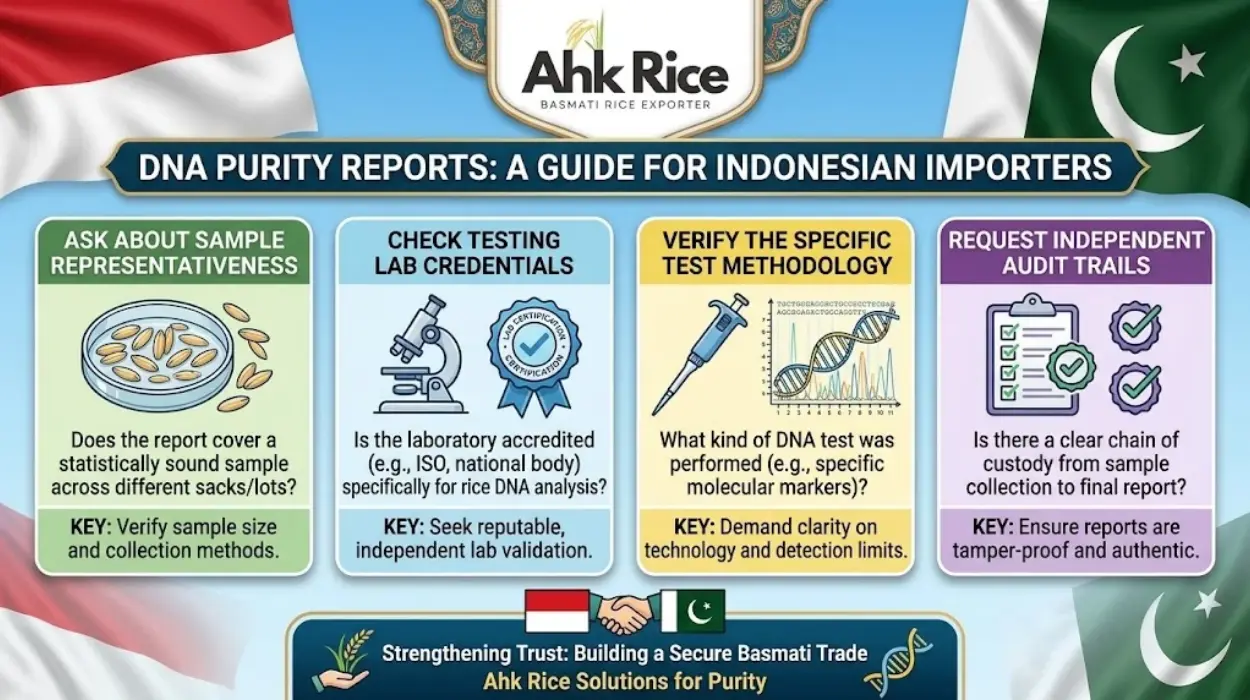
DNA Purity Reports: What Indonesian Importers Should Ask Pakistani Exporters
Indonesian importers should request batch-specific DNA purity reports supported by representative sampling, validated genetic markers, independent laboratory analysis, and traceable shipment records. A DNA report provides evidence of rice variety authenticity, while physical inspection and food safety testing establish additional quality requirements.
When sourcing Pakistani Basmati, buyers must understand how genetic authentication differs from conventional quality inspection. Learn how Basmati rice purity is tested through DNA analysis to understand genetic markers, adulteration detection, laboratory methods, and the limitations of DNA-based verification. This knowledge helps importers evaluate supplier documents instead of relying on unsupported purity claims.
AHK Rice is a Pakistani Basmati rice exporter based in Punjab, supplying1121, Super Kernel, and 1509 Basmati rice varieties to more than 15 countries. Its Pakistani Basmati rice supply and export services cover sourcing, processing, grading, custom packaging, and export documentation. For Indonesian buyers, the important consideration is whether the exporter can connect genetic test results with the actual commercial batch being shipped.
What Is a DNA Purity Report in Basmati Rice Trading?
A DNA purity report documents genetic testing performed on a rice sample to identify its genetic characteristics and assess whether the tested material matches the declared variety or contains detectable genetic admixtures. It provides evidence of authenticity rather than a complete assessment of commercial rice quality.
DNA stands for deoxyribonucleic acid. It carries genetic information within biological organisms. Rice varieties have identifiable genetic characteristics that laboratories examine through suitable molecular testing methods.
A DNA purity report generally includes:
- Sample identification and description.
- Declared rice variety.
- Laboratory name and testing location.
- DNA extraction method.
- Genetic markers used.
- Testing methodology.
- Results and interpretation.
- Testing date and report reference.
- Sample or batch identification.
The report must identify the tested sample clearly. A report without a sample reference or batch identification creates uncertainty about its connection to the commercial shipment.
For example, an importer ordering Pakistani 1121 Basmati needs evidence that the laboratory tested a representative sample from the relevant 1121 production lot. A generic report describing the exporter’s rice quality does not establish the genetic identity of a particular shipment.
Why Should Indonesian Importers Request DNA Testing?
Indonesian importers request DNA testing to reduce variety substitution, identify detectable genetic admixtures, protect product authenticity, and establish stronger supplier accountability. These benefits matter particularly when buyers purchase premium Basmati under specific varietal and origin declarations.
Rice authenticity affects commercial value. Premium Basmati varieties have different grain characteristics, cooking performance, aroma, and market positioning.
Three Pakistani varieties illustrate these differences:
- 1121 Basmati: Recognised for its extra-long grain and substantial cooked elongation.
- Super Kernel Basmati: Known for its characteristic aroma, slender grains, and traditional Pakistani Basmati identity.
- 1509 Basmati: Offers long grains, shorter crop maturity, and commercial value for bulk distribution.
Mixing varieties without disclosure changes the product’s commercial identity. It also creates differences in cooking results and customer expectations.
DNA testing provides an additional verification layer. However, it does not independently prove geographical origin, grain length, moisture content, pesticide compliance, or food safety. Importers need separate evidence for those requirements.
What Are the Available Solutions for Verifying Basmati Purity?
Importers can verify Basmati authenticity through DNA fingerprinting, physical grain inspection, laboratory quality testing, cooking evaluation, and supply-chain documentation. Each method answers a different question, so combining them provides stronger commercial assurance than relying on a single certificate.
1. DNA Fingerprinting
DNA fingerprinting examines genetic markers to identify characteristics associated with a rice variety.
Polymerase chain reaction (PCR) is a laboratory technique that amplifies selected DNA regions for analysis. Short tandem repeat (SSR) markers are genetic regions used to distinguish rice varieties.
A suitable testing programme compares the sample against authenticated reference profiles. The laboratory evaluates whether the observed genetic pattern matches the declared variety and identifies detectable differences within the scope of its method.
Main advantage: Genetic evidence supports variety authentication.
Main limitation: Results depend on marker selection, reference profiles, sample quality, and laboratory validation.
2. Physical Grain Inspection
Physical inspection evaluates visible grain characteristics, including:
- Grain length and shape.
- Broken grain percentage.
- Chalkiness.
- Foreign matter.
- Discolouration.
- Uniformity.
An inspector can identify obvious inconsistencies between a declared product specification and the delivered rice.
However, visual inspection cannot reliably distinguish every closely related rice variety. Two varieties can have similar physical characteristics.
3. Conventional Laboratory Testing
Food laboratories analyse measurable product characteristics such as moisture, broken percentage, foreign matter, and selected chemical or microbiological parameters.
These tests support contractual specifications and food safety requirements.
DNA testing and conventional laboratory testing therefore serve different purposes. One examines genetic identity, while the other evaluates measurable physical, chemical, or microbiological properties.
4. Cooking and Performance Testing
Cooking tests assess water absorption, grain elongation, texture, aroma, and post-cooking appearance.
For example, a restaurant distributor purchasing 1121 Basmati may prioritise grain elongation and separation after cooking. A retailer buying Super Kernel may prioritise aroma and consistent cooking results.
Cooking evaluation provides practical product evidence. It does not replace laboratory authentication.
5. Batch Traceability and Documentation
Traceability connects the tested sample with the production and export records.
Relevant documents include:
- Paddy and raw-material sourcing records.
- Milling and processing records.
- Production lot identification.
- Laboratory reports.
- Quality inspection records.
- Packing records.
- Container loading documentation.
Without traceability, a valid DNA report can still refer to rice unrelated to the delivered shipment.
How Do Different Basmati Verification Methods Compare?
DNA fingerprinting provides the strongest direct evidence of genetic identity, while physical inspection, conventional laboratory testing, cooking evaluation, and traceability establish complementary quality and shipment controls. Importers should select methods according to the risks associated with their product and purchasing agreement.
| Verification attribute | DNA fingerprinting | Physical inspection | Conventional laboratory testing | Cooking test |
|---|---|---|---|---|
| Main purpose | Genetic identity | Visible grain quality | Measurable quality and safety parameters | Cooking performance |
| Variety identification | Yes, within validated scope | Limited | Generally no | Limited |
| Admixture detection | Detectable genetic admixtures | Visible differences | Depends on analytical method | Performance differences |
| Grain length | No | Yes | Yes, when measured | Cooked elongation |
| Moisture measurement | No | Limited visual assessment | Yes | No |
| Aroma evaluation | No | Limited | Specialised analysis required | Yes |
| Best application | Authenticity verification | Shipment inspection | Quality and compliance | End-use suitability |
The comparison demonstrates why a DNA certificate alone cannot establish complete shipment quality.
An importer purchasing premium Basmati needs genetic verification alongside measurable product specifications. A wholesale buyer prioritising price and physical consistency also needs conventional inspection and representative sampling.
Which DNA Testing Approach Works Best for Indonesian Importers?
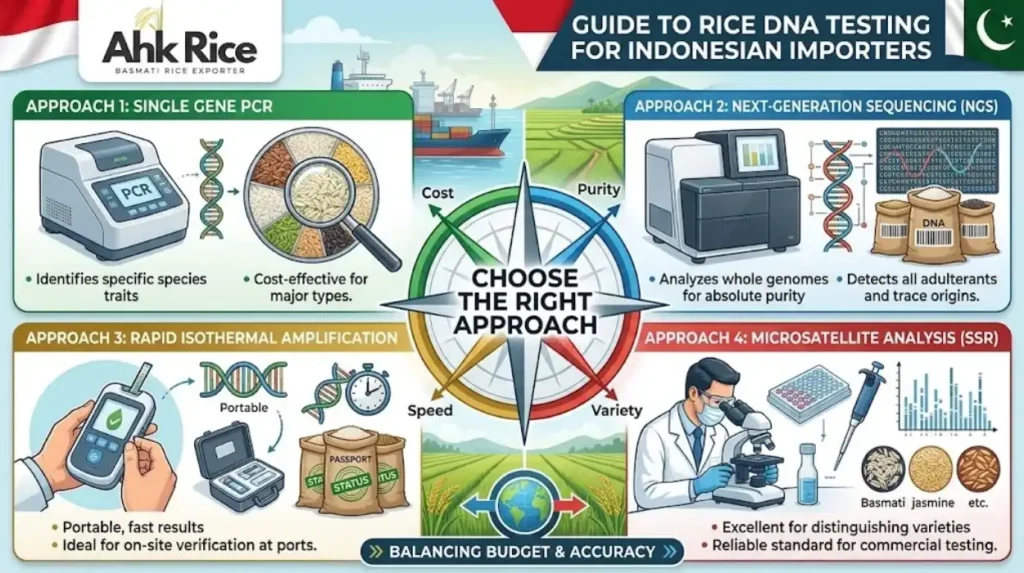
Independent laboratory testing using validated genetic markers, authenticated reference profiles, representative sampling, and shipment-level traceability provides the strongest practical verification approach. The testing arrangement should match the commercial risk, product value, and authenticity requirements of the Indonesian importer.
Three testing arrangements are relevant.
Exporter-Arranged Laboratory Testing
The exporter collects a representative sample and sends it to a laboratory.
This arrangement offers convenience and reduces coordination costs. It works for established supplier relationships where the buyer has agreed testing procedures and clear sample identification requirements.
The importer must still examine the laboratory’s competence and the report’s connection to the shipment.
Independent Third-Party Testing
An independent laboratory examines a sample under an agreed testing protocol.
This approach provides greater separation between the supplier and the testing process. It suits first-time transactions, premium private-label products, and contracts with strict authenticity requirements.
The buyer should confirm the laboratory’s experience with rice genetic authentication and the suitability of its reference database.
Buyer-Witnessed Sampling and Testing
The buyer or an appointed inspection agency witnesses sample collection before laboratory submission.
This arrangement strengthens confidence in sample representativeness and chain of custody. It is particularly useful for large shipments and recurring purchasing contracts.
The parties should document sample seals, collection dates, lot numbers, laboratory receipt, and report references.
Which Indonesian and International Markets Require Different Verification Strategies?
Indonesian importers should prioritise declared variety, consistent specifications, and traceable laboratory evidence, while Gulf buyers commonly evaluate premium grain presentation, aroma, cooking performance, and retail consistency. Both markets benefit from DNA authentication, but purchasing specifications and commercial priorities differ.
Indonesia: Authenticity and Commercial Consistency
Indonesian rice buyers operate across wholesale distribution, retail packaging, foodservice, and specialist imported-food channels.
Pakistani 1121 and Super Kernel serve premium Basmati positioning, while 1509 provides another long-grain option for buyers evaluating commercial value.
The appropriate grade depends on the buyer’s distribution channel:
- Premium retail: 1121 and Super Kernel.
- Specialist Basmati distribution: Super Kernel.
- Price-sensitive bulk purchasing: 1509, subject to buyer approval.
- Foodservice: The variety that meets cooking and cost specifications.
Importers should confirm Indonesian import requirements, product registration or approval requirements where applicable, labelling, and applicable food safety standards before shipment.
Gulf Markets: Grain Presentation and Cooking Performance
UAE and Saudi Arabian buyers commonly evaluate Basmati according to grain length, aroma, elongation, cooking consistency, and presentation.
1121 is suitable for premium positioning because of its extra-long grain characteristics. Super Kernel serves buyers seeking traditional Pakistani Basmati aroma. 1509 supports buyers seeking a long-grain commercial alternative.
Gulf buyers also place considerable attention on Steam and Sella processing options, particularly for foodservice, catering, and bulk distribution.
DNA authentication supports variety declarations in both regions. However, the commercial specification must reflect the requirements of the destination market.
How Do Price Per MT and Shelf Life Compare Between Indonesia and Gulf Markets?
Basmati prices per metric tonne and shelf life depend on variety, processing, grade, packaging, storage conditions, and shipping terms rather than destination alone. Importers should compare equivalent FOB or CIF quotations and documented storage specifications before selecting a supplier.
Price Comparison Per Metric Tonne
A meaningful price comparison requires the same product specification and Incoterm.
| Price factor | Indonesia | UAE and Saudi Arabia |
|---|---|---|
| Premium grade | 1121 and Super Kernel | 1121 and Super Kernel |
| Commercial alternative | 1509 | 1509 |
| Price quotation | FOB Karachi or CIF Indonesian port | FOB Karachi or CIF destination port |
| Major cost variables | Freight, insurance, duties, clearance | Freight, insurance, duties, clearance |
| DNA testing cost | Depends on laboratory and testing scope | Depends on laboratory and testing scope |
There is no verified current Indonesia-specific FOB or CIF price per MT available for these exact specifications. Publishing a fixed figure would create a misleading comparison.
For an accurate purchasing decision, request separate quotations for 1121, Super Kernel, and 1509. Each quotation should specify grain length, broken percentage, moisture, processing type, packaging, DNA testing charges, quantity, and Incoterm.
For example, a CIF quotation includes the cost of freight and insurance to the named destination port, whereas an FOB Karachi quotation does not include the main international freight and insurance paid by the buyer.
Shelf Life Comparison
Shelf life describes the period during which rice maintains its agreed quality under specified storage conditions.
| Product characteristic | Indonesia | Gulf markets |
|---|---|---|
| Raw Basmati storage | Depends on packaging and warehouse conditions | Depends on packaging and warehouse conditions |
| Steam rice | Requires moisture and pest control | Requires moisture and pest control |
| Golden Sella | Requires moisture and pest control | Requires moisture and pest control |
| Packaging | Moisture-resistant, sealed packaging | Moisture-resistant, sealed packaging |
| Storage priority | Controlled temperature and humidity | Protection from heat and humidity |
Golden Sella and Steam rice can have different cooking and storage characteristics. Neither processing method establishes a universal shelf-life period.
Importers should obtain a declared shelf-life specification, production date, best-before date, packaging details, and recommended warehouse conditions. The contract should also define the minimum remaining shelf life required upon arrival.
What Are the Advantages and Disadvantages of DNA Purity Reports?
DNA purity reports improve confidence in declared rice varieties, reduce the risk of undisclosed admixtures, and strengthen supplier accountability, but their reliability depends on sampling, laboratory competence, and genetic reference data. Importers should evaluate the report alongside physical specifications and shipment documentation.
Advantages of DNA Verification
1. Stronger variety authentication
DNA fingerprinting provides genetic evidence that supports the declared identity of Pakistani 1121, Super Kernel, or 1509 Basmati.
2. Better purchasing transparency
A laboratory report gives importers documented evidence to review before accepting a premium-grade purchase.
3. Reduced authenticity disputes
Batch-specific reports help buyers and exporters investigate disagreements about variety identity and detectable admixtures.
4. Stronger private-label confidence
Retailers selling Pakistani Basmati under their own brands can use documented testing as part of their supplier quality-control programme.
Disadvantages and Limitations
1. Testing does not establish complete quality
DNA analysis does not measure moisture, broken grains, grain length, aroma, or cooking performance.
2. Sampling affects reliability
A laboratory can produce accurate results for an unrepresentative sample. Sampling procedures must reflect the commercial lot.
3. Testing methods have limitations
A report cannot establish genetic differences that its selected markers and reference profiles cannot reliably distinguish.
4. Additional costs and coordination
Independent testing introduces laboratory charges, sample transportation, and additional time before final approval.
For example, an Indonesian distributor purchasing a container of Super Kernel should not accept a DNA report from an unrelated production batch. The importer should require a documented connection between the tested sample, production lot, packing records, and container shipment.
What Should Indonesian Importers Ask Pakistani Basmati Exporters?
Indonesian importers should ask exporters about laboratory independence, genetic markers, sampling procedures, report authenticity, batch identification, and shipment traceability. These questions establish whether a DNA certificate represents meaningful verification or simply a general supplier declaration.
The following questions provide a practical supplier-evaluation checklist.
1. Which Laboratory Conducted the DNA Analysis?
Request the laboratory’s legal name, location, testing scope, and relevant accreditation or competence documentation.
An independent laboratory provides greater separation from the supplier’s commercial interests.
2. Which Genetic Markers Were Used?
Ask whether the laboratory used SSR, PCR-based, or another validated molecular method.
The exporter should explain whether the selected markers distinguish the declared variety from relevant alternative varieties.
3. Does the Report Identify the Exact Production Batch?
The report should include a unique sample reference that connects to the exporter’s production lot.
Request matching references in the inspection report, packing records, and shipment documentation.
4. How Was the Sample Collected?
Ask whether the sample represents the complete production lot or only a small portion of the rice.
The exporter should provide sampling details, sample seals, and chain-of-custody information where applicable.
5. Does the Report Identify Detectable Admixtures?
Request the laboratory’s interpretation of genetic results and its detection limitations.
A report stating that a sample matches a reference profile is different from a report demonstrating that every possible form of admixture is absent.
6. Can the Exporter Provide Additional Quality Reports?
Request separate documents covering moisture, broken percentage, grain length, foreign matter, and applicable food safety parameters.
These reports complement DNA analysis and establish the commercial quality of the rice.
7. Can the Same Verification Process Be Applied to Repeat Orders?
For recurring imports, establish a consistent sampling, laboratory testing, and batch approval procedure.
This prevents the first shipment from receiving more rigorous verification than subsequent deliveries.
Which Factors Should Determine Your Final Supplier Decision?
The best supplier is the exporter that combines reliable genetic verification, consistent rice specifications, representative sampling, transparent pricing, and shipment-level traceability. Indonesian importers should evaluate these factors together rather than selecting a supplier solely because it provides a DNA certificate.
The following five-row decision framework helps buyers compare exporters.
| Decision factor | What to examine | Preferred evidence |
|---|---|---|
| Genetic authenticity | Declared variety and detectable admixtures | Validated DNA purity report |
| Laboratory credibility | Testing scope and competence | Laboratory credentials and methodology |
| Product consistency | Grain length, moisture, and broken percentage | Commercial specification and inspection report |
| Shipment traceability | Connection between sample and shipment | Lot numbers and loading records |
| Commercial reliability | Price, packaging, documents, and delivery terms | Detailed quotation and export documentation |
A supplier scoring highly across all five factors offers stronger purchasing assurance than one relying on an isolated laboratory certificate.
Buyers should also establish acceptance criteria before production. The purchase contract should identify the approved variety, quality limits, sampling procedure, testing laboratory, documentation requirements, and remedies for non-conforming shipments.
How Can Indonesian Importers Establish a Reliable DNA Verification Process?
A reliable verification process connects pre-shipment sampling, independent testing, product inspection, document review, and final shipment identification. Importers should establish these requirements before placing their first commercial order and apply the same procedure to subsequent production lots.
A practical process follows five stages:
- Supplier specification: Agree on 1121, Super Kernel, or 1509 and document the required commercial characteristics.
- Sample approval: Obtain a representative commercial sample and approve its physical and cooking characteristics.
- DNA testing: Arrange genetic analysis using suitable markers and authenticated reference profiles.
- Pre-shipment inspection: Verify the approved production lot against the agreed quality specification.
- Shipment documentation: Match laboratory references, lot numbers, packing records, and container details.
This approach gives Indonesian importers separate evidence for authenticity, quality, and shipment identity.
It also creates a documented basis for resolving disputes. If the delivered rice differs from the approved specification, the parties can investigate the production records and testing history rather than relying on verbal assurances.
Frequently Asked Questions
1. What Does a DNA Purity Report Prove for Pakistani Basmati Rice?
A DNA purity report provides genetic evidence about the tested rice sample. It assesses whether its genetic profile matches the declared variety within the scope of the laboratory’s validated testing method. It does not independently establish geographical origin or complete commercial quality.
2. Can DNA Testing Distinguish 1121 from Super Kernel Basmati?
DNA testing can distinguish varieties when the laboratory uses validated markers and authenticated reference profiles capable of differentiating them. Importers should request the testing scope and reference information before accepting the report.
3. Is a DNA Certificate Enough to Import Basmati Rice into Indonesia?
No. DNA authentication is only one component of supplier verification. Importers also need applicable import documentation, food safety compliance, product specifications, labelling information, and other destination-specific requirements.
4. Should Indonesian Importers Use Independent DNA Testing?
Independent testing is particularly useful for first-time suppliers, premium purchases, and private-label contracts. It provides additional confidence through laboratory analysis separate from the exporter’s own commercial operations.
5. How Much Does Basmati Rice DNA Testing Cost?
Testing costs depend on the laboratory, number of samples, genetic markers, analytical method, and testing requirements. Importers should request a separate quotation and clarify whether sample collection and courier charges are included.