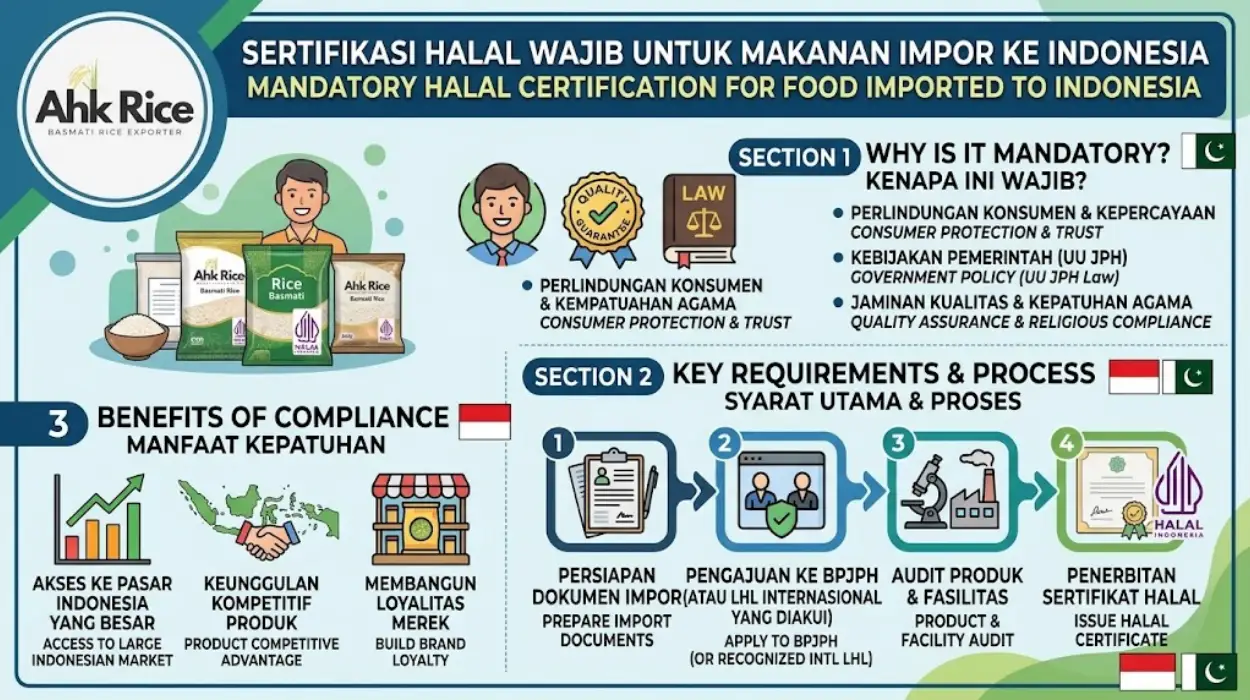
What Is Mandatory Halal Certification for Food Imported into Indonesia?
Mandatory halal certification for food imported into Indonesia is a regulatory system that establishes whether imported food products comply with Islamic dietary requirements. Indonesia administers this system through the Halal Product Assurance Organizing Agency (BPJPH), which oversees halal certification, foreign certificate recognition and product registration.
The system applies to food categories such as rice, packaged foods, processed agricultural products, meat and beverages. It establishes requirements for ingredients, manufacturing, storage, handling and product documentation. Foreign exporters and Indonesian importers must understand these requirements before distributing food in the Indonesian market.
Indonesia’s regulatory timeline is particularly important. On 16 October 2026, the Indonesian government announced an extension of the mandatory halal certification deadline for imported food and beverages. Under Government Regulation No. 40 of 2026, the imported food requirement begins on 18 October 2028, subject to the completion of mutual recognition arrangements for foreign halal certificates. ekon.go.id+1
What Is Mandatory Halal Certification for Imported Food?
Mandatory halal certification is an Indonesian legal requirement that verifies food compliance with Islamic dietary principles. BPJPH administers the system, recognises eligible foreign certificates and oversees registration before covered imported products enter commercial distribution.
Halal certification establishes the permitted status of food according to Islamic law. It examines ingredients, processing methods, manufacturing facilities and contamination controls. The objective is to ensure that products labelled halal meet recognised religious and regulatory standards.
Indonesia introduced its Halal Product Assurance framework through Law No. 33 of 2014, commonly known as the Halal Product Assurance Law. Government Regulation No. 42 of 2024 provides implementing rules, subsequently amended by Government Regulation No. 40 of 2026.
The framework covers food, beverages, pharmaceuticals, cosmetics and other specified product categories. Products containing clearly non-halal ingredients are exempt from halal certification but must carry appropriate non-halal information.
For imported rice, the relevant considerations include grain purity, processing aids, packaging materials, storage facilities and possible contact with non-halal substances.
How Does Indonesia’s Halal Certification System Work?
Indonesia’s halal certification system operates through BPJPH supervision, recognised halal certification bodies, foreign certificate registration and importer compliance. Exporters establish product compliance, while Indonesian importers coordinate applicable registration and market-entry documentation.
The process involves several regulatory participants.
1. BPJPH
The Halal Product Assurance Organizing Agency (BPJPH) is Indonesia’s government authority responsible for administering halal product assurance. Its responsibilities include managing certification, recognising foreign halal certification bodies and maintaining the national halal registration system.
2. Foreign Halal Certification Bodies
Foreign Halal Certification Bodies (FHCBs) are authorised organisations that inspect products and issue halal certificates in their respective countries. Their certificates receive recognition in Indonesia through formal mutual recognition cooperation with BPJPH.
3. Indonesian Importers
Importers coordinate the Indonesian registration process for recognised foreign halal certificates. They also maintain the documentation required for importing and distributing products.
4. Halal Auditors
Halal auditors examine ingredients, production facilities, processing procedures and contamination prevention. Their assessments provide evidence that a product complies with applicable halal standards.
5. SiHalal Registration System
SiHalal is BPJPH’s electronic platform for halal certification and foreign halal certificate registration. Indonesian importers or authorised representatives use the platform to complete relevant registration procedures.
What Are the Key Components of Indonesia’s Halal Requirements?
Indonesia’s halal requirements cover product ingredients, manufacturing processes, packaging materials, storage, transportation, certification documents and labelling. Each component establishes controls that prevent prohibited substances from entering products during production and international distribution.
The main components include:
1. Ingredient Verification
Every ingredient used in a food product requires appropriate halal assessment. This includes raw materials, additives, flavourings, processing aids and other substances that affect product composition.
For rice, ingredient verification focuses on the grain itself and any additional materials used during processing.
2. Manufacturing and Processing
Manufacturing facilities must maintain halal-compliant production conditions. Machinery, equipment, cleaning agents and processing materials require appropriate controls to prevent contamination.
Rice processing activities include:
- Paddy cleaning and husk removal.
- Dehusking and whitening.
- Grading and length separation.
- Colour sorting through Sortex machines.
- Steam or parboiling treatment where applicable.
- Final inspection and packaging.
Plain rice without prohibited ingredients has a different halal assessment from processed rice containing additives or flavouring ingredients.
3. Packaging and Storage
Packaging materials that directly contact food must satisfy applicable halal requirements. Storage facilities must also prevent contact with non-halal products.
BPJPH specifically identifies natural products such as rice as exempt from product halal certification under its guidance, while maintaining requirements for halal-compliant packaging, transportation and storage. BPJPH+1
4. Transportation and Distribution
Transportation arrangements must protect food from cross-contamination. Rice shipments require clean containers, suitable packaging and controlled handling throughout transportation.
5. Documentation and Labelling
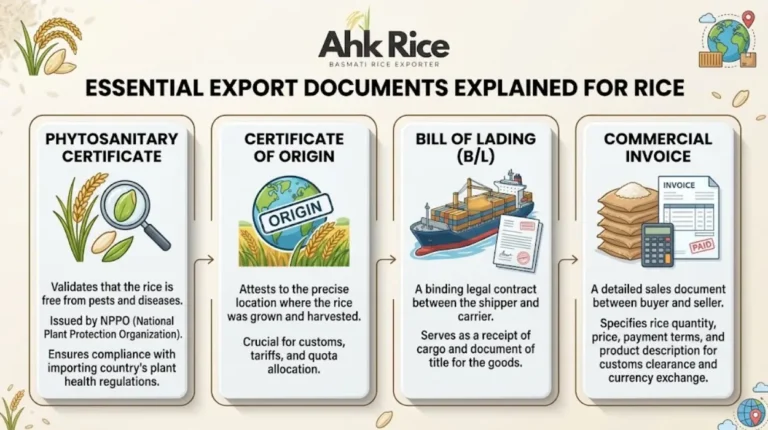
Importers maintain supporting documents, including applicable halal certificates, registration records, ingredient information and product specifications. Products subject to halal labelling requirements must display the appropriate Indonesian halal identification.
What Are the Benefits of Halal Certification for Imported Food?
Halal certification provides regulatory assurance, consumer confidence, ingredient transparency and controlled production practices. It helps food manufacturers and importers demonstrate compliance with Indonesian halal standards while improving market access and supply-chain accountability.
The principal benefits include:
- Regulatory compliance: Appropriate certification and registration help importers meet Indonesia’s halal product assurance requirements.
- Consumer confidence: Muslim consumers receive information about the halal status of covered products.
- Supply-chain transparency: Ingredient and processing documentation creates traceability throughout production and distribution.
- International trade readiness: Recognised foreign certificates simplify compliance when BPJPH mutual recognition arrangements apply.
- Quality management: Controlled handling, hygiene and contamination prevention strengthen manufacturing procedures.
- Market access: Properly documented products can meet the halal-related requirements applicable to Indonesian commercial distribution.
Halal certification and food safety certification serve different purposes. HACCP and ISO 22000 address food safety management, while halal certification evaluates compliance with Islamic dietary requirements. One certificate does not automatically replace the other.
Which Foreign Halal Certificates Does Indonesia Recognise?
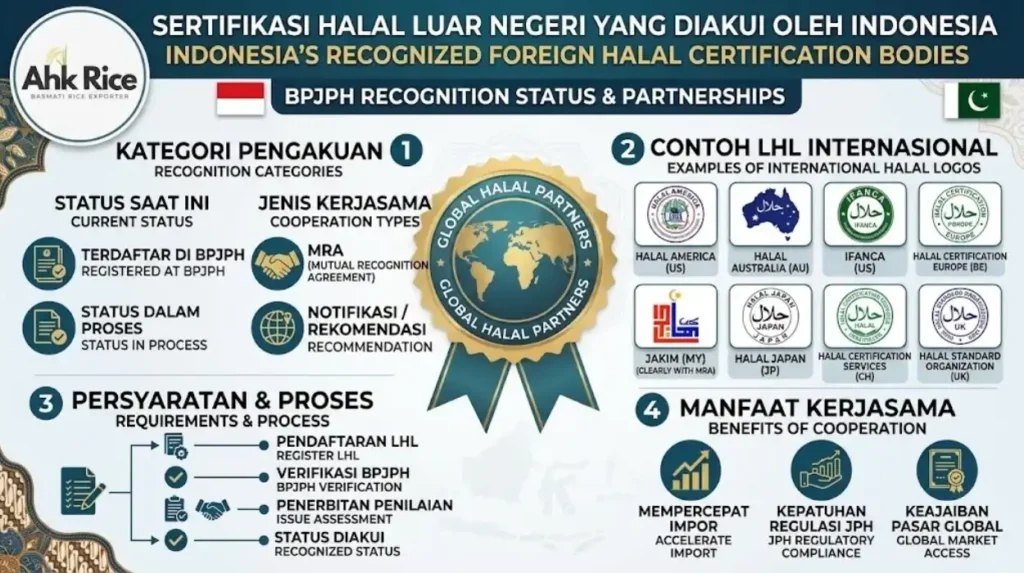
Indonesia recognises foreign halal certificates through mutual recognition cooperation between BPJPH and eligible foreign halal certification bodies. Recognition depends on the certifying organisation, certification scope and applicable registration requirements.
A foreign certificate does not automatically become valid for Indonesian distribution simply because an overseas organisation issued it.
The recognition process involves several considerations:
- The foreign certification body must have an applicable recognition arrangement with BPJPH.
- The certification body must cover the relevant product category.
- The certificate must remain valid and cover the exported product.
- The Indonesian importer or authorised representative must complete applicable foreign certificate registration.
- The importer must maintain the relevant registration documentation.
BPJPH Decree No. 221 of 2025 established procedures for foreign halal certificate registration. Under the recognition framework, qualifying foreign certificates do not require a completely new Indonesian certification application, but registration remains necessary before distribution. cmsbl.halal.go.id+1
Which Food Products and Markets Require Halal Compliance?
Indonesia’s halal framework covers imported food and beverages, including processed foods, agricultural ingredients and other regulated food categories. Exporters from Pakistan, India, Australia, Europe and other trading markets must assess product-specific requirements.
Common imported food categories include:
- Rice and cereal products.
- Packaged snacks and bakery products.
- Meat and processed meat products.
- Dairy products.
- Cooking ingredients and food additives.
- Processed fruits and vegetables.
- Beverages and prepared food products.
Pakistani Basmati Rice
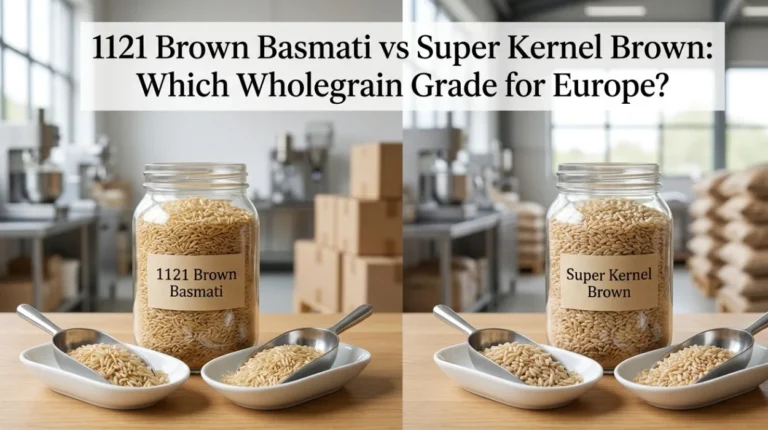
Pakistan supplies several Basmati varieties, including 1121, Super Kernel and 1509. These varieties serve different retail, wholesale and foodservice requirements.
For Indonesian rice buyers, important specifications include grain length, broken percentage, moisture, crop year, processing method and packaging format.
Plain, natural rice deserves particular attention because BPJPH guidance identifies rice as a naturally exempt product. Exporters must distinguish this exemption from the requirements applicable to packaging, storage, transportation and processed products. BPJPH
Other International Suppliers
India supplies Basmati and non-Basmati rice varieties. Thailand and Vietnam supply different long-grain and fragrant rice categories. Australia, Europe and other markets also supply agricultural and processed food products.
Each exporter must assess the relevant Indonesian tariff classification, product composition and applicable halal rules.
For rice exporters, understanding [BPJPH halal requirements and foreign halal certificate recognition for imported rice] (MOFU article) provides a useful next step when preparing documentation and selecting a recognised certification route.
When Does Mandatory Halal Certification for Imported Food Become Effective?
Under Government Regulation No. 40 of 2026, Indonesia’s mandatory halal certification requirement for imported food and beverages begins on 18 October 2028, subject to completion of foreign halal certificate mutual recognition arrangements.
The government originally scheduled the expanded imported food requirements for October 2026. However, the Indonesian government extended the implementation period through Government Regulation No. 40 of 2026, dated 14 October 2026.
The revised timeline is:
| Regulatory milestone | Applicable date |
|---|---|
| Original imported food deadline | October 2026 |
| New regulation issued | 14 October 2026 |
| Government extension announced | 16 October 2026 |
| New imported food compliance date | 18 October 2028 |
This extension gives foreign exporters, Indonesian importers and certification bodies additional time to prepare documentation and establish mutual recognition arrangements.
The new regulation also revokes BPJPH Regulation No. 4 of 2026 concerning foreign product halal conformity assessments. Exporters should therefore follow the amended regulatory framework rather than relying on the earlier pre-shipment inspection provisions. JDIH BPJPH+2
What Are the Common Problems and Misconceptions About Indonesian Halal Certification?
Common problems include assuming every foreign certificate receives automatic recognition, overlooking packaging requirements, confusing food safety certification with halal certification and applying outdated compliance deadlines to imported products.
Exporters and importers frequently encounter the following misunderstandings.
1. Every Foreign Halal Certificate Is Automatically Accepted
Foreign certificates require recognition through applicable BPJPH mutual recognition arrangements. An overseas certificate without the required recognition does not automatically qualify for Indonesian registration.
2. Every Rice Product Requires a Separate Halal Certificate
BPJPH guidance identifies natural rice as exempt from product halal certification. However, this does not remove the requirements concerning packaging, transportation, storage and contamination prevention.
Processed rice products containing additional ingredients require separate assessment according to their composition and applicable rules.
3. HACCP Certification Replaces Halal Certification
HACCP and ISO 22000 demonstrate food safety management practices. They do not independently establish halal status.
4. The 2026 Deadline Still Applies to Imported Food
The revised deadline for mandatory halal certification of imported food and beverages is 18 October 2028. Exporters must use Government Regulation No. 40 of 2026 as the updated regulatory reference.
5. Halal Certification Covers Only Ingredients
Halal assurance extends beyond ingredients. Processing, equipment, packaging, transportation and storage also influence the halal status of food products.
How Can Food Exporters Prepare for Indonesia’s Halal Requirements?
Food exporters should review product classification, verify ingredients, assess packaging materials, maintain production records and coordinate with Indonesian importers. These steps establish documentation readiness before the mandatory imported food compliance date.
A practical preparation process includes:
- Identify the product’s Indonesian Harmonized System classification.
- Determine whether the product requires halal certification or qualifies for an exemption.
- Review ingredients, additives and processing aids.
- Verify the recognition status of the foreign halal certification body where certification applies.
- Prepare manufacturing and product documentation.
- Review direct-contact packaging and storage arrangements.
- Coordinate certificate registration with the Indonesian importer where required.
- Confirm current BPJPH requirements before shipment.
For rice exporters, the assessment must distinguish plain agricultural rice from flavoured, fortified or otherwise processed rice products.
Maintaining product specifications, processing records, packaging declarations and shipment documentation helps importers establish a consistent compliance process.
Frequently Asked Questions
Is halal certification mandatory for food imported into Indonesia?
Indonesia’s halal framework establishes mandatory certification for covered imported food products from 18 October 2028. Certain naturally halal products, including plain rice, qualify for exemptions under applicable BPJPH guidance.
What is BPJPH in Indonesia?
BPJPH stands for the Halal Product Assurance Organizing Agency. It is Indonesia’s government authority responsible for administering halal certification, foreign certificate recognition and halal product assurance.
Does Indonesia accept foreign halal certificates?
Yes. Indonesia recognises certificates issued by foreign halal certification bodies that have applicable mutual recognition arrangements with BPJPH. Recognised certificates require registration before commercial distribution.
Is Pakistani Basmati rice required to have halal certification?
Plain, natural Basmati rice is identified as exempt from product halal certification under BPJPH guidance. Its packaging, storage and transportation must still satisfy applicable halal requirements. Processed rice products require individual assessment.
What is the new halal certification deadline for imported food?
The new compliance date is 18 October 2028 under Government Regulation No. 40 of 2026, subject to completion of mutual recognition arrangements for foreign halal certificates.