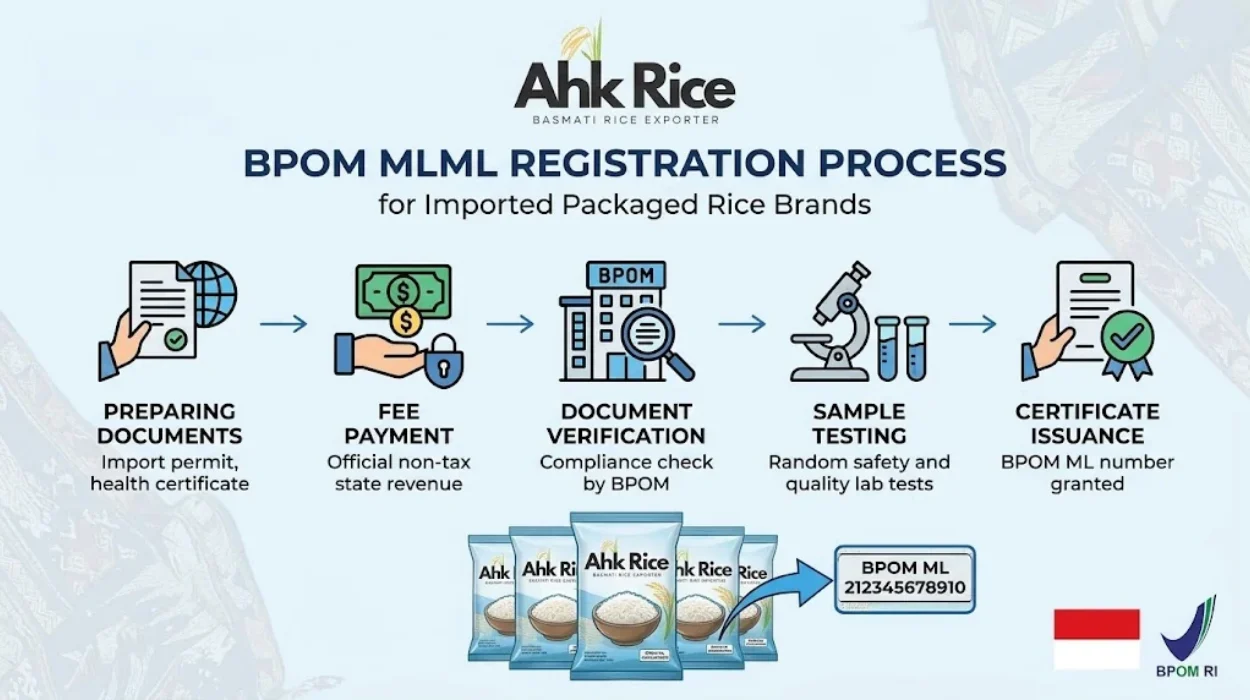
BPOM ML Registration Process for Imported Packaged Rice Brands
For imported packaged rice brands, BPOM ML registration is the appropriate route when rice is imported for retail sale in Indonesia, while bulk or qualifying minimally processed products can follow different regulatory treatment; the practical choice depends on packaging, processing, importer status, and intended market channel.
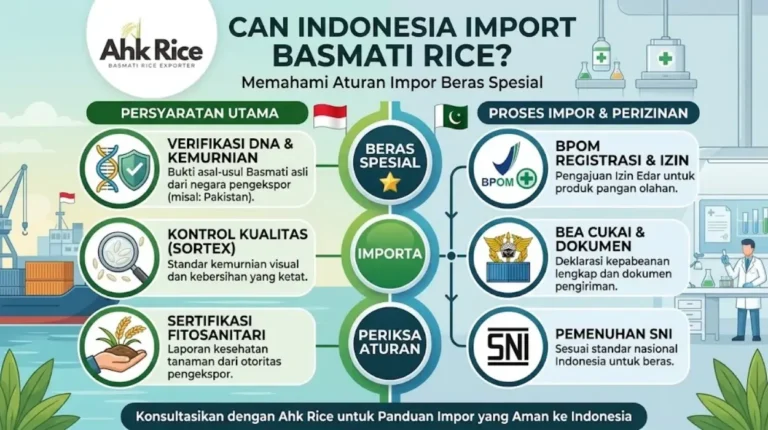
Indonesian importers often begin by asking whether their Pakistani Basmati rice needs a BPOM registration number. The answer depends on how the rice enters the market. BPOM states that imported processed food sold in retail packaging requires registration, while certain bulk products, products used only as ingredients, samples, and food undergoing only minimal post-harvest processing fall under exemptions.
For brands planning retail distribution, the guide to whether packaged Basmati rice needs BPOM registration in Indonesia provides the educational starting point. The next decision is selecting the right product, importer, documentation, and packaging structure before submitting the ML application.
What are the available solutions for imported packaged rice brands?
Imported packaged rice brands generally have three practical routes: register a retail-ready product under BPOM ML, import qualifying bulk rice for further processing or repacking, or operate within a specific exemption where the product is not directly sold as ordinary retail packaged food.
The first route is BPOM ML registration. ML refers to imported food registration, and BPOM identifies imported processed food with an ML registration number. The current registration approval uses a 15-digit PB-UMKU number, with imported products identified by the “BPOM RI ML” designation.
The second route is bulk commercial importation for further processing or use as an ingredient. BPOM lists processed food used further as a raw material and not sold directly to final consumers among products that do not require ordinary food registration. Large-pack products that are not directly sold to final consumers also have an exemption under the stated conditions.
The third route involves specific exemptions. These include qualifying samples, research quantities, personal consumption quantities, food with a shelf life under seven days, ready-to-eat food, and food subjected only to specified minimal post-harvest processing without the relevant additives.
For a Basmati rice brand selling 1 kg, 5 kg, 10 kg, or similar consumer packs through Indonesian retail, supermarket, e-commerce, or food distribution channels, the retail registration route is normally the relevant model.
How does the BPOM ML registration process work for imported rice?
The ML process starts with an eligible Indonesian importer or distributor, continues through company registration and product documentation in the BPOM risk-based system, and ends with product approval, label compliance, and use of the assigned ML registration number for legal retail distribution.
The Indonesian importer or appointed distributor is central to the process. BPOM states that products manufactured outside Indonesia and imported into Indonesia are registered by an importer or distributor appointed by the foreign product company.
The company first needs the appropriate business credentials. Current BPOM requirements for imported products include an NPWP, an NIB using the OSS-RBA framework, the applicable risk-based business documentation, and an SMKPO certificate for the distribution facility. The importer also needs a valid Letter of Appointment and suitable manufacturing or food-safety documentation from the overseas producer.
The overseas manufacturer normally supplies documentation such as GMP, HACCP, ISO 22000, or an equivalent government audit certificate. The Letter of Appointment must meet the applicable authentication requirements.
Registration is performed electronically through BPOM’s risk-based registration system, e-Reg RBA. BPOM also implemented KBLI 2025 in the registration system from July 2026, so new company registrations must use the appropriate NIB with KBLI 2025.
The product file then needs to align the composition, production information, packaging, label, food category, shelf-life information, and supporting safety or quality documents. BPOM requires registered processed food to satisfy safety, quality, nutritional, production, distribution, and retail requirements.
How do different BPOM and import approaches compare?
The main difference is commercial purpose: retail ML registration creates a compliant consumer product route, bulk import reduces immediate retail-registration requirements when conditions are met, and exemption routes apply only to narrowly defined uses that do not represent ordinary retail brand distribution.
| Attribute | Retail ML Registration | Bulk/Further Processing | Exempt Use |
|---|---|---|---|
| Main purpose | Consumer retail sales | Ingredient or further processing | Sample, research, qualifying use |
| Consumer packaging | Yes | Usually not final retail packaging | Limited or restricted |
| BPOM ML | Required for qualifying retail food | Not required where exemption applies | Not required where exemption applies |
| Indonesian importer | Required | Required under import rules | Responsible importing party |
| Label review | Critical | Depends on final product stage | Limited by use |
| Distribution scale | Retail and e-commerce | Foodservice, processing, bulk channels | Restricted purpose |
| Brand-building potential | Highest | Medium | Very low |
The retail route has the strongest connection between compliance and brand development. A private-label Basmati rice brand requires a consistent product identity, approved packaging, documented production origin, and controlled distribution.
The bulk route provides greater flexibility when rice will be processed or repacked in Indonesia under a qualifying business model. It does not automatically provide permission to place the same imported product directly on retail shelves.
The exemption route is the narrowest. A sample imported for registration testing is not equivalent to commercial retail stock. The distinction between testing quantity and commercial distribution is therefore important.
Which method works best for different Indonesian rice brands?
A retail brand should normally use the ML route, a processor or institutional buyer should evaluate bulk importation, and a company importing only samples should use the applicable exemption instead of building a retail registration structure around a temporary shipment.
A premium Basmati retail brand benefits from ML registration because its commercial objective is consumer-facing distribution. The package becomes part of the product identity, so the regulatory file needs to match the actual brand, product composition, production site, packaging, and importer.
A restaurant or foodservice buyer can evaluate bulk purchasing where the rice is supplied in commercial bulk formats and is not sold directly to consumers as the same packaged retail product. The business model should be established before importing because packaging and distribution conditions affect regulatory treatment.
A new private-label brand should structure the project around the final retail product rather than registering an unfinished concept. The importer, overseas mill, rice grade, processing type, package size, label design, and supporting documents should remain aligned.
A sampling-stage buyer has a different requirement. BPOM recognizes limited imports for samples used for testing, research, or registration purposes. Such quantities should not be treated as normal commercial retail inventory.
What are the pros and cons of each approach?
ML registration provides the strongest retail foundation but requires more documentation and coordination; bulk import can simplify the immediate product-registration burden but limits direct consumer branding, while exemptions reduce regulatory steps only because the commercial use itself is restricted.
BPOM ML registration
The major advantage is market readiness. A registered retail product can operate within the intended consumer channel once the applicable import and distribution requirements are satisfied.
The trade-off is documentation. The importer must coordinate Indonesian business credentials, overseas manufacturer evidence, appointment documents, product information, labels, and registration submission.
For example, a Pakistani 1121 Basmati brand packed into 5 kg consumer bags for Indonesian supermarkets needs a product structure designed around retail distribution rather than a bulk commodity shipment.
Bulk import
The major advantage is operational flexibility. A food manufacturer, distributor, or institutional buyer can import rice in a format suited to further processing or qualifying bulk distribution.
The trade-off is weaker direct brand positioning. A bulk shipment does not automatically create a finished consumer product that can be placed on retail shelves under a new brand.
Exempt imports
The major advantage is speed for legitimate limited purposes such as samples or research. The trade-off is the narrow commercial scope. An exemption does not function as a substitute for a retail registration.
Which Basmati grades and markets fit different strategies?

Indonesian retail brands commonly benefit from premium long-grain grades such as 1121, Super Kernel, and selected 1509 formats, while Western Indonesia favors frequent replenishment and competitive landed cost and Eastern Indonesia benefits from grades suited to longer inventory coverage.
For Indonesia, AHK Rice’s market planning data identifies Western Indonesia with preferences for 1121 White, 1121 Sella, and Super Kernel. Eastern Indonesia shows demand patterns suited to 1121 Sella, 1121 Steam, and 1509 Steam. Reference Pakistan-origin FOB levels for comparable premium Basmati grades sit around US$1,135–US$1,205/MT, before freight, insurance, destination charges, taxes, and inland costs.
The price difference between grades is commercially important. Current Pakistan market references place 1121 and Super Kernel in the premium Basmati segment, with 1121 White, Sella, Golden Sella, and Steam generally carrying different FOB values according to processing and specification. September 2026 reference prices place 1121 Basmati around US$1,135–US$1,205/MT and Super Kernel around US$1,165–US$1,205/MT.
For Indonesia, buyers should compare landed cost rather than FOB alone. Freight, insurance, port handling, customs costs, taxes, inspection, financing, and inland distribution change the commercial result. The FOB figures therefore function as sourcing references, not Indonesian wholesale quotations.
Shelf life also needs to be evaluated as a supply-chain specification rather than a single universal number. Properly processed and stored Basmati rice can support long commercial storage, but packaging integrity, moisture, humidity, pest control, warehouse conditions, and the chosen product’s aging characteristics affect inventory performance. AHK Rice’s Indonesia planning reference uses 12–24+ months as a planning range depending on grade and storage conditions.
Indonesia vs Gulf market comparison
| Market region | Typical grade preference | Reference FOB comparison | Shelf-life planning |
|---|---|---|---|
| Western Indonesia | 1121 White, 1121 Sella, Super Kernel | About US$1,135–$1,205/MT | 12–24+ months |
| Eastern Indonesia | 1121 Sella, 1121 Steam, 1509 Steam | About US$1,135–$1,205/MT for comparable premium grades | 12–24+ months |
| Gulf markets | 1121 Steam, Sella, Golden Sella | Premium grades commonly command higher processing-specific values | 12–24+ months |
The Gulf comparison is useful because the region has established demand for long-grain aromatic Basmati and parboiled formats. Indonesia places greater importance on adapting the product, package, importer structure, and distribution model to Indonesian requirements.
What decision factors should an importer use before choosing a registration route?
The correct route depends on five linked decisions: final sales channel, packaging format, importer structure, overseas manufacturing documentation, and whether the rice will reach Indonesian consumers as the imported packaged product or undergo further processing first.
| Decision factor | Retail ML | Bulk route | Exemption |
|---|---|---|---|
| Retail supermarket sales | Best fit | Poor fit | Not suitable |
| E-commerce brand | Best fit | Poor fit | Not suitable |
| Foodservice supply | Suitable | Strong fit | Restricted |
| Further processing | Limited relevance | Strong fit | Depends on use |
| Product sampling | Unnecessary | Unnecessary | Strong fit |
The first decision is where the rice will be sold. Supermarkets, branded e-commerce stores, and consumer retail channels point toward ML registration.
The second is what the package looks like at import. A final consumer package creates a different regulatory profile from bulk rice intended for further processing.
The third is who owns the Indonesian market operation. The importer or appointed distributor must have the appropriate Indonesian business and registration structure.
The fourth is whether the Pakistani supplier can provide a complete technical file. A rice exporter should be able to coordinate product specifications, production information, food-safety certifications, and brand-specific packaging documentation.
The fifth is whether the commercial model is stable. Changing the overseas production site, importer, composition, packaging type, or label can affect registration because BPOM identifies these differences as factors that can require separate registration.
What should a Pakistani Basmati supplier prepare for an Indonesian ML project?
A supplier should prepare a consistent product specification, overseas manufacturing evidence, product and packaging information, export documents, and private-label materials so the Indonesian importer can build a registration file around the exact Basmati product entering the retail market.
AHK Rice supplies Pakistani Basmati from Punjab and works with 1121, Super Kernel, and 1509 varieties across export markets. For an Indonesian private-label project, the practical focus is specification consistency rather than selecting a grade only by headline price.
The supplier and importer should align the Basmati variety, processing type, grain specification, moisture target, broken percentage, packaging material, net weight, production site, shelf-life statement, label design, and shipment documentation before commercial production.
This approach reduces mismatches between the approved product file and the physical rice shipment. It also supports repeat procurement because the brand specification remains stable across production batches.
For a new brand, the strongest model is therefore product specification first, regulatory structure second, packaging third, and commercial shipment fourth. The sequence prevents a low-cost packaging or product change from creating a registration problem later.
What is the best overall approach for an imported Basmati rice brand?
For a consumer-facing Indonesian Basmati brand, the strongest approach is to build the retail product around BPOM ML requirements from the beginning, align the Indonesian importer with the Pakistani manufacturer, and lock product, packaging, label, and documentation before shipment.
The comparison is straightforward. ML registration provides the clearest path for retail packaged rice. Bulk import suits businesses that genuinely operate at the processing or bulk-distribution level. Exemptions suit limited purposes rather than ordinary brand launches.
For Indonesian retail, the commercial decision should also account for grade economics. 1121 provides premium length and presentation, Super Kernel provides aromatic premium positioning, and 1509 provides an efficiency-oriented option for buyers balancing yield, cooking performance, and price.
The regulatory process and sourcing strategy should therefore be treated as one commercial workflow. The rice specification determines the product file. The packaging determines the retail presentation. The importer determines the Indonesian registration route. The manufacturer documentation supports the application.
For companies moving from compliance planning into brand launch, the next stage is evaluating how to launch a BPOM-ready Basmati rice brand through private labelling, including product selection, packaging coordination, and supplier documentation.
Frequently Asked Questions
Does imported packaged Basmati rice need BPOM ML registration in Indonesia?
Yes, qualifying processed food imported for retail sale in packaged form requires BPOM registration. Imported products use the ML designation, while specific exemptions apply to qualifying bulk, ingredient, sample, research, and other limited-use products.
Who submits BPOM ML registration for imported rice?
The Indonesian importer or distributor appointed by the overseas product company submits the registration for qualifying imported food products.
What documents does an importer need for ML registration?
Core company requirements include NPWP and NIB under OSS-RBA, with applicable risk-based business documentation and SMKPO. The imported-product file also includes an authenticated Letter of Appointment and overseas manufacturing evidence such as GMP, HACCP, ISO 22000, or an equivalent audit certificate.
How long is a BPOM food registration valid?
BPOM states that a food distribution permit is valid for five years and can be extended through re-registration.
Can bulk Basmati rice be imported without ML registration?
Qualifying food imported in bulk and not sold directly to final consumers, or food used further as a raw material, can fall under BPOM’s registration exemptions. The actual business model and product treatment must match the exemption conditions.
Does changing the rice packaging affect registration?
Yes. BPOM identifies differences in packaging type, composition, overseas production facility, importer or distributor, and label design among factors that can require separate registration.
What is the current BPOM registration system for imported food?
Food registration is handled electronically through BPOM’s risk-based e-Reg system. BPOM implemented KBLI 2025 in the registration system from July 2026, and new company registrations must use the appropriate NIB with KBLI 2025.
Which Basmati grade is suitable for an Indonesian private-label brand?
1121 is suitable for premium long-grain positioning, Super Kernel suits aromatic premium positioning, while 1509 provides an option for buyers prioritizing efficient sourcing and cooking performance. The final choice should match target retail price, consumer segment, processing type, and packaging strategy.