Request Current FOB and CIF Indonesia Basmati Rice Quotations from AHK Rice
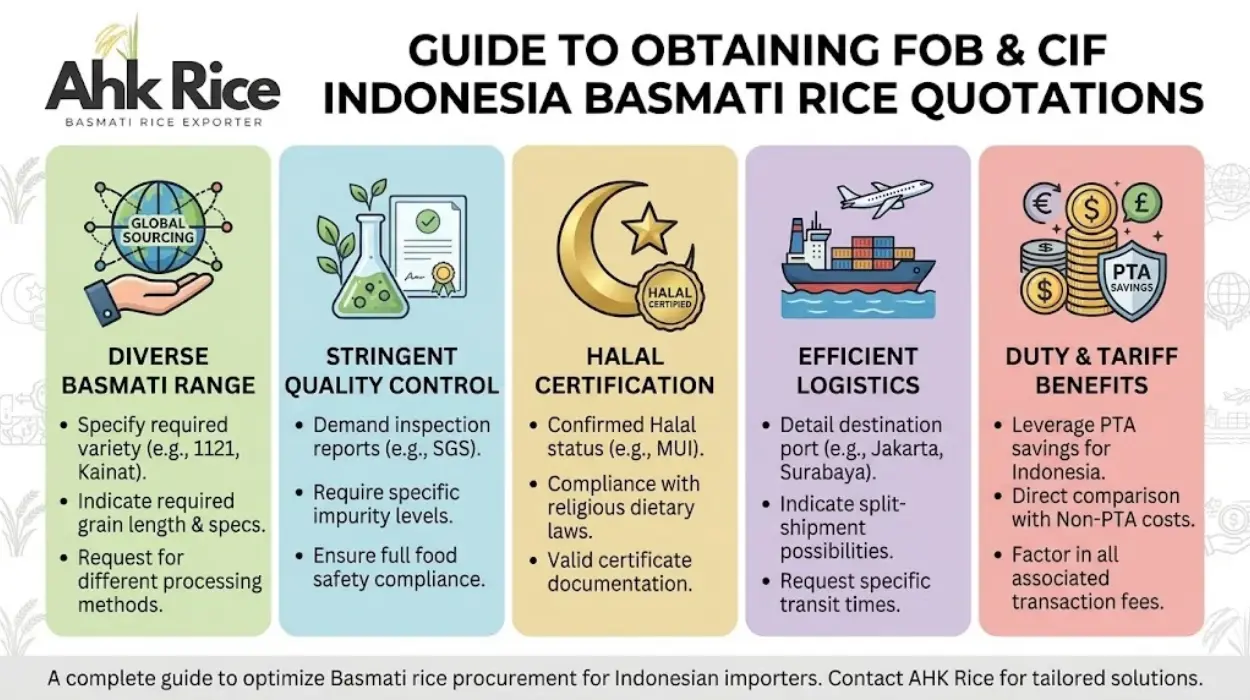
Indonesian Basmati buyers need a current quotation that separates product value from freight, insurance, packaging, inspection, and destination costs. A generic price per metric ton is not enough for a commercial import decision. The correct quotation should match the required variety, processing grade, quantity, packaging, destination port, and Incoterm.
For buyers who first need to understand the pricing structure, the guide on how Pakistani Basmati rice is priced for Indonesian buyers provides the commercial background before requesting a shipment-specific offer.
What is the best solution for requesting an Indonesia Basmati rice quotation?
The best solution is to request separate FOB Karachi and CIF quotations against one identical product specification, because this shows the rice cost, freight responsibility, insurance, and destination basis without mixing different commercial terms or quality levels.
AHK Rice prepares export quotations according to the buyer’s actual specification rather than applying one fixed price to every Indonesian shipment. The quotation should identify the Basmati variety, processing, grain specifications, quantity, packaging, destination port, and preferred delivery basis.
For example, a buyer sourcing 100 MT of 1121 Steam for Jakarta should not compare that offer with a supplier quoting 1509 Steam for Surabaya. The product, destination, freight route, and commercial requirements are different.
The useful comparison is therefore FOB Karachi versus CIF Jakarta or CIF Surabaya for the same grade and quantity. Buyers can then calculate the expected landed cost more accurately.
AHK Rice supplies Pakistani 1121, Super Kernel, and 1509 Basmati with options including White, Steam, and Sella processing. The first product selection should match the Indonesian sales channel rather than simply selecting the lowest quoted price.
Why choose AHK Rice for Indonesian Basmati rice sourcing?
AHK Rice provides Indonesian buyers with a specification-led export process covering product selection, processing, grading, packaging, quality control, documentation, and shipment preparation from Pakistan through the commercial export stage.
The advantage is control. A buyer can establish the required grain length, broken percentage, moisture, purity, processing type, packing format, and quantity before production.
This is important for repeat distribution. A lower first quotation has limited value if the next shipment changes grain quality, packaging, broken percentage, or cooking performance.
AHK Rice also supports customized export packaging. Indonesian distributors can specify bulk bags, retail packaging, printed bags, or private-label requirements according to the intended sales model and applicable import requirements.
Quality should remain connected to the commercial quotation. A buyer requesting premium 1121 with a tight broken limit should receive a quotation that reflects that specification rather than a generic 1121 price.
For a deeper comparison of freight responsibility and destination economics, buyers can also review the FOB Karachi vs CIF Jakarta and Surabaya Basmati rice cost breakdown.
What results can Indonesian buyers expect?
Indonesian buyers can expect a shipment-specific quotation, approved product specification, sample evaluation, documented export preparation, and a defined logistics plan when the order is structured around clear commercial requirements before production.
AHK Rice publishes an overall planning period of approximately 4–6 weeks for relevant Indonesia supply programs. Production can require around 7–10 days, export documentation and port preparation around one week, while sea transit is commonly planned at approximately 14–21 days for Jakarta and Surabaya routes. Actual arrival depends on vessel schedules, port conditions, customs clearance, and inland delivery.
A practical planning table is:
| Destination | Indicative sea transit | Overall procurement planning |
|---|---|---|
| Jakarta | 14–21 days | About 4–6 weeks |
| Surabaya | 14–21 days | About 4–6 weeks |
| Belawan | 17–26 days | About 4–6+ weeks |
| Other Indonesian ports | Confirm routing | Shipment-specific |
These are planning estimates rather than guaranteed delivery dates.
The result is stronger when the approved sample becomes the physical quality reference for the commercial order. This creates a direct connection between what the buyer tested and what the supplier produces.
How much does Pakistani Basmati rice cost for Indonesia?
The current quotation depends on variety, processing, grade, crop availability, quantity, packaging, inspection, freight, insurance, destination port, payment terms, and Incoterm, so Indonesian buyers should request a fresh offer instead of relying on an old market price.
AHK Rice has published indicative references around US$1,100 per MT FOB Karachi for 1121 Basmati on Indonesia-focused material, while other published Pakistan market references place premium Basmati grades around different ranges depending on specification. These figures are planning references, not fixed current quotations.
A commercial quotation should clearly separate the following:
| Cost factor | Why it affects price |
|---|---|
| Variety | 1121, Super Kernel and 1509 have different market positions |
| Processing | White, Steam and Sella require different processing |
| Grade | Grain length, purity and broken limits affect value |
| Quantity | Container volume influences production economics |
| Packaging | Retail and private-label packs add conversion costs |
| Inspection | Independent inspection adds service costs |
| Freight | Vessel, route and destination affect CIF value |
| Insurance | CIF calculations include agreed insurance |
| Destination | Jakarta and Surabaya can have different logistics |
| Payment terms | Commercial structure affects working capital |
For example, an FOB quotation may look lower because ocean freight and insurance remain with the buyer. A CIF quotation can provide easier shipment-cost planning because freight and insurance are incorporated into the quoted basis.
Neither figure alone represents the final Indonesian landed cost. Import duties, taxes, customs clearance, destination handling, inland transport, and other applicable local charges require separate assessment by the importer.
What is the full sample process and what does it cost?
The sample process begins with product specification, continues through sample preparation and international courier dispatch, and ends with buyer cooking and quality approval; the rice sample can be available at no product charge while courier and applicable phytosanitary costs are normally paid by the buyer.
First, the Indonesian buyer specifies the required variety, processing grade, grain profile, broken percentage, moisture target, packaging, quantity, and destination.
Second, AHK Rice prepares a representative sample against the requested specification. Depending on the program, sample quantities can reach up to 20 kg, while smaller samples may be used for faster courier testing.
Third, the buyer pays the applicable international courier and phytosanitary costs. The exact amount depends on sample weight, courier service, destination, and documentation requirements, so it should be confirmed before dispatch.
Fourth, the buyer tests aroma, grain appearance, cooking expansion, separation, texture, moisture, and broken percentage.
Fifth, the approved sample becomes the reference for the commercial specification. Production then follows the agreed grade, packaging, and quantity.
AHK Rice states that sample charges can be waived or adjusted in the final export quotation when the buyer proceeds with an approved commercial order. This makes sampling a practical quality-control step rather than a separate procurement exercise.
How do buyers choose between FOB Karachi and CIF Indonesia?

Choose FOB when your company has strong freight-buying capability and wants control over ocean logistics; choose CIF when you want AHK Rice to include agreed freight and insurance to the named Indonesian port for simpler shipment-cost planning.
FOB Karachi is useful for established importers with negotiated carrier contracts or freight-forwarding relationships. It provides greater control over freight selection but requires the buyer to manage additional logistics.
CIF is useful when the buyer wants a clearer supplier-arranged shipping structure. The quotation should identify the named destination port, freight basis, insurance coverage, validity period, and excluded destination costs.
The best decision depends on the buyer’s internal logistics capability.
For example, a large distributor with annual container contracts may prefer FOB Karachi. A smaller importer placing its first commercial shipment may prefer CIF because supplier-arranged freight reduces the number of separate logistics decisions.
The important point is to compare the two options using the same product specification and shipment quantity.
How do Indonesian buyers get started with AHK Rice?
Start by sending AHK Rice your required variety, processing grade, quantity, packaging, destination port, quality specifications, preferred Incoterm, and delivery window so the quotation can be prepared against an exact commercial requirement.
A practical quotation request should include:
- Required Basmati variety: 1121, Super Kernel, or 1509.
- Processing: White, Steam, Golden Sella, or another agreed grade.
- Quantity in metric tons.
- Broken percentage and moisture requirements.
- Packaging size and private-label requirements.
- Destination: Jakarta, Surabaya, or another Indonesian port.
- FOB or CIF preference.
- Inspection requirements.
- Desired shipment schedule.
- Sample requirement before bulk production.
AHK Rice can then align the specification with production, packaging, documentation, and shipment planning.
The buyer should also involve its Indonesian importer, customs representative, or compliance team before final shipment confirmation. This helps ensure that the selected product, documentation, labeling, import authorization, and destination requirements are addressed before cargo dispatch.
The commercial decision should not be based on FOB price alone. It should be based on approved quality + comparable specification + freight basis + landed cost + delivery schedule.
For Indonesian importers, distributors, wholesalers, restaurants, and private-label businesses, AHK Rice offers a structured route from sample approval to container-ready Pakistani Basmati supply.
To receive a current quotation, request an FOB or CIF Basmati rice quote from AHK Rice.
Frequently Asked Questions
Can Indonesian buyers request both FOB and CIF quotations?
Yes.
Buyers can request both bases for the same rice specification.
FOB covers the agreed export delivery basis at Karachi.
CIF includes agreed freight and insurance to the named port.
Comparing both helps determine the preferred procurement structure.
How much does Pakistani Basmati rice cost per MT?
Pricing depends on grade, quantity, processing and shipment terms.
Published AHK Rice references include approximately US$1,100/MT FOB Karachi for 1121.
Other grades can carry different prices.
Freight and destination charges are separate from FOB.
Buyers should request a current shipment-specific quotation.
How much does the sample cost?
The rice sample can be supplied free or at low product cost.
The buyer generally covers international courier charges.
Applicable phytosanitary costs may also be payable by the buyer.
The exact cost depends on sample weight and destination.
Sample charges may be adjusted after a confirmed bulk order.
How long does shipping to Indonesia take?
Jakarta and Surabaya sea transit is commonly planned at about 14–21 days.
Production and export preparation require additional time.
The overall planning period can reach approximately 4–6 weeks.
Customs clearance and inland delivery add destination time.
Actual schedules depend on vessels, ports, and importer arrangements.
Which Basmati variety should Indonesian buyers choose?
1121 suits premium retail and foodservice applications.
Super Kernel provides a strong aromatic Basmati option.
1509 offers a competitive choice for value-focused procurement.
Steam and Sella serve different cooking and holding requirements.
The final selection should follow the approved sample and target market.