Glycemic Index of Basmati vs White Rice: Nutrition Facts for Indonesian Health Buyers
For Indonesian health buyers, Basmati rice is the stronger choice when lower glycemic impact, grain quality, and portion control matter, while ordinary white rice remains practical for cost-sensitive, high-volume meals and mainstream foodservice.
Rice selection in Indonesia increasingly involves more than grain length, aroma, and cooking performance. Health-focused buyers also evaluate carbohydrate quality, glycemic index (GI), serving size, processing, and how rice fits into a balanced diet. Understanding the difference between Basmati and ordinary white rice helps importers, retailers, foodservice operators, and consumers choose a specification that matches the intended market.
For a broader explanation of Basmati origin, varieties, processing, and quality characteristics, buyers can review this guide to Pakistani Basmati rice varieties before comparing nutrition-focused applications.
What are the available solutions for Indonesian health buyers?
Indonesian health buyers can choose ordinary white rice, Pakistani Basmati, or specific Basmati grades such as 1121, Super Kernel, and 1509 Basmati rice, depending on GI goals, price, cooking use, packaging, and retail positioning.
The first solution is conventional white rice. Milling removes the bran and germ and produces a familiar polished grain. Its main commercial advantage is availability, affordability, and compatibility with everyday Indonesian meals. Its nutritional profile varies by variety, milling level, serving size, and cooking method.
The second solution is Basmati rice. Basmati is a long-grain aromatic rice traditionally associated with the Indian subcontinent. Pakistani Basmati comes primarily from Punjab and is valued for its aroma, long grain, separation after cooking, and elongation.
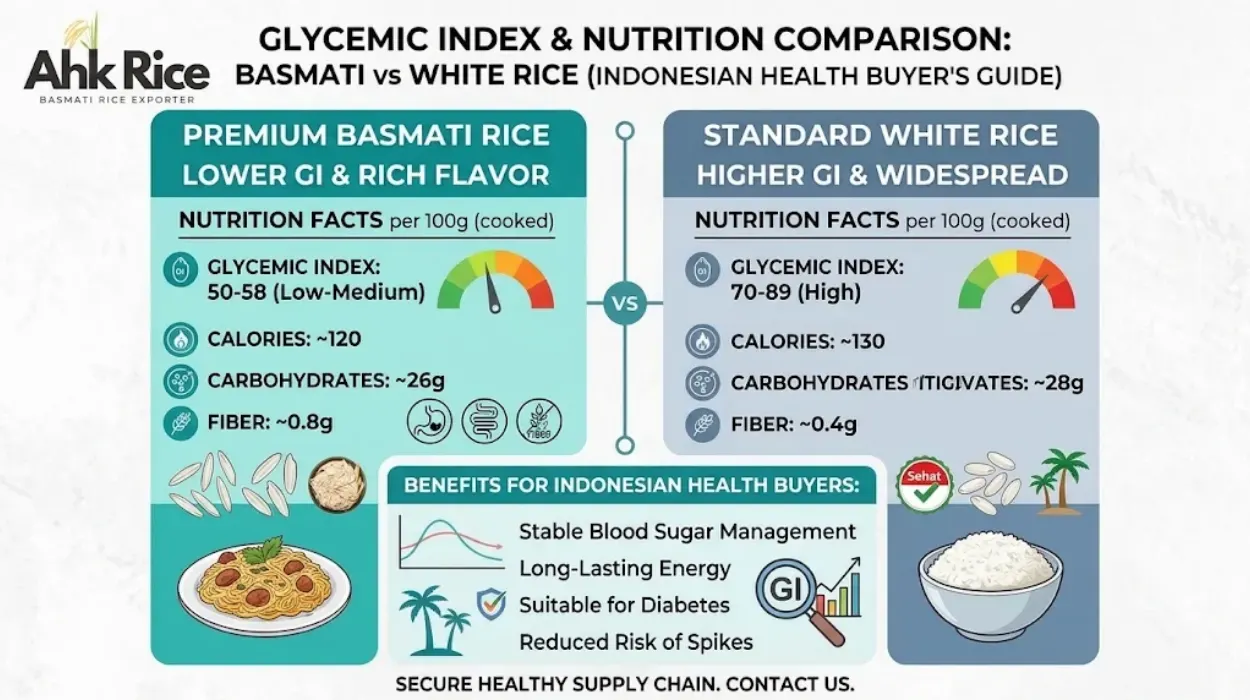
Basmati is relevant to health-oriented retail because cooked Basmati generally has a lower GI than many standard white rice varieties. GI measures how quickly a carbohydrate-containing food raises blood glucose relative to a reference food. It does not mean that Basmati is carbohydrate-free or automatically suitable for every diet.
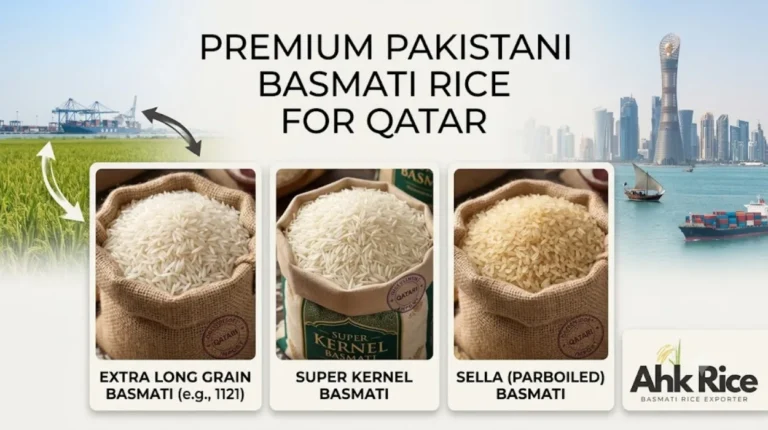
The third solution is specification-based Basmati sourcing. Buyers can select 1121, Super Kernel, or 1509 according to grain length, cooking behavior, market positioning, and price. These grades create different commercial options for Indonesian supermarkets, specialty stores, restaurants, caterers, and private-label brands.
How does Basmati compare with ordinary white rice?
Basmati generally provides a lower glycemic response than many ordinary white rice varieties, while ordinary white rice offers broader affordability and familiarity; actual GI depends on rice variety, processing, cooking, serving size, and meal composition.
| Specification | Pakistani Basmati | Ordinary White Rice |
|---|---|---|
| Grain structure | Long, slender aromatic grain | Usually shorter or medium grain |
| Glycemic impact | Generally lower GI than many standard white rice types | Often higher, depending on variety |
| Aroma | Distinctive natural aroma | Mild aroma |
| Cooked texture | Separate, elongated grains | Softer and more cohesive |
| Portion suitability | Works well for controlled portions | Easy to over-serve because of familiarity |
| Retail positioning | Premium, health-conscious, specialty | Mainstream and value-focused |
| Buyer priority | Nutrition positioning + quality + cooking performance | Price + availability + volume |
The GI difference is important but should not become the only purchasing criterion. Two rice products with different GI values can produce different dietary outcomes depending on serving size and the foods served alongside them.
A health-focused Indonesian retailer therefore needs to evaluate the complete product proposition. Grain quality, packaging, nutritional communication, cooking consistency, and consumer price all affect product performance.
Basmati also has a structural advantage for portion-based meals. Long, separate grains create a distinct eating experience, allowing retailers and foodservice operators to position smaller measured portions as a premium meal component.
What are the nutritional differences between Basmati and white rice?
Both Basmati and ordinary white rice primarily provide carbohydrate, but nutritional outcomes differ according to grain variety, milling, cooking, serving size, and meal composition; lower GI does not mean lower total carbohydrate or unlimited consumption.
A common mistake is to treat GI and carbohydrate content as the same measurement. They are not. Total carbohydrate describes how much carbohydrate a serving contains, while GI describes the relative speed at which available carbohydrate raises blood glucose.
This distinction matters for Indonesian health buyers. A rice product can have a moderate or lower GI while still contributing substantial carbohydrate to a meal. Portion size therefore remains a central nutritional factor.
Protein, fat, fiber, vitamins, and minerals also depend on the degree of milling and whether the rice is enriched or fortified. Standard polished white rice generally contains less naturally occurring fiber than less-milled rice because the bran and germ are removed.
Basmati does not automatically become a high-fiber food simply because it is aromatic or long-grain. Buyers should evaluate the actual product specification and nutrition panel rather than using the Basmati name as a nutritional guarantee.
Which Basmati grades work best for different Indonesian markets?
1121 suits premium retail and foodservice, Super Kernel fits aromatic premium and South Asian-oriented retail, while 1509 provides a practical balance of long grain, cooking performance, and commercial price positioning.
1121 Basmati is suitable for premium supermarket shelves, restaurants, caterers, and private-label programs where long grain appearance and premium positioning matter. Its long, slender appearance creates strong visual differentiation after cooking.
Super Kernel Basmati fits buyers seeking aromatic Pakistani Basmati with a premium grain profile. It works well for specialty grocery, ethnic retail, restaurant programs, and consumers who associate aroma and separate grains with premium rice.
1509 Basmati offers another commercial route. Its grain length, cooking performance, and relatively efficient crop profile make it relevant when buyers need premium characteristics while maintaining tighter cost control.
The correct grade therefore depends on the commercial objective. A premium Jakarta supermarket does not have the same purchasing logic as a large foodservice distributor supplying institutional kitchens.
How do Indonesian market regions differ in Basmati preferences?
Jakarta and major urban retail markets favor premium, differentiated Basmati for health-conscious and specialty consumers, while Java, Sumatra, and regional foodservice markets place greater emphasis on price, pack size, cooking consistency, and reliable bulk supply.
Region 1: Jakarta and major urban premium retail
Jakarta has a strong market for imported specialty foods, premium supermarkets, international cuisine, and health-oriented consumer products. Basmati can be positioned through premium packaging, controlled portions, cooking quality, and clear nutritional information.
Preferred grades: 1121 and Super Kernel
Indicative commercial positioning: premium imported rice, with pricing commonly above mainstream white rice
Shelf-life planning: generally around 18–24 months when correctly packed and stored according to specification
Best applications: premium retail, private label, restaurants, specialty grocery, health-focused food programs
Price must be quoted against the actual specification. Grade, crop year, moisture, broken percentage, packaging, order quantity, destination, and Incoterm all affect the final landed cost.
Region 2: Java, Sumatra and broader foodservice distribution
Large-volume buyers require consistency and cost control. Restaurants, caterers, wholesalers, and institutional kitchens often prioritize cooking yield, dependable supply, pack-size flexibility, and predictable pricing.
Preferred grades: 1509 for value-conscious premium applications, with 1121 and Super Kernel for higher-end programs
Indicative commercial positioning: competitive premium alternative to higher-priced specialty rice
Shelf-life planning: commonly around 18–24 months under appropriate storage conditions
Best applications: foodservice, wholesale distribution, catering, ethnic retail, and private-label programs
Shelf life is not determined by grade alone. Moisture, packaging material, warehouse temperature, humidity, pest control, and storage hygiene affect product stability.
What is the price difference between Basmati and ordinary white rice?
Basmati normally carries a premium over ordinary white rice because of variety, origin, processing, grain characteristics, and international logistics; Indonesian buyers should compare landed cost per metric ton rather than FOB price alone.
A practical purchasing comparison should separate the FOB Karachi price from the CIF Indonesian destination price. Freight, insurance, port charges, import requirements, duties, local handling, and distribution costs influence the final landed price.
For example, a buyer evaluating 1121 against conventional white rice should compare equivalent shipment quantities and packaging specifications. Comparing a 25 kg retail-ready Basmati pack with bulk commodity rice produces an incomplete cost calculation.
For AHK Rice, a previous benchmark for premium Super Kernel was around US$1,165–US$1,205 per MT FOB Karachi, depending on grade and specification. This is a benchmark rather than a live Indonesian quotation. Current pricing depends on crop, grain length, broken percentage, moisture, packaging, quantity, destination, and Incoterm.
The commercial question is therefore not simply “Which rice is cheaper?” It is “Which rice delivers the required nutrition positioning, consumer acceptance, cooking performance, and margin at the target landed cost?”
What are the pros and cons of Basmati and white rice?
Basmati offers lower-GI positioning, aroma, long-grain presentation, and premium differentiation, while white rice offers lower purchasing cost, broad consumer familiarity, and strong suitability for high-volume everyday foodservice.
Basmati advantages
Basmati provides strong differentiation. Its aroma, grain length, and cooked separation create a premium sensory profile.
It also supports lower-GI product positioning when the selected Basmati variety and preparation method provide a lower glycemic response than the comparison rice.
For retailers, Basmati supports higher-value packaging and specialty positioning. For restaurants, its appearance after cooking can support premium menu presentation.
Basmati limitations
The major limitation is price. Imported Basmati generally costs more than mainstream locally available rice.
Supply planning also requires more attention to import documentation, quality specifications, shipping schedules, and storage conditions.
White rice advantages
Ordinary white rice provides strong price competitiveness. Consumers already understand the product, and foodservice kitchens are familiar with its cooking characteristics.
It also works efficiently for high-volume meals where premium aroma and long-grain presentation are not primary purchasing criteria.
White rice limitations
Its lower price does not automatically make it the best choice for health-focused positioning. Many ordinary white rice varieties have a higher GI than Basmati, although the exact result depends on the variety and cooking method.
Which method works best for Indonesian health and retail buyers?
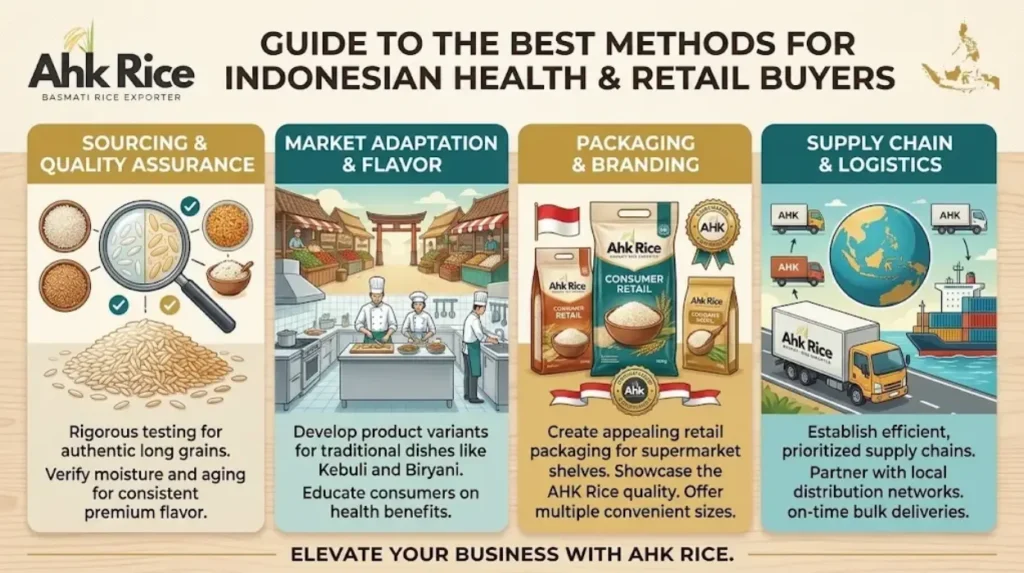
The best strategy is specification-based sourcing: select Basmati when GI positioning and premium quality matter, select 1509 when cost efficiency matters, and use 1121 or Super Kernel when premium grain appearance and aroma support stronger retail value.
A health-focused supermarket should prioritize consistent Basmati specifications, clear packaging information, controlled serving guidance, and reliable supply.
A restaurant should prioritize cooking performance. The buyer needs consistent grain length, low broken percentage, predictable moisture, and repeatable cooking results.
A wholesaler should prioritize landed cost and supply reliability. The lowest FOB price does not guarantee the lowest total procurement cost.
A private-label importer should evaluate both product quality and packaging requirements. The rice specification must align with the intended retail price, pack size, brand positioning, and consumer expectation.
What decision framework should Indonesian buyers use?
Indonesian buyers should evaluate GI positioning, grade, landed cost, shelf life, and end-use together instead of selecting rice on price or grain length alone.
| Decision factor | What to evaluate | Best-fit approach |
|---|---|---|
| Health positioning | GI, serving size, nutrition information | Basmati |
| Premium retail | Aroma, grain length, appearance | 1121 / Super Kernel |
| Cost control | Price per MT and cooking yield | 1509 |
| Foodservice | Cooking consistency and volume | 1509 / 1121 |
| Private label | Packaging, specification, supply reliability | Grade-specific Basmati |
This framework prevents a common procurement mistake: selecting a rice grade before defining the commercial application.
A health retailer needs a different specification from a restaurant distributor. A private-label supermarket needs a different specification from a bulk wholesaler.
What should buyers check before importing Pakistani Basmati rice into Indonesia?
Buyers should confirm rice grade, moisture, broken percentage, grain length, crop year, packaging, laboratory requirements, import documentation, shipment terms, and final destination before approving a commercial order.
Quality control should begin with the specification sheet. The buyer should define acceptable moisture, broken percentage, grain length, foreign matter, damaged grains, and other quality parameters before shipment.
A commercial sample should then be evaluated through cooking tests. Buyers can compare aroma, grain separation, elongation, texture, and taste against the target product.
For health-oriented positioning, the buyer should also verify the nutritional information and any permitted product claims through the applicable Indonesian regulatory process. GI claims should not be added to packaging simply because the product is Basmati.
The final commercial specification should be approved before loading. This creates a clear reference point for the exporter, importer, laboratory, packaging team, and receiving warehouse.
What is the practical solution for different Indonesian buyer types?
Premium retailers should prioritize 1121 or Super Kernel, cost-conscious foodservice buyers should evaluate 1509, and private-label importers should select the grade that balances nutrition positioning, landed cost, packaging, and repeatable cooking quality.
The comparison becomes straightforward when the buyer starts with the consumer and works backward to the rice specification.
For a premium health retailer, Basmati provides the strongest combination of differentiated grain quality and lower-GI positioning relative to many ordinary white rice products.
For institutional foodservice, 1509 can provide a more cost-conscious premium option while retaining long-grain cooking characteristics.
For specialty retail, Super Kernel provides aromatic identity and strong Pakistani Basmati positioning.
For premium restaurant programs, 1121 can provide long cooked grains and visual presentation that support higher-value dishes.
The objective is not to replace all white rice with Basmati. The objective is to match the rice specification to the consumer need, menu application, price architecture, and procurement model.
FAQs
Is Basmati rice lower GI than white rice?
Basmati generally has a lower glycemic index than many ordinary white rice varieties. The actual glycemic response depends on the specific rice variety, processing, cooking method, serving size, and meal composition.
Is Basmati rice healthier than ordinary white rice?
Basmati can be a stronger choice for buyers focused on glycemic impact and premium grain quality. It remains a carbohydrate-rich food, so portion size and overall meal composition remain important.
Which Pakistani Basmati is best for health-focused retail?
1121 and Super Kernel are strong choices for premium health-focused retail because of their long-grain characteristics, aroma, and premium positioning. 1509 provides a more cost-conscious alternative.
Does cooking change the glycemic response of rice?
Yes. Cooking method, cooking time, cooling, reheating, texture, and meal composition can influence the glycemic response of rice. Buyers should therefore avoid treating GI as a fixed property independent of preparation.
What is the shelf life of Pakistani Basmati rice?
A properly processed, packed, and stored Basmati product commonly carries a shelf-life specification around 18–24 months. The exact period depends on packaging, moisture, storage conditions, and the approved product specification.
Is Basmati suitable for Indonesian supermarkets?
Yes. Pakistani Basmati can serve premium supermarkets, specialty retailers, restaurants, private-label programs, and health-oriented food segments when the product specification and Indonesian import requirements are properly managed.