Pakistan Rice Export Decline: What Is Causing the Recent Slowdown?
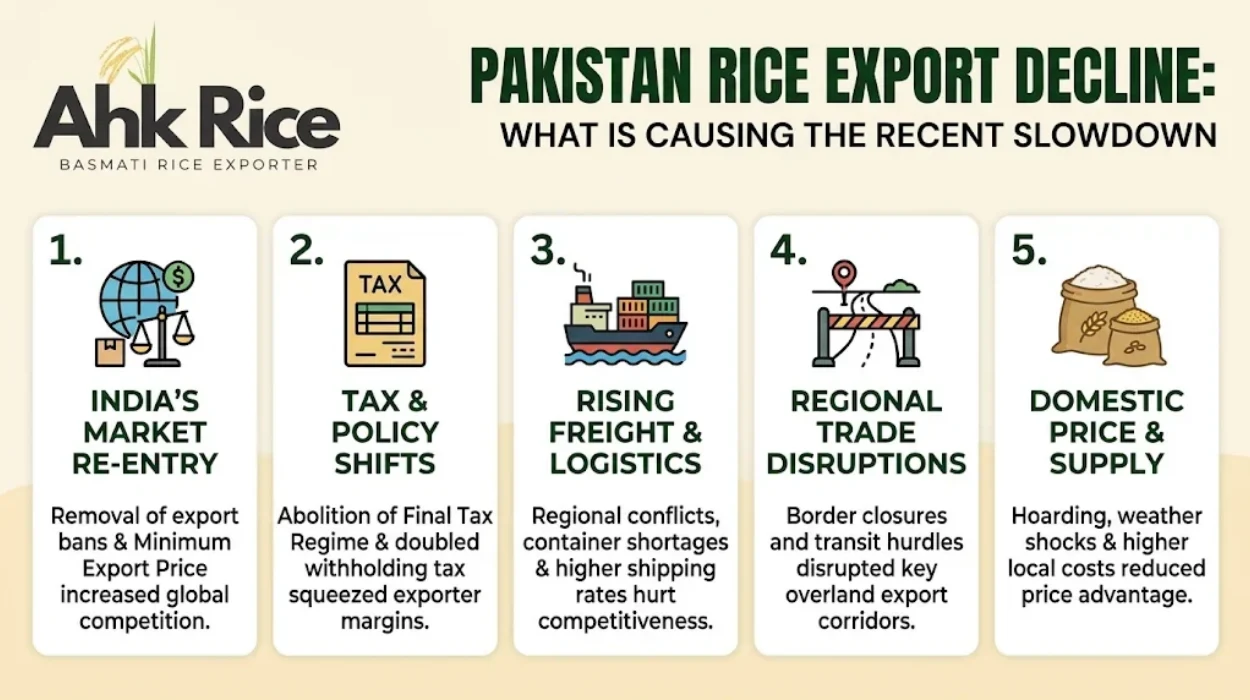
Pakistan’s rice export slowdown is driven by lower international prices, India’s return to global rice markets, weaker demand in several destinations, higher domestic production and logistics costs, and regional trade disruptions. Pakistan’s FY2025-26 rice exports fell sharply in both value and volume.
According to the Pakistan Economic Survey and Dawn, Pakistan exported approximately 4.29 million tonnes of rice worth US$2.29 billion in FY2025-26, compared with approximately 5.82 million tonnes worth US$3.35 billion in FY2024-25. This represents a decline of around 26% in export volume and 32% in export value.
Rice remains one of Pakistan’s major agricultural exports. The slowdown affects farmers, rice mills, exporters, logistics companies and international buyers. Understanding the causes requires examining global competition, domestic production costs, international demand and the structure of Pakistan’s rice export industry.
What is causing Pakistan’s rice export decline?
Pakistan’s rice export decline results from stronger Indian competition, lower global rice prices, weaker international demand, higher production and logistics costs, and disruptions across important trade routes. These factors have reduced Pakistan’s price competitiveness, particularly in non-Basmati rice markets.
India’s return to the global rice market
India is one of the most important external factors affecting Pakistan’s rice exports. India restricted several non-Basmati rice exports in July 2023 to protect domestic food supplies and control food inflation. It subsequently relaxed these restrictions and returned to international markets with greater export availability.
This increased the supply of rice available to international buyers. Indian exporters regained opportunities in price-sensitive markets across Africa, Asia and the Middle East.
According to the State Bank of Pakistan, India’s return to international markets contributed significantly to Pakistan’s export slowdown during FY2024-25.
Global rice supply increased
The slowdown also reflects changes in international rice production. Higher production across major exporting countries increased the quantity available for international trade.
USDA estimates placed global rice production at approximately 527.6 million tonnes on a milled basis for 2024/25. Increased availability strengthened competition among exporting countries.
When buyers have more suppliers, exporters face greater pressure to reduce prices and offer competitive payment and delivery terms.
How does India affect Pakistan’s rice export competitiveness?
India affects Pakistan’s rice competitiveness through larger export volumes, competitive prices, broader market coverage and strong access to major importing countries. Its increased global supply has reduced Pakistan’s pricing advantage, especially in non-Basmati rice markets.
India has a significant advantage in export capacity. According to PACRA sector analysis using USDA data, India’s rice exports reached approximately 23 million tonnes in MY2026, compared with approximately 4.3 million tonnes for Pakistan.
This difference gives Indian suppliers greater capacity to fulfil large international orders.
India also holds a substantial share of international rice trade. Its export scale allows suppliers to serve wholesalers, food distributors, government procurement agencies and large retail businesses.
International buyers compare several commercial factors before selecting an origin. These include FOB prices, freight costs, grain specifications, broken percentage, moisture, packaging and delivery schedules.
When Indian rice meets the required specifications at a lower landed cost, Pakistani exporters face additional pressure to retain their customers.
Which Pakistani rice varieties are most affected?
Non-Basmati rice has experienced stronger export pressure, while Basmati has demonstrated greater resilience because of its premium positioning, distinctive aroma, grain characteristics and established demand in markets that prioritize quality and origin.
Non-Basmati rice
Non-Basmati rice has faced substantial international price competition. This category serves bulk importers, wholesalers, food processors and institutional buyers.
According to Dawn’s reporting on Pakistan’s rice trade, non-Basmati export earnings declined during FY2024-25. The segment remained under pressure as Indian suppliers increased their international presence.
Buyers in this category frequently prioritize competitive pricing, consistent quality and reliable bulk deliveries.
Basmati rice
Basmati has performed differently from non-Basmati rice.
According to reported export figures, Pakistan exported approximately 794,638 tonnes of Basmati rice in FY2025-26, compared with approximately 808,069 tonnes in FY2024-25. Despite the slight volume decline, export receipts increased from approximately US$830.57 million to US$843 million.
This difference demonstrates the importance of product positioning.
Pakistani Basmati competes through aroma, grain length, cooking characteristics, purity and geographical origin. Important varieties include 1121, Super Kernel and 1509.
How do global prices affect Pakistan’s rice exports?
Lower global rice prices reduce Pakistan’s export earnings when international buyers demand cheaper quotations and exporters cannot maintain previous selling prices. Increased global supply and Indian competition have placed additional pressure on commodity rice prices and exporter margins.
Pakistan experienced favorable international market conditions during FY2024. These conditions supported higher export earnings and created a strong comparison base.
As global supply increased, international buyers gained more purchasing options.
This changed their negotiating position. Importers started comparing quotations from Pakistan, India, Thailand and Vietnam more closely.
A Pakistani exporter selling bulk non-Basmati rice must consider the competing supplier’s price, freight, quality and delivery conditions. Even a small difference in landed cost influences large-volume purchasing decisions.
What role do production and logistics costs play?
Higher production, energy, transportation and logistics costs reduce Pakistan’s export competitiveness because exporters need higher selling prices to maintain margins. International buyers compare landed costs across origins, making domestic cost increases difficult to transfer into export quotations.
Rice processing involves several cost-intensive operations. These include paddy procurement, drying, milling, grading, optical sorting, packaging, storage and inland transportation.
Energy expenses affect rice mills directly. Higher electricity and fuel costs increase the expense of operating machinery and maintaining processing facilities.
Transportation costs also influence export prices. Rice produced in Punjab must travel through domestic logistics networks before reaching export terminals.
International freight, port handling, container availability and shipping schedules add further expenses.
When these costs increase, Pakistani exporters face difficulties competing against suppliers with lower operating costs.
Which markets have experienced weaker Pakistani rice demand?
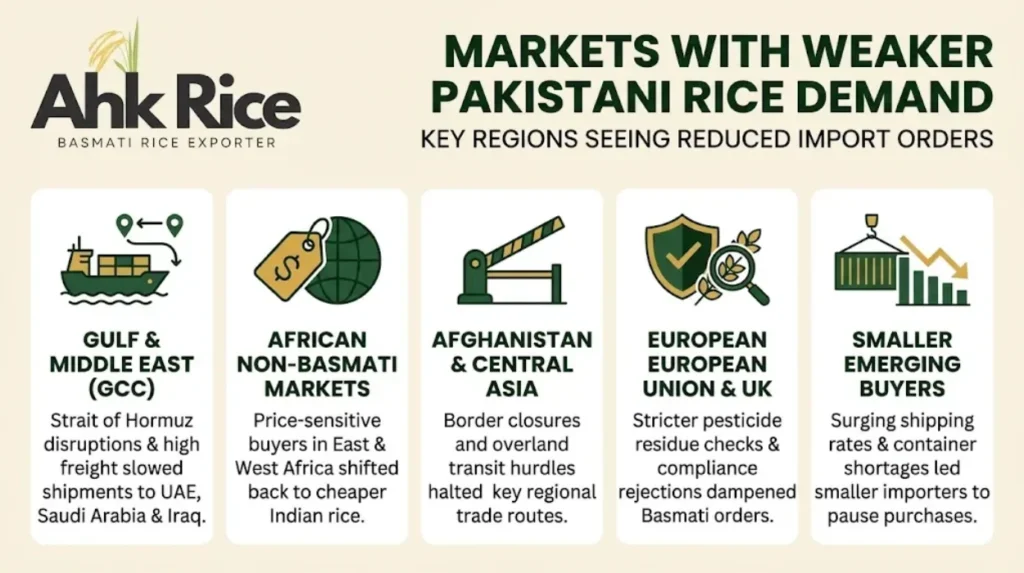
The slowdown extends across several international destinations, including African, ASEAN and selected European markets. Competition from India, lower international prices and changing procurement patterns have reduced Pakistani shipments in markets where buyers have alternative suppliers.
African markets
Africa remains an important destination for Pakistani rice. Importers purchase rice for wholesale distribution, retail packaging and food-service operations.
However, stronger competition from India and other Asian suppliers has affected Pakistan’s position in several African destinations.
ASEAN markets
ASEAN countries represent another important regional market.
According to reported FBR trade figures discussed by Express Tribune and other Pakistani business publications, Pakistan’s rice exports to ASEAN declined considerably during the first half of FY2025-26.
Lower demand and competitive international quotations contributed to this reduction.
European markets
European markets require exporters to meet specific food safety, quality and labeling requirements.
The United Kingdom provides an example of changing supplier shares. According to State Bank of Pakistan reporting, Pakistan’s share of UK rice imports declined from approximately 23% in 2024 to 11% in 2025, while India’s share increased from 30% to 36%.
These figures demonstrate how international competition changes market positions.
How do trade disruptions affect Pakistan rice exports?
Regional trade disruptions increase transportation costs and delay shipments, particularly when exporters depend on specific land routes, border crossings or maritime corridors. Border restrictions and Middle Eastern shipping disruptions have created additional challenges for Pakistan’s rice export supply chain.
Afghanistan is an important neighboring market and regional trade destination for Pakistan.
Border restrictions and changes in cross-border trade arrangements affect the movement of agricultural products. These disruptions influence delivery schedules and commercial relationships.
Maritime routes also affect export operations. The Pakistan Grain and Feed Update published by USDA in July 2026 discussed logistical challenges associated with the Strait of Hormuz and the development of alternative overland trade corridors.
Shipping disruptions increase uncertainty around freight rates, container availability and delivery timelines.
For international buyers, reliable delivery is an important purchasing requirement. Delayed shipments affect inventory management, retail distribution and contractual commitments.
What are the key components of Pakistan’s rice export supply chain?
Pakistan’s rice export supply chain consists of paddy production, procurement, drying, milling, grading, optical sorting, quality testing, packaging, documentation, container loading and international shipment. Every stage influences the final product specification and export value.
Paddy production
Punjab is Pakistan’s major rice-producing region. Important rice-growing areas include Gujranwala, Hafizabad, Sheikhupura, Narowal and Sialkot.
Farmers cultivate different rice varieties according to regional conditions, crop requirements and market demand.
Milling and processing
Harvested paddy passes through drying, husking, milling and polishing.
These operations remove the outer husk and separate edible rice grains from bran and other by-products.
Grading and sorting
Rice is graded according to grain length, broken percentage, moisture, foreign matter and other quality specifications.
Optical Sortex machines identify and remove unwanted grains and foreign material. Double Sortex processing provides an additional sorting stage when stricter purity requirements apply.
Quality verification
Commercial buyers evaluate moisture, broken percentage, grain length, purity and cooking characteristics.
A Certificate of Analysis records the tested specifications and provides quality documentation for the shipment.
Packaging and export preparation
Finished rice is packed according to buyer requirements. Common packaging formats include 5 kg, 10 kg, 25 kg and 50 kg bags.
Exporters prepare commercial invoices, packing lists, certificates and customs documentation before container loading.
What certifications and documents apply to Pakistani rice exports?
Pakistani rice exports commonly require commercial, origin, phytosanitary, customs and quality documentation, with additional certifications determined by the destination market and buyer. Requirements vary according to product type, packaging, importing-country regulations and private-label arrangements.
A Certificate of Origin identifies the country where the rice originates.
A phytosanitary certificate confirms compliance with applicable plant-health requirements.
A Certificate of Analysis records tested product specifications.
Other requirements include Halal certification, food safety certifications, laboratory reports, fumigation documentation and destination-specific import documents.
For branded retail products, labeling requirements are also important. Exporters must ensure that package information complies with the importing country’s food regulations.
What are the main misconceptions about Pakistan’s rice export slowdown?
The slowdown does not mean Pakistan has lost its rice export capability. Export statistics show a stronger decline in non-Basmati rice than Basmati, while Pakistan retains significant production capacity, established markets, processing infrastructure and opportunities in premium rice segments.
Misconception 1: All Pakistani rice exports are declining equally
Basmati and non-Basmati have different export performance patterns.
Basmati has demonstrated greater resilience, with export receipts increasing in FY2025-26 despite a modest reduction in shipment volume.
Misconception 2: India is the only cause
India’s return is a major competitive factor, but the slowdown also involves lower international prices, global supply increases, domestic costs, weaker demand and transportation disruptions.
Misconception 3: Lower exports mean lower production capacity
Export volume measures international shipments rather than total domestic production.
Pakistan can maintain substantial rice production while experiencing weaker export demand and lower international prices.
Misconception 4: Commodity rice and premium Basmati compete in the same way
Commodity rice is highly price-sensitive.
Premium Basmati competes through additional characteristics, including aroma, grain length, cooking performance, purity and geographical origin.
What is the outlook for Pakistan rice exports?
Pakistan’s export recovery depends on restoring price competitiveness, expanding differentiated Basmati sales, improving logistics, maintaining quality standards, diversifying destinations and reducing processing costs. These factors determine the industry’s ability to compete in international rice markets.
The Pakistani government introduced export incentives through the Drawback of Local Taxes and Levies scheme in January 2026. According to government reporting, the scheme provided a 9% rebate for Basmati rice and a 5% rebate for non-Basmati rice, with PKR 20 billion allocated to the initiative.
Pakistan also has opportunities to strengthen premium rice exports.
The international performance of Basmati demonstrates the importance of product differentiation. Varieties such as 1121, Super Kernel and 1509 compete through grain length, aroma, cooking performance, processing standards and packaging.
The future of Pakistan’s rice industry depends on matching the right variety and specification with the requirements of each importing market.
Frequently Asked Questions
Why are Pakistan rice exports declining?
Pakistan rice exports are declining because of stronger Indian competition, lower international prices, increased global supply, higher domestic production costs, weaker demand in several markets and regional logistics disruptions.
How much did Pakistan rice exports fall in FY2025-26?
Pakistan’s rice export earnings declined to approximately US$2.29 billion in FY2025-26, compared with US$3.35 billion in FY2024-25. Export volume declined to approximately 4.29 million tonnes.
Is Basmati affected more than non-Basmati rice?
No. Non-Basmati rice has experienced stronger export pressure. Pakistani Basmati has demonstrated greater resilience because of its premium positioning, aroma, grain characteristics and established international demand.
Why does Indian rice create pressure on Pakistan?
India exports rice in significantly larger quantities and holds a substantial share of global rice trade. Its competitive pricing gives international importers an alternative supplier, particularly for price-sensitive non-Basmati rice.
Which Pakistani rice varieties remain important for export?
Pakistan exports several important varieties, including 1121 Basmati, Super Kernel Basmati and 1509 Basmati. Non-Basmati varieties include IRRI-6 and IRRI-9.
Will Pakistan rice exports recover?
Recovery depends on international prices, competition, production costs, logistics, market access and the ability to expand premium rice sales. USDA’s July 2026 Pakistan Grain and Feed Update projected Pakistan’s rice exports at approximately 4.9 million tonnes for 2026/27.