What is the best solution for sourcing Basmati for Indonesia and other international markets?
The best solution is a Pakistani Basmati supplier that combines verified grain specifications, export-ready processing, sampling, packaging, documentation, and shipment coordination under one supply process. This reduces sourcing risk and creates consistent commercial shipments across different markets and buyer requirements.
Importers entering Indonesia or expanding distribution across Southeast Asia need more than a competitive rice price. They need a supplier that can match the required variety, grade, packing format, quality specifications, documentation, and shipment schedule before the order is confirmed.
A practical starting point is understanding which countries import the most Pakistani Basmati rice, because market selection affects product positioning, packaging, volume planning, and commercial terms. Indonesia is increasingly relevant for specialty rice distribution, while other international markets require different specifications and buyer expectations.
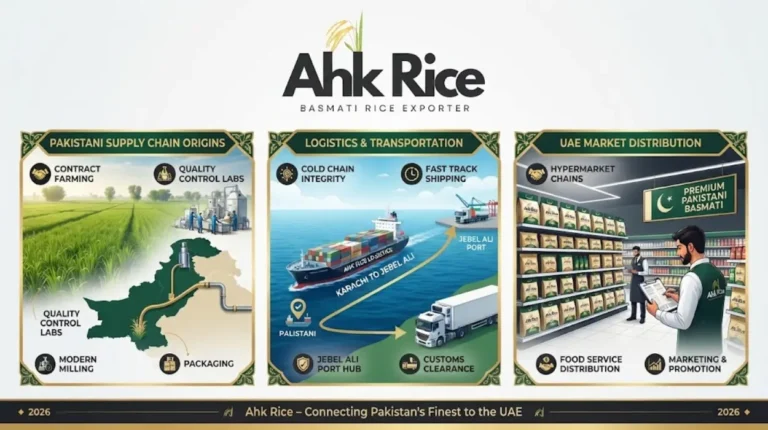
AHK Rice supplies Pakistani Basmati rice from Punjab and manages the process from sourcing and grading through export preparation. Its portfolio includes 1121, Super Kernel, and 1509 Basmati rice, giving importers multiple options for retail, wholesale, foodservice, and private-label programs.
The objective is straightforward: approve the product before shipment, agree the commercial specification, prepare the required packaging and documents, and move the cargo according to the agreed export terms.
Why choose AHK Rice as your Basmati rice supply partner?
AHK Rice is suitable for international buyers that need consistent Pakistani Basmati, controlled processing, custom packaging, commercial sampling, and coordinated export documentation rather than buying through disconnected suppliers and managing each stage separately.
AHK Rice works around a trade-oriented supply model. The buyer first identifies the required variety, grain specification, packing format, destination, quantity, and Incoterm. The supplier then prepares the commercial specification and sample process around those requirements.
This approach is especially useful when a buyer wants to establish a repeat supply program instead of making a single spot purchase.
The available Basmati portfolio supports different commercial positions. 1121 Basmati fits buyers prioritising premium grain length and aroma. 1509 Basmati provides a commercially efficient option for buyers balancing grain performance, volume, and price. Super Kernel Basmati targets buyers seeking Pakistani Basmati character with a strong premium positioning.
Processing also matters. Rice passes through cleaning, grading, sorting, and quality-control stages before container loading. Sortex processing helps separate unwanted grains and foreign material and supports a more consistent finished product.
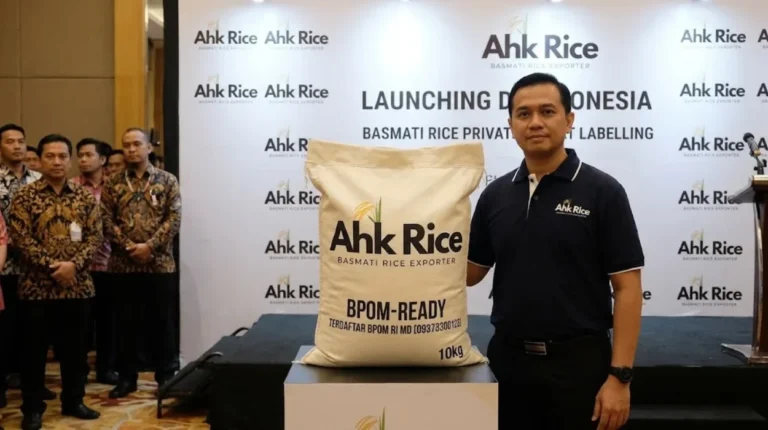
For buyers operating a retail or private-label business, AHK Rice can also coordinate packaging requirements. Pack sizes, artwork, labelling requirements, and packaging specifications can be agreed before production and shipment.
The same supply framework can serve different destinations, but destination-specific compliance remains important. Indonesia, the UAE, Saudi Arabia, Malaysia, the USA, and other markets can have different import, labelling, quarantine, and documentation requirements.
What results can importers expect from this supply model?
Importers can expect a clearer buying process, pre-shipment product approval, controlled specifications, export-ready documentation, customised packing options, and shipment planning that supports repeat Basmati supply instead of one-off purchasing.
The first measurable result is specification control. Buyers do not have to evaluate rice only after the container arrives. Commercial samples and agreed specifications establish the product parameters before the shipment is released.
The second result is operational consistency. A buyer can define the variety, grain length, moisture target, broken percentage, packing format, quantity, and destination before the order moves into export preparation.
The third result is better market alignment. A foodservice distributor may select a different Basmati grade from a supermarket private-label buyer. A wholesaler purchasing large quantities may prioritise price stability and loading efficiency, while a premium retailer may place greater emphasis on grain appearance, aroma, packaging, and cooking performance.
AHK Rice can structure the supply around these commercial differences rather than treating every buyer as requiring the same rice specification.
How long does shipping take to different markets?
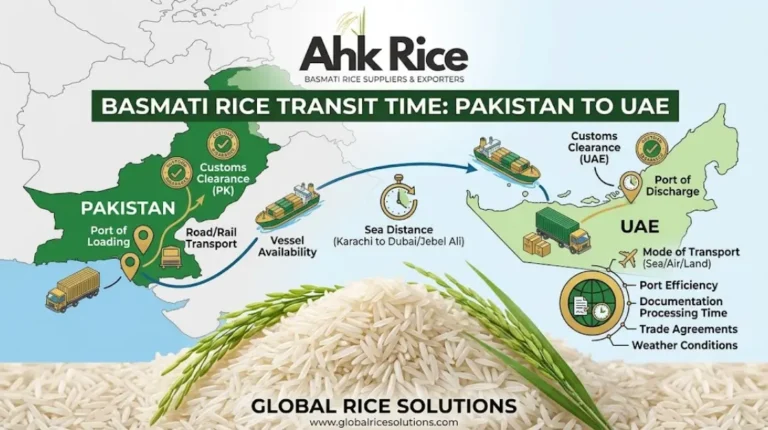
Shipping time depends on the destination port, vessel schedule, transshipment requirements, customs clearance, and Incoterm, so buyers should treat transit estimates as planning ranges rather than guaranteed delivery dates.
For planning purposes, Pakistani rice shipments commonly move by sea from Karachi to major international ports. Approximate port-to-port planning ranges can be:
| Market | Approximate sea transit planning |
|---|---|
| UAE | 5–10 days |
| Saudi Arabia | 10–18 days |
| Indonesia | 18–30 days |
| Malaysia | 12–20 days |
| USA East Coast | 30–45 days |
| USA West Coast | 25–40 days |
| Iraq | 10–20 days |
| Morocco | 20–30 days |
These are commercial planning ranges, not guaranteed arrival dates. Actual schedules change according to vessel availability, port congestion, routing, transshipment, customs procedures, and seasonal conditions.
For Indonesia, buyers should separately account for import clearance and local delivery after the vessel reaches the destination port. A shipment to Jakarta is therefore planned differently from one moving to Surabaya or another Indonesian distribution point.
How does the Basmati sample process work and what does it cost?
The sample process normally begins with buyer specifications, followed by product selection, sample preparation, courier dispatch, testing, commercial approval, and final specification confirmation before bulk production and container loading.
A buyer should provide the required variety, grade, quantity, destination, packing preference, and intended application. This allows AHK Rice to identify a suitable commercial product instead of sending an unspecified sample.
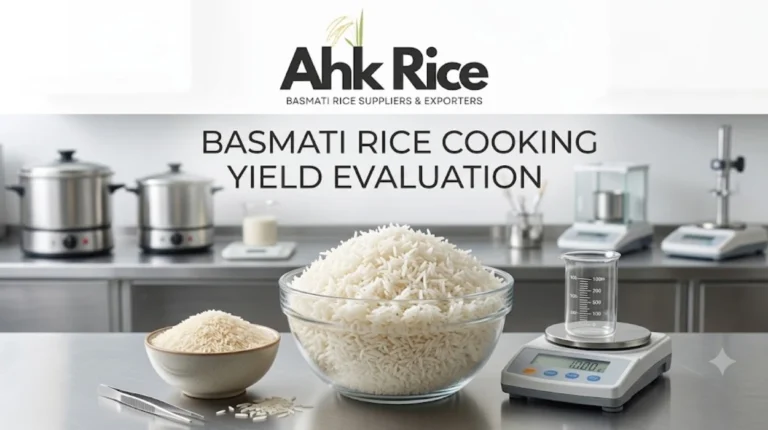
For example, an Indonesian importer sourcing Super Kernel for premium retail can request a defined grain specification and packing format. The sample can then be evaluated for appearance, aroma, cooking performance, grain separation, and overall suitability.
The process can be structured as follows:
- Buyer requirement: Confirm variety, grade, quantity, destination, packaging, and required documents.
- Product selection: AHK Rice matches the requirement with 1121, Super Kernel, 1509, or another suitable specification.
- Sample preparation: Commercial sample is prepared according to the agreed specification.
- Courier dispatch: Sample is sent to the buyer’s nominated address.
- Buyer testing: The importer evaluates cooking performance, appearance, aroma, grain quality, and compliance requirements.
- Commercial approval: Buyer confirms the sample and required specification.
- Bulk order: Quantity, packing, price, Incoterm, and shipment schedule are confirmed.
- Pre-shipment control: Final quality parameters and documentation are checked before loading.
For eligible sampling requirements, AHK Rice has offered up to 20 kg of Super Kernel Basmati for sampling, while the buyer covers courier shipping and applicable phytosanitary charges. Actual sample costs depend on the product, destination, quantity, courier, and required documentation.
This structure gives the buyer a practical decision point before committing to a full container.
What factors determine the price of Pakistani Basmati rice?
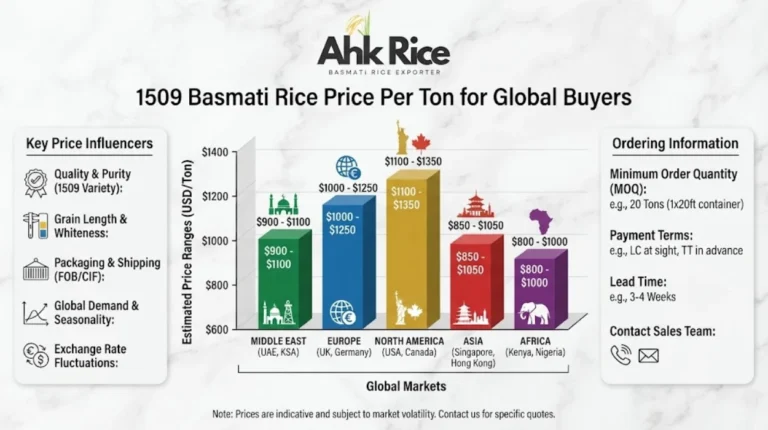
Basmati pricing depends on variety, grain length, broken percentage, moisture, crop year, processing, packing, order quantity, destination, freight conditions, and Incoterm, so a single universal price is not commercially meaningful.
A buyer comparing suppliers should request the same specification from each supplier. Comparing one supplier’s premium 1121 against another supplier’s standard 1509 creates a misleading price difference.
Important pricing factors include:
- Basmati variety and grade
- Grain length and appearance
- Broken percentage
- Moisture specification
- Crop year and aged/new crop status
- Steam, Sella, Golden Sella, or raw rice processing
- Sortex requirements
- Packaging material and printed artwork
- Bag size and quantity
- Order volume
- Container configuration
- Port of destination
- FOB, CFR, or CIF terms
- Inspection and documentation requirements
For commercial buyers, the correct question is therefore not simply “What is the rice price per MT?” It is “What is the landed or shipment cost for my exact specification and destination?”
That distinction becomes particularly important for Indonesia because freight, port selection, import requirements, local clearance, and inland distribution influence the buyer’s actual landed cost.
How do I decide between 1121, Super Kernel and 1509?
Choose 1121 when premium length and aroma are the priority, Super Kernel when Pakistani Basmati character and premium positioning matter, and 1509 when the buyer needs efficient bulk supply with strong cooking performance and commercial price control.
| Buyer priority | Suitable direction |
|---|---|
| Premium length and aroma | 1121 |
| Premium Pakistani Basmati positioning | Super Kernel |
| Bulk commercial supply | 1509 |
| Private-label retail | 1121 or Super Kernel |
| Foodservice and catering | 1509 or 1121 |
| Price-sensitive distribution | 1509 |
The final selection should be based on the buyer’s approved sample rather than the variety name alone.
For a deeper Southeast Asian market comparison, buyers can also review why Southeast Asia is an emerging market for Pakistani Basmati exporters. This provides useful context for evaluating regional demand before selecting a supply strategy.
How can an importer get started with AHK Rice?
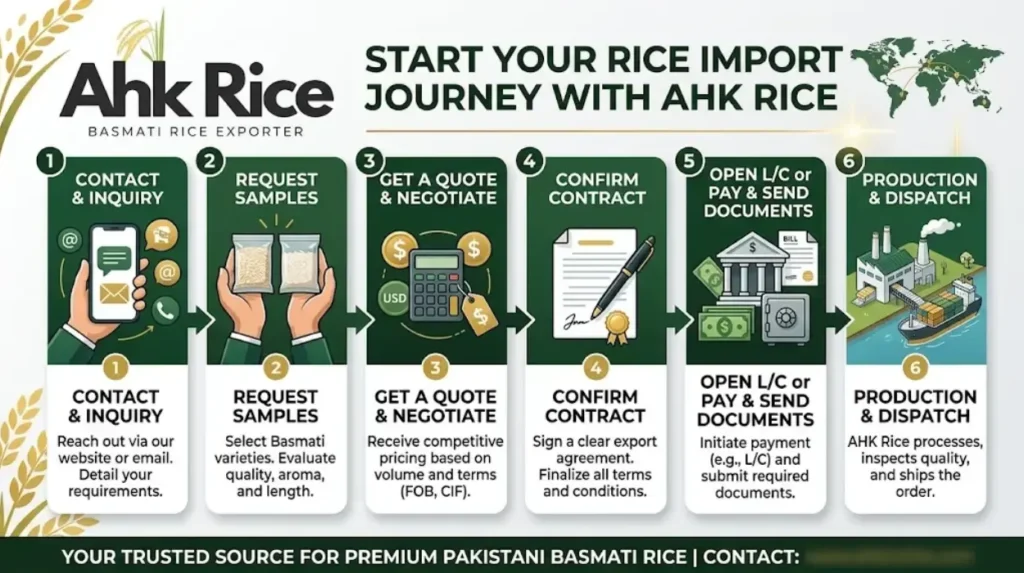
Start by sending the destination, required Basmati variety, specification, quantity, packing format, and preferred Incoterm; AHK Rice can then structure the sample, quotation, documentation, and shipment process around the buyer’s commercial requirements.
The process should begin with a clear purchase brief. Include the destination port, expected monthly or quarterly quantity, required variety, preferred pack size, private-label requirements, and whether the quotation should be FOB or delivered.
AHK Rice can then prepare the relevant commercial specification and sampling route. Once the buyer approves the sample, the order can progress toward final quotation, packaging, documentation, production, inspection, and container loading.
This is also where buyers should confirm whether they require a Certificate of Origin, phytosanitary documentation, laboratory testing, halal documentation, product-specific certificates, or destination-specific labelling.
The strongest buying decision comes from comparing complete specifications rather than headline prices. A lower quoted MT price is not necessarily cheaper if the grain specification, packaging, documentation, or delivered logistics differ.
For repeat buyers, the next step is establishing a supply schedule. Instead of negotiating every shipment from zero, the buyer can define an approved product specification and repeat order structure.
What should buyers check before placing a Basmati rice order?
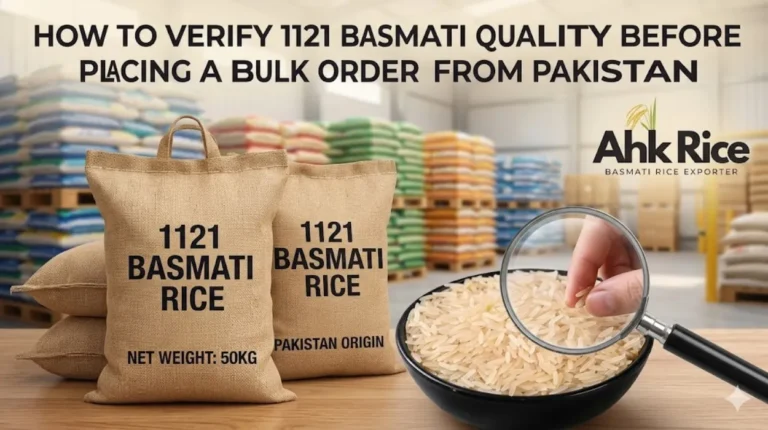
Before placing an order, buyers should verify the product specification, sample approval, supplier capability, packing requirements, export documentation, Incoterm, shipment schedule, and final commercial terms so the bulk shipment matches the approved purchase decision.
Confirm the exact variety and grade.
Confirm the grain specifications and quality tolerances.
Approve the commercial sample before bulk loading.
Confirm the packaging format and artwork.
Confirm the export documents required by the destination.
Confirm whether the quotation is FOB, CFR, or CIF.
Confirm the expected shipment window and destination port.
Confirm payment terms and the final commercial contract.
This checklist prevents the most common sourcing problem: agreeing on a product category while leaving the actual commercial specification unclear.
AHK Rice provides a direct supply route for buyers that want Pakistani Basmati sourced, processed, packed, and prepared for international shipment through one coordinated export process.
FAQs
Is AHK Rice a Pakistani Basmati rice exporter?
Yes. AHK Rice is a Pakistani Basmati rice exporter based in Punjab.
It supplies varieties including 1121, Super Kernel, and 1509.
The supply process covers sourcing, processing, grading, packaging, and export preparation.
Buyers can request samples before confirming bulk orders.
The company serves buyers across 15+ international markets.
Does AHK Rice supply Basmati rice to Indonesia?
Yes. AHK Rice can structure Pakistani Basmati supply for Indonesian buyers.
The buyer can specify variety, grade, quantity, packing, and destination port.
Indonesia-specific import and labelling requirements should be confirmed before shipment.
Samples can be evaluated before a commercial order is finalised.
Shipping time depends on the selected vessel route and destination port.
How much does a Basmati rice sample cost?
Sample costs depend on the product, quantity, destination, and courier service.
AHK Rice has offered up to 20 kg of Super Kernel for sampling.
The buyer covers courier shipping and applicable phytosanitary charges.
The buyer can test the sample before approving bulk supply.
Final sampling arrangements should be confirmed with the export team.
What information is needed for a quotation?
Buyers should provide the Basmati variety and required quality specification.
They should also state the required quantity and packaging format.
The destination port and preferred Incoterm are important for freight calculations.
Private-label buyers should provide packaging and labelling requirements.
These details allow AHK Rice to prepare a commercially relevant quotation.
How can I request a Basmati rice quotation from AHK Rice?
Start by sharing your product and destination requirements.
AHK Rice can then arrange product selection and sampling.
After sample approval, the commercial specification and order terms are confirmed.
The shipment is prepared with the agreed packaging and export documents.
Buyers can request a quotation from AHK Rice to begin the process.
Do you like this personality?