How are India’s rice policy changes affecting global rice markets?
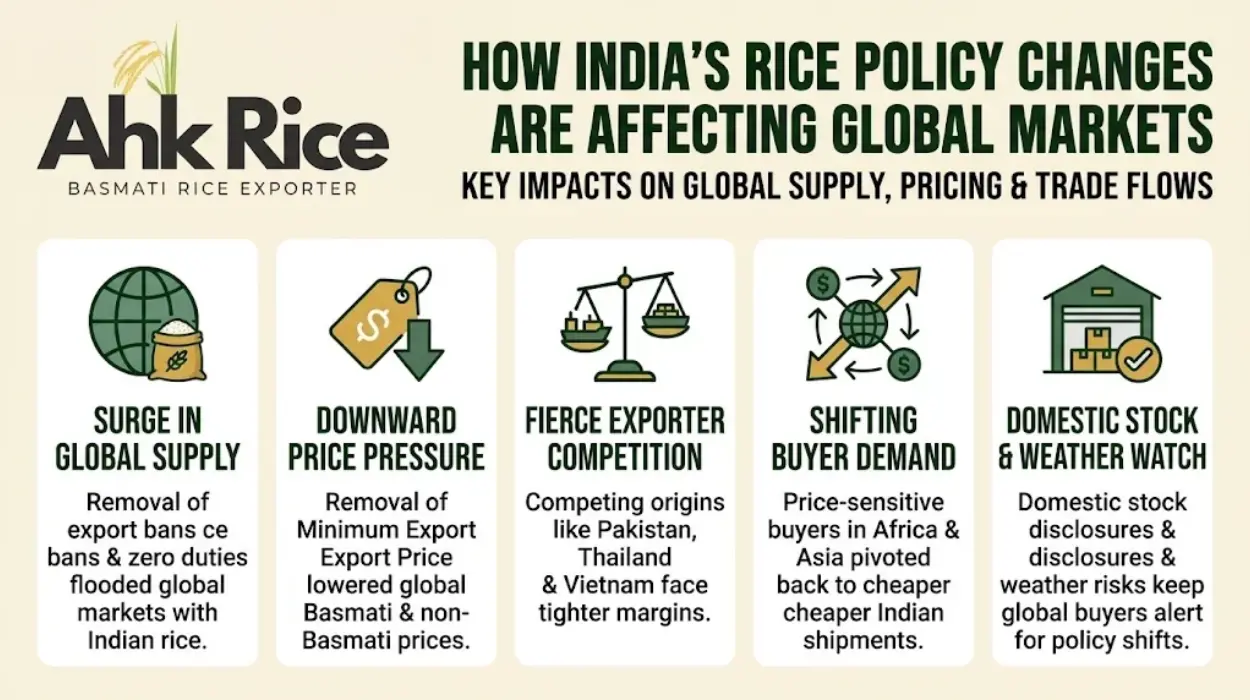
India’s rice policy changes influence global supply, export prices, buyer sourcing decisions and competitor demand. Export restrictions reduce available supplies, while policy relaxations restore competition and reshape purchasing opportunities for Pakistan, Thailand, Vietnam and other exporting countries.
India is one of the world’s largest rice exporters. Its decisions about export duties, minimum export prices, export bans and permitted rice categories directly influence international trade. Importers monitor these decisions because changes in Indian availability affect procurement costs, shipping arrangements and supplier selection.
For international buyers, understanding these developments requires more than following export announcements. Buyers must compare alternative origins, grain specifications, quality consistency and delivered prices. The educational guide to Pakistani Basmati rice varieties, origins and export characteristics provides useful background for evaluating Pakistan as an alternative sourcing origin.
India’s policy decisions also affect the competitive position of Pakistani exporters. When Indian supplies face restrictions, importers explore alternative suppliers. When restrictions ease, Indian exporters regain market access and increase competitive pressure.
What policy changes has India introduced in its rice export trade?
India has progressively relaxed the major rice export restrictions introduced during 2022 and 2023. However, export inspection requirements and domestic supply concerns continue to influence trade conditions, making policy monitoring essential for international rice buyers and competing exporters.
India introduced several restrictions to protect domestic food availability and control inflation. These measures included export prohibitions, minimum export prices (MEPs) and export duties.
The major policy developments include:
| Date | Policy change | International trade impact |
|---|---|---|
| July 2023 | Ban on non-Basmati white rice exports | Reduced internationally available supplies |
| October 2023 | Minimum export price for Basmati | Restricted lower-priced export offers |
| September 2024 | Removal of Basmati minimum export price | Increased price flexibility |
| September 2024 | Non-Basmati white rice exports resumed with an MEP | Restored part of India’s export supply |
| October 2024 | Removal of remaining rice export duties and MEP on non-Basmati white rice | Improved export competitiveness |
| March 2025 | Broken rice export prohibition lifted | Expanded exportable product categories |
| November 2026 | Revised European rice export inspection conditions | Changed certification requirements for European destinations |
The OECD documented the progressive relaxation of India’s restrictions through 2024 and March 2025. The November 2026 regulatory position also requires attention.
On 9 November 2026, India’s Directorate General of Foreign Trade issued Notification No. 47/2026-27. It clarified Certificate of Inspection requirements for Basmati and non-Basmati rice exports to European destinations. The requirement applies to EU member states, the UK, Iceland, Liechtenstein, Norway and Switzerland, while other European countries receive a temporary exemption until 1 April 2027. DGFT notification+1
Another development emerged in November 2026. Indian rice exporters reported concerns about possible restrictions on 100% broken white rice because of increasing domestic demand from ethanol producers and poultry-feed manufacturers. However, no new restriction had been announced as of 15 November 2026. S&P Global+1
These developments demonstrate that India’s rice trade policy remains connected to domestic food security, industrial demand and export competitiveness.
How do India’s export restrictions influence international rice prices?
Indian export restrictions influence international rice prices by changing the quantity available for international trade. Restrictions tighten supply and increase buyer competition, while policy relaxation restores export availability and places downward pressure on competing suppliers’ prices.
India’s export position matters because the country accounts for approximately 40% of global rice trade. Changes in its export availability affect procurement decisions across Africa, the Middle East and Southeast Asia.
When India restricted non-Basmati white rice exports in 2023, international buyers faced fewer sourcing options. Importers increased their attention towards Pakistan, Thailand and Vietnam. This created additional purchasing opportunities for competing exporters.
When India relaxed restrictions in 2024, more Indian rice entered international markets. Buyers regained access to competitively priced white and parboiled rice. Competing suppliers consequently faced stronger price competition.
USDA’s November 2026 market figures illustrate the current competitive position.
| Exporting country | Indicative FOB price per MT |
|---|---|
| India | $389 |
| Pakistan | $411 |
| Vietnam | $439 |
| Thailand | $497 |
| Uruguay | $610 |
| United States | $680 |
Indicative November 2026 quotations for 5% broken white rice, except US 4% broken. Figures are not equivalent to Basmati quotations.
India’s $389/MT quotation compared with Pakistan’s $411/MT demonstrates a $22/MT price difference. This difference influences bulk buyers evaluating standard white rice. It does not establish that Indian rice is cheaper in every grade or destination. USDA Apps+1
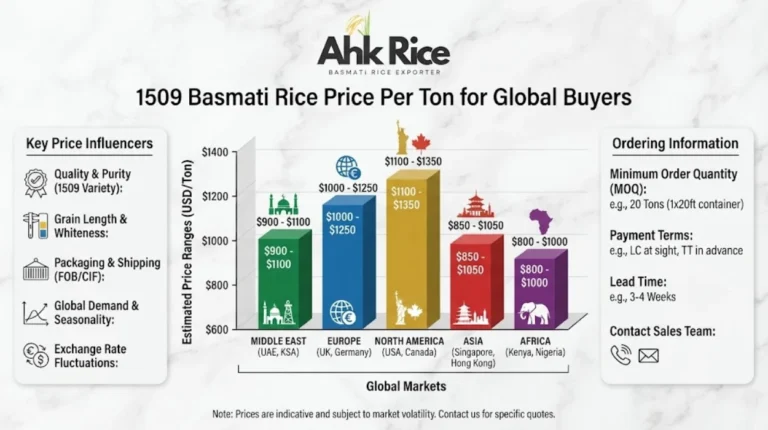
Basmati operates in a separate premium segment. November 2026 market quotations place Pakistani Basmati 2% broken around $1,115/MT and Indian Basmati 2% broken around $1,170/MT. These indicative quotations reflect different product specifications and market conditions. thairiceexporters.
For importers, the distinction between commodity rice and aromatic Basmati is essential. A low-priced non-Basmati offer cannot replace a premium Basmati specification without changing the product’s intended use.
What are the available solutions for international rice buyers?
International rice buyers can manage Indian export policy uncertainty through diversified sourcing, alternative rice varieties, forward procurement agreements and specification-based supplier selection. Each approach addresses different purchasing risks, including price volatility, supply interruptions, quality consistency and delivery requirements.
Four main sourcing approaches provide practical solutions.
1. Diversify sourcing between exporting countries
Importers can purchase rice from multiple origins instead of depending entirely on India.
Pakistan supplies Basmati and non-Basmati rice. Thailand and Vietnam provide additional alternatives for standard white rice and specialty varieties.
Diversification reduces dependence on one country’s export policy. It also gives procurement teams greater flexibility when international prices change.
However, buyers must compare specifications because different origins do not automatically provide equivalent grain quality.
2. Select alternative rice varieties
Changing the rice variety provides another solution.
Pakistan offers three commercially important Basmati categories:
- 1121 Basmati: Premium extra-long grain, aroma and cooked elongation.
- Super Kernel Basmati: Aromatic Pakistani Basmati suitable for premium retail and foodservice.
- 1509 Basmati: Long-grain variety suited to value-conscious premium buyers and bulk distribution.
Buyers should select varieties according to cooking performance, customer preferences, broken percentage and target selling price.
3. Use forward procurement agreements
Forward procurement means agreeing on commercial terms before the required delivery period.
Importers can negotiate specifications, shipment schedules, quantities and pricing mechanisms with exporters. This approach improves purchasing visibility and reduces exposure to sudden changes in spot-market availability.
However, contracts must define the shipment period, inspection standards and responsibilities for delays.
4. Establish alternative supplier relationships
Maintaining approved suppliers in Pakistan, Thailand and Vietnam creates purchasing flexibility.
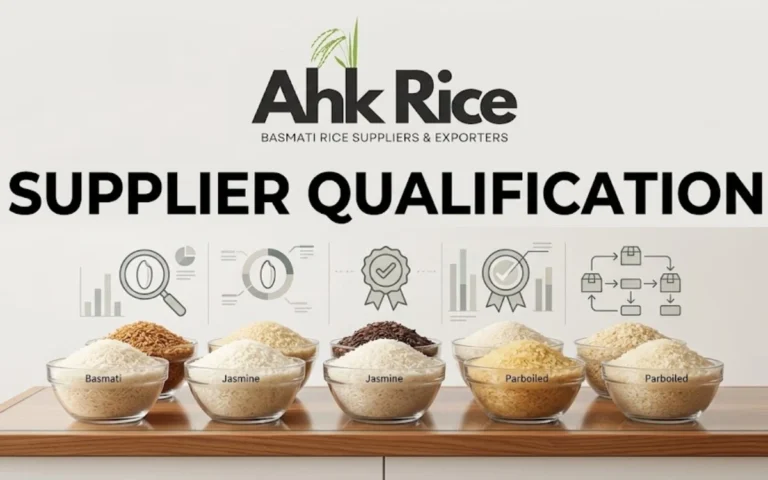
Buyers can evaluate suppliers through pre-shipment samples, laboratory reports, processing audits and commercial documentation.
AHK Rice, a Pakistani Basmati exporter based in Punjab, represents one sourcing option for importers evaluating 1121, Super Kernel and 1509 varieties. Its end-to-end processing and custom packaging capabilities address several procurement requirements.
How do different rice sourcing approaches compare?
Country diversification provides the strongest protection against origin-specific restrictions, while variety substitution addresses product requirements and forward contracts improve procurement stability. Supplier qualification strengthens quality control across all approaches and reduces operational purchasing risks.
The following comparison evaluates seven important procurement attributes.
| Comparison attribute | Single-origin sourcing | Multi-origin sourcing |
|---|---|---|
| Supply availability | Depends on one exporting country | Access to multiple supply sources |
| Policy exposure | Higher country-specific exposure | Distributed across origins |
| Price negotiation | Limited alternatives | Greater competitive comparison |
| Quality consistency | Easier to standardise one origin | Requires separate origin specifications |
| Shipment flexibility | Depends on one supplier network | More routing and supplier options |
| Product selection | Limited to selected origin varieties | Broader variety availability |
| Procurement complexity | Lower administrative workload | Higher supplier coordination requirements |
Single-origin sourcing works for importers with established supplier relationships and predictable demand. It simplifies specifications, documentation and quality management.
Multi-origin sourcing works better for large distributors and importers operating across several markets. It creates alternative purchasing channels when one country experiences export restrictions or logistical difficulties.
The trade-off is administrative complexity. Buyers must maintain separate quality specifications, contracts, inspection procedures and shipping arrangements for each origin.
A diversified procurement strategy therefore requires a central quality-control framework.
Which sourcing method works best for different international markets?

The best sourcing method depends on regional consumption patterns, rice varieties, purchasing budgets and import requirements. African commodity distributors generally prioritise competitive non-Basmati supplies, while Middle Eastern importers place greater importance on aromatic Basmati grades and consistent cooking performance.
1. West African markets
West African importers purchase substantial quantities of long-grain white and parboiled rice. Nigeria, Senegal, Ghana and other regional markets contain established demand for affordable rice products.
India’s competitive export prices influence procurement decisions in this region. When Indian supplies increase, buyers compare Indian, Pakistani, Thai and Vietnamese quotations.
For standard 5% broken white rice, November 2026 indicative quotations place India around $390–395/MT and Pakistan around $411–415/MT. These are FOB benchmarks, not landed prices. Business Recorder+1
Preferred grades and purchasing considerations:
- Standard white rice for supermarkets and wholesale distribution.
- Parboiled rice for markets with established parboiled consumption.
- Consistent broken percentage and moisture specifications.
- Competitive 5% and 25% broken grades.
- Reliable container availability and shipment documentation.
For these markets, multi-origin sourcing and competitive non-Basmati procurement offer practical advantages.
2. Middle Eastern markets
Middle Eastern markets have established demand for aromatic Basmati rice, particularly in Saudi Arabia, the UAE, Qatar and other Gulf destinations.
Pakistan and India remain important Basmati suppliers. Buyers compare grain length, aroma, ageing, broken percentage and cooking performance.
November 2026 indicative FOB quotations for premium Basmati 2% broken were approximately $1,115/MT for Pakistan and $1,170/MT for India. These figures are market benchmarks rather than guaranteed commercial offers. thairiceexporters.or.th+1
Preferred grades and purchasing considerations:
- 1121 Steam and 1121 Golden Sella for premium distribution.
- Super Kernel for aromatic retail and foodservice applications.
- 1509 for buyers balancing grain performance and procurement costs.
- Custom retail and wholesale packaging.
- Verified moisture, broken percentage and grain specifications.
For Gulf buyers, Pakistan offers an established alternative origin for premium Basmati procurement.
Shelf-life comparison across both regions
Shelf life depends on rice processing, moisture, packaging, storage conditions and whether the grain is aged.
| Product category | Typical commercial storage planning |
|---|---|
| Standard white rice | Approximately 12–24 months |
| Parboiled rice | Approximately 12–24 months |
| Properly packaged Basmati | Approximately 12–24 months |
| Aged Basmati | Depends on age before packing and storage conditions |
These are general planning ranges, not guaranteed expiry periods. Importers must follow validated product shelf-life studies and destination-country labelling requirements.
Properly sealed packaging, low moisture, pest control and cool, dry warehouses help preserve rice quality.
What are the advantages and disadvantages of sourcing Pakistani rice?
Pakistani rice provides international buyers with an alternative to Indian supplies, particularly in premium Basmati categories. Its advantages include aromatic varieties, competitive export quotations and product diversity, while procurement challenges include price competition, logistics and consistent specification management.
Advantages of Pakistani rice
1. Alternative export origin
Pakistan reduces importers’ dependence on Indian rice availability. Buyers can maintain alternative sourcing relationships when Indian export conditions change.
2. Established Basmati production
Punjab produces important Basmati varieties, including 1121, Super Kernel and 1509. These varieties serve different retail, wholesale and foodservice requirements.
3. Premium product positioning
Pakistani Basmati competes in markets where aroma, grain length and cooking characteristics influence purchasing decisions.
4. Flexible packaging
Exporters offer different packaging formats, including 5 kg, 10 kg, 25 kg and 50 kg bags, depending on commercial requirements and destination regulations.
5. Product diversification
Importers can source different Basmati grades through one export relationship, simplifying supplier management when processing and quality-control arrangements support those products.
Disadvantages and purchasing challenges
1. Indian price competition
India’s large exportable supply creates strong competition in standard white rice and some Basmati categories.
2. Freight and insurance costs
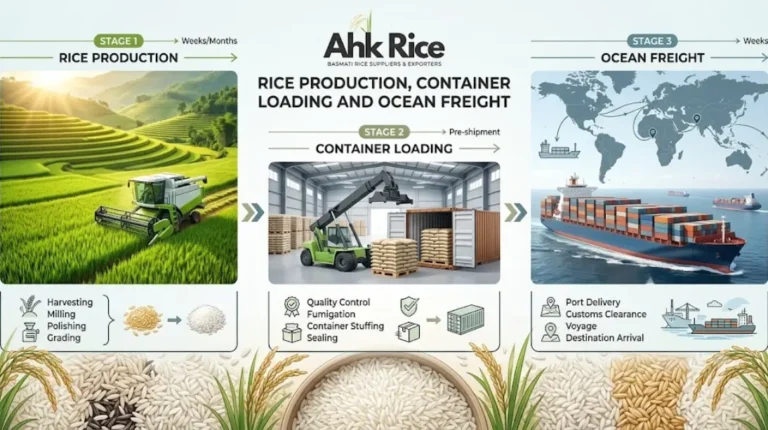
International freight rates, marine insurance and port conditions influence final landed prices. A lower FOB quotation does not always produce the lowest delivered cost.
3. Quality verification
Buyers must verify grain length, moisture, broken percentage, purity and processing consistency before confirming commercial shipments.
4. Supply planning
Harvest cycles, available stocks and shipment schedules influence purchasing decisions. Importers need advance procurement planning for large-volume orders.
5. Market-specific compliance
Each destination has different requirements for food safety, labelling, phytosanitary documentation and import approvals.
The most effective approach is to evaluate Pakistani rice using a complete commercial specification rather than comparing suppliers through price alone.
Which factors should importers consider before choosing a rice supplier?
Importers should evaluate export policy exposure, product specifications, FOB prices, destination requirements and supplier reliability before selecting a rice origin. These factors establish whether a procurement decision delivers consistent quality, competitive landed costs and dependable international supply.
The following five-row decision framework helps buyers compare sourcing options.
| Decision factor | What buyers should evaluate | Recommended approach |
|---|---|---|
| Export policy | Current export permissions and restrictions | Monitor official notifications |
| Product specifications | Grain length, moisture, broken percentage and purity | Approve a detailed specification sheet |
| Pricing | FOB, freight, insurance and landed costs | Compare equivalent grades |
| Quality assurance | Sortex processing, laboratory testing and inspection | Approve samples and COA |
| Supplier reliability | Production capacity, documents and shipment performance | Qualify suppliers before ordering |
Why does export policy monitoring matter?
Importers should monitor India’s Directorate General of Foreign Trade (DGFT), Pakistan’s Ministry of Commerce and relevant customs authorities.
Policy monitoring identifies changes affecting export permissions, certification requirements and shipment documentation.
European buyers should pay particular attention to India’s November 2026 inspection requirements. Other importing countries must also verify their own applicable import and food-safety conditions.
Why should buyers compare specifications instead of quotations alone?
Two rice quotations are not commercially equivalent when they have different grain lengths, broken percentages, moisture levels or processing methods.
For example, a buyer comparing Pakistani 1121 Basmati with Indian non-Basmati white rice is comparing two different product categories.
A proper comparison identifies the rice variety, grade, crop year, processing type, packaging and delivery terms before calculating the actual procurement difference.
How is Pakistan positioned to benefit from changing Indian rice policies?
Pakistan benefits when international buyers diversify rice sourcing, particularly in aromatic Basmati markets. Its export opportunities depend on competitive quotations, consistent processing, quality compliance and reliable shipments rather than Indian export restrictions alone.
Pakistan’s rice industry has experienced changing export conditions as international competition and global freight costs influence trade.
According to Pakistan’s FY2025–26 export figures, total rice exports reached approximately 4.3 million tonnes, compared with approximately 5.7 million tonnes in FY2024–25. Basmati exports remained comparatively resilient, with export earnings increasing despite slightly lower volumes. Column 3+1
More recent figures show improving momentum. During July–September 2026, Pakistan exported approximately 1.075 million tonnes of rice worth $652.40 million. Basmati shipments reached approximately 247,033 tonnes, representing an 80.21% increase in volume compared with the corresponding period of the previous financial year. Commerce Pakistan
These figures demonstrate the importance of product diversification and international demand.
Pakistan’s strongest opportunity lies in supplying buyers who value aromatic Basmati, consistent grain specifications and dependable export arrangements.
AHK Rice operates within this export segment, supplying 1121, Super Kernel and 1509 Basmati varieties to international markets. Its Punjab-based sourcing, processing, custom packaging and export coordination provide buyers with options for different procurement requirements.
The company’s commercial relevance comes from product specifications and supply capabilities rather than relying on temporary restrictions imposed by competing exporters.
What is the best long-term sourcing strategy when India’s rice policies change?
A diversified sourcing strategy supported by approved suppliers, product specifications and forward procurement agreements offers the strongest long-term protection against policy changes. Importers should maintain alternative origins while selecting rice according to market demand, quality standards and landed costs.
International rice buyers should avoid making purchasing decisions based entirely on temporary export restrictions.
India remains a major global supplier. Its policy relaxation can increase available supplies and strengthen price competition. Future domestic food-security concerns can also influence individual rice categories.
Pakistan provides an alternative, especially for premium Basmati procurement. Thailand and Vietnam offer additional sourcing choices for buyers focused on standard white rice and other varieties.
The most effective strategy combines:
- Multiple approved exporting countries.
- Defined quality specifications for every product.
- Regular FOB and CIF price comparisons.
- Pre-shipment sampling and quality inspection.
- Forward shipment planning.
- Monitoring of official export policy announcements.
Frequently Asked Questions
How do India’s rice export restrictions affect global markets?
Indian export restrictions reduce the quantity of rice available internationally. This increases competition among importers and creates opportunities for Pakistan, Thailand and Vietnam to supply alternative products.
2. Why do Indian rice policy changes affect Pakistani exporters?
India is a major rice exporter. When Indian restrictions are relaxed, additional supplies increase competition. When restrictions tighten, importers explore alternative origins, creating opportunities for Pakistani rice exporters.
Is Pakistani Basmati rice a good alternative to Indian Basmati?
Yes. Pakistani Basmati offers aromatic grain varieties, including 1121, Super Kernel and 1509. Buyers compare grain length, aroma, broken percentage, moisture and FOB prices before selecting an origin.
Which Pakistani Basmati varieties have international demand?
1121 Basmati serves premium retail and foodservice markets. Super Kernel targets aromatic rice distribution, while 1509 provides another option for buyers balancing grain quality and purchasing costs.
How should importers manage changing international rice prices?
Importers should compare quotations from multiple origins, monitor export policies, establish alternative suppliers and evaluate total landed costs. Forward procurement agreements also improve purchasing visibility.
Will India continue to dominate international rice exports?
India is expected to remain a major global supplier. USDA’s 2026/27 outlook identifies India as the leading exporter, with approximately 40% of global rice trade. Its export position depends on production, domestic availability and international demand. Economic Research Service
What should buyers check before importing Pakistani rice?
Buyers should check the variety, grain length, moisture, broken percentage, purity, packaging, Certificate of Origin, phytosanitary documentation and destination-specific food-safety requirements.