Evaluating Aroma Retention and Grain Quality in 1509 Rice
Choosing high-quality 1509 White Basmati Rice depends on evaluating aroma retention, grain quality, processing method, and storage performance together because these factors determine consumer satisfaction, export value, cooking consistency, and long-term market acceptance.
Importers, wholesalers, retailers, and food manufacturers increasingly evaluate rice beyond appearance. They examine how cultivation, milling, ageing, packaging, and storage influence flavour, grain integrity, and cooking performance. Understanding these quality indicators helps buyers make informed sourcing decisions while reducing quality-related risks. If you are learning about market demand before comparing specifications, read our guide explaining:
Why buyers increasingly prefer premium Pakistani 1509 White Basmati Rice.
Among trusted Pakistani exporters, 1509 White Basmati Rice from AHK Rice explains how controlled processing, quality inspection, customised packaging, and export documentation support consistent grain quality for international buyers.
1509 White Basmati Rice is an early-maturing Basmati variety developed to combine long grain appearance with high milling yield and attractive cooking characteristics. It has become one of Pakistan’s leading export varieties because it offers excellent value while maintaining authentic Basmati characteristics. According to 2026 international trade trends, demand continues growing across retail, food service, and industrial food processing sectors.
Specification Comparison of 1509 Rice Quality Factors
| Attribute | Premium Grade | Standard Export Grade |
|---|---|---|
| Average Grain Length | 8.2–8.4 mm | 7.8–8.1 mm |
| Grain Uniformity | Excellent | Good |
| Broken Percentage | Below 2% | Up to 5% |
| Natural Aroma Retention | Very High | Moderate |
| Cooking Elongation | Up to 2.2× | Around 2× |
| Moisture Level | 12–13% | Up to 14% |
| Export Market Value | Higher | Moderate |
Price per Metric Ton Comparison (2026)
| Grade | Average Export Price (USD/MT) |
|---|---|
| Premium 1509 White Basmati Rice | $930–1,050 |
| Standard Export Grade | $820–920 |
Prices vary according to crop quality, packaging specifications, destination, shipment volume, freight conditions, and contract terms.
Shelf Life Comparison
| Storage Condition | Premium Processed Rice | Standard Processed Rice |
|---|---|---|
| Cool Dry Warehouse | 24 months | 18–24 months |
| High Humidity Storage | Quality declines faster | Quality declines faster |
| Vacuum Packaging | Excellent aroma preservation | Good aroma preservation |
| PP Bag Storage | Good preservation | Moderate preservation |
Which regions prefer different grades of 1509 White Basmati Rice?
Different international markets prioritise different quality specifications according to consumer expectations, retail positioning, food regulations, purchasing power, and intended application. Matching rice grades with regional demand improves customer satisfaction, reduces complaints, and supports sustainable long-term trade relationships for exporters and importers.
International buyers rarely purchase identical specifications for every destination. Consumer behaviour, retail positioning, restaurant requirements, and local price sensitivity influence which grade performs best.
North America
The USA and Canada increasingly favour premium grades with:
- Higher grain uniformity
- Better aroma retention
- Lower broken percentage
- Superior cooking elongation
- Attractive retail appearance
Retail chains and speciality grocery stores generally prefer consistent packaging and premium polishing standards because consumers associate visual quality with premium value.
Middle East
Countries including Saudi Arabia, the UAE, Qatar, Oman, and Kuwait purchase both premium and commercial grades.
Premium grades dominate:
- Retail supermarkets
- Premium restaurants
- Hospitality
Commercial grades remain popular for:
- Catering companies
- Institutional buyers
- Food processing
- Wholesale distribution
The Middle East continues to be one of Pakistan’s largest Basmati export destinations in 2026.
What are the available solutions for maintaining aroma retention and grain quality?
Maintaining aroma retention and grain quality requires combining improved cultivation, careful harvesting, controlled milling, scientific ageing, proper storage, moisture management, and suitable packaging because every stage directly influences cooking performance, export quality, and consumer acceptance throughout the international supply chain.
Maintaining rice quality begins before harvesting. Genetics determine the grain’s potential, but post-harvest management determines whether that potential reaches consumers.
The primary quality preservation solutions include:
Controlled harvesting
Harvesting at the correct maturity reduces immature grains, chalkiness, and broken kernels.
Gentle milling
Modern milling equipment minimises grain breakage while preserving the outer grain structure.
Controlled ageing
Natural ageing allows moisture distribution throughout the grain.
This improves:
- Aroma expression
- Cooking elongation
- Texture
- Grain separation
Moisture management
Maintaining moisture between approximately 12% and 13% improves storage stability while reducing fungal risks.
Professional sorting
Optical colour sorters remove defective grains, foreign matter, and discoloured kernels.
Export-grade packaging
Multi-layer packaging protects rice against moisture, contamination, and physical damage during international transportation.
When these methods work together, exporters consistently achieve higher export grades.
How do different processing approaches compare?
Different processing methods produce measurable differences in aroma retention, grain integrity, appearance, cooking quality, and export value. Modern integrated processing consistently outperforms traditional handling because it reduces mechanical damage while preserving the rice’s natural characteristics throughout production.
Not every rice processor follows identical production standards.
Traditional processing
Traditional systems remain common among smaller mills.
Advantages include:
- Lower operating cost
- Simple production
- Flexible batch sizes
Limitations include:
- Higher breakage
- Less uniform polishing
- Variable moisture
- Greater contamination risk
Modern integrated processing
Integrated processing combines:
- Pre-cleaning
- Destoning
- Gentle milling
- Colour sorting
- Length grading
- Moisture monitoring
- Metal detection
- Automatic packaging
This creates consistent export specifications.
Naturally aged rice
Ageing enhances aroma complexity while improving grain firmness during cooking.
Many premium buyers specifically request naturally aged rice for retail shelves.
Fresh crop rice
Fresh rice offers competitive pricing but generally develops less pronounced aroma than aged stock.
Both categories remain commercially important depending on buyer priorities.
Which method works best for different purchasing cases?
The best evaluation method depends on the buyer’s target market, product positioning, processing requirements, and customer expectations. Premium retail programmes require stricter quality controls, while industrial food production often prioritises consistency, yield, and commercial efficiency over maximum aroma intensity.
Different buyers require different quality priorities.
Premium retail
Priority:
- Maximum aroma
- Uniform grains
- Attractive packaging
- Long shelf life
Recommended choice:
Premium naturally aged rice.
Restaurants
Priority:
- Cooking consistency
- Grain elongation
- Low breakage
- Reliable supply
Recommended choice:
Premium export-grade rice.
Food manufacturers
Priority:
- Uniform cooking
- Stable specifications
- Competitive cost
Recommended choice:
Commercial export grade.
Wholesale distribution
Priority:
- Price balance
- Reliable quality
- Large volume
Recommended choice:
Standard export grade with verified inspection.
Government procurement
Priority:
- Regulatory compliance
- Food safety
- Consistent shipments
Recommended choice:
Certified export-quality rice meeting contractual specifications.
What are the advantages and disadvantages of different quality strategies?
Every quality management strategy offers unique strengths and limitations. Evaluating production methods, storage systems, and processing technologies helps buyers understand trade-offs between cost, consistency, aroma preservation, and long-term commercial performance before making sourcing decisions.
Premium ageing strategy
Advantages:
- Stronger aroma
- Better elongation
- Higher retail appeal
- Premium positioning
Limitations:
- Higher inventory cost
- Longer storage period
Example:
Speciality supermarkets often select aged rice because consumers recognise its improved cooking quality.
Cost-focused processing
Advantages:
- Competitive pricing
- Faster turnover
- Wider accessibility
Limitations:
- Reduced aroma retention
- More variable appearance
Example:
Institutional catering frequently selects commercially processed rice to balance cost with acceptable cooking performance.
Advanced packaging
Advantages:
- Better moisture protection
- Improved shelf life
- Reduced contamination
Limitations:
- Higher packaging investment
Example:
Vacuum packaging helps preserve aroma during long ocean shipments.
Basic woven PP packaging
Advantages:
- Lower cost
- Easy logistics
- Broad availability
Limitations:
- Less moisture protection
- Reduced aroma preservation under challenging storage conditions
Which decision factors matter most before selecting 1509 White Basmati Rice?
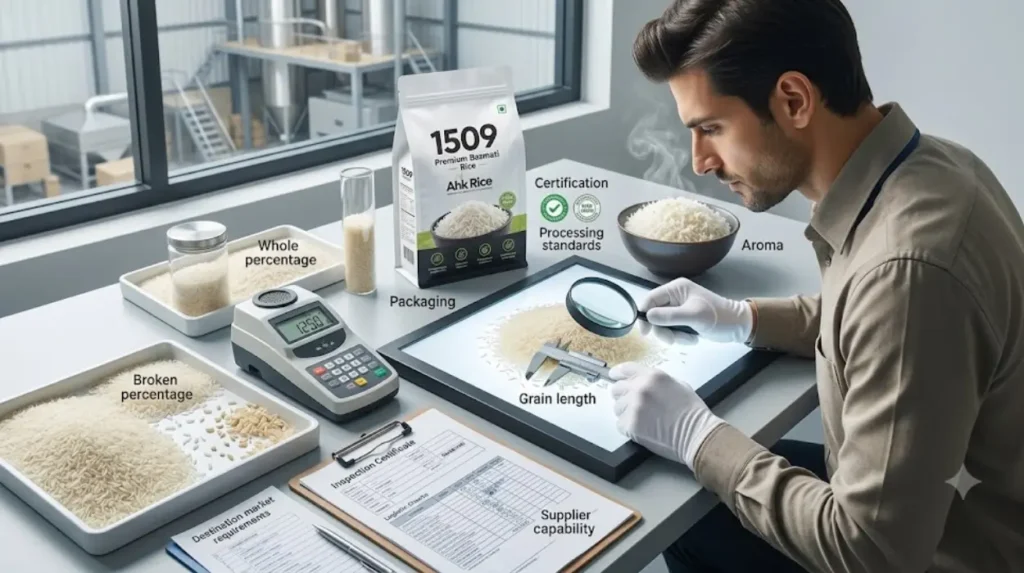
Successful purchasing decisions rely on evaluating grain quality, aroma retention, certification, processing technology, packaging, supplier capability, storage conditions, and destination market requirements together because every factor influences customer satisfaction, regulatory compliance, and commercial profitability across international trade.
Professional buyers evaluate multiple specifications before confirming purchases.
Grain length
Long, uniform grains improve perceived quality.
Aroma
Natural Basmati fragrance remains one of the strongest purchasing drivers.
Broken percentage
Lower broken percentages increase visual appeal and cooking consistency.
Moisture
Correct moisture improves storage stability.
Processing standards
Modern facilities reduce contamination while improving consistency.
Packaging
Suitable packaging protects rice throughout international shipping.
Supplier capability
Export experience, documentation, inspection procedures, and logistics coordination reduce operational risks.
Decision Framework
| Buying Priority | Recommended Solution | Best For | Primary Benefit |
|---|---|---|---|
| Premium Retail | Naturally aged premium grade | Supermarkets | Strong aroma and appearance |
| Restaurants | Premium export grade | Food service | Consistent cooking |
| Wholesale | Standard export grade | Distributors | Balanced cost and quality |
| Food Manufacturing | Commercial specification | Processors | Uniform production |
| Long-Distance Export | Premium packaging with controlled storage | International importers | Better aroma preservation |
Evaluating aroma retention and grain quality requires more than checking grain length alone. Buyers should assess cultivation practices, milling technology, ageing methods, moisture control, packaging quality, and storage conditions together because these interconnected factors determine cooking performance, shelf life, consumer satisfaction, and overall export value. By following a structured evaluation framework, importers can confidently select the most suitable 1509 White Basmati Rice specification for their target market while ensuring consistent quality throughout the supply chain. AHK Rice supports international buyers with end-to-end processing, customised packaging, and export solutions that align with modern global quality expectations. buyers ready to compare sourcing options from Pakistan, pointing to
Import 1509 White Basmati Rice from Pakistan to USA Markets.
Frequently Asked Questions
What makes 1509 White Basmati Rice different from other Basmati varieties?
1509 White Basmati Rice matures earlier than many traditional Basmati varieties while offering long grains, good cooking elongation, pleasant aroma, and high milling yield, making it popular in international export markets.
How can buyers evaluate aroma retention in 1509 White Basmati Rice?
Buyers should assess natural fragrance after opening the package, check storage conditions, review ageing methods, and verify moisture levels, as these factors directly affect aroma retention.
Which grade of 1509 White Basmati Rice is best for retail markets?
Premium export grade is the preferred choice for retail markets because it offers superior grain uniformity, low broken percentage, better aroma retention, and an attractive appearance.
Does ageing improve the quality of 1509 White Basmati Rice?
Yes. Natural ageing enhances aroma, improves grain firmness, increases cooking elongation, and helps produce a fluffier texture after cooking.
What is the ideal moisture level for export-quality 1509 White Basmati Rice?
The recommended moisture content is typically between 12% and 13%, helping preserve grain quality, reduce spoilage risks, and extend shelf life during storage and shipping.
How long can 1509 White Basmati Rice be stored?
When stored in a cool, dry environment with suitable packaging, premium-quality 1509 White Basmati Rice generally maintains its quality for up to 24 months.
Which countries have the highest demand for premium 1509 White Basmati Rice?
The United States, Canada, the United Arab Emirates, Saudi Arabia, Qatar, Oman, and Kuwait are among the leading markets that consistently import premium grades of 1509 White Basmati Rice.
Why is grain uniformity important when selecting 1509 White Basmati Rice?
Uniform grains improve cooking consistency, enhance visual appeal, reduce breakage, and meet the quality expectations of retailers, restaurants, and international buyers.