Global Rice Shortage Concerns and Their Market Impact
Global rice shortage concerns create purchasing risks for importers, wholesalers, food distributors and retail brands. Weather disruptions, production costs, export policies and shipping constraints influence international rice availability. Buyers need dependable suppliers, verified specifications and planned shipments to protect their inventory and maintain consistent market supply.
The global rice market is not necessarily experiencing an absolute shortage. However, declining production forecasts, uneven regional availability and changing export volumes create uncertainty for international buyers. According to the Food and Agriculture Organization (FAO), global rice production is forecast to decline in 2026 compared with the previous season. Its November 2026 outlook also identifies weather uncertainty and reduced producer profitability as important supply risks.
For importers, the commercial decision is straightforward: secure reliable supply before regional shortages, freight changes or procurement competition affect purchasing costs. Understanding the factors behind international rice export price fluctuations helps buyers evaluate quotations and negotiate more effectively.
What Are the Main Causes of Global Rice Shortage Concerns?
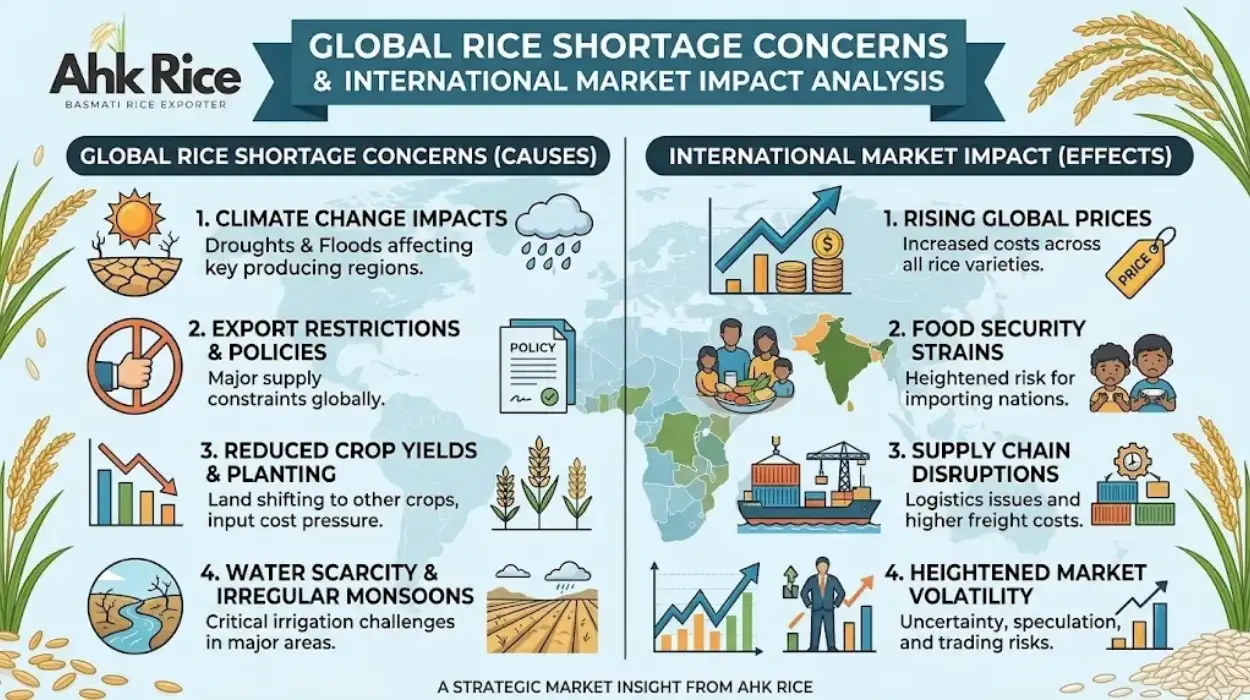
Global rice shortage concerns primarily result from weather-related production losses, rising agricultural costs, changing export policies and logistical disruptions. These factors reduce available exportable supplies in particular markets, increase procurement uncertainty and create price differences between rice origins and grades.
Rice production depends on predictable rainfall, irrigation availability, suitable temperatures and affordable agricultural inputs. When these conditions deteriorate, farmers face lower yields or increased cultivation costs.
The major supply risks include:
- Climate change and El Niño: Irregular rainfall, drought and excessive temperatures affect crop development and irrigation.
- Agricultural input costs: Fertilizer, fuel, electricity and labour expenses influence planting decisions.
- Export restrictions: Government policies can reduce internationally available quantities.
- Transportation disruptions: Port congestion, container shortages and shipping delays affect delivery schedules.
- Rising consumption: Population growth and food demand increase competition for available supplies.
The FAO’s November 2026 assessment projects global rice production at approximately 552 million tonnes, representing a decline from the previous season’s record output. The USDA’s November 2026 outlook also projects lower global production than the previous marketing year’s estimate.
These forecasts use different statistical methodologies and should not be treated as directly interchangeable.
The commercial impact is important. Even when global stocks remain substantial, particular importing countries can experience tighter availability of preferred varieties, broken percentages or packaging specifications.
For example, a distributor requiring premium 1121 Basmati cannot automatically replace it with another long-grain variety without changing its product positioning and customer expectations.
How Do Global Rice Shortages Affect International Rice Markets?
Global rice supply uncertainty affects import prices, supplier competition, purchasing schedules and inventory planning. Importers face greater exposure to changing FOB quotations, freight expenses and delivery schedules when available exportable quantities become concentrated among fewer origins.
The market impact extends beyond the price of paddy or milled rice.
1. Export price fluctuations
Reduced availability can increase competition between importers. Exporters adjust quotations according to raw material costs, processing expenses, quality requirements and available inventory.
2. Increased procurement competition
Large distributors may secure supplies earlier to protect their inventory. Smaller buyers can face fewer shipment options when exportable stocks become committed.
3. Changes in sourcing destinations
Importers increasingly compare Pakistan, India, Thailand and Vietnam according to variety, quality, price and shipment availability.
4. Inventory management pressure
Distributors must balance warehouse capacity against the risk of future price increases and delayed replenishment.
5. Greater demand for contractual transparency
Buyers require confirmed specifications, shipment windows, inspection arrangements and clearly defined Incoterms before making purchasing commitments.
For example, a UAE wholesaler purchasing Super Kernel Basmati may prioritize consistent aroma, controlled moisture and competitive FOB Karachi pricing. A US retailer may prioritize 1121 grain length, packaging compliance and consistent private-label specifications.
These requirements make supplier selection a commercial decision rather than simply a price comparison.
What Is the Best Solution for Global Rice Supply Uncertainty?
The best solution is to establish relationships with reliable rice exporters, approve product specifications before bulk purchasing and secure shipment schedules through documented procurement agreements. Diversified sourcing and early inventory planning reduce exposure to sudden supply disruptions.
Importers should evaluate suppliers using five commercial criteria.
- Production capacity: Confirm that the exporter can consistently supply the required monthly or seasonal volume.
- Product specifications: Establish grain length, moisture, broken percentage, processing type and crop year.
- Quality verification: Request representative samples, laboratory reports and a final Certificate of Analysis (COA).
- Export documentation: Confirm commercial invoices, packing lists, phytosanitary certificates and certificates of origin.
- Shipping arrangements: Agree on loading ports, Incoterms, shipment windows and destination requirements.
Pakistan provides an important sourcing option because its Punjab rice-producing regions supply internationally traded Basmati varieties.
Buyers can compare 1121, 1509 and Super Kernel according to their market positioning, target customers and procurement budgets.
For a more detailed understanding of weather-related production changes, importers should also review how weather conditions impact Pakistan’s rice production. This comparison helps buyers understand why crop conditions influence availability, quality and export quotations.
Which Pakistani Basmati Varieties Should Importers Consider?
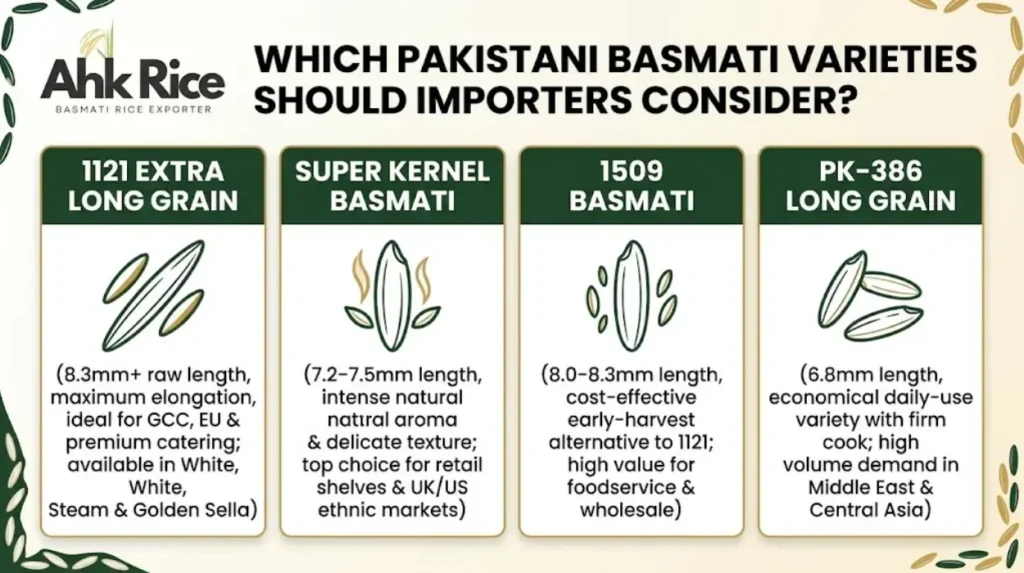
Importers should select rice varieties according to customer demand, grain characteristics, cooking performance and target selling prices. Pakistan’s 1121, 1509 and Super Kernel varieties address different commercial requirements.
| Rice variety | Main commercial advantage | Suitable buyers |
|---|---|---|
| 1121 Basmati | Premium grain length and cooked elongation | Premium retailers and foodservice |
| 1509 Basmati | Competitive sourcing and bulk supply options | Wholesale distributors |
| Super Kernel | Traditional aroma and established market demand | Ethnic grocery distributors |
Super Kernel Basmati is particularly relevant for importers targeting aromatic rice markets. Buyers can explore AHK Rice’s Pakistani Basmati rice export and supply services to assess available varieties, processing and export arrangements.
AHK Rice operates from Punjab, Pakistan, and supplies 1121, Super Kernel and 1509 varieties to more than 15 countries. Its export process covers sourcing, grading, processing, custom packaging and shipment preparation.
The correct sourcing decision depends on the buyer’s market rather than selecting the variety with the lowest quotation.
Why Choose AHK Rice for International Rice Procurement?
AHK Rice provides Pakistani Basmati sourcing with coordinated processing, quality specifications, packaging and export documentation. Buyers can work with one exporter to manage product selection and shipment preparation instead of coordinating separate suppliers for different stages.
Global supply uncertainty makes supplier consistency especially important. A competitive quotation has limited value if the exporter cannot maintain the agreed specifications or shipment schedule.
AHK Rice supports international buyers through the following services.
1. Multiple Basmati varieties
Importers can source 1121, 1509 and Super Kernel according to their distribution requirements.
2. Processing and grading
Rice processing includes cleaning, grading and Sortex-based sorting according to the agreed specification.
3. Custom packaging
Buyers can discuss retail and wholesale packaging requirements, including 5 kg, 10 kg, 25 kg and 50 kg formats, subject to product and order arrangements.
4. Export documentation
AHK Rice coordinates the export process and relevant shipment documents according to the destination and agreed trade terms.
5. Quality approval
Buyers can establish moisture, broken percentage, grain length and other quality requirements before bulk shipment.
6. International market coverage
AHK Rice supplies international markets and works with importers requiring coordinated sourcing and export preparation.
The practical benefit is improved procurement control. Importers receive a defined specification and can evaluate product quality before committing to larger quantities.
What Results Can Importers Expect from a Reliable Rice Exporter?
A reliable exporter helps importers maintain consistent product specifications, plan replenishment, reduce procurement uncertainty and manage shipment requirements. Results depend on order volume, crop availability, approved quality parameters and destination logistics.
Consider a distributor purchasing 25 metric tonnes of Pakistani Basmati for a wholesale network.
Without an approved specification, the buyer risks receiving rice with different grain lengths, moisture levels or broken percentages across shipments.
A documented purchasing arrangement establishes the expected quality before production begins.
The buyer can then:
- Approve the commercial sample.
- Confirm the final product specification.
- Review the production schedule.
- Arrange packaging and container loading.
- Verify export documentation.
- Track shipment progress.
AHK Rice uses this structured approach to support repeat purchasing and international distribution.
The objective is not to guarantee that market prices will remain stable. It is to give importers greater control over purchasing decisions when global supply conditions change.
How Much Does Pakistani Rice Export Supply Cost?
Rice export pricing depends on variety, crop availability, grain specifications, processing, packaging, order quantity, freight and destination requirements. Importers should request a shipment-specific quotation instead of relying on a general international market price.
The main cost factors include:
| Pricing factor | Impact on export quotation |
|---|---|
| Rice variety | 1121, 1509 and Super Kernel have different market values |
| Grain quality | Length, broken percentage and purity affect pricing |
| Moisture | Required moisture limits influence processing and acceptance |
| Processing | Steam, Sella, Golden Sella and Sortex requirements change costs |
| Packaging | Bag material, printing, weight and private labelling affect expenses |
| Order quantity | Volume influences production and container-loading economics |
| Destination | Freight, handling and documentation vary by market |
| Incoterms | FOB and CIF quotations allocate transportation costs differently |
FOB Karachi vs CIF Pricing
FOB Karachi covers the agreed export supply and loading obligations up to the vessel under the applicable Incoterms. The buyer arranges the main ocean freight and subsequent costs.
CIF includes the agreed cost, insurance and freight to the named destination port. Import clearance, duties and other destination charges remain subject to the agreed contract and applicable Incoterms.
During uncertain market conditions, buyers should compare quotations using identical specifications and delivery terms.
A cheaper quotation may involve a different crop year, higher broken percentage, different processing or a shorter list of included services.
How Many Days Does Rice Shipping Take to Different Markets?
Sea transit time depends on the destination port, vessel schedule, shipping route and transshipment requirements. Importers should distinguish port-to-port transit from the complete production, documentation and delivery schedule.
The following are indicative planning estimates for shipments from Karachi:
| Destination market | Indicative sea transit |
|---|---|
| UAE – Jebel Ali | 5–7 days |
| Saudi Arabia – Jeddah | 4–8 days |
| Indonesia | 14–21 days |
| USA – New York | 25–40 days |
These estimates are not guaranteed delivery dates. Production, inspection, export documentation, port handling, customs clearance and inland transportation require additional time.
AHK Rice recommends confirming the latest vessel schedule and shipment window before issuing a purchase order.
For example, a UAE distributor requiring regular monthly replenishment should coordinate production and booking before existing warehouse inventory becomes critically low.
A US importer should allow additional planning time for destination compliance, customs procedures and inland distribution.
What Is the Complete Rice Sample Approval Process and Its Cost?
The sample process allows importers to evaluate rice quality, cooking performance and specification compliance before approving commercial quantities. AHK Rice can provide samples of up to 20 kg of Super Kernel Basmati, subject to availability and agreed arrangements.
The process involves six stages.
Stage 1: Share purchasing requirements
The buyer provides the required variety, grain specifications, quantity, destination and packaging preferences.
Stage 2: Confirm sample specifications
AHK Rice discusses the sample grade, processing type, moisture requirements and other relevant parameters.
Stage 3: Prepare the sample
The agreed representative sample is prepared for dispatch. Buyers should confirm that the sample reflects the intended commercial specification.
Stage 4: Arrange international courier
The buyer covers applicable courier and shipping expenses. Phytosanitary certification and related charges are also payable by the buyer where applicable.
Stage 5: Conduct quality and cooking tests
The importer evaluates aroma, grain appearance, elongation, texture and cooking performance. Laboratory testing can be arranged where required, subject to separate costs.
Stage 6: Approve the commercial order
After approval, both parties confirm the final specification, quantity, packaging, price, Incoterm and shipment schedule.
Sample cost considerations
- Sample rice: Available free for the stated sampling offer.
- Courier: Paid by the buyer.
- Phytosanitary charges: Paid by the buyer where applicable.
- Laboratory testing: Additional cost if requested.
- Bulk order: Separately quoted according to specifications and quantity.
There is no fixed international courier or phytosanitary charge. The actual amount depends on destination, shipment weight, courier service and documentation requirements. Sample charges and any applicable concessions should be confirmed before dispatch.
This process reduces the risk of committing to bulk quantities before product approval.
How Can Importers Get Started with AHK Rice?
Importers can begin by sharing their preferred rice variety, quantity, destination and quality specifications. AHK Rice can then discuss product availability, sampling, packaging, export pricing and shipment arrangements for the proposed order.
A practical procurement sequence is:
- Identify the required variety and target market.
- Specify grain length, moisture and broken percentage.
- Confirm annual or monthly purchasing volume.
- Request a representative sample.
- Approve product quality and packaging.
- Obtain an FOB or CIF quotation.
- Confirm payment terms and shipment arrangements.
- Approve the final commercial specification before loading.
AHK Rice supports international importers through sourcing, processing, grading, packaging and export coordination.
For buyers concerned about global rice supply uncertainty, the priority is to establish a dependable sourcing relationship before procurement pressure increases.
The best purchasing decision combines competitive pricing, verified quality, realistic shipping schedules and documented export requirements.
Importers, wholesalers and distributors can discuss their requirements and request a current export quotation directly from AHK Rice through its request a rice export quotation page.
Frequently Asked Questions
Is the world facing a global rice shortage in 2026?
Global rice production forecasts indicate a decline from the previous season.
Weather uncertainty and agricultural production costs are affecting supply expectations.
However, declining production does not automatically mean an absolute global shortage.
Regional availability and exportable quantities differ between rice-producing countries.
Importers should monitor production forecasts and secure reliable suppliers.
How do global rice shortages affect rice export prices?
Lower exportable supplies can increase competition among international buyers.
Weather disruptions can increase production and sourcing expenses.
Export policies and freight costs also influence international quotations.
Premium Basmati varieties may experience different pricing movements from ordinary rice.
Importers should compare specifications and request updated FOB or CIF prices.
Why is Pakistan an important source of Basmati rice?
Pakistan produces internationally traded Basmati varieties in Punjab.
Its major commercial varieties include 1121, 1509 and Super Kernel.
These varieties serve premium retail, wholesale and foodservice markets.
Importers can select different grades according to customer requirements.
AHK Rice provides sourcing, processing, packaging and export coordination.
How long does Pakistani rice shipping take?
UAE shipments to Jebel Ali generally require 5–7 days of sea transit.
Saudi shipments to Jeddah generally require 4–8 days.
Indonesia shipments generally require 14–21 days.
New York shipments generally require 25–40 days.
Actual schedules depend on vessel availability, routing and port operations.
Can international buyers request free rice samples from AHK Rice?
AHK Rice offers up to 20 kg of Super Kernel Basmati for sampling, subject to availability.
The buyer pays international courier and shipping expenses.
Applicable phytosanitary charges are also payable by the buyer.
Importers can evaluate aroma, grain appearance and cooking performance.
Bulk purchasing begins after sample evaluation and commercial specification approval.