Why Are Wholesale Distributors Increasing Pakistani Basmati Rice Imports?
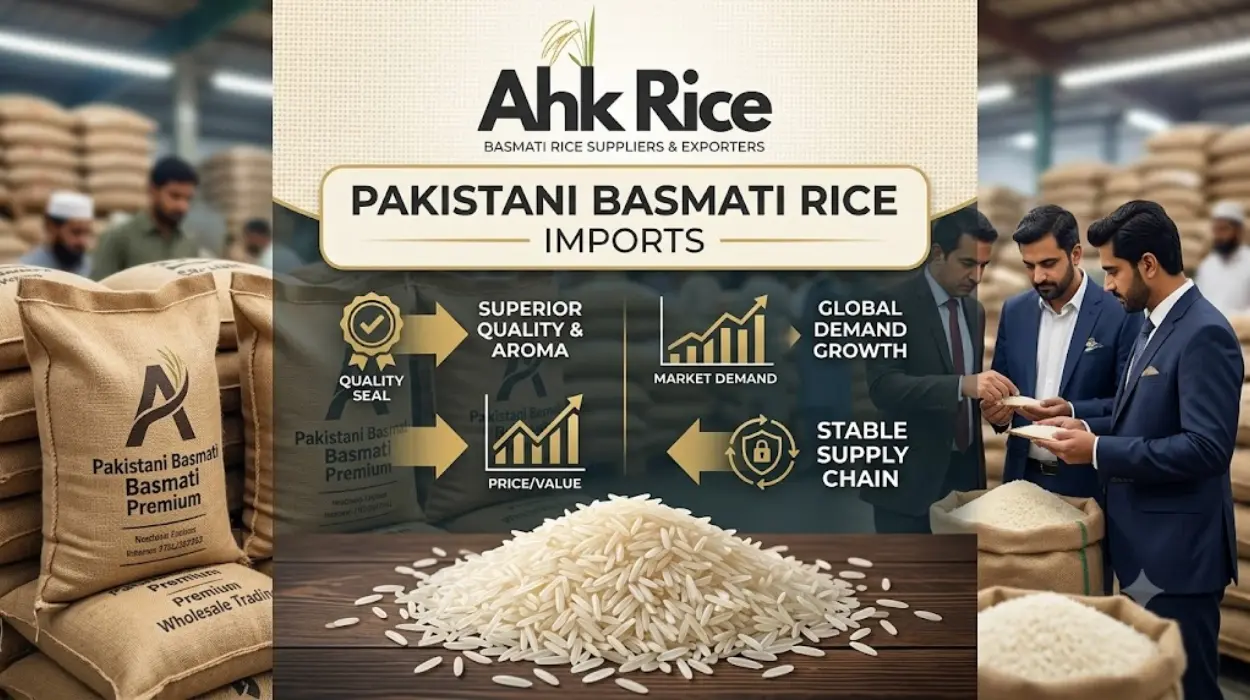
Wholesale distributors are increasing Pakistani Basmati rice imports because the product combines long-grain appearance, aromatic cooking quality, established export demand, and multiple commercial grades. Pakistan exported 808,643 MT of Basmati rice in 2024–25, generating approximately US$830.6 million in export value. The average Basmati export value was US$1,027.11 per MT.
Pakistani Basmati rice is a long-grain aromatic rice grown mainly in Punjab. The production region includes irrigated agricultural areas where rice cultivation, milling, grading, and export infrastructure support international trade. Wholesale distributors purchase it for supermarkets, ethnic grocery stores, restaurants, caterers, foodservice companies, and private-label programs.
The increase in distributor interest is not based on grain length alone. Buyers evaluate variety, moisture, broken percentage, purity, milling quality, cooking performance, packaging, documentation, and shipment consistency. The three commercially important varieties in this supply category include 1121 Basmati, Super Kernel Basmati, and 1509 Basmati.
What Is Pakistani Basmati Rice?
Pakistani Basmati rice is an aromatic long-grain rice produced primarily in Punjab and prepared for domestic and international markets through drying, cleaning, milling, grading, testing, packaging, and export procedures. Its commercial value comes from grain characteristics and cooking performance.
Basmati refers to a group of aromatic rice varieties associated with distinctive fragrance, elongated grains, and characteristic cooking behavior. Pakistani Basmati is strongly associated with Punjab because the region provides the agricultural conditions and established production systems required for commercial cultivation.
Wholesale distribution differs from retail purchasing. A distributor purchases rice in larger quantities and resells it through a network of retailers or foodservice customers. Examples include a distributor supplying 20 supermarkets, a foodservice wholesaler supplying 50 restaurants, or an importer supplying regional grocery chains.
Pakistan has an established rice-export sector. The Rice Exporters Association of Pakistan records total rice exports of 5.82 million MT in 2024–25, including 808,643 MT of Basmati rice.
The 2025–26 market also shows why supply planning matters. USDA reporting revised Pakistan’s rice production estimate to 8.0 million tons after flood-related crop losses and reduced the rice export forecast to 4.6 million tons. The report specifically identified Saudi Arabia, the UAE, GCC countries, Iran, Iraq, Syria, and Jordan among important Basmati markets affected by tighter exportable supply.
Where Is Pakistani Basmati Rice Grown?
Pakistani Basmati rice is primarily grown in Punjab, where established rice-growing districts support cultivation, harvesting, drying, milling, grading, and export operations. The Punjab production belt forms the agricultural foundation of Pakistan’s commercial Basmati supply chain.
Punjab provides the core production environment for Pakistani Basmati. Farmers cultivate rice during the warm growing season and harvest the crop after physiological maturity.
The crop then enters a supply chain connecting farms with rice mills and exporters. Paddy rice is the harvested form before milling. It contains the husk and requires mechanical processing before becoming the white or parboiled rice sold to distributors.
Geographic origin matters because Basmati is not simply defined by a long grain. Variety identity, cultivation area, processing method, grain dimensions, aroma, cooking characteristics, and purity determine commercial specifications.
For distributors, origin also provides traceability. A documented supply chain connects the agricultural source to the processing facility, finished product, laboratory analysis, packaging, container loading, and export documentation.
How Is Pakistani Basmati Rice Processed for Export?
Export processing converts harvested paddy into a cleaned, graded, tested, and packaged food product through controlled stages. The sequence normally includes receiving, drying, cleaning, dehusking, polishing, grading, sorting, laboratory testing, packaging, inspection, and container loading.
1. Paddy receiving
Rice mills receive harvested paddy from agricultural suppliers. The incoming material is checked for moisture, foreign material, immature grains, damaged grains, and other physical characteristics.
Moisture is important because excessive moisture creates storage and milling problems. Insufficient control during drying also affects grain integrity.
2. Drying
Freshly harvested paddy contains more moisture than finished export rice. Mechanical or controlled drying reduces moisture to a suitable level for storage and milling.
The drying process must protect the grain from excessive heat because rapid or uncontrolled drying can increase grain breakage.
3. Cleaning
Cleaning removes unwanted material from the paddy. Examples include stones, dust, straw, metal particles, seeds, and other foreign matter.
Modern rice mills use mechanical cleaning equipment to improve raw-material purity before milling.
4. Dehusking
A husker removes the outer husk from paddy. The resulting brown rice still contains the bran layer and requires additional processing when white rice is being produced.
Husking efficiency affects the recovery rate and the amount of broken grain generated during processing.
5. Whitening and polishing
For white Basmati rice, milling removes the bran layers. Polishing then improves the appearance of the grain.
Steam or parboiling processes create a different product profile. Steam Basmati receives controlled hydrothermal treatment before drying and milling, producing firmer grains and different cooking characteristics.
6. Grading
Grading separates rice according to grain length, broken percentage, and other physical specifications.
This stage is important for wholesale distributors because commercial buyers frequently purchase against defined specifications rather than simply purchasing “Basmati rice.”
7. Optical sorting
Optical sorting equipment identifies and removes grains that differ in color or appearance from the required specification.
Examples include discolored grains, chalky grains, damaged grains, and other visual defects.
8. Laboratory testing
Finished rice is tested against the agreed specification. Testing can cover moisture, broken percentage, grain dimensions, purity, foreign matter, and food-safety parameters.
The exact testing package depends on the destination market and buyer requirements.
9. Packaging
Rice is packed into formats suitable for the distribution channel. Examples include 5 kg retail bags, 10 kg bags, 20 kg foodservice bags, and larger commercial formats.
Private-label distributors also specify packaging material, artwork, labeling information, barcode requirements, and pallet configuration.
10. Container loading
The finished shipment is palletized or floor-loaded according to the agreed logistics plan. Documentation is prepared before export clearance and shipment.
This creates the final connection between agricultural production and the distributor’s warehouse.
Which Pakistani Basmati Grades Do Wholesale Distributors Buy?
Wholesale distributors generally select Basmati grades according to retail positioning, foodservice requirements, price targets, grain-length expectations, and cooking performance. The principal commercial choices include 1121 Basmati, Super Kernel Basmati, and 1509 Basmati.
1121 Basmati
1121 Basmati is recognized for exceptionally long grains and strong visual presentation after cooking. It is widely positioned in premium retail, foodservice, restaurant, catering, and private-label markets.
The variety is available in processing formats such as white and steam rice. Each format produces different cooking and texture characteristics.
Super Kernel Basmati
Super Kernel is a traditional Pakistani Basmati category with a strong position in domestic and export markets.
Distributors use it when they need recognizable Basmati characteristics while positioning the product below the highest premium long-grain segment. It fits retail bags, foodservice packs, restaurants, and ethnic grocery distribution.
1509 Basmati
1509 is an earlier-maturing Basmati variety with long grains and strong commercial demand. It is commonly processed as white, steam, or other specialized formats.
Distributors use 1509 when they need a balance between grain appearance, cooking performance, supply planning, and target market price.
The important distinction is that “grade” does not describe only the rice variety. Commercial specifications also include grain length, broken percentage, moisture, purity, milling degree, processing method, packaging, and allowable defects.
Why Are Wholesale Distributors Increasing Pakistani Basmati Rice Imports?
Distributors are increasing Pakistani Basmati imports because the category supports premium positioning, multiple price points, established international demand, and diverse downstream applications. The supply chain also supports bulk packaging, foodservice formats, retail programs, and private-label distribution.
The first driver is product differentiation. Basmati provides a recognizable aromatic rice category that distributors can separate from standard long-grain rice.
The second driver is product segmentation. A distributor can sell 1121 as a premium product, Super Kernel as a mainstream Basmati option, and 1509 as a value-oriented long-grain Basmati option.
The third driver is application diversity. Basmati is used by supermarkets, restaurants, caterers, institutional kitchens, food manufacturers, wholesalers, and online grocery businesses.
The fourth driver is established export infrastructure. Pakistan has decades of commercial experience supplying international rice markets. REAP describes Pakistan as one of the world’s major rice-producing countries and records Basmati exports across multiple years.
The fifth driver is market diversification. Pakistani rice exporters continue to engage with markets across the Middle East, Asia, Africa, Europe, and North America. In 2026, REAP activities included discussions concerning rice trade with Iran, Kenya, Bangladesh, and Uzbekistan.
For distributors, this established international network supports the development of repeat import programs rather than isolated spot purchases.
What Are the Key Components of a Wholesale Basmati Supply Chain?
A wholesale Basmati supply chain contains six connected components: agricultural sourcing, rice processing, quality control, packaging, export documentation, and international logistics. Failure in any component can affect product quality, shipment timing, landed cost, or regulatory compliance.
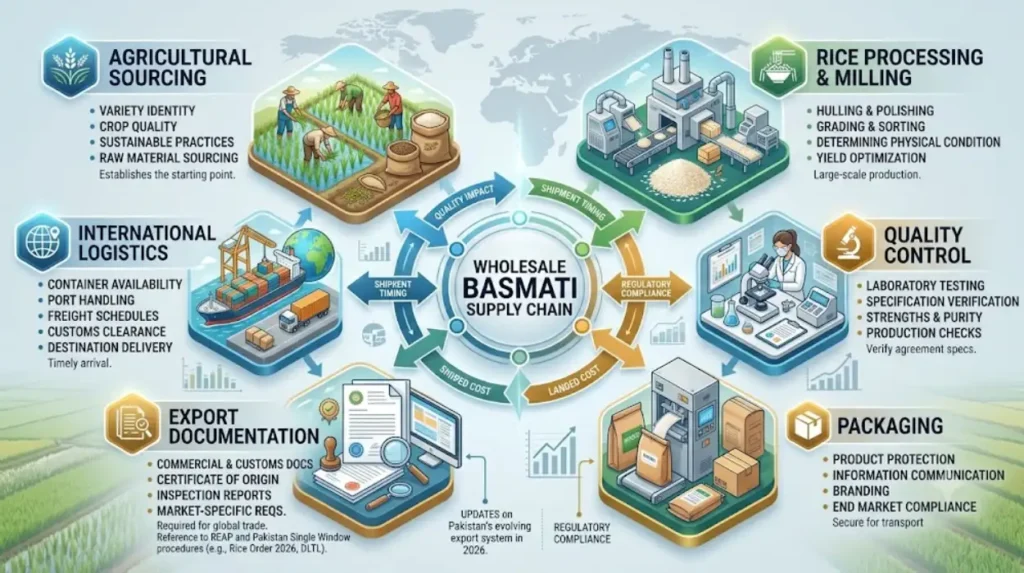
The first component is agricultural sourcing. Variety identity and crop quality establish the starting point.
The second is processing. Milling determines the physical condition of the finished rice.
The third is quality control. Laboratory and production checks verify that the shipment matches the agreed specification.
The fourth is packaging. Packaging protects the rice and communicates product information to the end market.
The fifth is documentation. Export shipments require commercial, customs, origin, inspection, and market-specific documentation.
The sixth is logistics. Container availability, port handling, freight schedules, customs clearance, and destination delivery determine when the distributor receives the shipment.
Pakistan’s export system also continued to evolve in 2026. REAP and Pakistan Single Window conducted a February 2026 briefing on the Rice Order 2026 and the Drawback of Local Taxes and Levies mechanism, showing the importance of current export procedures for rice businesses.
What Certifications and Documents Apply to Pakistani Basmati Rice?
Certification requirements depend on the destination country, product specification, buyer contract, and distribution channel. Common export controls include phytosanitary documentation, certificate of origin, laboratory analysis, commercial documents, food-safety evidence, and destination-specific compliance records.
A phytosanitary certificate confirms compliance with applicable plant-health requirements.
A certificate of origin identifies the country of origin for the exported product.
A certificate of analysis provides laboratory results against defined parameters. Examples include moisture, broken grains, foreign matter, pesticide residues, and microbiological criteria where applicable.
Food-safety certifications can also become buyer requirements. Examples include HACCP-based systems, ISO 22000, BRCGS, or other recognized food-safety standards, depending on the facility and importing market.
Distributors should distinguish between a legal import requirement and a buyer’s commercial requirement. A supermarket chain can demand a certification that is not itself a universal customs requirement.
The documentation package should therefore be established before production rather than after container loading.
What Are the Main Wholesale Uses of Pakistani Basmati Rice?
Pakistani Basmati rice serves wholesale retail, foodservice, restaurant, catering, private-label, and ethnic grocery markets. Each application requires a different balance of grain appearance, cooking performance, packaging size, price, documentation, and supply consistency.
Supermarket distribution
Retail distributors purchase packaged Basmati for supermarket shelves. Product appearance, package design, grain length, cooking quality, barcode information, and shelf stability become important.
Restaurant supply
Restaurants purchase larger bags because rice is used as a recurring food ingredient. Cooking yield and batch consistency become more important than retail packaging.
Catering and foodservice
Caterers require predictable quantities and repeatable cooking results. Large-format bags reduce packaging cost and simplify kitchen inventory.
Private-label programs
Private-label distributors sell rice under their own brand. They control packaging design, product positioning, pack size, and retail presentation while relying on an export supplier for processing and shipment execution.
Ethnic grocery distribution
Ethnic grocery wholesalers often stock several Basmati varieties because customers recognize differences between premium, mainstream, steam, white, and long-grain products.
What Problems and Misconceptions Affect Wholesale Pakistani Basmati Imports?
The most common misconceptions are that all Basmati rice is identical, longer grain always means better rice, the lowest price produces the lowest landed cost, and certification alone guarantees consistent supply. Wholesale purchasing requires a complete specification and repeatable supply system.
The first misconception is that all Basmati performs identically. Variety and processing method influence aroma, texture, elongation, firmness, and cooking yield.
The second misconception is that maximum grain length automatically means maximum value. A distributor also needs acceptable broken percentage, purity, moisture, milling quality, and cooking performance.
The third misconception is that the lowest FOB price is the cheapest supply option. Freight, insurance, port charges, customs costs, inland transportation, storage, rejected goods, and quality claims all influence landed cost.
The fourth misconception is that one successful container proves long-term supply reliability. A distributor needs consistent specifications across multiple shipments.
The fifth misconception is that certification replaces quality control. A certificate represents a defined test or management system. It does not eliminate the need for shipment-specific inspection and specification verification.
This is why distributor procurement increasingly moves from simple commodity purchasing toward supplier evaluation. The buyer needs to understand how the exporter sources rice, processes it, controls specifications, prepares documents, and manages repeat shipments.
The next stage is evaluating whether a supplier can support the distributor over multiple purchase cycles. The comparison should cover production capacity, product specifications, quality controls, documentation, packaging capability, shipment planning, and communication procedures. These criteria are covered in the next-stage guide on:
How distributors evaluate long-term Basmati rice supply partners.
Why Does Long-Term Supply Matter to Wholesale Distributors?
Long-term supply matters because distributors must maintain inventory, serve downstream customers, protect retail listings, and avoid specification changes between shipments. A reliable program therefore requires consistent variety, processing, quality parameters, packaging, documentation, and shipment execution.
A distributor does not sell a single container. The distributor builds inventory around expected customer demand.
If the second shipment has different grain length, moisture, broken percentage, aroma, packaging, or cooking performance, downstream customers can notice the difference.
Consistent specifications therefore protect retailer relationships and foodservice contracts.
Long-term supply also improves procurement planning. A distributor can establish recurring order quantities, preferred packaging, shipment schedules, testing procedures, and documentation requirements.
Pakistan’s 2025–26 supply constraints reinforce this point. USDA reporting identified reduced production and exportable supplies as factors affecting the ability to maintain existing export flows to important Basmati markets.
For that reason, the 2026 Basmati import decision is not simply about finding available rice. It is about understanding the relationship between variety, processing capacity, quality control, export documentation, logistics, and repeat supply.
Frequently Asked Questions
Why are wholesale distributors increasing Pakistani Basmati rice imports?
Wholesale distributors are increasing imports because Pakistani Basmati offers long grains, aromatic cooking quality, multiple commercial varieties, established export demand, and applications across retail, foodservice, restaurants, catering, and private-label programs.
Which Pakistani Basmati varieties are commonly imported by wholesalers?
The main commercial varieties include 1121 Basmati, Super Kernel Basmati, and 1509 Basmati. Buyers select among them according to grain length, cooking performance, processing method, target market, and price positioning.
Where is Pakistani Basmati rice grown?
Pakistani Basmati rice is primarily grown in Punjab. The region provides the agricultural production base and established infrastructure connecting paddy cultivation with drying, milling, grading, testing, packaging, and export.
How is Pakistani Basmati rice processed for export?
Export processing generally includes paddy receiving, drying, cleaning, dehusking, whitening or polishing, grading, optical sorting, laboratory testing, packaging, inspection, and container loading.
What grades of Pakistani Basmati rice are available?
Commercial options include 1121 Basmati, Super Kernel Basmati, and 1509 Basmati. Each can also be supplied in different processing formats, including white and steam rice, depending on buyer specifications.
Which countries import Pakistani Basmati rice?
Pakistani Basmati is exported to markets across the Middle East, Asia, Africa, Europe, and North America. Important destinations include Saudi Arabia, the UAE, Iran, Iraq, Jordan, and other international markets.
What certifications are relevant to Pakistani Basmati rice exports?
Requirements vary by destination and buyer. Common documentation includes phytosanitary certificates, certificates of origin, certificates of analysis, commercial documents, and applicable food-safety certifications.
Why is grain length important for wholesale Basmati buyers?
Grain length influences visual presentation and market positioning, but buyers also evaluate broken percentage, moisture, purity, milling quality, aroma, cooking performance, and consistency.