1121 Brown Basmati vs Vietnamese Gao Lut Brown Rice: Taste, Texture and Cooking Time
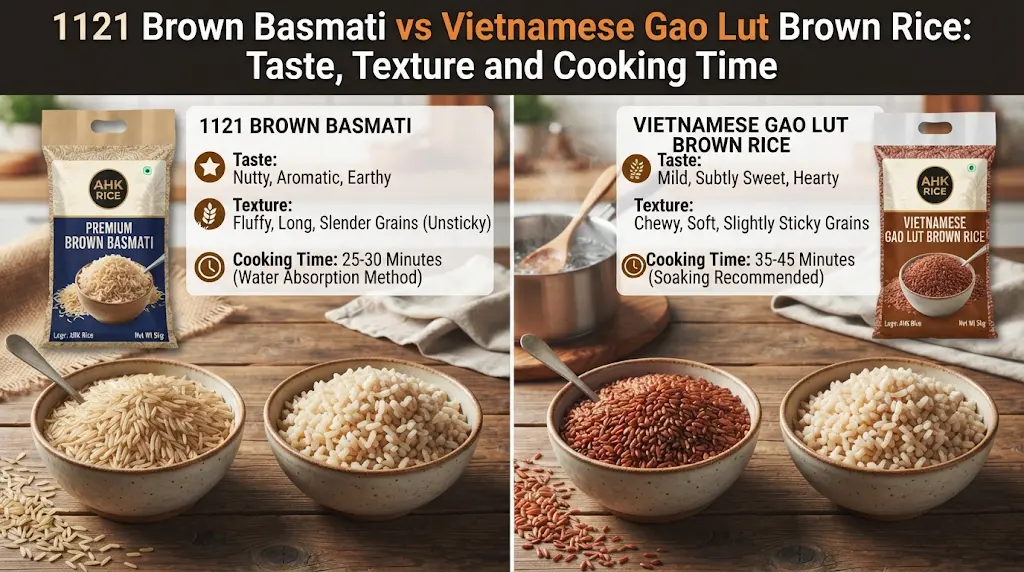
1121 Brown Basmati delivers a long, separate, aromatic grain with a firmer bite and a 2.0x to 2.5x elongation ratio, whereas Vietnamese Gao Lut brown rice cooks softer, slightly cohesive, and faster with a mild, sweet whole-grain profile.
Health-conscious buyers, speciality grocers, and foodservice operators often struggle to choose between whole-grain rice options that retain bran nutrients without sacrificing plate appeal or kitchen throughput. Understanding why health-conscious Vietnamese shoppers are discovering 1121 brown basmati rice helps explain how whole-grain demand is shifting beyond traditional local staples. Whole-grain milling leaves the lipid-rich bran intact, which changes water absorption, cooking time, aroma release, and oxidation rates across every variety.
What Are the Available Solutions for Whole-Grain Rice Buyers?
Whole-grain buyers can source 1121 Brown Basmati from Punjab or Vietnamese Gao Lut brown rice from the Mekong Delta, choosing between extra-long aromatic grains with high elongation or shorter-to-medium whole-grain rices prized for soft cohesion and lower entry pricing.
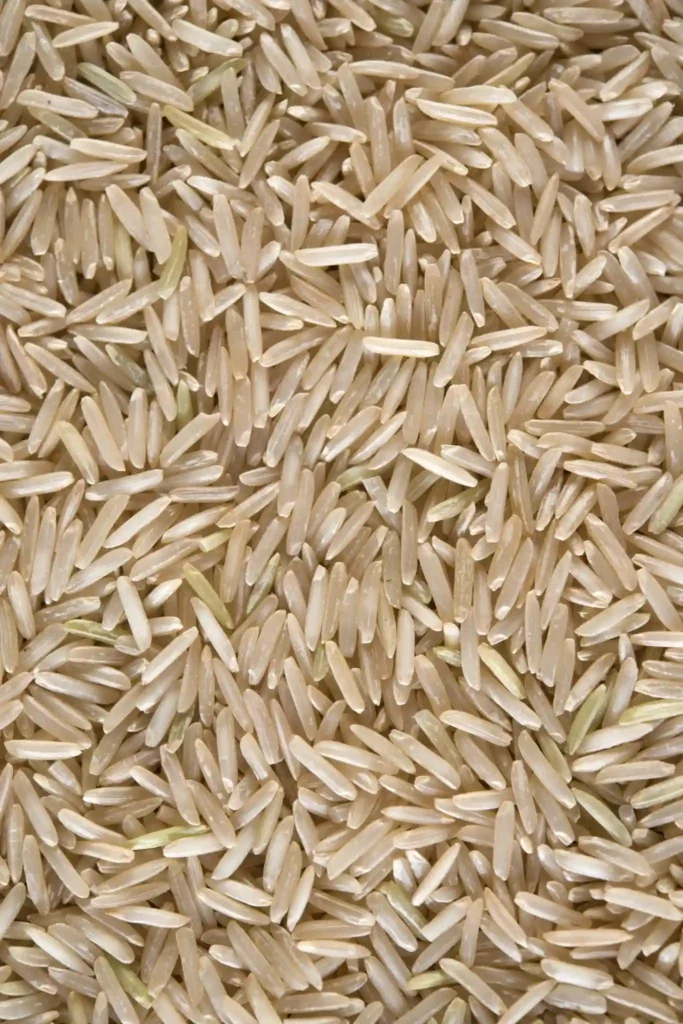
1121 Brown Basmati is dehusked paddy of the extra-long 1121 Basmati cultivar grown in the alluvial plains of Punjab, retaining its outer bran layer and germ without full white-rice polishing. For buyers evaluating 1121 Brown Basmati Rice, the core value lies in combining whole-grain nutrition with dramatic linear grain elongation (often exceeding 20 mm cooked) and a distinct nutty, floral aroma. Exporters such as AHK Rice process 1121, Super Kernel, and 1509 varieties from Punjab for more than 15 countries, offering end-to-end milling, custom packaging, and export documentation.
Vietnamese Gao Lut brown rice refers broadly in Vietnam to whole-grain dehusked rice (“gạo lứt”) milled from domestic long-grain, fragrant, or speciality pigmented/short-to-medium cultivars grown largely in the Mekong Delta. In Vietnamese culinary and wellness traditions, Gao Lut includes both standard light-brown whole grains and darker red/purple speciality rices associated with macrobiotic and health-focused diets.
Processors and importers also segment these two categories by post-harvest conditioning and packaging format. Raw brown rice retains maximum volatile aroma compounds and natural bran oils, while parboiled or lightly conditioned variants alter firmness and moisture stability. Retail pouches (1 kg to 5 kg), foodservice sacks (25 kg), and bulk export shipments (50 kg or containerised lots) determine how well bran oils are protected against heat and humidity during transit.
How Do Different Approaches Compare in Taste, Texture, Cooking Time, and Specs?
1121 Brown Basmati cooks into slender, non-sticky grains in roughly 25 to 35 minutes after soaking, while Vietnamese Gao Lut cooks into softer, slightly clinging grains in about 20 to 30 minutes with milder aroma and lower per-ton export pricing.
Taste, texture, and cooking time depend on starch composition, grain geometry, and bran thickness. 1121 Basmati carries intermediate amylose content (around 21% to 22% in standard 1121 profiles), which supports non-sticky grain separation and strong lengthwise elongation rather than excessive lateral swelling. When left as brown rice, the fibrous bran adds a pleasant chew while keeping individual kernels distinct on the plate.
Vietnamese Gao Lut spans multiple domestic cultivars, typically cooking to a softer, more tender bite with subtle sweetness and gentle cohesion. Because many Vietnamese fragrant and everyday rices have softer cooking profiles than extra-long 1121 Basmati, Gao Lut often integrates smoothly into Asian bowl meals, rice cookers, and macrobiotic dishes without feeling rigid.
Cooking time for any whole-grain rice is longer than white rice because water must penetrate the bran and aleurone layer before starch gelatinisation completes. Soaking 1121 Brown Basmati for 30 to 45 minutes shortens stovetop or steamer cooking time and reduces grain cracking. Vietnamese Gao Lut generally absorbs moisture slightly faster, especially when pre-soaked for 20 to 30 minutes, though dense red or heritage Gao Lut types can require longer simmering.
| Specification Attribute | 1121 Brown Basmati (Punjab) | Vietnamese Gao Lut Brown Rice |
| Raw Grain Length | Extra-long slender (typically ~8.0–8.4 mm) | Medium to long depending on cultivar (typically ~6.0–7.5 mm) |
| Cooked Elongation Ratio | High (approximately 2.0x–2.5x, reaching 20 mm+) | Moderate (typically ~1.5x–1.9x) |
| Cooked Texture | Firm, separate, non-sticky with bran chew | Tender to soft, lightly cohesive or sweet |
| Aroma Profile | Distinct nutty, floral Basmati aroma | Mild cereal or light fragrant note (cultivar-dependent) |
| Typical Cooking Time | ~25–35 minutes (shorter with 30–45 min soak) | ~20–30 minutes (varies by grain density/soak) |
| Indicative Export Price (2026) | Higher tier; benchmark 1121 FOB/export around $900–$1,200/MT depending on grade/crop | Lower tier; Vietnamese export/brown benchmarks generally ~$400–$600/MT range by grade |
| Ambient Shelf Life | ~6–9 months ambient; ~12+ months cool/vacuum/chilled | ~6–9 months ambient; ~12+ months cool/vacuum/chilled |
How Do Market Regions, Prices, and Shelf Life Compare?
South/Middle Eastern and international speciality corridors favour extra-long 1121 grades at higher per-MT prices, while Southeast Asian and domestic health channels favour accessible Gao Lut grades at lower per-MT prices, with both sharing a roughly 6-to-9-month ambient shelf life.
Market Grades and Regional Preferences
In export markets serving Middle Eastern, European, and international speciality buyers, buyers prioritise extra-long kernel length, low broken percentage (often 0% to 5%), uniform moisture control, and strong elongation after cooking. Within 1121 and broader Punjab basmati portfolios, importers compare raw, steam, and sella/parboiled grades alongside whole-grain brown options depending on culinary use and shelf stability goals.
In Vietnam and Southeast Asian health-food markets, buyers evaluate Gao Lut by grain uniformity, low broken count, cleanliness, and alignment with local wellness positioning. Retailers and health stores stock Gao Lut for everyday family bowls, weight-management shoppers, and macrobiotic consumers, while increasingly introducing imported whole-grain basmati as a premium, non-sticky alternative for modern kitchens.
Price per Metric Ton Comparison (2026)
Export pricing in 2026 reflects clear structural differences between extra-long 1121 Basmati and Vietnamese rice benchmarks. Market reports in 2026 show Pakistani 1121 Basmati export levels generally sitting in the upper tier (roughly $900 to $1,205/MT depending on processing, crop, and contract terms), whereas Vietnamese rice export indicators in late 2026 sit substantially lower (around $400 to $570/MT across standard white, fragrant, and broken export benchmarks, with domestic Grade 2 brown rice trading around 9,525–10,350 VND/kg).
Exact brown rice quotes depend on milling yield, broken tolerance, moisture percentage, packaging format, and freight lane. Because brown rice skips the final whitening pass that removes bran weight, milling recovery and moisture management (typically kept around or below 12% to 13.5% for safe storage) directly affect landed cost per metric ton.
Shelf Life Comparison Across Storage Conditions
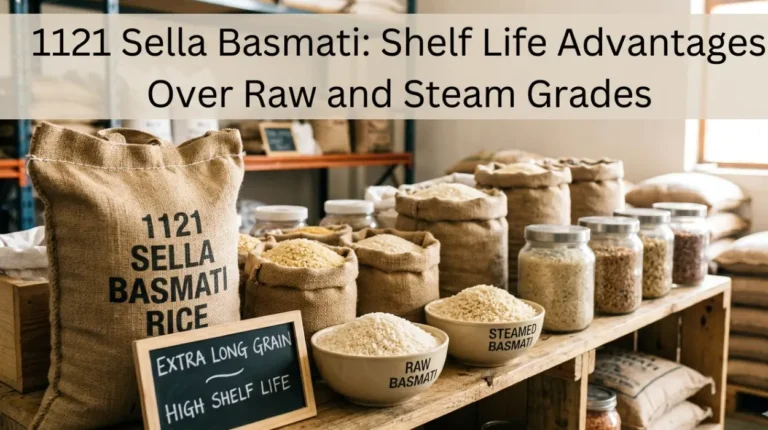
Both 1121 Brown Basmati and Vietnamese Gao Lut brown rice face the same biological constraint: bran oil oxidation. Once the outer hull is removed, natural lipids in the bran and germ begin interacting with oxygen, heat, and moisture over time.
Under typical ambient pantry or warehouse conditions, whole-grain brown rice generally maintains peak sensory quality for about 6 to 9 months, compared with 12 to 24+ months for milled white rice. Cool temperatures, low relative humidity, nitrogen flushing or vacuum/barrier retail pouches, and rapid inventory turnover extend usable quality closer to a full year.
Which Method Works Best for Different Cases?
Choose 1121 Brown Basmati when dishes demand elongated, separate grains and premium speciality positioning, and choose Vietnamese Gao Lut when menus or shoppers prioritise softer texture, local familiarity, or lower per-ton cost.
- Plated rice dishes, pilafs, and contemporary bowls: 1121 Brown Basmati holds long, slender kernels that stay distinct rather than clumping.
- Everyday rice-cooker meals and softer whole-grain bowls: Vietnamese Gao Lut provides a gentler bite that blends easily with steamed vegetables and savoury braises.
- High-turnover retail and health food shelves: Vacuum-sealed or barrier-packed brown rice in smaller consumer weights protects bran freshness before oxidation occurs.
- Cost-sensitive bulk and foodservice operations: Vietnamese Gao Lut offers lower base per-MT pricing, while 1121 Brown Basmati supports higher retail margins for speciality differentiation.
What Are the Pros and Cons of Each Option?
1121 Brown Basmati excels in grain length, elongation, and aromatic distinction but costs more per metric ton, whereas Vietnamese Gao Lut offers lower cost and softer cohesion but lacks extra-long basmati elongation.
1121 Brown Basmati Pros and Cons
- Pro — Extra-long elongation: Cooked kernels stretch well past 20 mm, visually elevating platters and bowls.
- Pro — Separate, non-sticky grain structure: Intermediate amylose helps grains stay individual even as whole-grain brown rice.
- Pro — Distinctive aroma: Natural basmati fragrance sets it apart from neutral whole-grain rices.
- Con — Higher price per MT: Commands a substantial price premium over standard and Vietnamese rice benchmarks.
- Con — Longer cooking and soaking window: Requires adequate hydration and simmering time for tender bran texture.
For example, a modern health-focused restaurant serving grain bowls with grilled meats or roasted vegetables gains strong visual presentation and clean separation from 1121 Brown Basmati. Conversely, a budget-driven canteen serving large daily volumes may find the higher per-MT cost harder to absorb without menu price adjustments.
Vietnamese Gao Lut Brown Rice Pros and Cons
- Pro — Competitive pricing: Lower per-MT export and domestic benchmarks support accessible retail and foodservice pricing.
- Pro — Familiar, softer bite: Cooks into a tender, approachable grain texture suited to everyday Asian meals.
- Pro — Variety of domestic profiles: Available across light-brown, fragrant, and darker speciality cultivars in Vietnam.
- Con — Lower elongation ratio: Does not match the dramatic lengthwise stretch of 1121 Basmati.
- Con — Bran oxidation risk: Like all brown rice, warm humid storage accelerates rancidity and staling if unsealed.
For example, a neighbourhood wellness grocer stocking daily macrobiotic staples can price Vietnamese Gao Lut affordably for repeat weekly buyers. However, if a customer expects long, airy, non-sticky basmati grains for a spiced rice dish, Gao Lut will cook softer and shorter.
What Decision Factors Should Buyers Weigh Before Sourcing?
Buyers should weigh target cooking texture, landed cost per metric ton, shelf-life turnover speed, packaging protection against bran oxidation, and market positioning before locking in a supply contract.
| Decision Factor | What to Evaluate Before Buying | You emphasise local wellness traditions and value | You emphasise local wellness traditions and value |
| Target Texture & Plate Look | Grain elongation, separation, and chew vs. soft cohesion | You want long, separate, non-sticky grains with aroma | You want softer, cohesive grains for everyday bowls |
| Landed Cost (USD/MT) | Raw grain cost, freight, duties, and retail/menu margin | Premium positioning supports higher per-MT cost | Lower per-MT cost is critical to unit economics |
| Shelf Life & Turnover | Warehouse climate, transit time, and inventory velocity | You pair whole-grain supply with tight stock rotation & good packaging | You turn stock quickly or use protective retail packs |
| Cooking Time & Prep | Kitchen prep window, soaking workflow, and equipment | Kitchens can accommodate soaking and ~25–35 min cooking | Quick, straightforward bowl prep is preferred |
| Brand Positioning | Specialty/imported health appeal vs. local staple familiarity | You differentiate with long-grain basmati heritage | You emphasize local wellness traditions and value |
For buyers evaluating how to launch or scale a dedicated store brand around whole-grain basmati, explore how to source private-label 1121 brown basmati rice for Vietnam health food stores with AHK Rice to plan packaging, specifications, and export execution.