How Indian and Pakistani Restaurants in Ho Chi Minh City Use 1121 Sella Basmati Rice
1121 Sella Basmati rice is an extra-long-grain aromatic rice cultivar that undergoes hydrothermal parboiling before milling. It features an average raw grain length of 8.30 to 8.40 millimetres and elongates up to 20 millimetres after cooking without breaking.
1121 Basmati is a hybrid rice cultivar developed from traditional Basmati breeding lines. The term “Sella” refers to the traditional South Asian parboiling method applied to paddy rice while the outer husk remains intact. During parboiling, water-soluble nutrients from the bran layer migrate into the starchy endosperm.
The starches inside the kernel undergo gelatinisation during thermal processing. Gelatinisation locks the internal starch structure into a rigid, translucent matrix. This structural transformation changes the raw kernel colour from chalky white to a pale cream or deep golden hue depending on steaming duration.
Indian and Pakistani restaurants in Ho Chi Minh City districts such as District 1, District 3, and District 7 rely on 1121 Sella for high-volume South Asian cuisine. Local Vietnamese rice varieties like ST25 or Jasmine contain higher amylopectin levels, which create a sticky texture unsuitable for layered rice dishes. 1121 Sella contains 22% to 25% amylose, ensuring every cooked kernel remains completely distinct, non-sticky, and firm under heavy spice gravies.
Where Is 1121 Sella Basmati Rice Grown?
1121 Sella Basmati rice is cultivated exclusively in the Indo-Gangetic Plain across Punjab, Pakistan, and northern India. The Kalar tract in Pakistani Punjab—spanning Sheikhupura, Gujranwala, Sialkot, and Narowal—provides the specific alluvial soil and climate required for authentic aroma development.
Authentic Basmati aroma comes from the chemical compound 2-acetyl-1-pyrroline (2-AP). The synthesis of 2-AP inside the rice plant requires cool night temperatures below 25°C during the grain-filling stage in October and November. Daytime temperatures must remain between 30°C and 35°C with high relative humidity.
The Kalar bowl in Punjab receives mineral-rich glacial meltwater from the Ravi and Chenab rivers. The clay-loam soil retains moisture while allowing proper root aeration during the 135-day to 145-day crop cycle.
In 2026, Pakistani Punjab remains a primary global origin for 1121 Sella exports. Exporters like AHK Rice source paddy directly from contracted farms across the Kalar tract to guarantee varietal purity above 95% before processing begins.
How Does 1121 Sella Basmati Processing Work Step by Step?
1121 Sella processing converts raw harvested paddy into hardened, parboiled kernels through 8 sequential mechanical and thermal stages. The process starts with paddy cleaning and soaking, moves through pressurised steaming and drying, and finishes with hulling, polishing, and optical sorting.
Step 1: Pre-Cleaning and Destoning
Raw paddy arrives at the milling facility containing 16% to 18% moisture alongside field impurities. Vibrating sieves, magnetic separators, and gravity destoners remove straw, dust, metal fragments, and stones.
Step 2: Hydrothermal Soaking
Clean paddy enters stainless steel soaking tanks filled with water heated to 65°C to 70°C. The grains soak for 6 to 8 hours until kernel moisture reaches 30% to 32%, saturating the starch granules completely.
Step 3: Pressurised Steaming
Drained paddy moves into pressurised steam vessels for 15 to 20 minutes at 1.5 to 2.0 bar pressure. This heat treatment gelatinises the starch, hardens the grain, and fixes the golden or creamy colour.
Step 4: Controlled Drying
Steamed paddy passes through multi-stage continuous flow dryers using hot air at 80°C to 90°C. The drying cycle reduces moisture content to 12.5% to 13.5% in two passes with a 12-hour tempering rest in between to prevent internal stress cracks.
Step 5: Dehusking
Dried paddy enters rubber-roll shellers that strip away the outer silica husk. Husk aspirators separate the loose hulls from the parboiled brown rice kernels.
Step 6: Abrasive and Friction Whitening
Parboiled brown rice passes through vertical abrasive whiteners and horizontal friction polishers. These machines remove the bran layers while preserving the hardened endosperm, resulting in less than 1% broken grains.
Step 7: Length Grading and Optical Sorting
Indented cylinder graders separate whole kernels from broken pieces based on exact millimetre length. High-definition RGB and infrared optical sorters eject discoloured, chalky, or immature kernels at rates exceeding 10 metric tons per hour.
Step 8: Moisture Stabilisation and Packaging
Finished rice rests in aerated storage bins for 48 hours to equalise grain temperature before automated weighing. Automated bagging lines pack the rice into 5 kg, 10 kg, 20 kg, or 50 kg polypropylene, non-woven, or jute bags.
What Are the Key Components and Available Grades of 1121 Basmati Rice?
1121 Basmati rice is categorised into 6 distinct commercial grades based on post-harvest thermal treatment and milling depth. These grades include Golden Sella, Creamy Sella, Steam, Raw White, Brown, and Broken rice, each engineered for specific culinary and commercial requirements.
Commercial kitchens in Ho Chi Minh City evaluate 1121 grades using 4 physical metrics: raw grain length, moisture content, broken grain percentage, and colour profile. Understanding these grade distinctions prevents texture failures during commercial batch cooking.
| Grade Name | Processing Method | Raw Grain Length | Moisture Content | Broken Limit | Color Profile | Primary Commercial Use |
| 1121 Golden Sella | Full Parboiling | 8.30–8.40 mm | 12.0%–13.0% | Under 1.0% | Deep Golden Yellow | Heavy dum biryani, catering, banquets |
| 1121 Creamy Sella | Controlled Parboiling | 8.30–8.40 mm | 12.0%–13.0% | Under 1.0% | Pale Ivory / Cream | Fine-dining restaurants, pulao, pilaf |
| 1121 Steam | Paddy Steaming (No Soak) | 8.30–8.40 mm | 12.5%–13.5% | Under 2.0% | Off-White / Translucent | Delicate curries, tandoori platters |
| 1121 White (Raw) | Direct Milling (Aged) | 8.25–8.35 mm | 12.0%–13.0% | Under 2.0% | Bright Chalky White | Retail packs, home cooking, steamed rice |
| 1121 Brown | Dehusking Only | 8.30–8.40 mm | 12.5%–13.5% | Under 2.0% | Tan / Light Brown | Health-focused menus, high-fibre bowls |
| 1121 Broken (Tibar/Dubar) | Size-Graded Milling Byproduct | 4.50–6.50 mm | 12.5%–13.5% | 100% Broken | White or Golden | Kheer, rice flour, economy meal boxes |
Hospitality buyers in Northern Vietnam face similar procurement choices when balancing grain durability against delicate aroma, a dynamic explored in detail in [1121 Sella vs 1121 Steam Basmati: Which Is Better for Biryani Restaurants in Hanoi?]. While Golden Sella dominates high-heat dum cooking due to its maximum thermal resistance, Creamy Sella provides a lighter visual presentation for upscale dining rooms.
What Are the Operational Benefits of 1121 Sella for Ho Chi Minh City Restaurants?
1121 Sella Basmati delivers 4 measurable operational advantages for South Asian restaurants in Ho Chi Minh City: 2.5x cooked volume expansion, zero grain breakage during stirring, 6-hour steam-table holding stability, and 24-month tropical shelf life.
Superior Cooked Volume Yield
One kilogram of dry 1121 Sella Basmati absorbs 2.2 to 2.5 litres of water during boiling. This hydration capacity produces 3.2 to 3.5 kilograms of cooked rice per raw kilogram, reducing per-plate food cost by 18% to 22% compared to standard long-grain rice.
Mechanical Shear Resistance
Commercial kitchen staff stir large 40-litre degchi pots using heavy metal paddles when layering marinated meats and saffron milk. Gelatinised starch gives 1121 Sella high tensile strength, preventing kernels from snapping or turning into paste under aggressive mixing.
Extended Steam-Table Holding
Restaurants in Ho Chi Minh City serving lunch buffets and late-night delivery orders hold cooked rice in electric warmers for hours. Unparboiled rice releases surface amylose and clumps within 45 minutes, whereas 1121 Sella retains individual grain separation for up to 6 hours at 65°C.
Tropical Climate Shelf Stability
Ho Chi Minh City maintains year-round ambient temperatures between 28°C and 34°C with 75% to 85% relative humidity. Parboiling destroys insect eggs during the 70°C soaking stage and hardens the outer kernel against weevil penetration, extending warehouse shelf life to 24 months.
How Do Indian and Pakistani Restaurants in Ho Chi Minh City Use 1121 Sella?
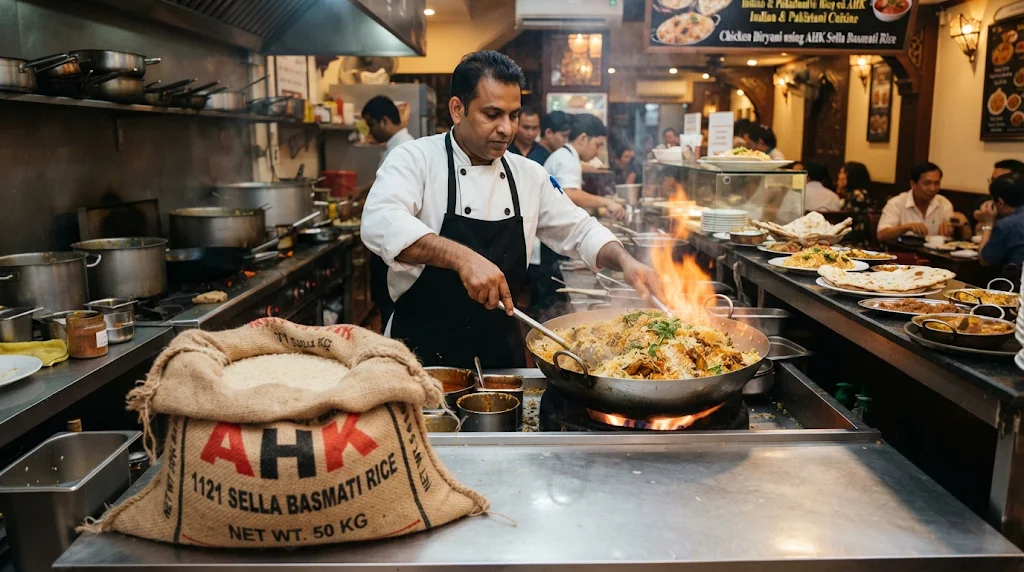
Restaurants across Ho Chi Minh City use 1121 Sella Basmati across 5 primary kitchen applications: Hyderabadi and Karachi dum biryani, aromatic pulao, buffet service, delivery meal boxes, and banquet catering.
Authentic Dum Biryani Preparation
Chefs soak 1121 Sella for 45 to 60 minutes in room-temperature water before par-boiling it to 75% doneness in salted water with whole spices like green cardamom, bay leaves, and cloves. They layer the par-boiled rice over spiced mutton or chicken in heavy-bottomed copper pots, seal the lid with dough, and steam over low heat for 35 minutes. The grains absorb meat juices without losing their elongated structure.
Yakhni and Zafrani Pulao
Pakistani restaurants in District 1 and Ben Thanh areas simmer 1121 Sella directly in concentrated bone broth (yakhni) or saffron-infused stock. Because the starch is pre-gelatinised, the rice absorbs rich fats and broths evenly without becoming greasy or mushy.
High-Volume Corporate Lunch Buffets
South Asian eateries serving expatriate offices in District 1 and Thu Duc City rely on 1121 Sella for daily lunch buffets. Kitchens batch-cook 25 kilograms of plain jeera (cumin) rice at 10:30 AM and serve it continuously until 2:30 PM without texture degradation.
Food Delivery App Orders (GrabFood and ShopeeFood)
Delivery orders in Ho Chi Minh City travel 20 to 40 minutes inside sealed plastic or foil containers in hot motorbike boxes. 1121 Sella resists condensation softening inside closed containers, ensuring the biryani arrives fluffy at the customer’s door.
Large-Scale Indian Wedding and Event Catering
Event caterers servicing destination Indian weddings at Saigon riverside hotels cook 1121 Sella in 100-kilogram batches. The predictable water-to-rice ratio eliminates batch-to-batch inconsistency across multi-day wedding functions.
Which Global Markets Import 1121 Sella Basmati Rice?
Global import demand for 1121 Sella Basmati is led by the Middle East, Europe, North America, and emerging Southeast Asian hubs like Vietnam. In 2026, Gulf Cooperation Council (GCC) countries absorb over 60% of Pakistani Basmati exports, while Vietnam shows accelerating trial and container adoption.
- Middle East (Saudi Arabia, UAE, Iraq, Kuwait, Qatar): Saudi Arabia and the UAE represent the largest volume buyers globally, importing hundreds of thousands of metric tons annually for traditional dishes like Kabsa, Mandi, and Majboos.
- European Union and United Kingdom: The UK, Germany, Netherlands, and Belgium import high-purity 1121 Sella under strict Maximum Residue Limit (MRL) pesticide compliance for ethnic retail chains and curry houses.
- North America (United States and Canada): Importers in New Jersey, Texas, California, and Ontario distribute 1121 Sella in 10 lb and 20 lb retail bags alongside 40 lb foodservice sacks.
- Vietnam (Ho Chi Minh City and Hanoi): 2026 trade data confirms steady Pakistan-to-Vietnam Basmati shipments entering Cat Lai Port in Ho Chi Minh City. Pakistani suppliers account for over 50% of recorded Basmati shipments into Vietnam, driven by expanding Indian tourism, expatriate communities, and speciality restaurants.
What Certifications Apply to 1121 Sella Basmati Rice Exports?
Exporting 1121 Sella Basmati from Pakistan to Vietnam requires 7 mandatory food safety, phytosanitary, and trade compliance certifications. These documents verify hygiene standards, pest-free status, and origin authenticity for Vietnamese customs clearance.
- ISO 22000 (Food Safety Management System): Certifies that the milling and parboiling facility controls food safety hazards across the entire production chain.
- HACCP (Hazard Analysis and Critical Control Points): Verifies preventive controls against biological, chemical, and physical contamination during soaking, steaming, and packaging.
- GMP (Good Manufacturing Practices): Confirms sanitary facility design, pest control, and worker hygiene standards inside the processing plant.
- Phytosanitary Certificate: Issued by the Department of Plant Protection (DPP) in Pakistan, certifying the consignment is free from quarantine pests, soil, and weed seeds.
- Fumigation Certificate: Confirms pre-shipment treatment with phosphine or methyl bromide inside the shipping container to eliminate storage insects during sea transit.
- Halal Certification: Issued by accredited Islamic certification bodies, verifying zero cross-contamination with non-Halal substances for Muslim-owned restaurants.
- Certificate of Origin (Form A / COO): Issued by the local Chamber of Commerce to authenticate Pakistani origin and determine applicable import tariff rates in Vietnam.
What Are Common Problems and Misconceptions About 1121 Sella Basmati Rice?
Buyers and chefs frequently encounter 4 misconceptions regarding 1121 Sella: confusing it with chemically bleached rice, under-soaking dry grains before cooking, expecting strong raw aroma, and misidentifying Sella as a separate botanical species.
Misconception 1: Golden Sella Contains Artificial Yellow Dye
Many first-time buyers assume the yellow colour of 1121 Golden Sella comes from turmeric or synthetic food colouring. The golden hue is 100% natural, resulting from Maillard reactions between amino acids and reducing sugars in the rice bran during pressurised steaming.
Misconception 2: Sella Cooks Using the Same Water Ratio as White Rice
Chefs accustomed to raw white Basmati often soak 1121 Sella for only 15 minutes and use a 1:1.5 water ratio. Because parboiled starch is densely gelatinised, under-soaked Sella remains hard in the centre. Chefs must soak 1121 Sella for a full 45 to 60 minutes and boil it in excess water (1:4 ratio) before draining.
Misconception 3: Weak Raw Aroma Means Low Quality
Raw 1121 Sella smells milder in the dry bag than raw white Basmati because thermal steaming encapsulates volatile 2-AP aroma compounds inside the hardened starch matrix. The authentic nutty Basmati fragrance releases fully once the grain hydrates and expands in boiling water.
Misconception 4: Sella Is a Different Rice Variety Than 1121 Steam
Sella and Steam are processing methods, not botanical varieties. Both products originate from the same 1121 paddy seed harvested in Punjab. An exporter like AHK Rice processes the same raw 1121 paddy into White, Steam, Creamy Sella, or Golden Sella depending on buyer specifications.