1121 Creamy Sella Buffet Holding Time for Hotels
How long can 1121 creamy sella rice stay on a hotel buffet in China?
For best texture, serve 1121 creamy sella rice within 30–60 minutes of cooking, while keeping it at or above 60°C; do not treat this as a universal legal limit, because Chinese food-safety controls, the hotel’s HACCP plan and local inspection requirements determine the final holding procedure. Long holding gradually reduces the rice’s fresh aroma, increases surface drying and can make grains firmer or sticky as starch retrogrades. A covered, thermostatically controlled bain-marie or rice warmer is preferable to an open tray. Hotels should record cooking, transfer and discard times, measure the food temperature with a calibrated probe and avoid topping up an old batch with newly cooked rice.
Cooked rice is a time-and-temperature-controlled food. Parboiled rice may remain visibly separate for longer than ordinary white rice, but its resilience does not make indefinite buffet holding safe. If the rice falls below the site’s approved hot-holding limit, staff should follow the documented corrective action rather than repeatedly reheating it. The safest operating target is a short service window, small replenishment batches and rapid removal at the end of service.
What is 1121 creamy sella basmati rice?
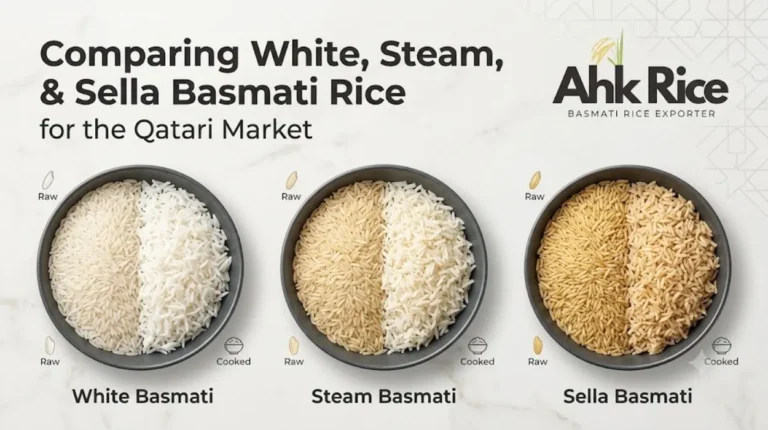
1121 creamy sella is a very long-grain basmati type that has been parboiled, dried and milled, producing a naturally cream-coloured appearance and a firm, separate cooked texture. “1121” is a commercial variety or breeding designation used in the South Asian rice trade, not a cooking method. “Sella” means parboiled processing, in which paddy is hydrothermally treated before milling. “Creamy” describes the characteristic pale cream colour associated with the product, although colour can vary between mills, crops and specifications.
Commercial listings commonly report an average raw grain length of about 8.2–8.35 mm, maximum moisture near 12–12.5% and broken rice near 1% for premium specifications, but these are contract parameters rather than a single universal standard. Other offers use different purity, broken, moisture and admixture limits. Buyers should therefore rely on an agreed specification, laboratory certificate and representative pre-shipment sample rather than the product name alone.
Where is basmati rice grown and why does origin matter?
Basmati is associated with the Himalayan foothills of India and Pakistan, where seasonal temperature patterns, alluvial soils and traditional varieties contribute to its aroma and grain quality. Pakistan’s principal basmati-producing area lies in Punjab, while Indian production is concentrated in northern states including Punjab, Haryana, Himachal Pradesh, Uttarakhand, Uttar Pradesh and Jammu and Kashmir. The crop is generally grown in warm conditions with ample water during establishment and grain filling, followed by drier weather as the crop matures.
Rice performs best in level fields with reliable irrigation, adequate fertility and soils capable of retaining water without prolonged uncontrolled flooding. Excess nitrogen can increase lodging, delay maturity and affect grain quality, while poorly managed irrigation can reduce yield and encourage disease. Basmati quality also depends on genotype, crop maturity, harvest timing, drying and storage, so geographical origin alone cannot guarantee aroma or buffet performance.
How is 1121 creamy sella rice cultivated and harvested?
Production normally progresses from certified or selected seed to nursery establishment, field transplanting or direct sowing, managed irrigation, weed and pest control, drainage before harvest and mechanical or manual harvesting at physiological maturity. Farmers prepare a level seedbed and establish seedlings or sow directly, depending on local practice. Water management is adjusted to crop stage rather than maintaining unnecessary deep flooding throughout the season. Nutrient applications should follow soil testing and local agronomic advice, particularly for nitrogen.
The crop is harvested when panicles and grains have matured sufficiently to limit immature kernels and field losses. Harvesting too early raises chalky and immature grain percentages; harvesting too late can increase shattering, weather damage and lodging. Paddy is cleaned and dried promptly after harvest because high moisture encourages mould, heating and quality deterioration during storage.
How is creamy sella rice processed from paddy to export product?
Sella processing follows a controlled sequence: intake inspection, cleaning, soaking, steaming or hydrothermal treatment, drying, dehusking, separation, whitening, polishing, grading, optical sorting, metal detection and packing. First, the mill samples incoming paddy for moisture, varietal purity, foreign matter, immature grains, insects and visible damage. Stones, straw, dust and other materials are removed by pre-cleaners, sieves, aspiration and destoners. The cleaned paddy is then soaked so water penetrates the kernel before steaming or another validated parboiling treatment gelatinises part of the starch.
After parboiling, the grain is dried in controlled stages to a stable storage moisture. Drying too rapidly can create fissures and increase breakage during milling. Rubber-roll hullers remove the husk, and paddy separators recover unhulled grains. Whitening removes bran layers, polishing adjusts appearance, and length graders separate head rice from brokens. Optical sorters remove discoloured or defective kernels, while final checks confirm net weight, foreign matter, moisture, packaging integrity and traceability.
Which specifications affect buffet texture?
Buffet performance depends chiefly on variety, parboiling severity, moisture, head-rice percentage, milling quality, cooking ratio, post-cook temperature and holding time rather than grain length alone. Long, intact kernels generally produce a more attractive buffet presentation and tolerate stirring better than broken rice. Excess brokens release more surface starch, increasing clumping and pastiness. A moisture level around 12–12.5% is frequently specified for export lots, but the correct value must follow the contract and storage conditions.
Parboiling strengthens the kernel and drives nutrients towards the interior, which helps reduce breakage and supports a separate cooked result. Under-parboiling can leave inconsistent texture and more fragile grains; over-processing can reduce aroma or create an excessively firm bite. Hotels should assess cooked yield, elongation, aroma, firmness after 30, 60 and 90 minutes, and the proportion of clumped or split grains.
How should hotels cook 1121 creamy sella for a buffet?
Hotels should rinse according to the supplier’s instructions, use a validated water-to-rice ratio, cook until the centre is tender, rest briefly, fluff gently and transfer immediately to a covered hot-holding unit. Sella rice often needs soaking or a slightly longer cooking period than ordinary white rice, but the required method varies with parboiling intensity, equipment, batch size and desired dish. A kitchen should establish its own recipe through controlled trials rather than copying a ratio from a different product.
Use a broad, heavy vessel or commercial rice cooker that distributes heat evenly. Avoid aggressive stirring, which breaks grains and spreads starch. After cooking, a short covered rest allows moisture to equalise before gentle separation with a clean paddle. For buffet service, shallow pans and smaller replenishment batches usually preserve texture better than one deep pan held for several hours.
What causes texture deterioration during buffet holding?
The main causes are moisture migration, evaporation, starch retrogradation, mechanical handling, uneven heating and repeated temperature fluctuations. Evaporation dries exposed grains, especially around the edges and surface. Condensation under a lid can then create wet patches, while the centre remains comparatively dry. Starch retrogradation, the reassociation of starch molecules after cooking, gradually produces a firmer or less fluffy mouthfeel.
Overfilled pans restrict heat circulation and encourage cold spots. Excessive steam can make grains swollen and sticky, while dry heat causes crusting. Repeated scraping damages long kernels and releases starch. Quality improves when staff keep pans covered, minimise lid opening, rotate stock under a documented system and replace rather than mix batches.
What food-safety controls apply to hotel rice service in China?
Hotels should operate to China’s applicable food-safety requirements and their approved HACCP-based controls, with validated hot-holding temperatures, time records, clean utensils, calibrated thermometers and defined discard rules. The exact requirement can depend on the food-service operation, municipality, inspection interpretation and current national or local standards. A supplier certificate does not replace the hotel’s responsibility for safe cooking, holding and service.
Rice should be cooked in a hygienic area, protected from raw-food contamination and transferred using clean equipment. Staff should measure the internal temperature of the food, not merely the warmer’s display. If a batch enters the danger range or exceeds the approved time, the corrective action should be recorded and the batch discarded where required. Cooling and reuse require a separate validated procedure; simply placing a warm tray in a refrigerator is not adequate rapid cooling.
Which defects should buyers reject or investigate?
Common warning signs include musty odour, insect activity, excessive brokens, chalky or immature grains, red streaks, blackened kernels, foreign matter, inconsistent colour, high moisture and poor cooking uniformity. A small amount of natural variation may be permitted by contract, but visible defects can indicate weak cleaning, poor drying, storage damage or inadequate sorting. Off-odours should never be masked with spices or sauces.
Buyers should compare the certificate of analysis with an independent sample when the shipment is commercially significant. Useful checks include moisture, broken percentage, foreign matter, damaged and discoloured grains, pesticide residues, heavy metals where relevant, microbiological indicators for processed products and authenticity or varietal testing when origin claims matter. Packaging should be food-contact suitable, sealed against moisture and clearly marked with lot identification, origin, packing date and best-before information as required.
Which countries import basmati and what does this mean for China?
Basmati is traded widely across the Gulf, Middle East, Europe, North America, Africa and Asia, while China has its own rice supply, import controls and consumer preferences that must be assessed separately. Export destinations reported for 1121 products commonly include Gulf and Middle Eastern markets such as Saudi Arabia, the United Arab Emirates, Qatar, Kuwait, Oman, Iraq and Jordan, alongside African and other international markets. FAO forecasts published for 2025 described global rice trade as reaching a record or near-record level depending on the forecast edition, while noting changing export conditions among major suppliers.
For China, importers and hotels should verify the current tariff classification, approved overseas establishment or supplier requirements where applicable, Chinese-language labelling, residue and contaminant limits, phytosanitary documentation, customs declarations and any inspection requirements in force at the time of shipment. Requirements can change, so importers should confirm them with China’s competent authorities and customs broker before contracting. A product specification suitable for the Gulf or UK is not automatically compliant for China.
How should hotels validate a supplier and a buffet recipe?
Validation should combine documentary checks, laboratory testing, a representative cooking trial and measured holding tests conducted in the hotel’s actual equipment. Request the technical specification, certificate of analysis, lot traceability, country-of-origin documentation, allergen statement where required and evidence of the supplier’s food-safety system. Certifications such as HACCP or ISO 22000 can support supplier evaluation, but their scope, issuing body and current validity must be checked.
During the trial, record raw grain length, broken percentage, cooked yield, water uptake, cooking time, aroma, firmness, clumping and appearance at defined holding intervals. Test both a freshly cooked batch and a normal production-sized batch because scale changes heat distribution. Approve the lot only when it meets the kitchen’s sensory, safety and cost requirements, then review performance whenever the crop, mill, packaging or cooking equipment changes.
What is the practical recommendation for 1121 creamy sella buffet service?
Use premium, well-sorted 1121 creamy sella, cook it with a validated hotel recipe, hold it covered at the approved hot temperature, serve in small batches and target consumption within 30–60 minutes for the best texture. This interval is a quality recommendation, not a substitute for China’s food-safety rules or the hotel’s documented control plan. Longer service can be possible when equipment and controls are validated, but texture generally declines as exposure time increases.
The most reliable operating model is batch cooking matched to demand, rapid transfer to a clean covered warmer, minimal agitation and strict time-and-temperature records. If guests require rice throughout a long service, staggered production usually gives better results than holding one large batch. The final decision should be based on measured safety performance, cooked-rice texture and the current requirements governing the Chinese food-service operation.
Frequently asked questions about 1121 creamy sella buffet holding
Is 1121 creamy sella rice suitable for hotel buffets?
Yes, 1121 creamy sella is generally suitable for hotel buffets because parboiling produces long, firm grains that resist breakage and remain relatively separate. Suitability still depends on the specific lot, cooking method, holding equipment and food-safety controls. A kitchen trial should confirm texture, yield, aroma and appearance before menu approval.
How long should cooked basmati rice be kept warm?
For best quality, use cooked 1121 basmati within 30–60 minutes, while maintaining the hotel’s approved hot-holding temperature. This is a quality target rather than a universal legal rule. Local Chinese requirements and the site’s HACCP plan may set different controls, so staff must follow the documented time-and-temperature procedure.
Why does sella rice become hard on a buffet?
Sella rice becomes hard mainly because exposed moisture evaporates and cooked starch gradually retrogrades during holding. Dry heat, oversized pans, frequent lid opening and insufficient steam accelerate the change. Covered service, smaller batches, gentle handling and correctly regulated holding equipment help preserve a tender, separate texture.
What is the difference between 1121 sella and ordinary basmati rice?
1121 identifies a long-grain commercial variety, while sella identifies parboiled processing. Ordinary basmati may be raw milled rice rather than parboiled rice, and it can cook more softly or require a different water ratio. The two terms describe different attributes and should not be treated as interchangeable grades.
What should Chinese hotels check before importing 1121 creamy sella?
Chinese hotels or importers should check the current import classification, approved supplier and establishment requirements, Chinese labelling, residue and contaminant limits, phytosanitary documents, lot traceability and customs procedures. They should also verify the supplier’s specification and certificate of analysis, then conduct a local cooking and buffet-holding trial before purchase.