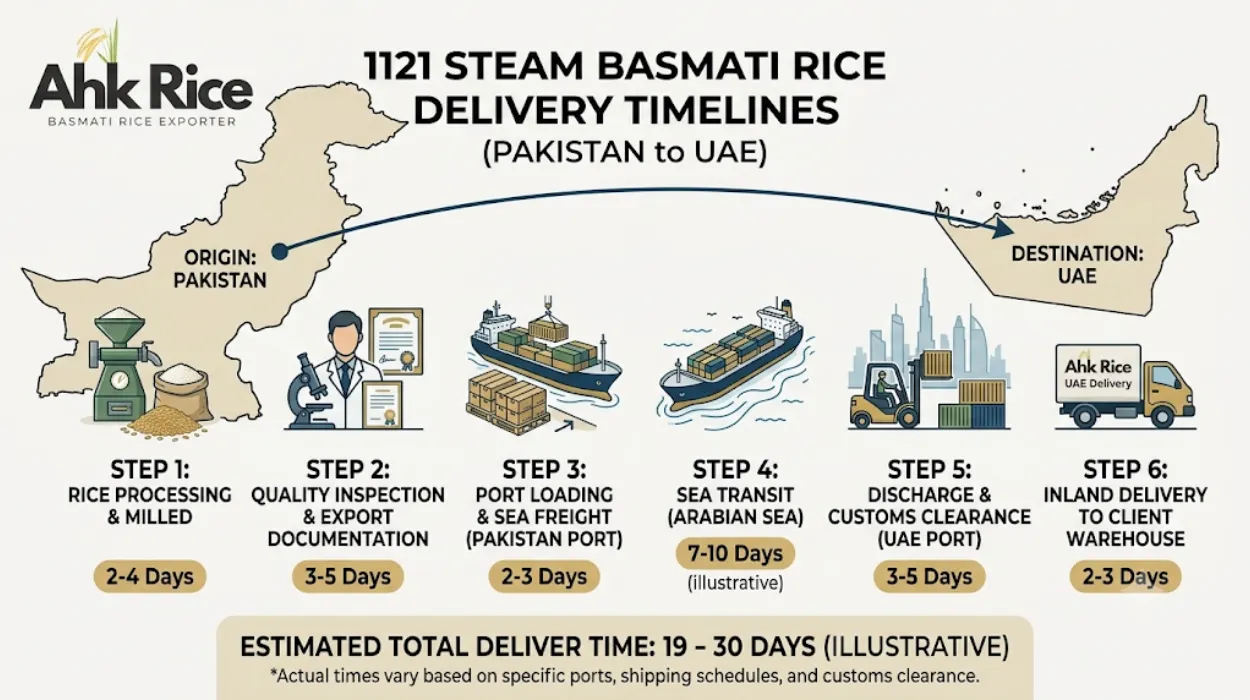
1121 Steam Basmati Rice Delivery Timelines from Pakistan to UAE
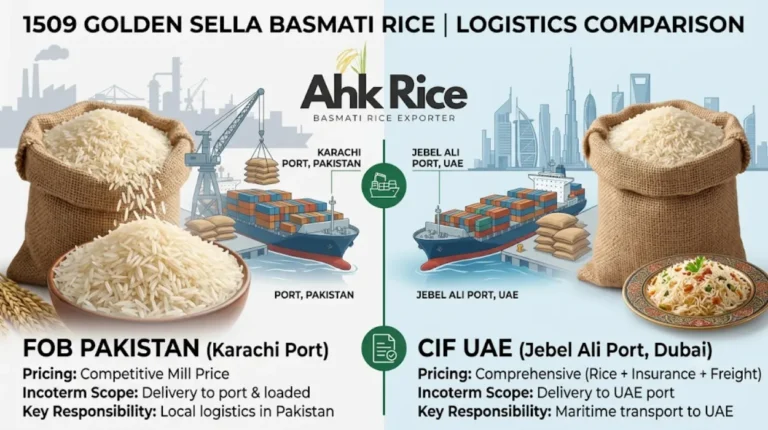
1121 Steam Basmati Rice typically reaches UAE buyers within 12–22 days from order confirmation. Here is why: Pakistan offers short sea routes to Gulf ports, frequent vessel schedules, and established rice export infrastructure. Delivery speed depends on processing readiness, container availability, customs clearance, and destination port operations.
UAE importers evaluate delivery timelines before selecting suppliers because inventory planning directly affects profitability. 1121 Steam Basmati Rice remains one of the most imported premium rice categories across Dubai, Abu Dhabi, Sharjah, and Northern Emirates due to its extra-long grain, strong aroma, and high cooking expansion.
Understanding delivery timelines requires understanding processing schedules, logistics options, transit methods, and destination requirements. Buyers seeking foundational knowledge about Pakistani Basmati varieties can first explore our guide on understanding 1121 Steam Basmati Rice specifications and export grades.
AHK Rice, a Pakistani Basmati exporter based in Punjab, supplies 1121 Steam, Super Kernel, and 1509 varieties through end-to-end processing, custom packaging, and international export operations.
What delivery solutions are available for shipping 1121 Steam Basmati Rice to the UAE?
The main options are full-container shipping, consolidated cargo, ready-stock dispatch, and contract-based scheduled shipments, with delivery ranging from 12 to 22 days depending on inventory status and logistics planning.
Rice exporters use multiple shipping models because UAE buyers have different purchasing volumes.
Ready Stock Shipments
Ready-stock shipments offer the fastest solution.
Rice is already milled, graded, packed, inspected, and prepared for loading. Exporters only arrange vessel booking and customs clearance.
Typical delivery timeline:
| Stage | Days |
|---|---|
| Documentation | 1–2 |
| Loading | 1–2 |
| Sea Transit | 5–8 |
| UAE Clearance | 2–4 |
| Total | 9–16 Days |
Full Container Load (FCL)
FCL shipping suits wholesalers and distributors purchasing 20–27 MT.
One buyer occupies the entire container. Documentation remains simpler and unloading is faster.
Less than Container Load (LCL)
LCL shipping suits smaller importers.
Several buyers share one container. Consolidation adds handling time.
Typical delivery extends by three to seven days.
Scheduled Contract Shipments
Scheduled contracts suit supermarkets and foodservice distributors.
Exporters reserve processing capacity and vessel schedules in advance. Delivery consistency improves significantly throughout the year.
With shipping solutions explained, the next question is how these methods compare in performance and cost.
How do different delivery approaches compare?
Ready-stock FCL shipments provide the fastest delivery, scheduled contracts provide the highest consistency, and LCL shipments provide the lowest entry cost for smaller buyers.
Specification Comparison Table
| Attribute | Ready Stock FCL | Production-Based FCL | LCL Shipment |
|---|---|---|---|
| Order Volume | 20–27 MT | 20–27 MT | 1–15 MT |
| Processing Time | 0–3 Days | 7–15 Days | 0–5 Days |
| Loading Time | 1–2 Days | 1–2 Days | 2–5 Days |
| Transit Time | 5–8 Days | 5–8 Days | 6–10 Days |
| Customs Handling | Standard | Standard | Extended |
| Delivery Reliability | High | Medium | Medium |
| Total Timeline | 9–16 Days | 15–25 Days | 14–22 Days |
Production-based shipments require additional processing.
Rice must be cleaned, polished, graded, sorted, packed, tested, and certified before dispatch.
LCL shipments reduce inventory investment.
Additional consolidation procedures increase transit variability. UAE buyers often experience arrival differences of several days.
Ready-stock containers provide the most predictable schedule. Importers preparing seasonal promotions often choose this method.
With delivery methods compared, the next question becomes which option works best for specific buyer requirements.
Which delivery method works best for different UAE buyers?
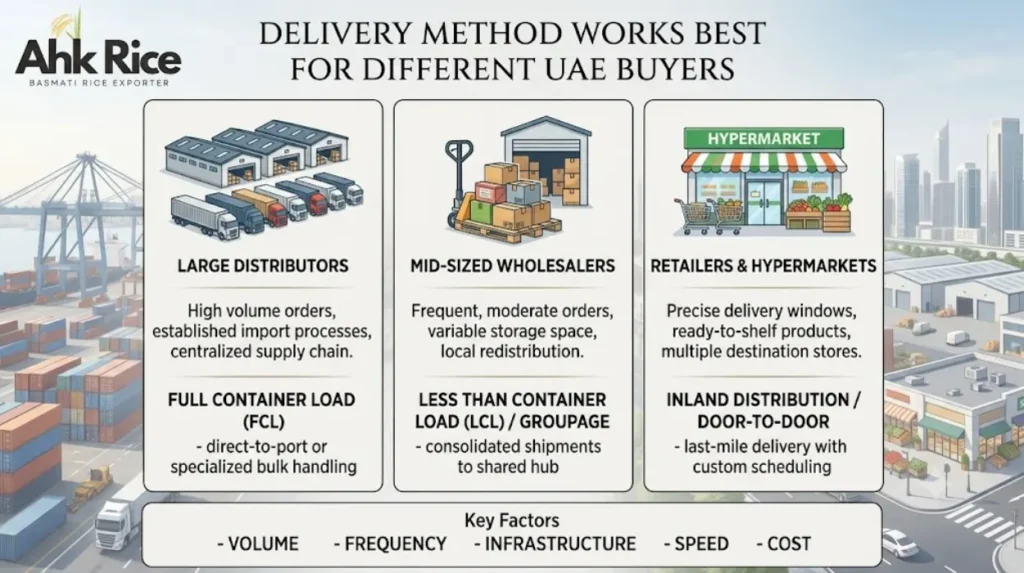
Distributors benefit from FCL shipments, supermarkets benefit from scheduled contracts, and smaller traders benefit from LCL cargo because each option aligns with inventory requirements and purchasing volume.
UAE Distributor Example
Dubai distributors commonly purchase 20-foot containers.
FCL shipping minimizes handling. Product reaches warehouses quickly. Distribution begins immediately after customs release.
Supermarket Supply Example
Retail chains require inventory consistency.
Scheduled contracts maintain predictable monthly arrivals. Stock shortages become less frequent.
Catering and Hospitality Example
Hotels and restaurants often prioritize uninterrupted supply.
Contract shipments provide stable replenishment schedules throughout the year.
Small Importer Example
New market entrants frequently test demand first.
LCL shipments reduce upfront investment. Importers validate consumer demand before ordering full containers.
Market Preference Comparison
| Market Region | Preferred Grade | Typical Purchase Style |
|---|---|---|
| UAE Retail Sector | 1121 Steam Premium | Scheduled Contracts |
| UAE Wholesale Market | 1121 Steam Standard | FCL Containers |
| GCC Foodservice | 1121 Steam Export Grade | FCL Containers |
| Independent Traders | Mixed Steam Grades | LCL Cargo |
Different buyers require different logistics strategies. The next section evaluates advantages and disadvantages of each approach.
What are the pros and cons of each delivery solution?
FCL offers speed and control, LCL offers flexibility, and scheduled contracts offer consistency. Each approach solves a different operational challenge.
FCL Advantages
- Faster unloading
- Lower handling risk
- Better shipment visibility
- Simplified customs procedures
FCL Limitations
- Higher inventory commitment
- Larger capital requirement
- Full container purchasing obligation
LCL Advantages
- Lower initial investment
- Flexible purchasing volume
- Market testing opportunity
LCL Limitations
- Longer consolidation periods
- Increased handling exposure
- Less predictable arrival schedules
Scheduled Contract Advantages
- Consistent inventory flow
- Better forecasting accuracy
- Reduced stockout risk
Scheduled Contract Limitations
- Longer planning cycle
- Forecast commitment requirements
- Fixed procurement schedules
Example comparison:
FCL arrives faster than LCL. A Dubai wholesaler may receive stock within 12 days. An LCL shipment may require 18 days.
Scheduled contracts outperform spot purchases in inventory planning. Retailers maintain shelf availability throughout peak demand periods.
With strengths and weaknesses established, the next question focuses on pricing and shelf-life considerations.
How do price and shelf life compare across purchasing approaches?
Larger shipments reduce per-ton logistics costs, while all properly stored 1121 Steam Basmati Rice maintains quality for approximately 12 months.
Price Per Metric Ton Comparison
| Purchase Method | Estimated Logistics Cost Impact |
|---|---|
| FCL Container | Lowest per MT |
| Scheduled FCL | Moderate per MT |
| LCL Cargo | Highest per MT |
Container utilization directly affects logistics efficiency.
Full containers spread transportation costs across more rice. Smaller shipments carry proportionally higher expenses.
Shelf Life Comparison
| Product Type | Shelf Life |
|---|---|
| 1121 Steam Basmati Rice | 12 Months |
| Premium Aged 1121 Steam | 12–18 Months |
| Vacuum Packed Retail Rice | 18–24 Months |
Storage conditions influence quality preservation.
Temperature control, moisture management, and warehouse hygiene maintain grain integrity throughout storage periods.
Pakistan exported significant rice volumes to Gulf markets during recent years, reinforcing UAE supply chain reliability (source: Pakistan Bureau of Statistics, FY2024-25).
Pricing and storage considerations lead directly into buyer decision factors.
What factors should buyers evaluate before selecting a delivery option?
Order size, urgency, inventory turnover, warehouse capacity, and procurement strategy determine the best delivery solution for UAE importers.
Decision Framework
| Decision Factor | Best Option |
|---|---|
| Immediate Requirement | Ready Stock FCL |
| Lowest Investment | LCL Cargo |
| Consistent Monthly Demand | Scheduled Contract |
| Large Wholesale Distribution | FCL Container |
| Retail Chain Supply | Scheduled Contract |
Key Evaluation Steps
- Determine monthly consumption.
- Calculate warehouse capacity.
- Select required packaging.
- Confirm delivery deadline.
- Reserve vessel schedules.
- Verify documentation requirements.
- Monitor customs procedures.
Importers with stable demand patterns usually achieve better planning through scheduled procurement.
Buyers facing urgent inventory shortages typically benefit from ready-stock shipments.
Understanding these decision factors creates a clear framework for evaluating suppliers and delivery schedules.
Frequently Asked Questions
How long does 1121 Steam Basmati Rice take to reach UAE from Pakistan?
1121 Steam Basmati Rice usually arrives within 12–22 days. Ready-stock containers can arrive in as little as 9–16 days.
Which UAE ports receive Pakistani rice shipments?
Major destinations include Jebel Ali, Khalifa Port, Sharjah Port, and Hamriyah Port.
Is FCL faster than LCL shipping?
Yes. FCL shipments avoid consolidation delays and generally arrive several days earlier.
What shipment size fits a 20-foot container?
A 20-foot container typically loads 24–27 metric tons depending on packaging format.