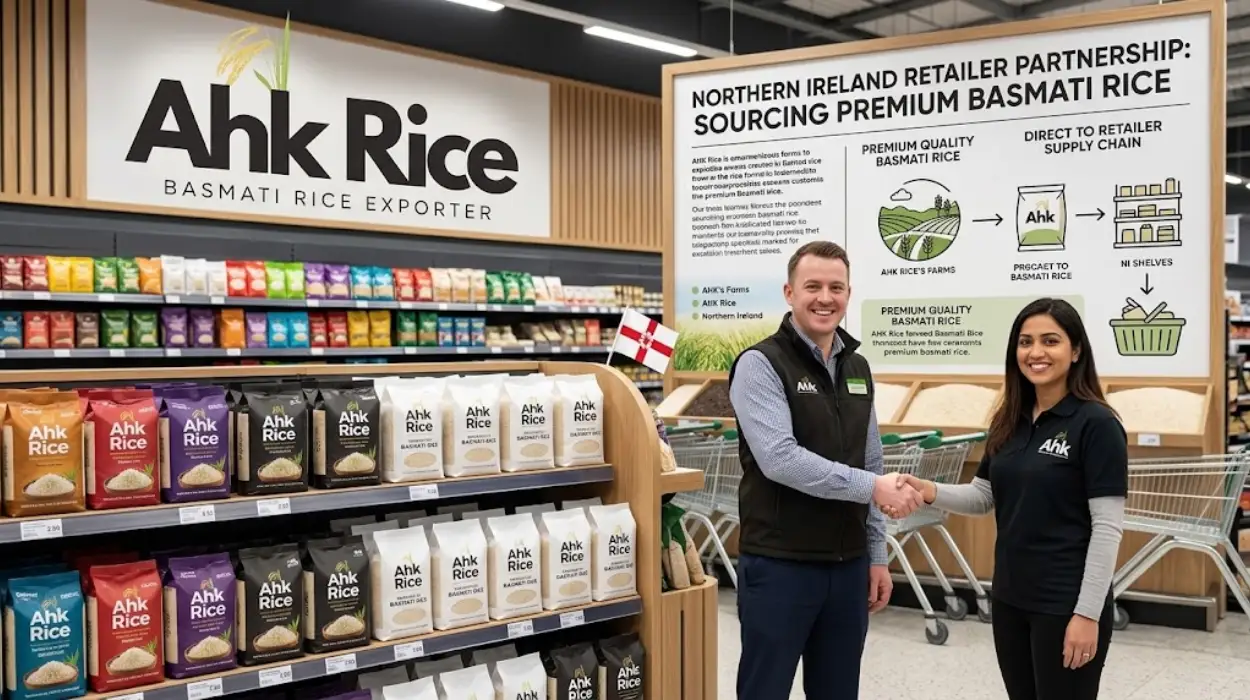
AHK Rice Helps Northern Ireland Retailers Source Premium Basmati Rice
Northern Ireland retailers need consistent Pakistani Basmati, verified specifications, controlled packaging, and predictable UK logistics to build profitable rice lines. Here is why: direct sourcing reduces specification uncertainty, supports private-label formats, and gives retailers control over grade, packing, inspection, and shipment planning. For background, see why premium Basmati rice is growing in Northern Ireland retail.
What is the best solution for Northern Ireland retailers sourcing Basmati rice?
The best solution is direct exporter sourcing with approved samples, defined specifications, retail packaging, inspection, and documented shipment planning. This model lets Northern Ireland retailers compare quality before committing to container volumes and private-label production.
Northern Ireland retail buyers should start with the product specification. The specification should define variety, grain length, broken percentage, moisture, milling degree, packaging, crop requirements, and destination terms.
AHK Rice supplies 1121, Super Kernel, and 1509 Basmati varieties from Pakistan. These varieties can serve premium retail, wholesale, foodservice, and private-label programs. AHK Rice also provides processing, grading, colour sorting, customized packaging, and export documentation.
Which grades should retailers evaluate first?
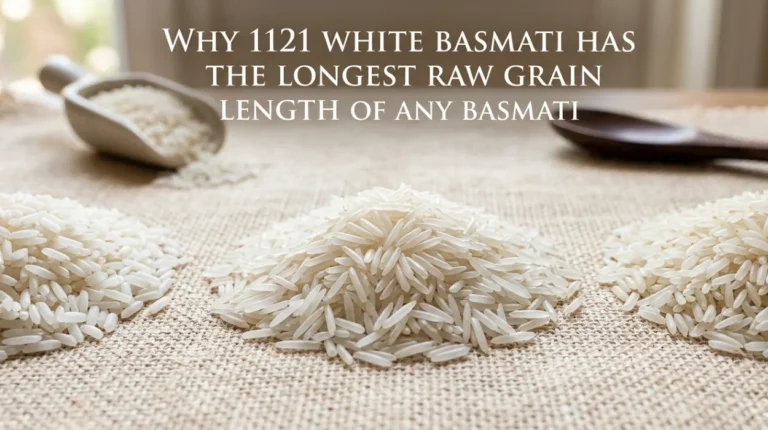
1121 White and Super Kernel are strong starting points for premium retail, while 1509 provides a commercially efficient alternative. Grade selection should match shelf positioning, cooking expectations, consumer demand, and target retail price.
| Product | Main retail advantage | Suitable positioning |
|---|---|---|
| 1121 White | Extra-long grain and premium appearance | Premium retail |
| 1121 Sella | Firm cooked grain and visual appeal | Premium and foodservice |
| Super Kernel | Traditional aroma and long grain | Established Basmati retail |
| 1509 White | Long grain and commercial efficiency | Value-premium retail |
| 1509 Sella | Firm texture and cooking stability | Foodservice and retail |
UK import data shows Pakistan supplied 168.7 million kg of rice to the UK in 2024, worth approximately $174.3 million. Pakistan ranked behind India by import value but remained a major UK rice supplier. (source: World Bank WITS, 2024)
Retailers should therefore compare suppliers on specification consistency rather than origin alone. Basmati authenticity and accurate product descriptions also matter because UK rules regulate how Basmati rice is described and presented.
With the product specification defined, the next decision is which exporter can control the complete supply process.
Why choose AHK Rice for Northern Ireland retail supply?
AHK Rice combines Pakistani Basmati sourcing with milling, grading, colour sorting, customized packaging, inspection, and export documentation. This integrated process gives retailers one commercial contact for product quality and shipment preparation.
AHK Rice operates from Bucheki, Nankana Sahib, Punjab, and focuses on Pakistani Basmati exports. Its published product range includes 1121, Super Kernel, and 1509. The company also states that its quality system includes ISO 22000:2018, HACCP, ISO 9001:2015, GMP, and Halal certification.
Retailers can use AHK Rice’s Basmati rice export service to define the required variety, packing format, quantity, and destination before receiving a commercial quotation.
What does the export process include?
The process covers specification confirmation, sample approval, production, quality testing, packaging, documentation, container loading, dispatch, and delivery coordination. Each stage creates a control point before the retailer commits to repeat procurement.
- Define the rice variety, grade, grain length, broken percentage, moisture target, packaging, and quantity.
- Request representative samples for physical and cooking evaluation.
- Test aroma, grain appearance, cooking performance, purity, and other agreed specifications.
- Approve the sample and commercial specification.
- Confirm packaging artwork, bag material, pack size, and labelling requirements.
- Produce the approved specification through controlled milling, grading, and sorting.
- Inspect the finished consignment before loading.
- Prepare the commercial invoice, packing list, Certificate of Origin, Phytosanitary Certificate, and other required documents.
- Load the approved rice into the export container.
- Dispatch the container through the agreed Pakistan–UK shipping route.
UK customs classifies rice under heading 1006 according to its processing state. Importers must therefore ensure the commodity classification matches the actual product.
Northern Ireland also requires careful consideration of the post-Brexit food trade framework. Goods entering Northern Ireland for the NI market can use applicable UK arrangements, while goods destined for Ireland or the EU remain subject to EU controls.
This controlled process reduces the risk of receiving a product that differs from the approved retail specification.
How does the sample process work and what does it cost?
The sample process should confirm product quality before commercial production, with costs separated into rice, courier, phytosanitary, testing, and packaging components. AHK Rice can structure sampling around the buyer’s requested grade and final retail specification.
The first stage is sample selection. The retailer specifies 1121, Super Kernel, 1509, White, Steam, or Sella requirements. AHK Rice then prepares a representative sample for evaluation.
The second stage is sample dispatch. AHK Rice’s published export process for other markets allows samples up to 20 kg while the buyer covers courier and Phytosanitary Certificate costs. Those sample charges can be waived in the final commercial quotation after an approved order.
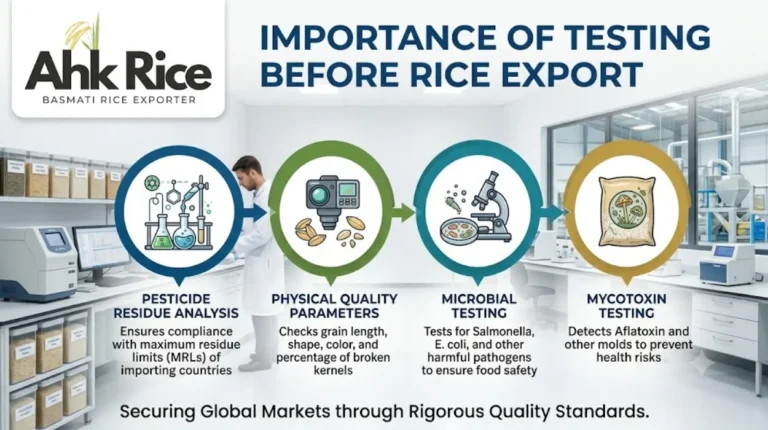
The third stage is testing. Retailers can evaluate raw grain length, colour, broken percentage, aroma, cooking elongation, texture, and packaging suitability. Additional laboratory or third-party testing can be added where the specification requires it.
Pakistan’s Department of Plant Protection lists the Phytosanitary Certificate procedure at PKR 2,500, with a stated processing time of 1–3 working days. Requirements include documents such as the commercial invoice and packing list. (source: Pakistan Trade Information Portal)
The fourth stage is commercial approval. The retailer compares the sample against its existing product, target shelf price, and intended customer segment. Approved samples then become the reference specification for production.
The final sample cost depends on courier weight, destination, laboratory requirements, packaging, and phytosanitary requirements. Retailers should request a destination-specific sample quotation rather than relying on a generic allowance.
How long does shipping to Northern Ireland take?
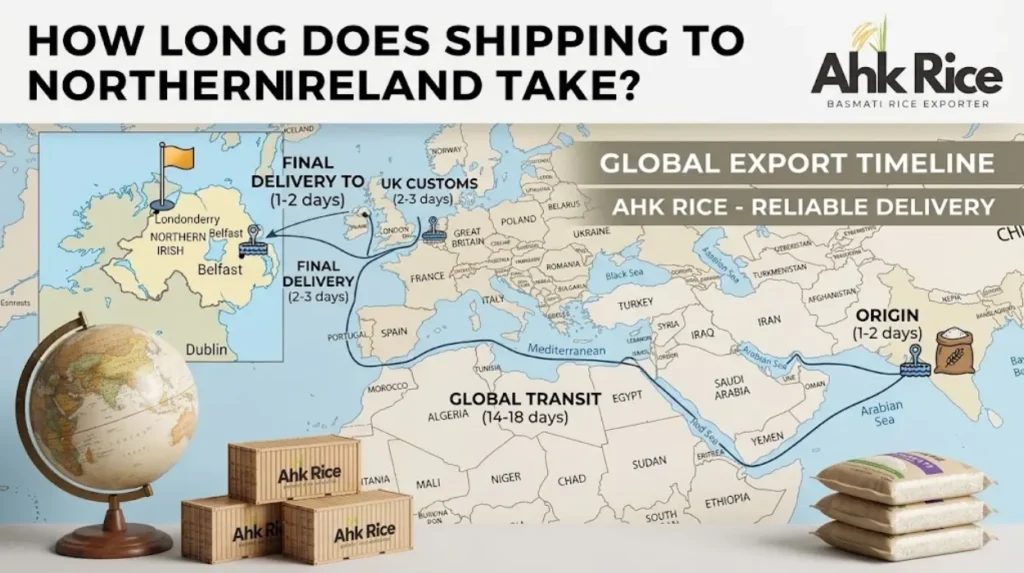
Plan approximately 30–40 days for the Pakistan-to-UK ocean movement, then allow additional time for port handling, clearance, and final Northern Ireland delivery. Actual timing depends on vessel schedules, customs processing, and inland transport.
Current Karachi-to-Felixstowe FCL schedules show estimated ocean transit around 28–33 days. Another current market source gives 24–40 days for Karachi-to-Felixstowe Basmati shipments.
AHK Rice’s own 2026 UK shipping guide gives a broader end-to-end estimate of 28–40 days, including export preparation, ocean movement, UK handling, and delivery.
| Market destination | Planning window | Main variables |
|---|---|---|
| Northern Ireland | 30–40+ days | Felixstowe routing, clearance, inland delivery |
| England | 28–40 days | Port and final warehouse |
| Scotland | 30–42 days | Port routing and inland distance |
| Wales | 29–41 days | Port handling and inland transport |
Northern Ireland delivery should be planned from the UK port arrival rather than the vessel departure date. Retailers should also build inventory protection into seasonal procurement plans.
Sample delivery is much faster than commercial sea freight. Courier timing depends on the service and origin. Retailers should treat sample delivery and container transit as separate planning stages.
Shipping duration becomes a procurement variable rather than an afterthought. The next decision is the expected commercial outcome.
What results can Northern Ireland retailers expect?
Retailers can expect stronger specification control, more consistent product positioning, private-label flexibility, and clearer landed-cost planning from a structured sourcing program. These benefits become stronger when the same specification is maintained across repeat shipments.
Quality consistency supports repeat purchases. A retail customer expects the same grain appearance, aroma, cooking performance, and pack presentation across multiple purchases.
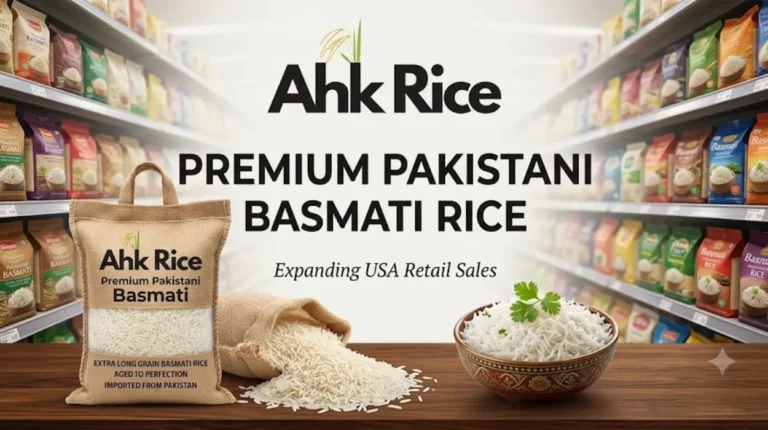
Packaging flexibility also supports category differentiation. A retailer can select pack sizes and branding according to its shelf strategy instead of selling only a standard exporter pack.
AHK Rice states that it provides customized packaging and private-label options. Its export process also includes grading, colour sorting, documentation, and pre-shipment inspection.
The commercial result depends on the product chosen. Premium 1121 can support higher-value positioning. Super Kernel can serve traditional Basmati buyers. 1509 can provide an alternative where procurement efficiency matters more.
Retailers should also compare the full landed cost. A low FOB price does not automatically produce the lowest retail cost after packaging, freight, insurance, customs, inspection, and inland delivery.
What factors affect the price of premium Basmati rice?
Rice variety, grade, order volume, packaging, printing, quality requirements, freight, destination, inspection, and market conditions determine the final commercial price. Retail buyers should compare complete specifications rather than headline FOB prices.
| Cost factor | Commercial effect |
|---|---|
| Rice variety | High |
| Grade and broken percentage | High |
| Retail packaging | High |
| Order volume | High |
| Freight and destination | High |
| Inspection and laboratory testing | Medium |
| Printing and artwork | Medium |
Packaging becomes especially important for private-label retail. A 5 kg consumer pack requires different material, artwork, labelling, and packing economics from a 25 kg foodservice bag.
Freight also changes the landed calculation. Current Karachi-to-Felixstowe FCL indications show base ocean freight around US$5,895–US$6,381 for a 40-foot container, although these are route-specific market rates and not an AHK Rice quotation.
Retailers should therefore request prices using exact specifications. A useful RFQ should include variety, grade, pack size, quantity, destination, Incoterm, artwork requirements, inspection requirements, and delivery schedule.
For a broader comparison of imported rice product-line planning, the supplied MOFU article title is “How Do Retailers Build Successful Imported Rice Product Lines?”. Its exact AHK Rice URL was not available in the supplied brief, so a URL has not been invented.
How can a Northern Ireland retailer get started?
Start with one defined retail specification, request a representative sample, approve the quality, confirm packaging, calculate landed cost, and then schedule the first commercial shipment. This sequence keeps product decisions ahead of procurement commitments.
- Define the target variety and grade.
- Specify grain length, broken percentage, moisture, purity, and packaging.
- Request the required sample quantity.
- Evaluate cooking performance and retail presentation.
- Confirm laboratory and inspection requirements.
- Approve the commercial sample.
- Finalize packaging artwork and documentation.
- Compare FOB, CFR/CNF, or CIF commercial terms.
- Schedule production and vessel booking.
- Receive the shipment into the planned Northern Ireland distribution network.
AHK Rice provides direct export coordination from Pakistan. Its published quotation process requests destination port, product, packing, quantity, and Incoterm information.
The strongest buying decision is therefore specification-led. Retailers should approve the rice before negotiating only on price. A consistent specification creates a better foundation for repeat orders, private-label growth, and inventory planning.
Request a customized Basmati rice quotation.
Frequently Asked Questions
Can Northern Ireland retailers import Basmati rice from Pakistan?
Yes, Northern Ireland retailers can source Pakistani Basmati through commercial import arrangements.
The shipment requires appropriate customs and food compliance documentation.
Product classification and labelling must match the actual rice specification.
The Windsor Framework also affects movements involving Ireland and EU destinations.
Retailers should confirm destination-specific requirements before shipment.
Which Pakistani Basmati varieties are suitable for retail?
1121, Super Kernel, and 1509 provide practical starting points for retail evaluation.
1121 supports premium long-grain positioning and strong shelf presentation.
Super Kernel suits buyers seeking traditional Basmati characteristics.
1509 offers another long-grain option for commercially focused retail programs.
Final selection should follow sample and specification approval.
How much does a rice sample from Pakistan cost?
Sample cost depends on courier, weight, phytosanitary, testing, and packaging requirements.
AHK Rice’s published model allows samples up to 20 kg for certain export markets.
The buyer covers courier and Phytosanitary Certificate costs under that model.
Pakistan’s published Phytosanitary Certificate fee is PKR 2,500.
Exact Northern Ireland sample costs should be quoted for the requested specification.
How many days does Pakistani Basmati take to reach Northern Ireland?
Allow roughly 30–40 days for a standard Pakistan-to-UK commercial sea shipment.
Karachi-to-Felixstowe ocean transit can take approximately 28–33 days.
Port handling and customs clearance add additional time.
Northern Ireland inland delivery requires further scheduling after UK arrival.
Retailers should maintain buffer stock around seasonal demand periods.
Why should retailers request samples before placing container orders?
Samples allow retailers to verify the actual product before committing to commercial volume.
Buyers can inspect grain appearance, aroma, cooking texture, and broken percentage.
Packaging can also be reviewed before private-label production begins.
Approved samples create a reference point for repeat shipment specifications.
This reduces the risk of purchasing unsuitable rice at container scale.