How Can Indonesian Buyers Match Pakistani Basmati Grades to Customer Segments?
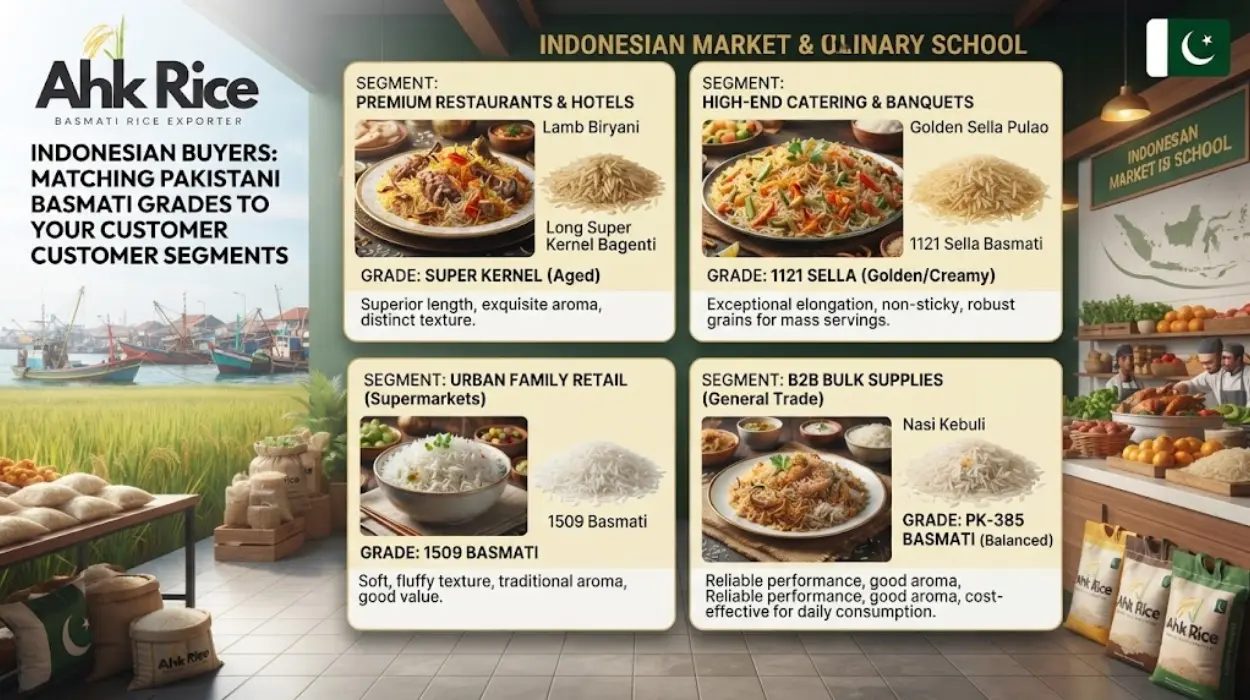
Indonesian buyers match Pakistani Basmati grades to customer segments by comparing grain length, processing type, cooking performance, and selling price. Here is why: 1121 suits premium retail and HORECA, Super Kernel suits traditional Basmati demand, and 1509 suits value-focused distribution.
Indonesian rice importers serve different customer groups. Retailers sell packaged rice to households. HORECA businesses serve hotels, restaurants, and catering operations. Wholesalers distribute rice to smaller shops, foodservice businesses, and regional markets.
Each segment requires a different balance of appearance, aroma, cooking performance, and cost. Pakistani Basmati grades provide a structured way to match those requirements.
What Are Pakistani Basmati Rice Grades?
Pakistani Basmati rice grades identify rice varieties and processing specifications. 1121, Super Kernel, and 1509 describe distinct Basmati varieties. Steam, Sella, and White describe processing types. Grade selection connects grain characteristics with customer expectations.
Pakistani Basmati rice grows primarily in Punjab, where soil, irrigation, climate, and traditional cultivation practices support aromatic long-grain rice production. The Basmati region includes areas around the Ravi, Chenab, and other irrigation systems.
Basmati rice develops its characteristic aroma during cultivation and maturation. Farmers harvest mature paddy before milling removes the husk and prepares the grain for export.
How Do Variety and Processing Differ?
Rice variety describes the plant and grain characteristics. Processing describes the treatment applied after harvesting. A 1121 Steam grain and a 1121 Sella grain belong to the same variety but have different cooking properties.
White rice undergoes dehusking and polishing. Steam rice receives steam treatment before drying and milling. Sella rice receives parboiling before drying and milling.
Processing changes the grain’s texture, appearance, cooking behavior, and resistance to breakage. Indonesian buyers therefore evaluate variety and processing together.
How Does Pakistani Basmati Rice Processing Work?
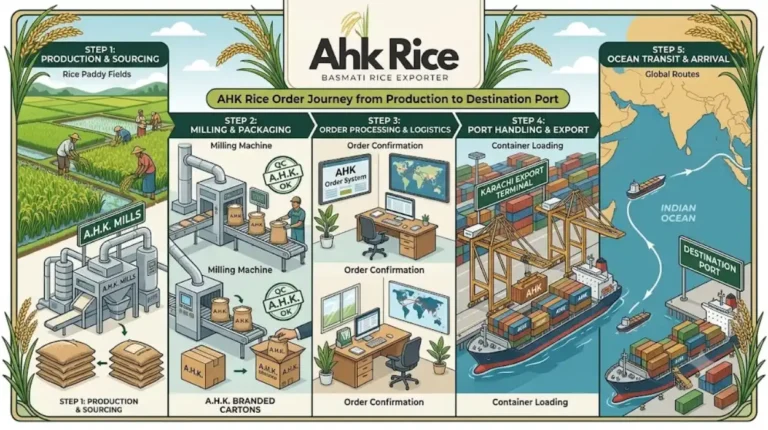
Pakistani Basmati rice processing follows 9 main stages: paddy cleaning, dehusking, paddy separation, whitening, polishing, grading, colour sorting, quality testing, and packaging. Each stage protects grain quality and prepares rice for a specific customer segment.
What Happens During Processing?
- Clean the paddy. Remove stones, dust, straw, and other foreign material from harvested paddy.
- De-husk the grain. Remove the outer husk to produce brown rice.
- Separate the paddy. Remove remaining unhusked grains from dehusked rice.
- Whiten the grain. Remove the bran layer to produce white rice.
- Polish the grain. Improve surface appearance and remove remaining bran particles.
- Grade by length. Separate whole grains, broken grains, and different length categories.
- Sort by colour. Remove discoloured grains and visible defects.
- Test the rice. Check moisture, foreign matter, broken percentage, and other quality attributes.
- Pack the rice. Fill approved packaging formats according to buyer specifications.
The processing sequence determines how rice performs during cooking and distribution. Steam rice retains a firmer texture. Sella rice provides stronger grain separation. White rice provides a familiar cooking experience for many households.
What Is 1121 Basmati Rice?
1121 Basmati is a long-grain Pakistani rice variety known for its extended grain length and premium appearance. Its slender grains suit premium retail, restaurants, catering operations, and foodservice businesses that value presentation.
1121 Steam retains a long, firm grain after cooking. It suits biryani, pulao, and premium rice dishes. 1121 Sella provides firm grains with strong separation. 1121 Golden Sella delivers a golden appearance and a firm cooking texture.
The grain length of 1121 commonly reaches approximately 8.3–9.2 millimetres in raw form, depending on grade and specification. Indonesian buyers should confirm the exact grain length before procurement.
What Is Super Kernel Basmati Rice?
Super Kernel Basmati is a traditional Pakistani Basmati variety with a long, slender grain and strong aromatic cooking profile. It suits customers who prefer traditional Basmati characteristics rather than the longest available grain.
Super Kernel Steam offers a firm texture and aromatic cooked rice. Super Kernel Sella provides a firmer, separate grain structure. Super Kernel White provides a familiar white-rice appearance with Basmati aroma.
Super Kernel fits premium household rice, restaurants, catering businesses, and wholesalers serving customers who recognise traditional Basmati varieties.
What Is 1509 Basmati Rice?
1509 Basmati is a long-grain Pakistani variety that offers a practical balance between appearance, cooking performance, and cost. It suits mid-premium retail, restaurants, catering businesses, and wholesalers serving price-sensitive customers.
1509 Steam provides long, firm cooked grains. 1509 Sella provides firm grains and strong separation. 1509 White offers a white appearance and familiar cooking behavior.
The variety supports retail and foodservice products that require Basmati characteristics without the highest premium associated with longer-grain varieties.
With the main varieties and processing stages established, the next question is how Indonesian businesses match them with specific customer groups.
Which Pakistani Basmati Grade Fits Indonesian Retail?
1121 Steam and 1121 Golden Sella suit premium retail, while 1509 Steam and Super Kernel White suit mid-premium household products. Retail buyers should match grain appearance, cooking performance, packaging, and price with household purchasing behavior.
Which Grade Suits Premium Retail?
1121 Steam offers long, slender grains that create a premium visual impression. Retailers use this appearance to position rice for biryani, pulao, and special meals.
1121 Golden Sella provides a golden appearance and firm cooked grains. It suits premium packaged rice where colour and grain separation influence purchase decisions.
Super Kernel Steam provides a traditional Basmati profile. It suits households that value aroma and familiar Basmati cooking characteristics.
Which Grade Suits Mid-Premium Retail?
1509 Steam provides long grains and reliable cooking performance at a practical price point. It suits Indonesian retailers targeting households that want Basmati characteristics without premium 1121 pricing.
1509 White provides a familiar white appearance. It suits everyday household rice products and retail packaging designed for regular consumption.
Retailers should also compare bag sizes. A 5 kg pack suits household purchasing. A 10 kg pack suits larger households. A 25 kg pack suits family buyers and small foodservice businesses.
Which Pakistani Basmati Grade Fits Indonesian HORECA?
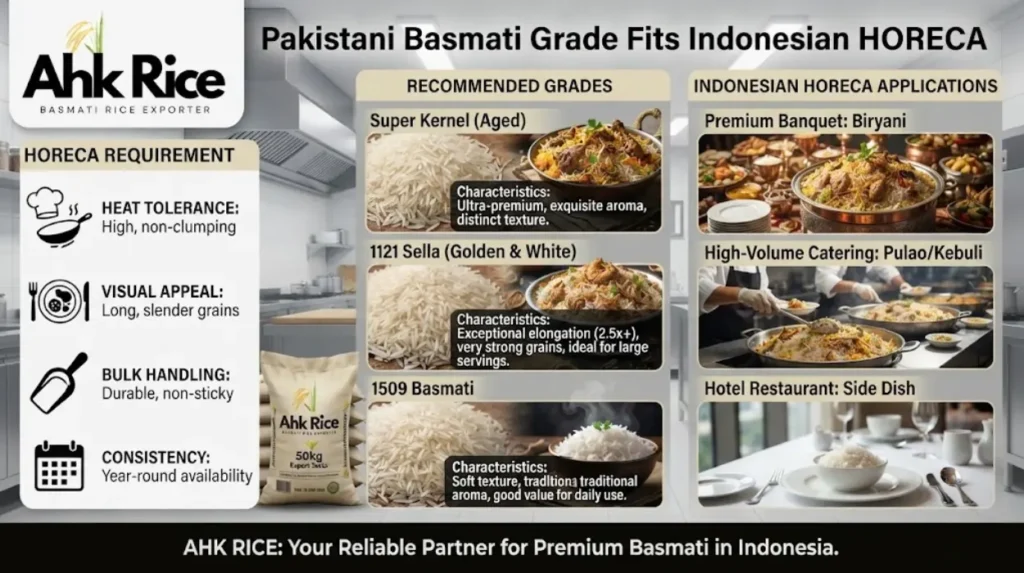
1121 Steam suits premium restaurants, while 1121 Sella and Super Kernel Sella suit catering operations requiring firm, separate grains. HORECA buyers should evaluate cooked yield, grain separation, aroma, and consistency across repeated cooking batches.
Which Grade Suits Premium Restaurants?
1121 Steam delivers long, attractive grains after cooking. Restaurants use it for biryani, pulao, and plated rice dishes where appearance supports the dining experience.
1121 Golden Sella provides a firm texture and golden colour. It suits restaurants serving rice dishes that require distinct grains and strong presentation.
Super Kernel Steam suits restaurants that prioritise traditional Basmati aroma. Its cooking profile supports biryani and pulao recipes with familiar Basmati characteristics.
Which Grade Suits Catering Operations?
1121 Sella provides firm grains and strong separation after cooking. Catering businesses benefit from this performance during large-batch cooking.
Super Kernel Sella suits catering kitchens that require traditional Basmati aroma and consistent grain structure. Its processing supports separate cooked grains for biryani, pulao, and rice platters.
1509 Sella provides a practical option for catering businesses that balance food quality with ingredient cost. It suits high-volume operations serving value-focused menus.
HORECA buyers should test rice using their own cooking equipment. Cooking time, water ratio, batch size, and holding conditions affect final texture.
Which Pakistani Basmati Grade Fits Indonesian Wholesale?
1509 Steam, 1509 White, and Super Kernel White suit wholesale distribution because they balance price, cooking performance, and broad customer demand. Wholesalers should match each grade with retailer requirements, restaurant purchasing patterns, and regional selling prices.
Which Grade Suits Value-Focused Distribution?
1509 Steam provides long grains and a firm texture. It suits wholesalers supplying mid-premium retail and restaurants.
1509 White offers a familiar appearance and practical cooking performance. It suits everyday rice distribution where customers prioritise price and reliable cooking.
Super Kernel White suits wholesalers serving traditional Basmati demand. Its aromatic profile supports retail and foodservice customers who recognise the variety.
Which Grade Suits Premium Wholesale?
1121 Steam suits wholesalers supplying premium retailers, restaurants, and catering businesses. Its long grain and cooking performance support higher-value customer segments.
1121 Sella suits wholesale buyers serving restaurants and caterers that need firm grains and strong separation. It provides a useful option for large-volume rice dishes.
Wholesale buyers should separate product specifications from marketing names. A premium label does not replace grain length, broken percentage, moisture, and cooking tests.
What Quality Specifications Should Indonesian Buyers Check?
Indonesian buyers should check variety, processing type, grain length, moisture, broken percentage, foreign matter, and packaging before approving Pakistani Basmati rice. These specifications connect product quality with customer expectations and distribution requirements.
What Are the Main Quality Components?
| Quality attribute | Why it matters |
|---|---|
| Variety | Identifies 1121, Super Kernel, or 1509 characteristics |
| Processing type | Defines Steam, Sella, Golden Sella, or White rice |
| Grain length | Supports premium appearance and grade positioning |
| Broken percentage | Influences appearance and cooking consistency |
| Moisture | Supports storage stability and quality control |
| Foreign matter | Protects food safety and product cleanliness |
| Packaging | Protects rice during storage and transport |
Indonesian buyers should confirm each specification through a product sample and inspection report. Suppliers should provide the agreed specification before shipment.
What Certifications Apply to Pakistani Basmati Rice?
Export certifications verify product quality, food safety, origin, and shipment compliance. Indonesian buyers should confirm the documents required for their import category and destination regulations.
Common export documents include a commercial invoice, packing list, certificate of origin, phytosanitary certificate, and bill of lading. Food safety documentation depends on the buyer’s requirements and Indonesian import rules.
Food safety systems such as HACCP and ISO 22000 support hazard control and food safety management. These certifications apply to processing facilities and require verification from the relevant certification body.
What Problems Do Indonesian Buyers Face When Matching Grades?
The main problems involve confusing variety with processing, choosing by grain length alone, and assuming every grade suits every customer. Buyers solve these problems by testing samples and matching specifications with customer use.
Does Longer Grain Always Mean Better Rice?
Longer grain does not automatically mean better cooking performance. A premium restaurant needs aroma, texture, and grain separation. A wholesaler serving everyday households needs a balanced cost and cooking profile.
1121 offers a longer grain than many traditional Basmati grades. Super Kernel offers a traditional aromatic profile. 1509 offers a practical balance between appearance and cost.
Does Sella Always Suit Every Customer?
Sella rice provides firm grains and strong separation. Some households prefer the familiar cooking behavior of White rice. Restaurants and caterers often value Sella for large-batch cooking.
Indonesian buyers should select processing based on customer preference rather than assuming one processing type suits every channel.
Does Packaging Replace Quality Testing?
Packaging protects rice during transport and storage. It does not replace product testing. Buyers should inspect grain length, broken percentage, moisture, foreign matter, and cooking performance before shipment.
With the main quality risks identified, Indonesian buyers can use grade selection to build a more reliable purchasing specification.
How Can Indonesian Buyers Build a Grade Selection Framework?
Indonesian buyers should match customer segment, cooking application, grain appearance, processing type, and target price before choosing a Pakistani Basmati grade. A structured framework improves purchasing decisions and reduces mismatched product specifications.
| Decision factor | Retail | HORECA | Wholesale |
|---|---|---|---|
| Main priority | Appearance and packaging | Cooking performance | Price and broad demand |
| Premium choice | 1121 Steam | 1121 Steam | 1121 Steam |
| Traditional choice | Super Kernel | Super Kernel Sella | Super Kernel White |
| Value choice | 1509 Steam | 1509 Sella | 1509 White |
| Main test | Appearance and cooking | Batch cooking | Cost and consistency |
The next stage is comparing these grades against actual Indonesian retail, HORECA, and wholesale purchasing requirements.
Frequently Asked Questions
Which Pakistani Basmati grade suits Indonesian premium retailers?
1121 Steam suits premium retailers because its long, slender grains create a premium appearance after cooking. 1121 Golden Sella suits retailers that prefer golden colour and firm grain separation.
Is Super Kernel suitable for Indonesian restaurants?
Super Kernel suits restaurants that value traditional Basmati aroma. Super Kernel Steam and Sella support biryani, pulao, and rice dishes requiring aromatic cooked grains.
Which Pakistani Basmati grade suits Indonesian wholesalers?
1509 Steam, 1509 White, and Super Kernel White suit wholesalers because they balance price, cooking performance, and broad customer demand.
What is the difference between 1121 Steam and 1121 Sella?
1121 Steam produces long, firm grains with a familiar Basmati cooking profile. 1121 Sella provides firmer grains and stronger separation after cooking.
What documents should Indonesian buyers request?
Indonesian buyers should request a commercial invoice, packing list, certificate of origin, phytosanitary certificate, bill of lading, and applicable food safety documentation.