Why Is Food Labelling Important for England Rice Retail Businesses?
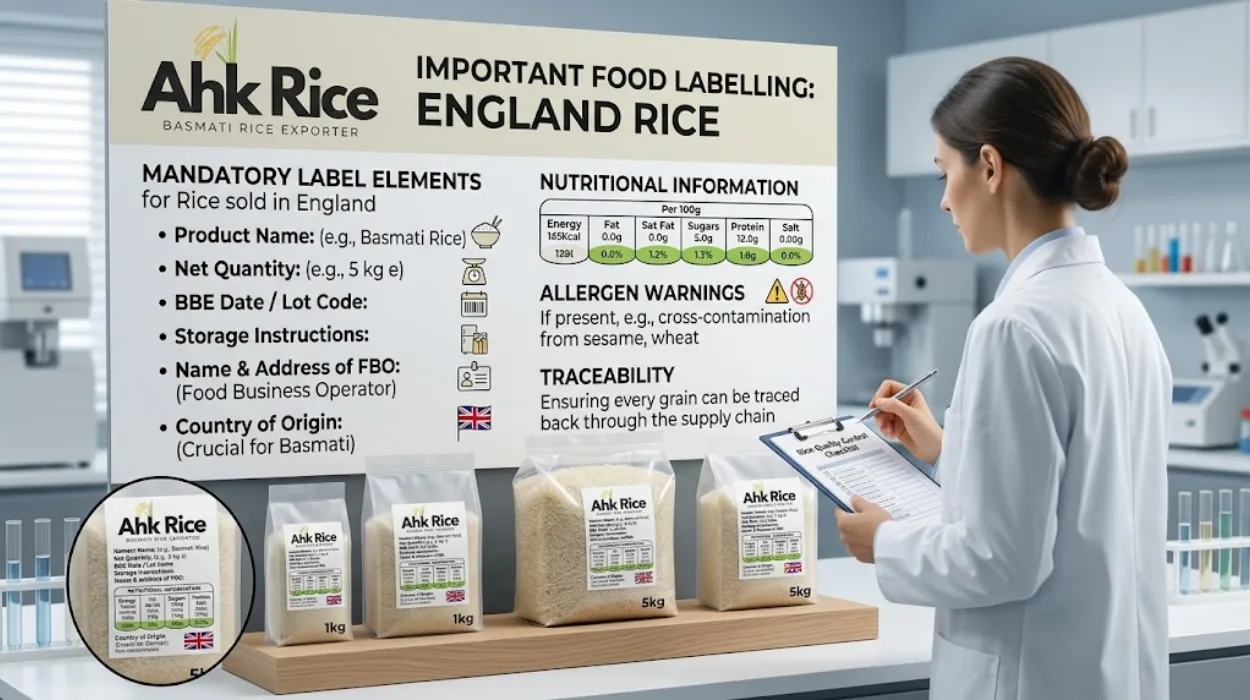
Food labelling is important for England rice retailers because accurate labels identify the food, quantity, origin, ingredients, dates, storage requirements, responsible business and required warnings. Here is why: these details help consumers make informed choices and help retailers meet Great Britain food information requirements.
What Is Food Labelling for Rice Retail Businesses?
Food labelling is the information printed on rice packaging that identifies the product and communicates legally required consumer information. Rice labels typically state the food name, net quantity, date marking, storage conditions, business address and origin details where required.
Rice labelling applies to prepacked products sold through supermarkets, independent shops, wholesalers with retail packs and other food businesses. The label must remain clear, easy to read, permanent, visible and accurate. Food information must not mislead consumers about the product, its origin, composition or characteristics.
Rice is generally classified by grain size, processing condition and grain characteristics. UK government guidance identifies categories including polished, parboiled and broken rice. Basmati is a long-grain, aromatic and slender rice variety.
For a retail pack, the product description should match the actual rice inside. Examples include 1121 Basmati Rice, Super Kernel Basmati Rice, 1509 Basmati Rice, White Rice, Brown Rice, Steam Rice and Golden Sella Rice.
Which Rice Grades Can England Retailers Sell?
Common Pakistani Basmati grades include 1121 White, 1121 Steam, 1121 Golden Sella, 1121 Creamy Sella, 1121 Brown, Super Kernel grades and 1509 grades. Each designation communicates a specific product characteristic.
AHK Rice supplies Pakistani Basmati varieties including 1121, Super Kernel and 1509. Available processing grades include:
- 1121 White
- 1121 Steam
- 1121 Golden Sella
- 1121 Creamy Sella
- 1121 Brown
- Super Kernel White
- Super Kernel Steam
- Super Kernel Sella
- Super Kernel Parboiled
- 1509 White
- 1509 Steam
- 1509 Golden Sella
The grade name should accurately describe the rice sold. A retailer should not use a premium grade name for a different grain specification. This principle connects product identity directly with label accuracy.
With the product identity established, the next question is how a compliant rice label communicates that identity to shoppers.
How Does Rice Labelling Work in England?
Rice labelling works by placing required information in a readable format on packaging before the product reaches consumers. Retailers and food businesses use the label to communicate identity, quantity, dates, origin, storage and responsible business details.
The process starts with product identification. The pack states the name of the food, such as Basmati rice or brown rice. The description must represent the actual product.
The next element is net quantity. Packaged food above 5g or 5ml requires quantity information in appropriate metric units. Rice retail packs therefore commonly use grams or kilograms.
The label then carries the relevant date marking. Best-before information is used where quality determines the date requirement. Use-by dates apply where food safety requires them.
Storage instructions follow the product’s handling needs. Examples include keeping the product dry, storing it away from direct sunlight and resealing an opened pack.
The responsible business information identifies the business marketing the food or the importer. Great Britain food products must carry a UK, Channel Islands or Isle of Man business address where the applicable rules require an address.
The final stage is verification. Retailers check spelling, quantity, dates, product identity and required statements before placing packs on shelves.
With the labelling process established, the next question is which information forms the core of an England rice label.
What Are the Key Components of a Rice Label?
The key components are food name, net quantity, date marking, ingredients where applicable, origin where required, storage information, responsible business details and necessary warnings. These components create a complete consumer information system.
Which Information Identifies the Rice?
The food name identifies the product category and grade, while the pack description communicates characteristics such as Basmati, brown, white, steam or parboiled rice.
A label stating “1121 Basmati Rice” identifies both the variety and product type. A label stating “Golden Sella Basmati Rice” communicates a parboiled processing style associated with that product.
Which Quantity Information Is Required?
Net quantity uses metric measurements such as 500g, 1kg, 5kg or 10kg for packaged rice sold to consumers. The quantity must appear close enough to the food name for both details to be viewed together.
Unit pricing also matters at retail level. Retailers must display applicable prices in sterling and provide unit pricing for relevant products, using metric measures such as kilograms.
When Does Origin Information Matter?
Origin information becomes mandatory when leaving it off would mislead consumers about where the food comes from. Images, wording and geographical references must not create a false impression about origin.
Pakistani rice provides a clear example. A pack using Pakistan-related product claims should accurately represent the rice’s origin and supply chain.
What About Ingredients and Allergens?
A single-ingredient rice product normally does not require a multi-ingredient list, while products containing additional ingredients require the ingredients to be listed by weight.
GOV.UK guidance requires foods containing 2 or more ingredients to list them under an appropriate ingredients heading. Ingredients appear in descending order of weight. Allergens must receive clear emphasis within the ingredients list when present.
Examples include rice mixes containing spices, vegetables, sauces or seasoning. Those additions change the labelling requirement compared with plain rice.
With the label components defined, the next question is why these details matter beyond legal compliance.
What Benefits Does Accurate Rice Labelling Provide?
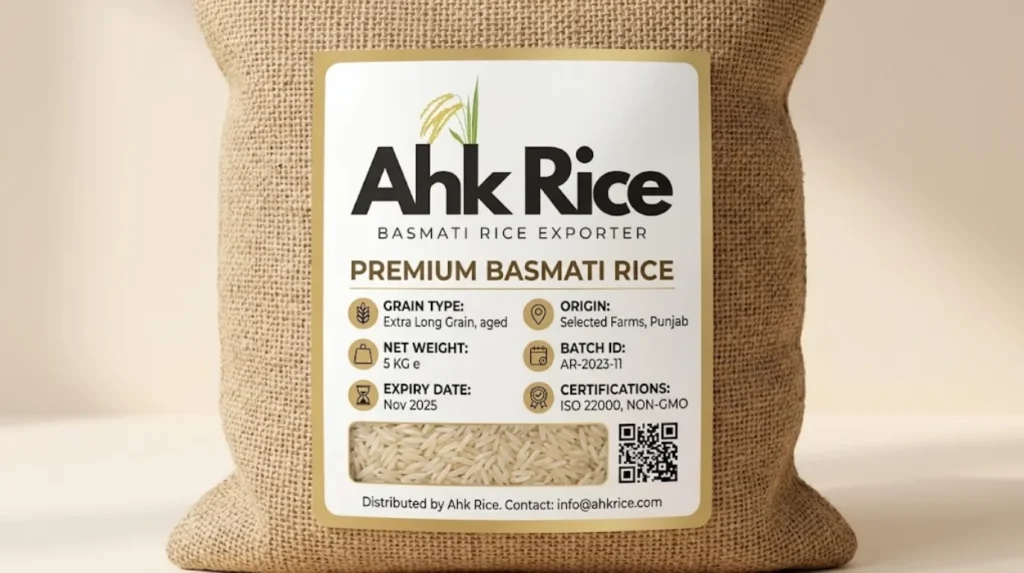
Accurate labelling improves consumer understanding, supports traceability, reduces misleading product descriptions and gives retailers a consistent basis for stock control and compliance checks.
Consumer understanding is the first benefit. Shoppers can identify the rice variety, pack size, date and storage information before purchase.
Product transparency is another benefit. A clear label connects the retail pack with its declared product identity and responsible food business.
Traceability also improves. A business address and lot information help connect a retail pack with the relevant supply chain. GOV.UK requires applicable labels to include a lot number or use-by date.
Compliance becomes easier to manage when retailers use a fixed label verification process. Staff can check product name, quantity, dates, storage conditions and business details against the approved specification.
Food safety controls also connect with imported rice. Current Great Britain controls list rice from Pakistan under controls covering pesticide residues, aflatoxins and Ochratoxin A. The current FSA list was updated in July 2026.
These controls concern the food itself rather than simply the printed label. Retail businesses therefore need accurate product documentation behind the information presented to consumers.
With these benefits established, the next question is where England rice retailers apply labelling requirements in daily operations.
Where Do England Rice Retailers Use Food Labelling?
England rice retailers use food labelling across supermarket packs, independent retail bags, imported branded products, private-label products and rice mixes sold directly to consumers.
How Does Labelling Apply to Supermarket Rice?
Supermarket rice uses prepacked labels to communicate product identity, quantity, dates, storage information and responsible business details before the consumer selects the product.
Examples include 1kg Basmati rice, 5kg long-grain rice and 500g brown rice. Each pack needs information appropriate to its composition and sales format.
How Does Labelling Apply to Private-Label Rice?
Private-label rice requires accurate information under the retailer’s marketed brand while identifying the responsible food business or importer.
The rice supplier provides product specifications, but the final retail label must accurately represent the product. Retailers should match the label against the approved specification before printing packaging.
How Does Imported Pakistani Rice Enter the Retail Supply Chain?
Imported Pakistani rice is cultivated and harvested in Pakistan, then milled, dehusked, polished, sorted, graded, packed, inspected, dispatched and imported into Great Britain.
A typical sequence is:
- Cultivate the rice in suitable agricultural regions of Pakistan.
- Harvest the paddy at the required maturity.
- Clean the paddy to remove field debris.
- De-husk the grain to remove the outer husk.
- Polish the grain where a white rice specification requires polishing.
- Parboil the grain for applicable Sella or parboiled grades.
- Dry the grain to achieve the required moisture specification.
- Sort the grain using size and quality controls.
- Grade the rice according to the contracted specification.
- Pack the rice into the required retail or wholesale format.
- Inspect the shipment against quality and export requirements.
- Dispatch the consignment for Great Britain import and retail distribution.
AHK Rice operates an end-to-end processing and export model covering Pakistani Basmati varieties. Its stated varieties include 1121, Super Kernel and 1509, with custom packaging and export processing.
Import controls remain separate from retail labelling. Government guidance states that imported cereals must meet the same or equivalent food hygiene standards and procedures as food produced in Great Britain.
With the retail use cases established, the final issue is understanding the mistakes that create labelling problems.
What Common Rice Labelling Problems Should Retailers Avoid?
Common problems include incorrect product descriptions, missing quantity information, misleading origin claims, incomplete business details, unclear dates, incorrect storage instructions and unsupported claims.
Is Rice Origin the Same as Packing Location?
No. Production, processing, packing and brand ownership can represent different locations, so retailers must distinguish these supply-chain roles accurately.
Government pesticide monitoring reports specifically note that a sample’s stated country can relate to processing, consumer packing or brand ownership rather than rice production.
A pack should therefore avoid wording that creates a false impression about geographical origin.
Does Every Rice Pack Need an Ingredients List?
Plain single-ingredient rice does not follow the same ingredients-list requirement as rice containing 2 or more ingredients.
A seasoned rice product containing rice, vegetables and spices requires an ingredients list. The ingredients must appear in descending order of weight.
Are Certifications the Same as Legal Labelling Requirements?
No. Legal labelling requirements define mandatory consumer information, while certifications provide additional evidence about systems, processes or product controls.
Relevant food businesses commonly work with systems such as HACCP, ISO 22000 and BRCGS. These certifications should never replace required label information. Their applicability depends on the business, customer specification and certification scope.
Imported rice also requires attention to food safety controls. Pakistan-origin rice is currently listed under Great Britain controls for pesticide residues, aflatoxins and Ochratoxin A.
Retailers should therefore connect three records: the approved product specification, the packaging artwork and the import documentation.
Accurate labels complete the connection between rice specification, supply-chain documentation and consumer information.
Frequently Asked Questions
What information must appear on packaged rice in England?
Required information depends on the product, but commonly includes the food name, net quantity, date marking, applicable ingredients, origin information where required, storage conditions and responsible business details.
Does Basmati rice need its origin stated?
Origin must be shown where omitting it would mislead consumers. A retailer should ensure geographical wording and imagery accurately represent the rice’s origin.
Does Pakistani rice face additional Great Britain controls?
Yes. Current Great Britain controls list Pakistan-origin rice for pesticide residues, aflatoxins and Ochratoxin A. Retailers should confirm current import requirements for each shipment.
What Basmati varieties can Pakistani suppliers provide?
Pakistani suppliers provide varieties including 1121, Super Kernel and 1509. Processing grades include White, Steam, Golden Sella, Creamy Sella, Brown and Parboiled formats.
What is the difference between food certification and food labelling?
Food labelling communicates required product information to consumers. Certification verifies defined management, safety or quality systems against a recognised standard. Certification does not replace mandatory label information.
Where should retailers learn about imported rice labelling expectations?
Retailers can use detailed guidance covering how imported rice products meet UK labelling expectations, including product information, origin, packaging and compliance considerations.