How Do Commercial Buyers Compare Imported Rice Quality and Value?
Commercial buyers should compare imported rice by specification, landed cost, cooking performance, storage life, and supply consistency rather than price alone. Here is why: a lower FOB price can produce higher total costs through breakage, storage losses, inconsistent grades, or rejected shipments.
Imported rice value is the relationship between measurable quality and total procurement cost. Commercial buyers therefore compare grain length, broken percentage, moisture, processing grade, cleanliness, packaging, shelf life, and documentation before selecting a supplier.
For buyers beginning with the fundamentals, understanding how Pakistani Basmati rice is processed and exported provides the necessary context for evaluating commercial specifications.
The strongest comparison method starts with a written specification sheet. The buyer then requests representative samples, verifies laboratory results, calculates landed cost, and evaluates destination-market suitability. This approach turns rice purchasing from a price exercise into a controlled procurement decision.
What are the available solutions for comparing imported rice?
Commercial buyers have four practical comparison methods: specification sheets, physical samples, laboratory reports, and landed-cost analysis. Each method measures a different part of rice value, so buyers achieve stronger decisions by combining them.
Specification-based comparison
A specification sheet records measurable characteristics before a commercial order. Common fields include variety, processing grade, average grain length, broken percentage, moisture, foreign matter, packaging, crop year, and certification.
Specification comparison works well during supplier shortlisting. A buyer can place competing offers into one document and identify differences quickly.
A specification sheet also creates a contractual reference. The final shipment can be inspected against the agreed values before dispatch.
Sample-based comparison
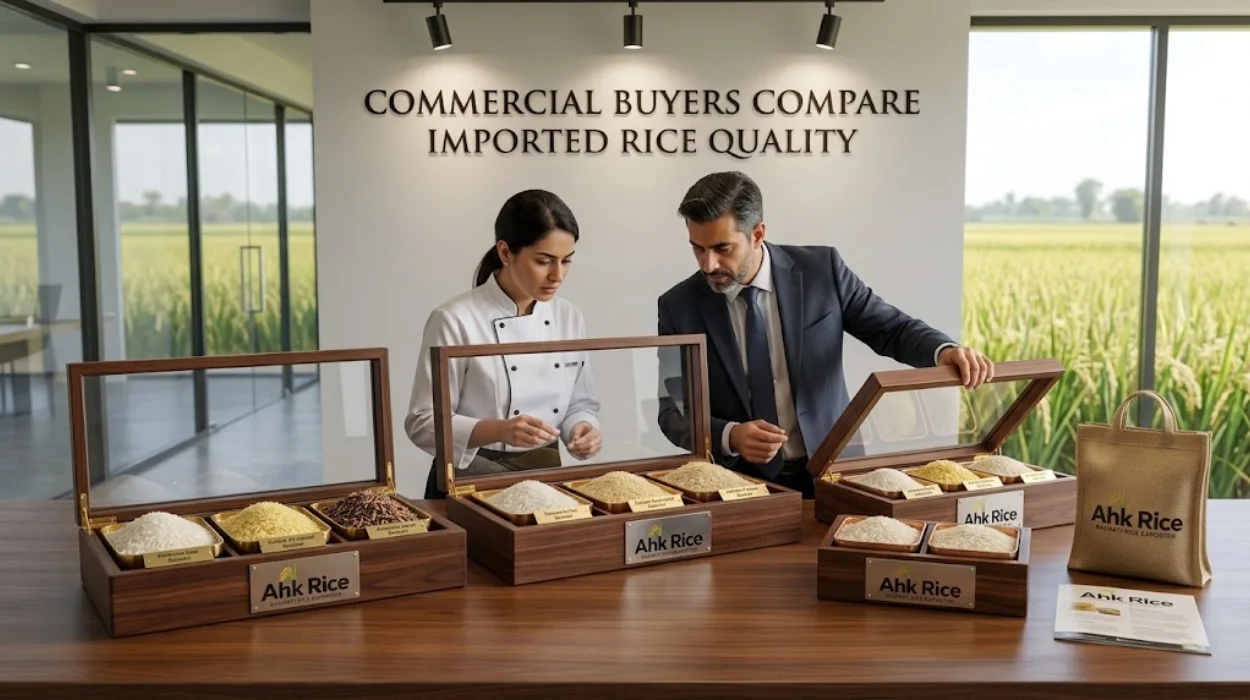
Physical samples reveal characteristics that a quotation cannot demonstrate. Buyers can inspect colour, aroma, grain uniformity, broken grains, cooking behaviour, and visual cleanliness.
Cooking tests provide another layer of evidence. A foodservice buyer can compare cooked elongation, grain separation, texture, aroma, and consistency across samples.
Sample testing becomes especially important when two suppliers quote similar prices. The better sample can deliver greater value through improved customer acceptance and cooking performance.
Laboratory-based comparison
Laboratory testing measures attributes that visual inspection cannot reliably establish. Moisture, pesticide residues, contaminants, foreign matter, and other quality indicators can require documented testing.
Laboratory reports also strengthen compliance control. UK, EU, Gulf, and other importing markets apply food-safety and documentation requirements that buyers must consider before shipment.
Landed-cost comparison
Landed cost includes more than the supplier quotation. Buyers calculate product cost, freight, insurance where applicable, port charges, customs-related costs, inspection expenses, and inland delivery.
A rice offer at $900 per MT is not automatically better than one at $930 per MT. The $930 product may generate lower breakage, better storage performance, or fewer handling costs.
The four methods establish the evidence base; the next question is how buyers should compare those measurements consistently.
How do different imported rice approaches compare?
Specification-led purchasing offers the strongest overall control because it combines physical quality, documented compliance, cooking performance, storage characteristics, and commercial cost. Price-only purchasing provides the weakest basis for long-term value.
Seven-attribute specification comparison
| Attribute | Premium 1121 | Super Kernel | 1509 | Commercial relevance |
|---|---|---|---|---|
| Variety | 1121 Basmati | Super Kernel Basmati | 1509 Basmati | Defines product identity |
| Grain profile | Extra-long | Long, traditional | Long, cost-efficient | Influences presentation |
| Processing options | White, Steam, Sella, Brown | White, Steam, Sella | White, Steam, Sella | Matches cooking requirements |
| Broken percentage | Usually specified contractually | Usually specified contractually | Usually specified contractually | Affects usable yield |
| Moisture | Common export target below 14% | Common export target below 14% | Common export target below 14% | Supports storage stability |
| Primary value | Premium appearance | Traditional aroma | Competitive economics | Determines buyer positioning |
| Best commercial fit | Premium retail and foodservice | Premium foodservice | Volume-focused foodservice | Connects product to demand |
AHK Rice processes Pakistani Basmati varieties through cleaning, dehusking, polishing, grading, sorting, packaging, and export preparation. Its product range includes 1121, Super Kernel, and 1509.
The comparison should not treat every grade as interchangeable. Processing changes cooking behaviour, appearance, storage characteristics, and buyer suitability.
White rice versus Steam rice
White Basmati receives whitening and polishing to produce a bright, clean appearance. It suits retail and foodservice buyers prioritising visual uniformity and familiar cooking characteristics.
Steam rice receives steam treatment during processing. The process supports grain strength and cooking performance while retaining the characteristic Basmati profile.
Sella versus Steam
Sella rice undergoes parboiling before drying and milling. Golden Sella develops a golden colour and strong grain structure.
Steam rice uses steam processing without the same parboiling sequence associated with Sella. Buyers therefore compare the two based on colour preference, cooking application, storage requirements, and market expectations.
AHK Rice identifies Golden Sella and other parboiled grades among its export categories. Its processing information also describes cleaning, dehusking, whitening, polishing, grading, and sorting as core production stages.
The grade comparison shows why price cannot stand alone; regional demand provides the next layer of commercial evaluation.
Which rice grades do Middle Eastern buyers prefer?

Middle Eastern buyers commonly favour 1121, Super Kernel, and 1509 grades according to price position, grain presentation, cooking use, and local foodservice requirements. Premium foodservice often values extra-long grain, while volume buyers emphasise cost efficiency.
Gulf premium segment
1121 Basmati suits buyers seeking extra-long grain presentation. Its long cooked grain supports biryani, mandi, kabsa, and banquet applications.
Super Kernel suits buyers seeking traditional Basmati characteristics with a premium positioning. Its aroma and long-grain appearance support restaurants, hotels, wholesalers, and specialty retail.
Gulf value segment
1509 provides a more cost-oriented option for buyers who require long-grain Basmati characteristics without paying the premium associated with top 1121 specifications.
AHK Rice describes 1509 as a high-yield long-grain variety with a competitive price position compared with 1121.
Indicative price comparison
Commercial buyers should treat the following figures as illustrative procurement bands, not live quotations.
| Grade | Indicative price per MT | Typical position |
|---|---|---|
| 1121 premium | $950–$1,150 | Premium |
| Super Kernel | $900–$1,080 | Upper-mid |
| 1509 | $820–$980 | Value |
Actual pricing changes with crop year, broken percentage, moisture, processing grade, packaging, order volume, Incoterm, freight, and destination.
The Gulf comparison establishes how grade and price interact; the European market requires a stronger compliance and documentation focus.
Which rice grades suit UK and European commercial buyers?
UK and European buyers commonly prioritise clean appearance, consistent specifications, traceability, food-safety documentation, and retail presentation alongside competitive pricing. White 1121 and selected premium grades fit these requirements particularly well.
Retail preference
1121 White Basmati suits premium retail because its polished appearance supports uniform shelf presentation. AHK Rice describes 1121 White specifications around 8.20–8.40 mm raw grain length and cooked elongation above 2.0x in one EU retail guide.
Foodservice preference
Foodservice buyers can favour 1121 Steam, Super Kernel, or 1509 depending on menu positioning and procurement targets. Catering operations generally value cooking consistency, whole-grain yield, and predictable portion performance.
Compliance preference
European procurement also evaluates pesticide-residue compliance, food safety systems, traceability, phytosanitary documentation, and packaging information. These requirements can materially affect the usable value of a shipment.
The UK and European comparison demonstrates that compliance belongs inside the value calculation, not outside it.
How does shelf life affect imported rice value?
Shelf life affects value through storage flexibility, inventory turnover, warehouse conditions, and product stability. Parboiled grades such as Golden Sella generally provide stronger storage characteristics than standard white or steam grades.
| Processing grade | Typical commercial storage position | Best use |
|---|---|---|
| Golden Sella | Strong | Long inventory cycles |
| Creamy Sella | Strong | Wholesale and foodservice |
| Steam | Moderate to strong | Regular foodservice |
| White | Moderate | Faster retail turnover |
| Brown | More storage-sensitive | Health-focused channels |
Shelf life depends on moisture, packaging, warehouse temperature, humidity, pests, oxygen exposure, and handling. Buyers should therefore specify storage conditions instead of relying on one universal shelf-life number.
A 40°C warehouse creates a different risk profile from a temperature-controlled facility. Gulf importers holding large inventories should therefore place greater emphasis on storage stability and warehouse controls.
Golden Sella can provide a practical advantage for buyers managing longer inventory cycles. Steam or White can remain appropriate for faster-moving products where appearance and cooking profile carry greater weight.
Shelf life completes the physical quality assessment; the next step is deciding which method fits each commercial case.
Which method works best for different commercial cases?
The best method depends on the buyer’s business model, with specification-led evaluation for retailers, sample-led testing for foodservice, and landed-cost analysis for high-volume wholesalers.
Premium retail
Premium retailers should prioritise grain uniformity, appearance, residue compliance, packaging, documentation, and consumer cooking performance.
1121 White commonly fits this model. Buyers can combine specification sheets, samples, laboratory reports, and packaging approval before placing a purchase order.
Restaurant and catering
Foodservice buyers should prioritise cooking yield, grain separation, aroma, broken percentage, and cost per usable cooked portion.
1121 Steam and Super Kernel can suit premium menus. 1509 can suit larger catering operations requiring cost control.
Wholesale distribution
Wholesalers should prioritise landed cost, shelf life, inventory turnover, packaging, and repeatability.
1509 can provide a strong value position. Golden Sella can provide an advantage for distributors managing longer storage periods.
Private-label retail
Private-label buyers need product consistency and packaging flexibility. Custom bags, weight formats, labelling, and documentation become procurement criteria alongside grain quality.
AHK Rice provides custom packaging and private-label options as part of its export services.
Different buyer models therefore require different weighting; the next section makes those trade-offs explicit.
What are the pros and cons of each purchasing approach?
Specification-led procurement delivers the strongest control, while price-led procurement offers speed but increases quality and commercial risk. Sample-led procurement improves sensory confidence, while laboratory-led procurement strengthens measurable compliance.
| Approach | Main advantage | Main limitation | Example |
|---|---|---|---|
| Price comparison | Fast supplier screening | Ignores quality differences | Lowest FOB offer |
| Specification comparison | Clear product matching | Requires detailed specifications | 1121 under agreed limits |
| Sample comparison | Tests real cooking performance | Sample may not represent every lot | Restaurant trial |
| Laboratory comparison | Verifies measurable quality | Adds testing cost | Moisture and residue tests |
| Landed-cost comparison | Shows true procurement value | Requires freight and destination data | CIF versus FOB |
Price comparison works best during initial screening. It should not determine the final supplier alone.
Specification comparison works best when buyers already know the product requirements. It creates a clear commercial benchmark.
Sample comparison works best for foodservice and retail products where cooking performance directly affects customer satisfaction.
Laboratory comparison works best for regulated markets and high-value shipments. It provides evidence beyond visual inspection.
Landed-cost comparison works best for procurement teams managing large volumes. A difference of $30 per MT across 500 MT equals $15,000, making small unit-cost differences commercially significant.
The pros and cons show why no single measurement is sufficient; buyers need a structured decision framework.
What decision factors should commercial buyers use?
Commercial buyers should score specification compliance, landed cost, cooking performance, storage life, and supplier reliability before selecting imported rice. A weighted framework prevents one attractive feature from dominating the decision.
Five-row decision framework
| Decision factor | Weight | Buyer question | Strong result |
|---|---|---|---|
| Specification compliance | 30% | Does the lot meet every agreed parameter? | Full compliance |
| Landed cost | 25% | What is the final cost per MT? | Competitive total cost |
| Cooking performance | 20% | Does the rice perform consistently? | Strong yield and separation |
| Shelf life | 15% | Can inventory remain stable? | Suitable storage profile |
| Supplier reliability | 10% | Can repeat orders match the specification? | Consistent supply |
Specification compliance receives the highest weighting because a cheap shipment that fails agreed parameters creates operational costs.
Landed cost receives the second-highest weighting because procurement budgets depend on the final delivered cost rather than the headline quotation.
Cooking performance matters most for restaurants, catering businesses, and consumer-facing retail products. Poor cooking performance can reduce repeat purchases.
Shelf life becomes more important for buyers holding large inventories. Storage stability directly affects stock planning.
Supplier reliability completes the framework. A consistent supplier reduces specification drift between shipments and simplifies procurement planning.
How can buyers create a reliable rice procurement specification?
A reliable specification should define variety, processing grade, grain length, broken percentage, moisture, foreign matter, packaging, certification, and inspection requirements before ordering.
Start with the variety. State whether the requirement is 1121, Super Kernel, or 1509.
Define the processing grade. State White, Steam, Golden Sella, Creamy Sella, Brown, or another agreed form.
Set measurable grain parameters. Include average grain length, broken percentage, moisture, foreign matter, and other contractual limits.
Define packaging. State bag material, net weight, printing requirements, palletisation requirements, and private-label details.
Define inspection. State the inspection company, sampling method, laboratory requirements, and acceptance procedure.
Define documentation. Include commercial invoice, packing list, certificate of origin, phytosanitary certificate, fumigation certificate, bill of lading, and other destination-specific documents.
AHK Rice states that its export documentation process includes commercial invoices, packing lists, phytosanitary certificates, certificates of origin, fumigation certificates, and bills of lading.
A written specification converts buyer expectations into measurable procurement controls. That makes supplier comparisons more accurate and repeat orders easier to manage.
What is the most effective way to compare imported rice value?
The most effective approach combines specifications, samples, laboratory verification, landed cost, shelf life, and supplier consistency in one procurement scorecard. This method measures both product quality and commercial performance.
Commercial buyers should first identify the end market. Market requirements determine the acceptable grade, packaging, documentation, and price position.
Next, buyers should create one specification sheet for every supplier. Identical fields prevent suppliers from presenting incomparable information.
Buyers should then evaluate samples. Cooking tests reveal grain separation, aroma, texture, elongation, and practical usability.
Laboratory verification should confirm measurable quality and compliance requirements. The buyer can then calculate the landed cost per metric ton.
Finally, buyers should score storage stability and supplier reliability. The winning offer is the product that delivers the strongest total value against the agreed requirements.
This approach also supports long-term procurement. Buyers can compare future shipments against the original specification and identify quality changes quickly.
For England food businesses moving from evaluation toward supplier selection, the next logical resource is the commercial guide to sourcing Pakistani Basmati rice for England food businesses, which addresses the decision stage more directly.
What should buyers remember before placing an imported rice order?
Buyers should never select imported rice from price alone; they should compare specifications, landed cost, cooking performance, shelf life, compliance, packaging, and supply reliability together.
A $20 per MT saving can disappear through higher breakage or storage losses. A premium grade can justify its price when it improves cooking yield, presentation, or customer acceptance.
1121 fits premium positioning. Super Kernel fits traditional premium applications. 1509 provides a strong value-oriented option.
White rice supports clean visual presentation. Steam supports strong cooking performance. Golden Sella supports longer storage-oriented applications.
The correct choice therefore depends on the buyer’s market, customer, storage conditions, required specifications, and procurement budget. A structured comparison creates a defensible purchasing decision rather than a simple lowest-price selection.
Frequently Asked Questions
How do commercial buyers compare imported rice quality?
Commercial buyers compare variety, grain length, broken percentage, moisture, foreign matter, processing grade, cooking performance, packaging, certification, and supplier consistency.
Is the cheapest imported rice always the best value?
No. The lowest quoted price can produce higher total costs through breakage, storage losses, inconsistent specifications, or additional handling requirements.
Which Pakistani Basmati variety offers the best commercial value?
1509 generally provides the strongest value-oriented position, while 1121 serves premium applications and Super Kernel supports traditional premium demand.
Which rice grade is better for long-term storage?
Golden Sella generally provides stronger storage characteristics than standard White rice because parboiling improves grain structure and stability.
What should a UK rice importer check before ordering?
UK buyers should check product specifications, food-safety documentation, pesticide-residue compliance, packaging information, traceability, inspection requirements, and landed cost.
Why are rice samples important before bulk purchasing?
Samples allow buyers to test grain appearance, aroma, cooking elongation, texture, separation, and breakage before committing to a commercial quantity.
What is landed cost in rice importing?
Landed cost is the total procurement cost after combining the rice price with applicable freight, insurance, port, customs, inspection, and inland delivery expenses.
Where to insert the BOFU article link
Place the BOFU link in the second-to-last section, immediately after the sentence explaining that England food businesses are moving from evaluation toward supplier selection. This is the strongest MOFU-to-BOFU transition because the reader has already compared grades, pricing, shelf life, specifications, and decision factors.
Recommended anchor: commercial guide to sourcing Pakistani Basmati rice for England food businesses
Target BOFU article: AHK Rice Supplies Pakistani Basmati Rice for England Food Businesses
This placement keeps the link decision-focused without interrupting the informational comparison earlier in the article.
SEO Metadata
Primary keyword: commercial rice quality comparison
Secondary keywords: imported rice quality and value, commercial rice buyers, Pakistani Basmati rice comparison, rice price per MT, Basmati rice grades, imported rice quality specifications
Meta title: How Commercial Buyers Compare Imported Rice Value
Meta description: Learn how commercial buyers compare imported rice quality, price per MT, grades, shelf life, cooking performance, compliance, and supplier value.