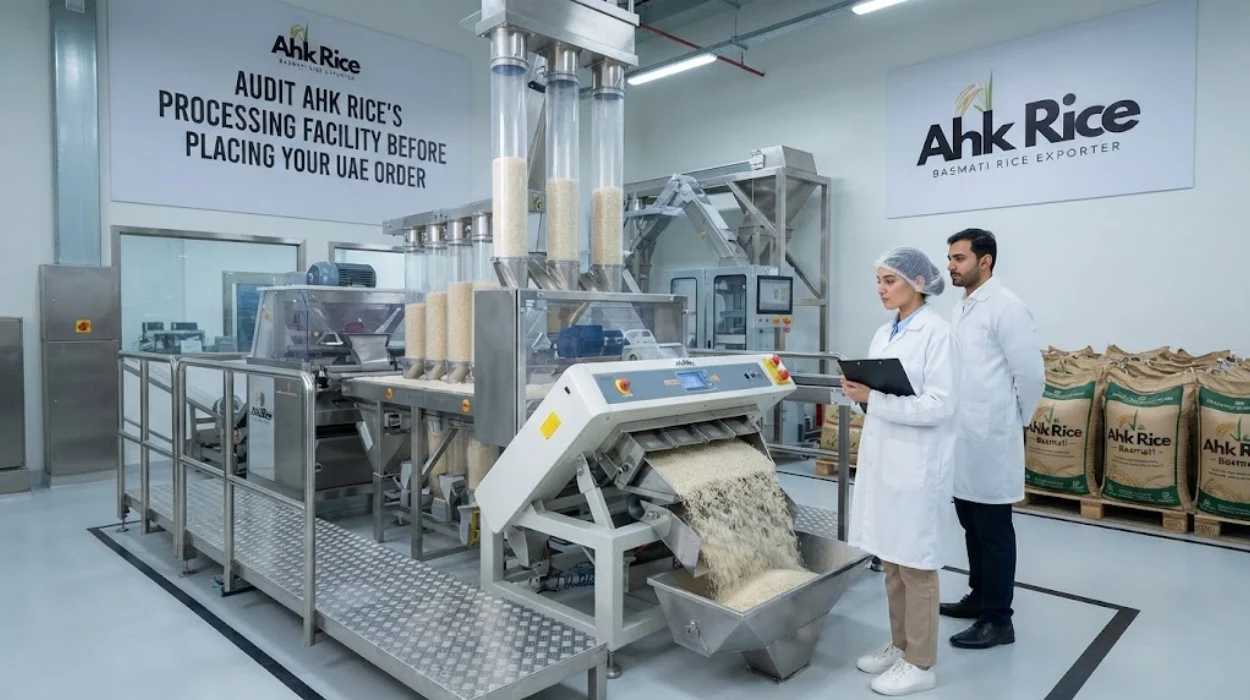
Audit AHK Rice’s Processing Facility Before Placing Your UAE Order
Audit the processing facility, verify the rice specification, approve the sample, and confirm export controls before placing a UAE order. Here is why: facility capability determines whether the supplier can reproduce your approved grain quality across commercial volumes. AHK Rice operates from Bucheki, Nankana Sahib, Punjab, close to Pakistan’s major Basmati-growing areas. Its UAE export process covers sourcing, milling, sorting, packaging, documentation, inspection, and shipment.
For UAE buyers, the audit should examine paddy sourcing, cleaning, dehusking, polishing, grading, colour sorting, moisture control, packing, storage, quality testing, and container loading. Buyers should also compare the facility process with the specifications explained in this guide to how Basmati rice is processed from paddy to export-ready grain. A facility audit turns supplier claims into measurable purchasing evidence.
What is the best solution for auditing AHK Rice before a UAE order?
The best solution is a specification-led audit covering processing, quality control, storage, packing, documentation, sampling, and loading. This approach connects the approved sample with the commercial shipment and exposes process gaps before payment, production, or container dispatch begins.
A UAE buyer should start with the exact purchase specification. Define the variety, processing type, grain length, broken percentage, moisture, foreign matter, packaging, quantity, and destination port. AHK Rice lists UAE products including 1121, Super Kernel, and 1509 Basmati.
The facility review should then follow the physical rice flow. Inspect paddy intake, cleaning, dehusking, milling, polishing, grading, Sortex sorting, packing, storage, and loading. These stages show whether the supplier controls quality before the product reaches the container.
What should a UAE buyer verify?
| Audit area | What to verify | Commercial outcome |
|---|---|---|
| Paddy sourcing | Variety and origin | Correct Basmati identity |
| Cleaning | Foreign-material removal | Cleaner export grain |
| Milling | Dehusking and whitening | Consistent appearance |
| Grading | Length and broken separation | Defined commercial grade |
| Sortex | Colour and defect removal | Better visual uniformity |
| Moisture | Batch testing | Lower storage risk |
| Packing | Bag size and labelling | UAE-ready presentation |
| Loading | Weight and container control | Shipment traceability |
A factory audit should also examine records. Recent factory-audit guidance describes an audit as a review of supplier systems, records, and capability rather than only the quality of one shipment.
This distinction matters for UAE importers buying repeatedly. One excellent sample does not prove production consistency. A documented process provides stronger evidence.
With the audit scope established, the next decision is whether AHK Rice’s processing and export model fits your UAE requirements.
Why choose AHK Rice for a UAE Basmati order?
AHK Rice combines Punjab sourcing, rice processing, export packaging, quality checks, and UAE shipment coordination in one supply workflow. This reduces coordination between separate traders, processors, inspection companies, packers, and freight providers during commercial procurement.
AHK Rice supplies Pakistani Basmati rice to UAE buyers through its export operation. Its UAE page identifies 1121, Super Kernel, and 1509 as available varieties. It also specifies white and steamed formats, multiple packaging sizes, and Sortex-clean export quality.
AHK Rice can therefore be evaluated as a processing-and-export supplier rather than only a trading intermediary. That distinction matters when your order requires a repeatable milling specification.
For example, a Dubai distributor purchasing 1121 Steam should approve the grain appearance, moisture, broken percentage, packaging, and cooking performance before production. The approved specification then becomes the reference for the commercial lot.
The step-by-step Basmati milling process covering cleaning, dehusking, whitening, polishing and Sortex sorting should also be used as the technical comparison framework during the facility review.
AHK Rice’s UAE export workflow includes inquiry, order confirmation, advance payment, quality sourcing, milling, packaging, documentation, final quality control, loading, and shipment.
AHK Rice also identifies export documentation such as the Certificate of Origin, Phytosanitary Certificate, Fumigation Certificate, and Bill of Lading within its UAE shipment process.
For buyers requiring independent verification, third-party inspection can be incorporated into the purchasing process. The audit should confirm which inspection body will inspect quantity, quality, packaging, and loading.
With the supplier model established, the next question is what measurable results the UAE buyer should expect.
What results can be expected from the facility audit?
A completed audit should produce an approved product specification, verified processing flow, documented quality controls, sample approval, packaging confirmation, inspection requirements, and a shipment timeline for the UAE destination.
The first result is specification certainty. The buyer knows exactly which rice will be purchased and which measurable characteristics define acceptance.
The second result is process visibility. The buyer can identify where cleaning, milling, grading, sorting, moisture testing, packing, and final inspection occur.
The third result is shipment planning. AHK Rice states that UAE shipments move from Karachi to UAE ports and gives a sea-shipping range of 7–14 days on its UAE export page.
Other current supplier information shows Karachi-to-Jebel Ali transit can be approximately 5–8 days, depending on the shipping service and vessel schedule. A buyer should therefore treat transit time as a logistics estimate, not a guaranteed delivery date.
For a 1509 order, AHK Rice’s current UAE product information gives Jebel Ali transit at approximately 5–7 days and Abu Dhabi at approximately 4–6 days.
Production time must be added separately. AHK Rice’s 1509 export workflow states that sorting and polishing can take 7–10 days.
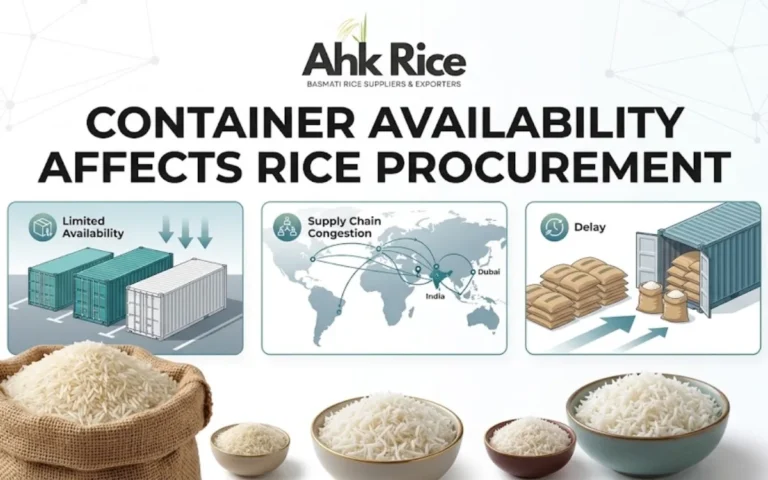
A practical UAE planning window therefore combines production, inspection, documentation, port clearance, vessel availability, sea transit, and UAE customs clearance.
For example, a Dubai importer should avoid planning inventory around sea transit alone. Production and export documentation must be completed before the container reaches Karachi port.
AHK Rice’s facility audit therefore creates a commercial control point before the buyer commits to a full container.
What affects the price of an AHK Rice UAE order?
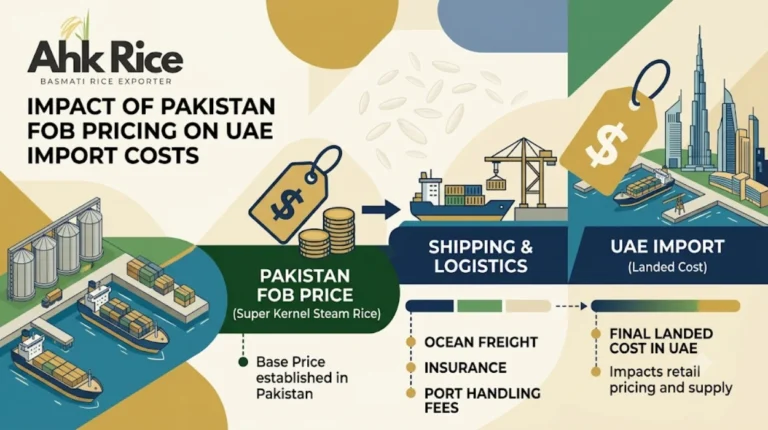
UAE pricing depends on variety, processing type, grain specification, broken percentage, moisture target, packaging, quantity, inspection, Incoterm, destination port, season, and freight conditions. A facility audit helps buyers compare quotations using identical specifications.
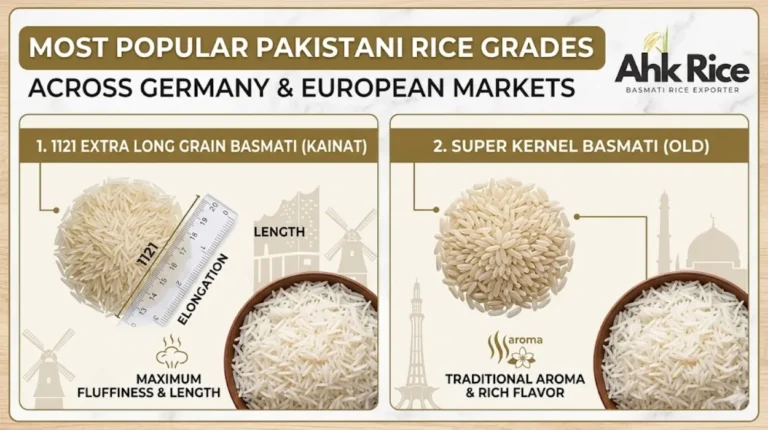
Rice variety is the first pricing factor. 1121, Super Kernel, and 1509 serve different commercial requirements. Premium grain length, aroma, processing, and market positioning influence the quotation.
Processing also affects price. White, Steam, Golden Sella, Creamy Sella, and other processing formats require different production steps and specifications.
Packaging changes the landed cost. A UAE importer may require 5 kg or 10 kg retail bags, while foodservice and wholesale buyers often use larger formats. AHK Rice lists multiple packaging options for UAE shipments.
Quantity affects the commercial rate because container utilization, packaging production, milling volume, and freight allocation change with order size.
Inspection adds another cost variable. Buyers requesting SGS or another independent inspection should include the inspection charge in the landed-cost calculation.
The Incoterm also changes the quotation. FOB separates the supplier’s export-side responsibility from ocean freight and destination charges. CIF includes freight and insurance to the named destination port.
Sample procurement follows a different cost structure. AHK Rice offers up to 20 kg of rice free for sampling. The buyer covers courier transportation and the applicable Phytosanitary Certificate cost.
The practical sample process is straightforward:
- Specify the variety, processing type, quantity, and UAE destination.
- Approve the requested sample specification.
- Provide your courier account or select a courier arrangement.
- Pay the courier and applicable Phytosanitary Certificate charges.
- Receive the sample for physical and cooking evaluation.
- Test grain length, broken percentage, moisture, appearance, aroma, and cooking performance.
- Approve the commercial specification before bulk production.
AHK Rice states that its UAE process can also include third-party inspection before shipment.
With cost factors defined, the final decision is how to move from facility audit to a controlled commercial order.
How do you get started with AHK Rice?

Start with a written UAE specification, request the matching sample, audit the processing controls, approve the laboratory and physical results, confirm packaging, and then authorize production and shipment against the approved specification.
Begin with the destination port. State Jebel Ali, Dubai, Abu Dhabi, or another UAE port in the inquiry. The port determines the freight calculation and shipment schedule.
Next, specify the rice. State 1121, Super Kernel, or 1509. Add white, Steam, Golden Sella, Creamy Sella, or another required processing type.
Then specify quality parameters. Include grain length, broken percentage, moisture, foreign matter, colour, packaging, quantity, crop, and inspection requirements.
Request the sample before placing the full commercial order. Use the sample to evaluate appearance, aroma, cooking elongation, texture, and broken percentage.
Complete the facility review next. Verify the processing sequence and confirm that the commercial specification can be reproduced at scale.
Approve the final specification in writing. Include the agreed quality parameters in the Proforma Invoice or commercial specification sheet.
Confirm the export documents. Include the commercial invoice, packing list, Bill of Lading, Certificate of Origin, Phytosanitary Certificate, Fumigation Certificate, and any required inspection documentation.
Finally, confirm the production window and vessel schedule. AHK Rice’s UAE export workflow covers final quality control, container loading, documentation, and shipment.
AHK Rice is therefore best evaluated through measurable controls rather than price alone. A buyer who audits the facility, approves the sample, fixes the specification, and confirms inspection requirements reduces the main risks before committing to a UAE container.
For a commercial order, request a UAE Basmati rice quotation from AHK Rice with your destination port, variety, processing type, packing, quantity, and required specification.
Frequently Asked Questions
Why should UAE buyers audit a rice processing facility?
A facility audit verifies supplier capability before a commercial order.
It examines processing, quality control, storage, packing, and loading.
The audit also checks whether the approved sample can be reproduced.
This reduces quality and consistency risks during bulk procurement.
The final result is a stronger basis for supplier approval.
What Basmati varieties does AHK Rice supply to UAE buyers?
AHK Rice lists 1121, Super Kernel, and 1509 Basmati for UAE exports.
These varieties serve different retail, wholesale, foodservice, and catering requirements.
Processing formats include white and steamed rice.
Packaging can be specified according to the buyer’s distribution model.
The final grade should be fixed before commercial production.
How much does an AHK Rice sample cost?
AHK Rice offers up to 20 kg of rice free for sampling.
The buyer pays courier transportation for the sample.
The buyer also pays the applicable Phytosanitary Certificate cost.
The buyer can use their own courier account.
The sample should be approved before full-volume production.
How long does shipping from Pakistan to UAE take?
AHK Rice states a 7–14 day sea-shipping range to UAE ports.
The exact transit depends on vessel schedules and destination port.
Jebel Ali services can provide shorter transit windows on selected routes.
Production and port clearance require additional time.
Buyers should plan inventory using the complete shipment timeline.
What should be checked before placing a UAE rice order?
Check the variety and processing specification first.
Verify grain length, broken percentage, moisture, packaging, and inspection requirements.
Approve a physical sample before bulk production.
Confirm export documentation and container-loading procedures.
Then compare the final quotation against the approved specification.
Why is Sortex sorting important for UAE rice imports?
Sortex sorting removes visually defective or discoloured grains.
It improves the uniformity of the finished export lot.
Colour sorting supports consistent retail and foodservice presentation.
The process should be verified during the facility audit.
Buyers should still confirm the final specification through inspection and testing.